Baby Steps
On frustration, presence, and the unlikely dharma in a highly acclaimed video game The post Baby Steps appeared first on Tricycle: The Buddhist Review.
 Lynk
Lynk
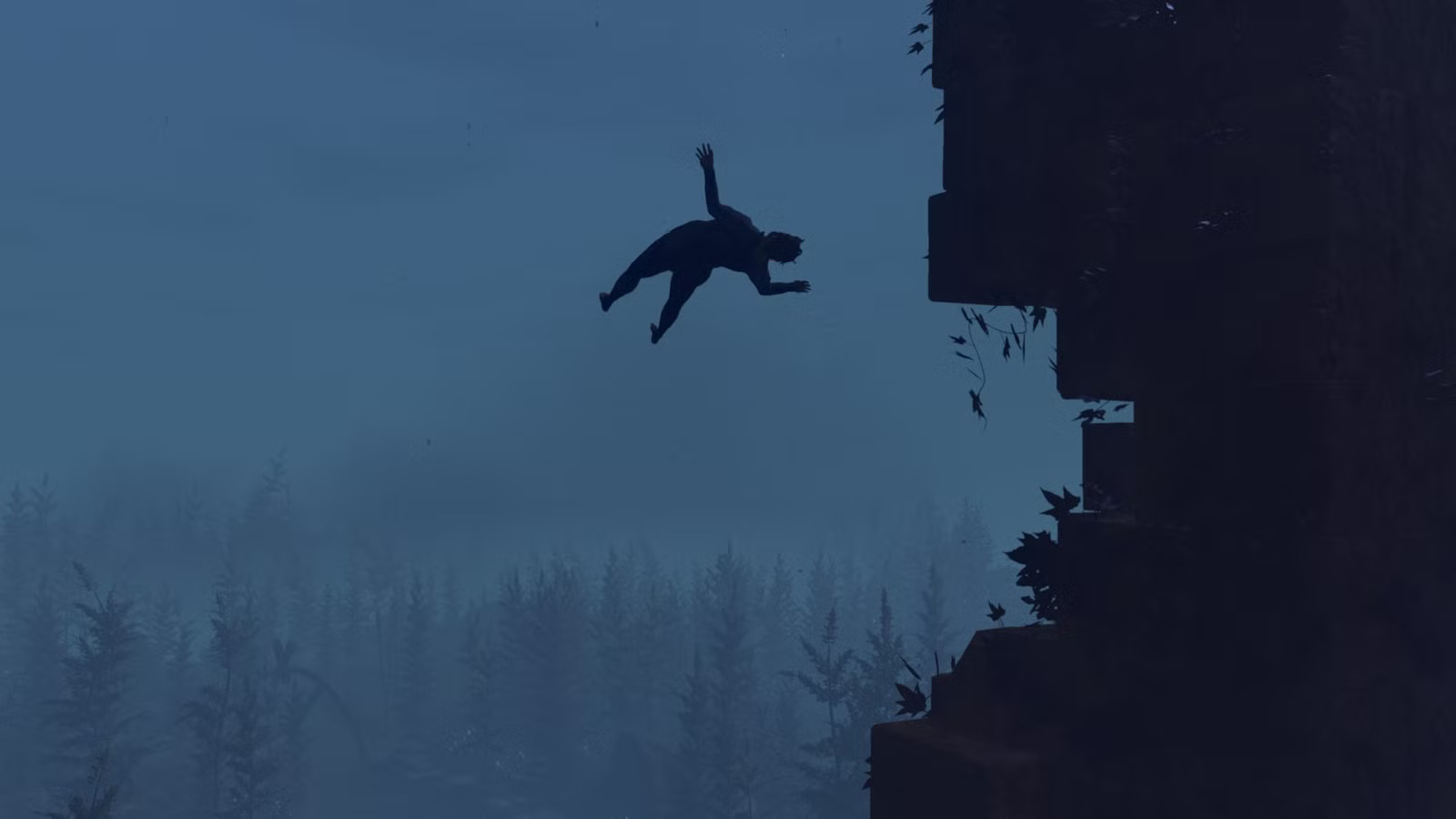
You raise one foot. Your balance shifts. For one vertiginous moment, it seems like you might fall. After all, you don’t usually move this slowly. But that’s the point: to do this methodically, to be as present as possible during this usually automated act of movement. So you shift your weight forward, feel the pressure move from heel to toe, and find your center of gravity. Then you repeat the process. If these seem like instructions for walking meditation, you’re right. But it’s also the core gameplay loop of one of 2025’s most acclaimed games.
In the deeply funny and surprisingly insightful Baby Steps, created by Bennett Foddy, Gabe Cuzzillo, and Maxi Boch, each press of the controller trigger lifts one leg, and the analog stick lets you place that foot and make your character, Nate, take one step forward. It might sound simple. But unlike walking meditation, one wrong step here will send your character plummeting, head over heels, down a cliffside you’ve just spent countless painstaking minutes ascending.
Baby Steps
Developed by Gabe Cuzzillo, Maxi Boch, and Bennett Foddy
Devolver Digital, September 2025, single-player walking simulator
Is this frustrating? In many ways, yes. You will fall in Baby Steps—a lot. Particularly in the opening hours, the mechanics set the player up for failure, guaranteeing the repeated sight gag of Nate tripping over himself and screaming while attempting the simplest step. But the game is never unfair. The controls are so precise that nearly any mistake is the result of inattention. And each failure is a teaching moment, setting the player up to be as intentional as possible with the next footfall, or else face the consequences.
It helps that Baby Steps is, at heart, a slapstick comedy. There are no real tragedies here: Your character is never damaged. You cannot die. Yes, Nate’s onesie-clad body flails like a rag doll as he falls, draping itself over branches and rock outcroppings. But he always picks himself up. And this ethos is infectious. It teaches a skill that’s uncommon in video games: not a superpower, not battle techniques, but simple acceptance.
There’s a sense of nonjudgment possible even during Baby Step’s most catastrophic falls. Sure, you could respond with frustration to a slip off a rickety bridge onto a mudslide that sends you back down to a near-inescapable mire. You could shout, “It’s so unfair! Why is this happening to me?” Or you could accept that the fall happened, that this playful razzing of your plight is really the point of the game’s design, and that the only thing left to do is get on with exploring the path before you.
This is the method of flowing with—rather than resisting—the current moment that Baby Steps teaches: Wherever you fall, there you are.
Wherever you fall, there you are.
In fact, acceptance of the present moment is baked into the game’s fundamental design: There are no checkpoints in Baby Steps. No shortcuts. No do-overs. Every step permanently saves the game exactly where you are. This means that if you fall, losing twenty minutes of progress up the mountain, there is no option to reset to just before your epic failure. All you can do is accept that your character is where he is—exactly where your choices have landed him—and start climbing again.
The game continually urges you toward the lesson implied by its title: Take it easy, friend. One step at a time. You’re a beginner here. When it presents the player with what appears to be shortcuts to the next goal, they almost always end in punch lines. Did you spend ten minutes white-knuckling up a series of slippery steps and sand piles? Expect to reach the top and be informed that the passage has crumbled, and you’ll need to go around. Made it up a river ledge and onto a bridge that should lead directly to your next objective? The way will inevitably be blocked by a sleeping bear.
 Baby Steps
So, yes, the joke is on the player, but it’s never cruel. Instead, it’s a lesson delivered with a smile: Surely, you know at this point that there are no easy shortcuts in life, don’t you? You have to go through this thing, one moment, one breath, one step at a time, no matter how agonizing. You may as well be fully present while it’s happening.
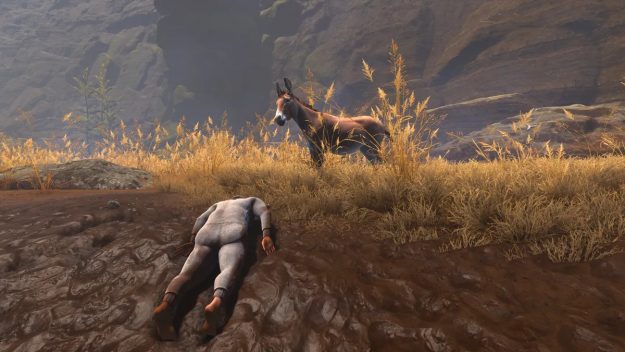
Time and again, you’re inclined to find the easy way forward in the game’s surreal world—to skip past the struggles and get to the supposed good stuff: the real goal of summiting the mountain. But the supporting characters continually remind you that there can’t be shortcuts, because there is no real goal. “You know there’s nothing up there, right?” a humanoid donkey tells Nate, pointing out the snowy mountaintop we’ve just spent countless painful hours trying to climb. “It’s just a white triangle.”
It’s a cliché to say that life is about the journey, not the destination. But Baby Steps is suggesting it isn’t even about the journey. It’s about the moment, right now, of footfall, pressure, and movement. And that’s walking meditation in a nutshell. Only here, you’re practicing all the way up a snow-clad mountain that looks, at first glance, taller than Everest.
And just as walking meditation can too often be dismissed as a break between the real work of sitting meditation, Baby Steps takes a mechanic that blurs into automaticity in both video games and everyday life—putting one foot in front of another—and asks us to focus on how this small action, functioning at all, verges on the miraculous.
“Walking meditation is learning to walk again with ease,” wrote Thich Nhat Hanh. “When you were about a year old, you began to walk with tottering steps. Now, in practicing walking meditation, you are learning to walk again. However, after a few weeks of practice, you will be able to step solidly, in peace and comfort.” In other words, walking meditation involves quite literally taking baby steps.
Returning to a beginner state like this is often central to how our practice clears mental habits and illusions, refocusing on a more expansive experience of the present. And it’s this exact rebirth that Nate undergoes throughout the game. Plucked from his prior life as an unemployed gamer, he’s transported to a strange alternate world where he’s reduced to moving like a literal infant. In this reborn state, Nate can no longer fall back on the same aversive tendencies he’s accumulated over his lifetime. He can’t just retreat to his parents’ basement, order a pizza, and spend the day playing video games. Stripped of the familiar, all he can do is accept the path before him and respond appropriately—in this case, by taking a single step.
 Baby Steps
Although he’s now a game design professor at New York University, Bennett Foddy trained as a moral philosopher of addiction, and the game continually engages with that topic. Nate is depicted as a video game addict, yes. But he’s also addicted to the habits of aversion that insist that if he only achieves a certain objective, attains a certain trophy, he will overcome all of the world’s inconveniences, annoyances, and, indeed, suffering. Most interestingly, we, as the players, also seem to be addicted. Why are we so insistent on climbing that mountain? Why can’t we just let Nate stop and enjoy the view?
Over the game’s run-time, there’s a powerful blending of narrative and design. Just as Nate begins to grapple with his own self-defeating tendencies, the player becomes increasingly nimble at navigating the world. The once-infuriating movement mechanics melt away into a flow state as we read slight changes in gradation, make the required shifts in balance, and reach previously impossible vistas. There is real growth here. Nate isn’t just a sight gag—there’s a legitimately hopeful path forward for him, one that involves community, awareness of the present moment, and the resilience that comes from laughing at life’s strangeness.
Video games are one of the few art forms that can reveal how our minds react to adversity in a particularly powerful way. And though many mainstream games polish away frictional design to better fulfill player fantasies, Baby Steps suggests that frustration is not a wrinkle to be ironed out. Instead, irritating the player is a way of showing them that their choices genuinely matter. There are consequences to our decisions, not just in terms of where Nate’s foot is placed but also in terms of how we think about and frame his repeated falls.
Video games are one of the few art forms that can reveal how our minds react to adversity in a particularly powerful way.
Indeed, when I started imagining how I might write this essay, I learned the consequences of an unmindful life the hard way. As my mind wandered, imagining the comparison I might make between practice and this bizarre digital world, my character misplaced a foot, slipped, and fell halfway down a hellish spiral inside a pitch-black cavern I’d just spent fifteen minutes summiting. To add insult to injury, Nate dropped his lantern, sending it clattering to the bottom of this chamber. For a few moments, I assumed my sole light source would be returned to me, perhaps through a cutscene.
But then I remembered which game I was playing—one intent on teaching me the consequences of my actions—and began my slow descent in the darkness to pick up the lantern and illuminate the way forward, now with one more reminder to pay attention to that single step before me.