Benefits of Yoga in the Morning: 15 Reasons to Start Today
⚡ Quick Answer BoxThe benefits of yoga in the morning include cortisol regulation, metabolic activation, improved joint lubrication through synovial […]
 Astrong


⚡ Quick Answer Box
The benefits of yoga in the morning include cortisol regulation, metabolic activation, improved joint lubrication through synovial fluid production, enhanced mental clarity through increased cerebral blood flow, serotonin and dopamine release for mood stability, lymphatic system activation, digestive stimulation, and the establishment of a consistent mindfulness anchor for the entire day. Morning yoga works with the body’s natural circadian biology — the cortisol awakening response — making it physiologically more effective for energy, metabolism, and mood than evening practice for most people.
Most people start their mornings in reaction mode — alarm, phone, coffee, rush. The day begins before the body and mind have had a single moment to arrive in it.
Morning yoga changes this completely. Not by adding one more thing to a busy morning. But by replacing the reactive start with an intentional one — 20 minutes that reset your cortisol, activate your metabolism, lubricate your joints, clear your mind, and set a tone of calm focus that carries through every hour that follows.
The benefits of yoga in the morning are not vague wellness claims. They are measurable, physiological, and well-documented. This guide covers exactly what happens in your body when you practice yoga in the morning — from the first breath to the last pose — and why those changes produce effects that last the entire day.
By the end of this guide, you will understand the science, know the 15 specific benefits, and have a complete 20-minute morning yoga routine you can start tomorrow.
Why Morning Is the Best Time for Yoga: The Biology
Before covering the specific benefits, understanding the biological context makes everything else make sense.
The Cortisol Awakening Response (CAR)
Within 30–45 minutes of waking, the body produces a sharp, natural spike in cortisol — the Cortisol Awakening Response (CAR). This spike is not pathological stress. It is the body’s biological alarm clock — mobilizing energy, activating cognitive function, and preparing the immune and metabolic systems for the demands of the day.
The problem is what happens to this spike in most modern mornings: phones, emails, news, rushing — all of which convert this natural, functional cortisol surge into a stress response that persists throughout the day, elevating baseline cortisol and creating the pattern of morning anxiety, low energy, and reactive emotional states that most people accept as normal.
Morning yoga works with the CAR — channeling the cortisol spike through purposeful movement and breath that metabolizes the cortisol physiologically rather than psychologically. The result is a cortisol curve that rises naturally, is used effectively, and returns to baseline — leaving you energized without being anxious, alert without being wired.
Circadian Biology and the Morning Practice
The body’s circadian system — governed by the suprachiasmatic nucleus in the hypothalamus — regulates virtually every physiological function including hormone production, body temperature, metabolism, cognitive performance, and immune activity.
Morning yoga sends a powerful zeitgeber (time-giver signal) to the circadian system — particularly when combined with exposure to morning light during practice. This signal synchronizes the body’s internal clock, improving the timing and efficiency of every biological function regulated by it.
People who practice yoga consistently in the morning report better sleep, more predictable energy patterns, more stable mood, and more consistent appetite regulation — all of which are downstream effects of a well-entrained circadian rhythm.
15 Benefits of Yoga in the Morning: The Complete Science-Backed Guide
Benefit 1: Cortisol Regulation — Start the Day Without Anxiety
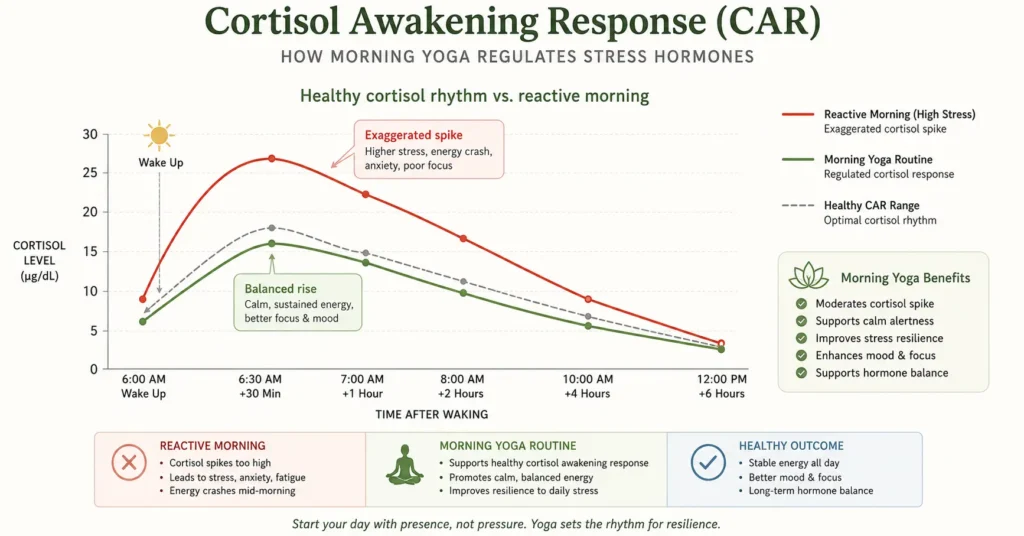
Morning yoga regulates the Cortisol Awakening Response — preventing the natural morning cortisol spike from becoming a stress response that persists all day.
The mechanism: Yoga activates the parasympathetic nervous system through slow diaphragmatic breathing and mindful movement. When practiced during the CAR window (within 60–90 minutes of waking), this parasympathetic activation metabolizes the cortisol surge appropriately — producing alertness and energy rather than anxiety and tension.
Research published by the National Center for Biotechnology Information confirms that yoga and pranayama significantly reduce serum cortisol levels and activate the parasympathetic nervous system — directly converting the morning cortisol spike from a stressor into a functional energizer. (Read the research)
What you feel: Mental clarity and calm alertness within 20 minutes of practice — versus the anxious, wired-but-tired feeling that follows a cortisol-reactive morning.
Benefit 2: Joint Lubrication Through Synovial Fluid Production
Morning yoga reduces the stiffness, aching, and creaking that most people experience in their joints after a night of sleep — through a specific physiological mechanism called synovial fluid production.
The mechanism: Synovial fluid is the lubricating fluid found in all major joints — knees, hips, shoulders, spine, ankles. During sleep, the body produces minimal synovial fluid because the joints are not under load and the synovial membrane is relatively inactive.
Upon waking, the joints are “dry” — which is why morning stiffness is universal. Gentle yoga movement stimulates the synovial membrane to produce fluid, which then lubricates the cartilage surfaces and reduces friction. This process takes approximately 5–10 minutes of gentle movement — which is why morning yoga should always begin with slow, gentle warm-up poses (Cat-Cow, gentle spinal rolls) before any deeper stretching.
What you feel: A dramatic reduction in morning joint stiffness within the first 10 minutes of practice. By 20 minutes, joints that were aching at waking feel mobile, fluid, and comfortable.
Long-term benefit: Consistent morning yoga maintains the health of the synovial membrane itself — reducing the cumulative joint wear that leads to osteoarthritis over decades.
Benefit 3: Metabolic Activation and Blood Sugar Regulation
Morning yoga activates the metabolism through muscular engagement, improved insulin sensitivity, and the cortisol-mediated mobilization of energy stores — setting a metabolic tone that influences calorie utilization for hours after practice.
The mechanism: Morning yoga raises the basal metabolic rate through two pathways:
Muscular thermogenesis — the heat produced by muscular contraction during yoga poses raises core body temperature, increasing the metabolic rate during and for 1–2 hours after practice.
Insulin sensitivity improvement — muscular activity in the morning improves the cells’ sensitivity to insulin — meaning glucose is transported into muscle cells more efficiently throughout the day, reducing blood sugar spikes after meals and improving sustained energy levels.
A study published in the Journal of Diabetes Research found that yoga practice significantly improved fasting blood glucose and insulin resistance markers — effects that were most pronounced when practice occurred in the morning before the first meal.
What you feel: More stable energy throughout the day — no mid-morning crash, reduced sugar cravings, and more consistent mental focus that does not depend on caffeine for maintenance.
Benefit 4: Serotonin and Dopamine Release — Stable Mood All Day
Morning yoga produces measurable increases in serotonin and dopamine — the two primary neurotransmitters governing mood stability, motivation, and emotional resilience.
The mechanism:
Serotonin — synthesized in the gut and brain stem, serotonin governs mood stability, impulse control, and the sense of well-being. Physical movement and exposure to light (both available in morning yoga) directly stimulate serotonin synthesis.
Dopamine — the motivation and reward neurotransmitter. The completion of a morning yoga practice — even a short one — activates the dopaminergic reward pathway, producing a sense of accomplishment and motivation that carries forward into the rest of the day.
What you feel: A genuine, drug-free mood elevation within 20 minutes of practice. People who practice morning yoga consistently report significantly better mood stability, less irritability, and more emotional resilience to daily stressors — not from spiritual belief, but from measurable neurochemistry.
Benefit 5: Enhanced Mental Clarity Through Increased Cerebral Blood Flow
Morning yoga directly increases blood flow to the prefrontal cortex — the brain region governing executive function, decision-making, focus, emotional regulation, and creativity.
The mechanism: Inversions and forward folds in yoga — Downward Dog, Standing Forward Fold, Child’s Pose — create mild elevations of the head relative to the heart, increasing cerebral blood flow. Combined with deep, oxygenating diaphragmatic breathing, this enhanced blood flow delivers significantly more oxygen and glucose to the brain’s most cognitively active regions.
The prefrontal cortex is the last brain region to receive blood flow in a stressed, cortisol-reactive morning — when circulation is preferentially directed to survival-mode structures (amygdala, brain stem). Morning yoga reverses this by first reducing the stress response and then enhancing prefrontal circulation — directly improving the cognitive functions most needed for a productive day.
What you feel: A quality of mental clarity and focused thinking within 30 minutes of morning yoga that most people describe as “the best their brain feels all day.” Enhanced creativity, faster decision-making, and better emotional regulation throughout the morning hours.
Benefit 6: Digestive Activation and Gut Motility
Morning yoga activates the digestive system — stimulating peristalsis, improving gut motility, and supporting the elimination cycle that the body naturally initiates upon waking.
The mechanism: Upon waking, the enteric nervous system (the “second brain” governing gut function) activates the gastrocolic reflex — a signal that initiates bowel movement in response to the first food or drink of the day. Morning yoga enhances this reflex through three mechanisms:
Twisting poses (Seated Twist, Revolved Chair) mechanically compress and release the ascending and descending colon — stimulating peristalsis directly.
Diaphragmatic breathing creates rhythmic pressure changes in the abdominal cavity that massage the intestines and stimulate digestive motility.
Parasympathetic activation — the “rest and digest” state that yoga induces — directly enhances gut secretion, enzyme production, and the muscular contractions that move food through the digestive tract.
What you feel: More regular, complete morning elimination. Reduced bloating throughout the day. Improved appetite regulation and reduced digestive discomfort after meals.
Benefit 7: Lymphatic System Activation
Morning yoga is one of the most effective tools available for activating the lymphatic system — the immune network that has pooled and stagnated overnight during sleep.
The mechanism: During sleep, the lymphatic system operates at its lowest activity level — lymph fluid pools in the extremities and abdomen due to lack of movement. Upon waking, this pooled lymph needs to be mobilized for the immune system to function at full capacity.
Morning yoga activates lymphatic flow through three mechanisms simultaneously:
Muscular contraction — the primary pump for lymphatic circulation. Every yoga pose that engages a muscle group drives lymph fluid through the lymphatic vessels in that region.
Deep breathing — the pressure changes created by diaphragmatic breathing draw lymph fluid through the thoracic duct — the main lymphatic vessel draining into the bloodstream.
Inversions — Downward Dog, Legs Up the Wall — reverse the gravitational pooling of lymph from the overnight rest position.
What you feel: Reduced morning puffiness (particularly in the face and extremities), improved immune responsiveness throughout the day, and the physical sensation of “loosening up” that occurs as lymphatic congestion clears in the first 10–15 minutes of practice.
Benefit 8: Spinal Decompression and Posture Reset
Morning yoga decompresses the spine — reversing the compression that occurs during sleep and resetting postural alignment before the day’s sitting, standing, and movement patterns reinforce poor posture.
The mechanism: During sleep, even in the best sleeping positions, the intervertebral discs gradually compress due to sustained postures and reduced spinal fluid movement. Upon waking, the spine is at its most compressed — which is why morning back stiffness is so common.
Morning yoga — particularly Cat-Cow, Downward Dog, Child’s Pose, and spinal twists — creates traction and decompression through the entire spinal column. This:
Rehydrates the intervertebral discs (which absorb fluid when unloaded and released) Releases the deep paraspinal muscles (erector spinae, multifidus) that have been in sustained contraction during sleep Resets the natural spinal curves — lumbar lordosis, thoracic kyphosis, cervical lordosis — that poor sleeping positions distortWhat you feel: A profound reduction in morning back pain and stiffness within 10–15 minutes of practice. Over weeks, consistent morning yoga produces measurable improvement in daytime posture — reducing the cumulative spinal load that leads to chronic back pain.
Benefit 9: Breath Capacity and Respiratory Awakening
Morning yoga reopens the full capacity of the respiratory system — expanding lung volume, clearing respiratory mucus that accumulates overnight, and establishing the deep breathing pattern that maximizes oxygen delivery throughout the day.
The mechanism: During sleep, breathing is shallow — using primarily the upper lung fields. The lower lung lobes (which contain the greatest density of alveoli and gas exchange surface area) are relatively underventilated overnight. Morning yoga — through chest-opening poses and diaphragmatic breathing — reactivates the lower lung fields, clears overnight respiratory secretions, and restores full tidal volume.
Pranayama practiced in the morning — particularly Kapalabhati and Nadi Shodhana — dramatically accelerates this respiratory awakening, clearing the sinuses and establishing a breathing pattern that maximizes oxygen saturation for the remainder of the day.
What you feel: Clearer breathing, reduced morning congestion, and a sense of physical openness in the chest within the first 10 minutes of practice.
Benefit 10: Improved Flexibility — The Morning Advantage
Counterintuitively, morning is actually the optimal time to improve long-term flexibility — despite the body being stiffer at waking than at any other point in the day.
The mechanism: Muscle tissue and connective tissue (fascia, tendons, ligaments) respond to stretching through a process called creep — the gradual elongation of connective tissue under sustained load. The morning stiffness that makes early practice feel harder is actually the state in which connective tissue is most responsive to stretching stimulus — because the reduced synovial fluid and lower tissue temperature make the connective tissue more viscous and therefore more plastic under a held stretch.
In practical terms: the discomfort of morning stiffness is the signal that the conditions for connective tissue adaptation are present. Consistently stretching in this state produces faster long-term flexibility gains than evening practice — when the tissue is already warm and pre-elongated from a full day of activity.
What you feel: Initial stiffness that clears within 10 minutes, followed by a deeper sense of stretch than felt in evening practice. Over weeks, measurably faster flexibility improvement compared to evening-only practitioners.
Benefit 11: Mindfulness Anchor for the Entire Day
Morning yoga establishes a mindfulness anchor — a reference point of calm, body awareness, and present-moment attention that the mind can return to throughout the day when stress or distraction arise.
The mechanism: The focused breath-body synchronization of morning yoga activates the anterior cingulate cortex (ACC) and the insula — brain regions governing self-awareness, attentional control, and interoception (the perception of internal body states). Consistent morning activation of these regions gradually increases their gray matter density — a structural brain change documented in long-term meditators and yoga practitioners.
What this means practically: People who practice morning yoga consistently report that they are better able to notice rising stress, anxiety, or reactivity during the day — and to respond rather than react. The morning practice creates a neurological baseline of calm awareness that the mind can reference even under pressure.
Benefit 12: Improved Sleep Quality — The Morning Feedback Loop
Morning yoga improves sleep quality the following night — creating a positive feedback loop where better sleep leads to more productive morning practice, which leads to better sleep.
The mechanism: Morning yoga advances the circadian phase — the timing of the body’s internal clock. By sending a strong “morning” signal (movement, light exposure, cortisol metabolism) at a consistent time each day, morning yoga:
Strengthens the circadian rhythm’s amplitude (the difference between peak waking alertness and nighttime sleepiness) Accelerates sleep onset at night by creating a cleaner separation between the active phase and the rest phase Improves slow-wave sleep duration — the most physically restorative sleep stageWhat you feel: Noticeably easier to fall asleep at night. More consistent waking at the same time without an alarm. Morning alertness that arrives naturally rather than requiring caffeine.
Benefit 13: Consistency and Habit Formation
Morning yoga is practiced consistently at higher rates than evening yoga — making it the most effective time slot for establishing a sustainable long-term practice.
The mechanism: Habit formation research (including James Clear’s Atomic Habits framework and BJ Fogg’s behavioral design work) consistently shows that morning habits are more successfully maintained than evening habits for three reasons:
Decision fatigue — by evening, willpower and decision-making capacity are depleted by the choices made throughout the day. Morning habits require decisions when cognitive resources are highest.
Fewer competing demands — social events, work overruns, family responsibilities, and fatigue all tend to displace evening exercise plans. Mornings are more predictably available.
Identity reinforcement — completing a morning practice before the day begins reinforces the identity of “I am someone who practices yoga” at the start of each day — which compounds over time into a stronger behavioral commitment.
What this means: The single most reliable way to make yoga a consistent part of your life is to make it the first significant thing you do each day.
Benefit 14: Weight Management and Body Composition
Morning yoga supports healthy weight management through cortisol regulation, metabolic activation, improved insulin sensitivity, and the mindfulness-eating connection that reduces stress-driven overconsumption.
The mechanism: The weight management benefits of morning yoga operate through four pathways:
Cortisol-driven fat storage — chronically elevated cortisol promotes visceral fat accumulation (particularly around the abdomen). Morning yoga reduces cortisol, directly reducing this fat-storage signal.
Metabolic rate — the muscular engagement and thermogenic effect of morning yoga elevates the resting metabolic rate for 1–3 hours post-practice.
Mindful eating initiation — people who begin the day with yoga consistently report more conscious food choices throughout the day — choosing foods that are consistent with the values of care and awareness established in the morning practice.
Blood sugar stability — improved insulin sensitivity (Benefit 3) reduces the blood sugar swings that drive hunger, cravings, and reactive overeating.
What you feel: Over 8–12 weeks of consistent morning yoga, reduced abdominal bloating, more stable appetite, reduced sugar cravings, and gradual improvement in body composition — even without changes in diet.
Benefit 15: Setting the Tone for the Entire Day
Morning yoga establishes the psychological and physiological tone for the entire day — creating a reference experience of calm, intention, and self-care that influences every interaction, decision, and response that follows.
The mechanism: The first 20–30 minutes of the day have a disproportionate effect on psychological state — a phenomenon researchers call the morning effect or primacy effect of daily experience. How the morning begins tends to persist as the dominant emotional and cognitive tone until a significant disrupting event shifts it.
Morning yoga creates a morning tone of:
Physical ease (reduced stiffness and pain) Mental clarity (prefrontal cortex activation) Emotional stability (serotonin and cortisol regulation) Intentionality (the deliberate choice to begin the day with self-care)This tone is not fragile — it does not disappear at the first frustration. It becomes a reference state that the nervous system can return to throughout the day.
What you feel: Days that begin with morning yoga feel qualitatively different — more spacious, more responsive, more manageable — than days that begin reactively. Over weeks, this difference becomes the primary motivator for maintaining the practice.
Morning Yoga vs Evening Yoga: Which Is Better?
Both morning and evening yoga offer significant benefits — but they serve different physiological purposes.
| Cortisol | Regulates the awakening surge | Has less cortisol to regulate |
| Body temperature | Cooler — better for connective tissue adaptation | Warmer — better for deep stretching |
| Energy effect | Activating and energizing | Calming and restorative |
| Flexibility | Less immediate depth | Greater immediate depth |
| Long-term flexibility gains | Faster (cold tissue adapts more) | Slower (warm tissue pre-elongated) |
| Sleep effect | Advances circadian phase — better sleep | Direct pre-sleep calming |
| Habit consistency | Higher — fewer competing demands | Lower — evening plans displace it |
| Immune activation | High — lymphatic system most stagnant | Moderate |
| Mental clarity | Highest benefit | Lower benefit |
| Best for | Energy, clarity, metabolism, habit | Stress release, flexibility, sleep |
| Ideal duration | 20–40 minutes | 30–60 minutes |
The verdict: For most people, morning yoga delivers more measurable daily-life benefits than evening yoga — particularly for energy, mental clarity, mood, metabolism, and habit consistency. Evening yoga is an excellent complement, not a replacement.
Your Complete 20-Minute Morning Yoga Routine
This sequence is specifically designed to deliver the maximum number of morning benefits in the minimum time — built around the physiological priorities of the morning body.
Phase 1 — Awaken (5 Minutes)
Goal: Synovial fluid production, spinal decompression, nervous system awakening
1. Reclined Knees to Chest (Apanasana) — 8 breaths Lie on your back. Draw both knees to your chest. Rock gently side to side. Feel the lower back releasing and the lumbar spine decompressing.
2. Reclined Spinal Twist — 5 breaths each side From knees to chest, let both knees fall to the right. Left arm extended. 5 slow breaths. Switch sides. This begins the digestive stimulation and paraspinal release simultaneously.
3. Cat-Cow — 10 slow cycles On hands and knees. Cow on inhale (belly drops, chest lifts). Cat on exhale (spine rounds). Move slowly — this is the primary synovial fluid activator for the spine. Each cycle lubricates one more intervertebral segment.
Phase 2 — Activate (10 Minutes)
Goal: Metabolic activation, cerebral blood flow, lymphatic stimulation, cortisol metabolism
4. Downward Facing Dog — 8 breaths Press back from tabletop. Hips high, spine long, knees generously bent if needed. Head hangs — this begins the cerebral blood flow enhancement. Breathe deeply — each inhale drives lymph through the thoracic duct.
5. Three-Legged Dog (right leg) — 5 breaths From Downward Dog, lift the right leg. Hip flexion activates the hip flexors and glutes, driving lymphatic circulation through the inguinal and pelvic lymph nodes.
6. Low Lunge (Anjaneyasana) — right side — 6 breaths Step right foot forward. Lower left knee. Hands on right thigh. Feel the left hip flexor opening — the psoas releasing from its overnight shortened position. On an inhale, sweep arms overhead.
7. Warrior Pose 1 — right side — 6 breaths From Low Lunge, back foot at 45°, hips square forward, arms overhead. Metabolic activation through full-body engagement. Feel the cortisol converting to purposeful energy rather than anxious tension.
8. Warrior Pose 2 — right side — 5 breaths Open arms to T-shape, hips open sideways. The lateral hip opening addresses the obturator internus and piriformis — hip muscles chronically shortened by overnight sleep positions.
9. Repeat steps 5–8 on the LEFT side
10. Standing Forward Fold (Uttanasana) — 10 breaths From Mountain Pose, hinge forward. Knees generously bent. Head hangs completely. This is the most significant single cerebral blood flow enhancement in the sequence — and the deepest vagal stimulation available in a standing pose.
11. Seated Spinal Twist (right, then left) — 6 breaths each Come to seated. Cross right foot outside left knee. Inhale tall, exhale twist right. This is the primary digestive activation pose — compressing and releasing the ascending colon on the right twist and the descending colon on the left.
Phase 3 — Integrate (5 Minutes)
Goal: Cortisol stabilization, serotonin consolidation, mindfulness anchor establishment
12. Seated Forward Fold — 10 breaths Legs extended. Hinge from hips. Rest forehead on bolster or legs. Extended exhale (6–8 counts). This is the primary vagal tone activation in the sequence — consolidating the parasympathetic shift and stabilizing the post-cortisol neurochemistry.
13. Supported Fish Pose — 3 minutes Bolster under upper back. Chest open. Arms out. Eyes closed. This is the serotonin consolidation pose — the open chest position is associated with increased serotonin synthesis, and the thymus stimulation supports immune morning activation.
14. Savasana — 3 minutes Flat on back. Bolster under knees. Eyes closed. Allow everything to settle. The mindfulness anchor is established in these final minutes — the reference state of calm awareness that the mind will return to throughout the day.
How to Build a Consistent Morning Yoga Habit: 4-Week Plan
Consistency produces all fifteen benefits described above. One session per week produces almost none of them. Here is a realistic progression:
Week 1 — Minimum Viable Practice (10 Minutes)
Practice only Phase 1 (Awaken) of the morning sequence above. 10 minutes. Every day. The goal is not fitness — it is habit installation. Do it before coffee. Do it in pajamas. Do it imperfectly.
Why: The first week of habit formation is about creating the behavioral groove — the automatic trigger-response connection between waking and rolling out the mat. Quality is irrelevant at this stage. Consistency is everything.
Week 2 — Extend to 15 Minutes
Add the first half of Phase 2 — through Warrior Pose 1. Still before coffee. Still in whatever you slept in. Begin to notice the difference in how the rest of the day feels compared to the days you miss.
Week 3 — Full 20-Minute Practice
Practice the complete sequence. Begin to notice the mood, energy, and clarity benefits accumulating. Sleep quality typically improves noticeably by week 3 — creating a positive feedback loop.
Week 4 and Beyond — Personalize and Deepen
Add a 5-minute pranayama practice before the physical sequence. Extend Savasana to 5 minutes. Begin to explore the deeper poses covered in our Vinyasa Yoga Flow Sequences for Beginners guide. The practice is now yours.
Morning Yoga Pranayama: 3 Techniques for Maximum Benefit
1. Kapalabhati (Skull-Shining Breath) — 3 minutes
Morning benefit: The most activating pranayama available. Clears respiratory mucus, stimulates the abdominal organs, elevates core temperature, and produces an immediate energy surge through sympathetic nervous system stimulation — followed by a parasympathetic rebound that creates calm alertness.
How: Sit tall. Rapid forceful exhales through the nose — each driven by a sharp lower-belly contraction. Inhale is passive. Start with 30 contractions, rest for 3 normal breaths, repeat 3 rounds.
Avoid if: Pregnant, during menstruation, with high blood pressure, or with any abdominal hernia.
2. Nadi Shodhana (Alternate Nostril Breathing) — 5 minutes
Morning benefit: Balances the left and right hemispheres of the brain — improving bilateral cognitive function, emotional regulation, and the integration of analytical and creative thinking. Ideal before mentally demanding work.
How: Close right nostril with thumb, inhale left (4 counts). Close left with ring finger, exhale right (8 counts). Inhale right (4 counts). Exhale left (8 counts). Ten cycles.
3. Bhramari (Humming Bee Breath) — 3 minutes
Morning benefit: The vibration of Bhramari stimulates the vagus nerve directly through bone conduction — producing an immediate parasympathetic shift that counteracts any residual morning anxiety. Also increases nasal nitric oxide production — supporting the morning immune activation discussed in our Yoga to Increase Immune System guide.
How: Sit comfortably. Close ears with thumbs. Inhale fully. Exhale with a sustained “mmmm” hum — feel the vibration in your skull and sinuses. Repeat 7–10 times.
Morning Yoga for Specific Goals
Morning Yoga for Energy and Focus
Best poses: Kapalabhati pranayama, Sun Salutation A × 3, Warrior Pose 1 and 2, Standing Forward Fold, Seated Twist. Why: Prioritizes cortisol metabolism, cerebral blood flow, and serotonin release over restorative elements.
Morning Yoga for Weight Management
Best poses: Sun Salutations (builds heat and metabolic activation), Warrior sequences, Chair Pose (Utkatasana), Bridge Pose, Boat Pose (on moderate days). Why: Maximizes thermogenic muscular engagement and insulin sensitivity improvement.
Morning Yoga for Stress Reduction
Best poses: Extended Cat-Cow, Child’s Pose (extended hold), Seated Forward Fold, Supported Fish, Nadi Shodhana pranayama. Why: Prioritizes parasympathetic activation and cortisol regulation over energizing elements.
Morning Yoga for Back Pain
Best poses: Reclined Knees to Chest, Cat-Cow, Child’s Pose, Supine Twist, Bridge Pose (gentle), Downward Dog. Why: Prioritizes spinal decompression, synovial fluid production, and paraspinal muscle release.
Morning Yoga for Immunity
Best poses: Downward Dog, Shoulder Stand (or Legs Up the Wall), Camel Pose, Seated Twist, Supported Fish. Why: Combines lymphatic activation, thymus stimulation, and cortisol regulation. See our complete Yoga to Increase Immune System guide for the full immune-focused sequence.
What Happens to Your Body When You Do Yoga Every Morning for 30 Days
Days 1–7: Morning stiffness decreases noticeably. Cortisol spike feels less anxious. Energy in the first two hours of the day improves. Some disruption to sleep as the circadian rhythm begins to adjust.
Days 8–14: Sleep onset improves. Mood stability throughout the day is noticeably better. Digestive regularity improves. Mental clarity in the morning hours becomes more reliable. The practice begins to feel natural rather than effortful.
Days 15–21: Flexibility measurably improves — poses accessible now were uncomfortable at day 1. The mindfulness anchor effect becomes apparent — you notice stress arising during the day and can respond rather than react. Energy levels stabilize across the full day.
Days 22–30: The practice has become a habit — missing it creates a noticeable absence rather than a relief. Sleep quality is consistently better. Morning anxiety is significantly reduced. Multiple people in your life have noticed a change in your mood and energy without knowing about the practice.
Beyond 30 days: The benefits compound. The structural brain changes (increased gray matter in the insula and ACC) are developing. Flexibility continues to improve. Immune function markers are measurably improving. The practice has become part of your identity.
Common Mistakes in Morning Yoga (And How to Avoid Them)
❌ Skipping warm-up and jumping into deep poses Cold connective tissue tears under sudden load. Always begin with 5 minutes of gentle movement (reclined poses, Cat-Cow) before any standing or deep poses. The synovial fluid production that makes morning yoga safe takes 5–10 minutes to activate.
❌ Practicing on a full stomach Morning yoga is best practiced before breakfast — or at least 30 minutes after a light snack. A full stomach displaces the diaphragm and restricts the diaphragmatic breathing that is essential to the practice’s cortisol-regulating mechanism.
❌ Setting the alarm 5 minutes earlier and calling that enough Morning yoga needs 20 minutes minimum to activate all fifteen benefits described in this guide. Set the alarm 25 minutes earlier than usual. The sleep you “lose” is more than compensated by the sleep quality improvements that begin within 2 weeks.
❌ Practicing with the phone nearby Every glance at a phone notification reactivates the sympathetic nervous system and disrupts the cortisol regulation that morning yoga is specifically designed to produce. Phone goes in another room until after Savasana. Non-negotiable.
❌ Skipping Savasana because you’re running late Savasana is where the neurochemical consolidation happens — where serotonin stabilizes, cortisol finalizes its regulation, and the mindfulness anchor sets. A 3-minute Savasana is better than none. Never skip it entirely.
Conclusion
Every morning gives you the same choice: react to the day, or begin it with intention.
The reactive morning is familiar. Alarm. Phone. Rush. Coffee. By the time you sit at your desk, the cortisol has already converted to anxiety, the joints are still stiff, the mind is already scattered across the twelve things it needs to do, and the day feels like something happening to you rather than something you are moving through with awareness.
The morning yoga morning is different — not because it eliminates the demands of the day, but because it changes the state from which you meet them.
Twenty minutes of movement and breath. Cortisol regulated. Joints lubricated. Serotonin rising. Mind clear. A body that feels, for the first time since waking, genuinely alive and ready.
The benefits of yoga in the morning are not aspirational. They are physiological. They are measurable. And they begin — not after months of perfect practice — but tomorrow morning, in the first five minutes of your very first session.
The only question is whether tomorrow morning will be the morning you begin.
Roll out your mat. Take the first breath. Visit TheShivYoga.com and practice with us tomorrow morning.
Disclaimer: This article is for informational and educational purposes only and does not constitute medical advice. Always consult a qualified healthcare provider before beginning any new exercise or yoga program, particularly if you have pre-existing health conditions, joint problems, or cardiovascular conditions. If any pose causes pain or discomfort, stop immediately and rest.
Key Takeaways
The Cortisol Awakening Response (CAR) is the biological foundation of morning yoga’s effectiveness — morning practice metabolizes this cortisol surge into calm energy rather than allowing it to become anxious tension. Synovial fluid production — the mechanism behind morning stiffness relief — requires 5–10 minutes of gentle movement to activate. Never skip the warm-up phase of morning yoga. Morning stiffness is actually an advantage for long-term flexibility gains — cold, viscous connective tissue is more plastic and adapts faster to stretching than pre-warmed tissue. 15 specific benefits are produced by morning yoga: cortisol regulation, joint lubrication, metabolic activation, serotonin release, cerebral blood flow, lymphatic activation, digestive stimulation, spinal decompression, respiratory awakening, flexibility improvement, mindfulness anchoring, sleep quality improvement, habit consistency, weight management support, and day-tone setting. The complete 20-minute sequence has three phases: Awaken (synovial fluid + spinal decompression), Activate (metabolism + cortisol + lymphatics), and Integrate (serotonin + mindfulness anchor). Practice before breakfast for maximum cortisol regulation and metabolic benefit. Week 1 goal is consistency, not quality — 10 minutes imperfectly beats 60 minutes occasionally. Morning yoga produces measurable physiological improvements within 2–4 weeks and habit solidification within 30 days.FAQ Section
Q1: What are the main benefits of doing yoga in the morning?
The main benefits of morning yoga include cortisol regulation (converting the morning stress surge into calm energy), joint lubrication through synovial fluid production, metabolic activation, serotonin and dopamine release for mood stability, enhanced mental clarity through cerebral blood flow, lymphatic system activation, digestive stimulation, and the establishment of a mindfulness anchor for the entire day.
Q2: Is it better to do yoga in the morning or evening?
Morning yoga delivers more measurable daily-life benefits for most people — particularly for energy, mental clarity, habit consistency, metabolic activation, and lymphatic immune support. Evening yoga is better for deep flexibility work, direct pre-sleep relaxation, and stress release after a demanding day. The ideal is both — a morning activation practice and an evening restorative practice.
Q3: How long should a morning yoga session be for beginners?
Beginners should start with 10–15 minutes of morning yoga — focusing on Phase 1 (Awaken) of the routine in this guide. After 2 weeks, extend to 20 minutes by adding Phase 2. After 4 weeks, practice the complete 20-minute sequence. Consistency at 10 minutes beats occasional 60-minute sessions for both habit formation and physiological benefit.
Q4: Should I do morning yoga before or after breakfast?
Practice morning yoga before breakfast for maximum metabolic and cortisol-regulating benefit. Practicing on a light or empty stomach allows full diaphragmatic breathing (a full stomach restricts the diaphragm), maximizes the insulin sensitivity improvement from practice, and ensures the cortisol awakening response is addressed before food consumption shifts the metabolic environment. If very hungry, a small piece of fruit 20 minutes before practice is acceptable.
Q5: What happens to your body if you do yoga every morning for 30 days?
Within 30 days of daily morning yoga: morning stiffness decreases significantly (weeks 1–2), sleep quality improves measurably (week 2), mood stability and mental clarity improve (weeks 2–3), flexibility improves in all major muscle groups (weeks 3–4), digestive regularity improves, and the practice becomes habitual rather than effortful. Multiple measurable physiological improvements — in cortisol, flexibility, sleep, and mood — are established within this timeframe.