The Moment of Death
On the practice of phowa and the transition of dying The post The Moment of Death appeared first on Tricycle: The Buddhist Review.
 UsenB
UsenB

On the practice of phowa and the transition of dying
 Photo by Courtnie Tosana
Phowa practice is considered one of the most powerful and important of all the Vajrayana teachings because by accomplishing phowa we can bypass the bardos, the intermediate or in-between states. Phowa is basically a shortcut to enlightenment, a shortcut for not returning to samsara. It’s like going out the emergency exit or taking the private exit in the executive lounge at the airport.
The first bardo is the bardo of the moment of death. This is the experience of the time when the different elements of the physical body have dissolved, and you take your last breath. When you exhale and cannot inhale again, that is the moment of death. Most people go through this experience gradually, although life can end suddenly in many cases. If you die suddenly, you immediately go to your last breath. But when the transition is more gradual, there are several stages of the physical elements dissolving in the body.
Accomplishing phowa, we can bypass the bardos.
The five elements are earth, water, fire, wind, and space. Our bodies are composed of these elements and function on the basis of these elements. For example, our flesh, bones, and muscles are the earth element. Our blood and other liquids are the water element. The warmth of the body is the fire element. Our breath and any movement inside the body is the wind, or air element. And all the cavities or spaces in the body are the space element. At the time of death, the essence of these elements is exhausted, and they start to deteriorate or dissolve into one another. First, the essence of the earth element dissolves into the water element. When this happens, you feel very heavy and dull or may feel like you’re sinking. At this stage you may ask others to help you sit up. These are signs that the earth element is dissolving into the water element.
The second step takes place when the essence of the water element dissolves into the fire element. When this happens, you may experience thirst and ask for some liquid or water. Externally, your mouth becomes very dry.
Third, the essence of the fire element dissolves into the wind element. At this point you may feel cold and ask for more clothes or covers. Externally, others can see that your body heat is disappearing, starting with your hands and feet and dissolving from the limbs to the center of your body.
Then the essence of the wind element dissolves into the space element. Your movements become heavy and slow, and you may not be able to move at all anymore. Speech becomes slow and difficult. Even the movement of the eyes becomes very slow—you can no longer roll your eyeballs. Inwardly, you feel heavy and slow. Externally, your breath may become noisy, like you’re pulling up or pushing down to breathe. It becomes difficult to inhale. These are all signs that the wind element is dissolving into the space element.
Right after that, when the wind element dissolves into space, there is the final outer sign, which is the last breath. The last breath is the sign that the wind element has completely dissolved into the space element. Conventionally, this is considered the moment of death. But according to the Vajrayana, even though the external breath has stopped, the inner breath of the subtle energies continues. There are four inner visions that people can experience at this time. In Tibetan they’re called nangwa, chepa, topa, and nyertob. Nangwa means “clear visions” or “manifestation.” Chepa means “arising visions” or “increase.” Topa means “gaining visions” or “attainment.” And nyertob means “regaining visions” or “full attainment.”
What is happening at this time? In terms of the eight consciousnesses described in the Buddha’s teaching, the first seven merge into the eighth consciousness. The eighth consciousness is the root of the others, so all the other consciousnesses dissolve back into the center, or root consciousness. In the first stage, called nangwa, or “manifestation,” the five sense consciousnesses—seeing, hearing, smelling, tasting, and touching—dissolve into the sixth consciousness, the mental consciousness. When that happens, there is a short burst of very clear vision, an instant of very bright light, which then dissolves. It’s like a burst of flame, and then it disappears. It’s similar to a butterlamp or candle flaring up right before it goes out. Internally, you experience a flash or a momentary appearance, like fireflies.
The second visionary experience, called chepa, or “increase,” happens when the sixth consciousness, the mental consciousness, merges into the seventh or emotional consciousness. When this happens, you briefly experience the three emotions of attachment, anger, and ignorance. Anger comes in the first instant, and then attachment and ignorance are experienced for an instance. Each of them arises for a second and then they’re gone.
The third stage, called topa, or “attainment,” happens when the seventh consciousness merges into the eighth consciousness. The eighth consciousness is the ground of mind, which is sometimes called the “subconscious storehouse.” This is the alayavijnana in Sanskrit, and kunzhi nampar shepa in Tibetan. When the seventh consciousness dissolves into the eighth, you feel that everything has been completed, everything has been gained. In a way, there is no more hope or fear—everything is just there. Having that thought for a brief instant is known as the experience of attainment.
Now, where is the eighth consciousness, the ground of awareness, or alaya, going to merge? It is going to merge into the clear light of the dharmakaya or the dharmadhatu, the buddha nature. We can use different words for this, but basically it is the experience of luminosity. This stage is called “full attainment,” or nyertob in Tibetan. When that happens, there is a moment of vividness and calmness, a state of peace and tranquility.
◆
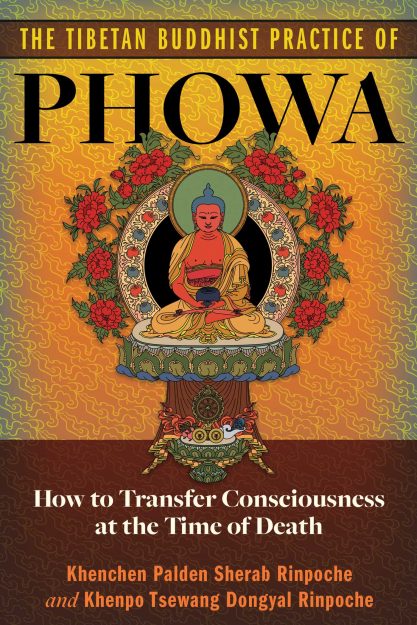
From The Tibetan Buddhist Practice of Phowa by Ven. Khenchen Palden Sherab Rinpoche (1938–2010) and Ven. Khenpo Tsewang Dongyal Rinpoche © 2026 Inner Traditions. Printed with permission from the publisher Inner Traditions International. www.InnerTraditions.com

Thank you for subscribing to Tricycle! As a nonprofit, we depend on readers like you to keep Buddhist teachings and practices widely available.
This article is only for Subscribers!
Subscribe now to read this article and get immediate access to everything else.
Already a subscriber? Log in.