
Doritos Marketing Campaigns: Advertising, Target Market & Brand Success
Doritos marketing campaigns have never felt like ordinary snack advertising, no doubt. Far beyond selling tortilla chips, they create entertainment, invite people into the joke, and somehow turn a triangular chip into something people actually want to talk about....
 BigThink
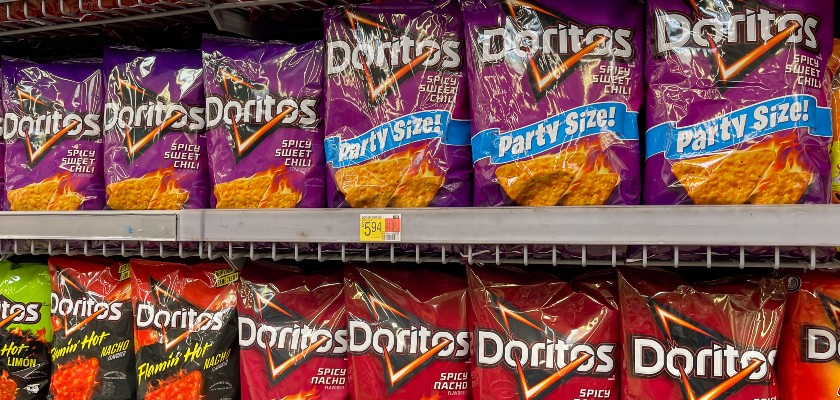
Doritos marketing campaigns have never felt like ordinary snack advertising, no doubt. Far beyond selling tortilla chips, they create entertainment, invite people into the joke, and somehow turn a triangular chip into something people actually want to talk about.
Over the past six decades, Frito-Lay’s flagship chip has built one of the most recognizable personalities in the snack aisle. Think bold packaging, unforgettable Super Bowl ads, fan-made commercials, TikTok challenges, and campaigns that are often just weird enough to work. Doritos has also become unusually comfortable handing part of its brand over to its audience and seeing what happens next.
Not every campaign becomes a cultural moment, of course. But Doritos has developed a clear way of taking creative risks without losing the personality people associate with the brand.
So, what actually makes the Doritos marketing strategy work?
We’ll look at its advertising approach, target audience, social media activity, and some of its most memorable campaigns, from Super Bowl classics and TikTok activations to Doritos Mexico’s Mars-inspired brand platform, to see how a bag of chips keeps finding its way into the cultural conversation.
Inside Doristos Marketing Campaigns
How Doritos Built Its Marketing Strategy What Are Doritos’ Marketing Objectives? Who Is the Doritos Target Market? Doritos’ Core Target Audience Psychographics, Interests, and Consumer Behavior How Doritos Advertising Speaks to Its Target Market Doritos Advertising Strategy Doritos Marketing Campaigns That Shaped the Brand I Want Sumo (2011) Feeding Frenzy (2014) Bold Exit (2014) Inner Hulk Challenge: Smash (2015) Abduction (2025) Crash the Super Bowl (2025) Digital and Social-First Doritos Campaigns Doritos Advertising Campaigns: What Makes Them Work? How Doritos Uses Localization in Global Marketing Doritos Marketing Campaigns in Mexico Doritos Advertising in Japan Doritos Marketing in the US vs. Mexico vs. Japan How Doritos Uses Social Media and Digital Marketing The Role of Product Innovation in Doritos Marketing What Marketers Can Learn From Doritos’ Marketing Strategy Frequently Asked Questions About Doritos MarketingHow Doritos Built Its Marketing Strategy
It’s tempting to jump straight into campaign highlights, but Doritos marketing only makes sense once you understand the strategic scaffolding underneath it. The brand didn’t “simply” become a cultural fixture by accident, it built a repeatable system built on a few consistent pillars.
Bold brand positioning and personality 👉🏻 Doritos has spent decades associating itself with the word “bold,” both literally (its old tagline was “For the Bold”) and tonally. The brand currently markets under the tagline “Another Level,” but the underlying personality, like irreverent, a little chaotic, unafraid of weird ideas, has stayed constant since the 1990s. This gives every creative team, in every country, a shared filter for deciding whether an idea is “on brand.”
Turning a snack product into an entertainment brand 👉🏻 Most chip brands run product-focused advertising: show the bag, show the flavor, show someone enjoying it. Doritos does that too, but its most memorable work treats the chip as a supporting character in a bigger entertainment property, a Super Bowl short film, a TikTok challenge, an advergame, a sci-fi short about a planet for outsiders.
Doritos Crash Course, released for Xbox 360 in 2010, is a free 2.5D platform game in which players race their Xbox avatars through obstacle courses. The uploaded academic paper analyzing the game describes Doritos branding at the beginning of stages, online rankings, and the game’s role as both entertainment and advertising.
When brands launch games, creator programs and entertainment properties every week. In 2010, it was a clearer signal of where Doritos was heading: from advertiser to participant in entertainment culture.
Consistency across products, packaging, advertising, and culture 👉🏻 The red-and-blue color system, the triangle shape, and the crunch sound are used so consistently that Doritos once built an entire campaign around removing its own logo and betting people would still recognize the brand from color and shape alone. That’s a confident bet, and it only works if the underlying visual system has been reinforced for years beforehand.
It’s also worth placing Doritos inside its corporate context. Doritos is owned by Frito-Lay, the snacks division of PepsiCo, alongside sibling brands like Lay’s, Cheetos, Tostitos, and Fritos. That matters for two reasons:
Doritos benefits from PepsiCo’s media buying scale (which is part of why it can afford a Super Bowl spot nearly every year), It has to differentiate itself sharply from sister brands competing in the same snack aisle. Boldness, humor, and youth-culture fluency are how it does that.This foundation is what makes the rest of Doritos’ advertising and campaign work legible. Every tactic discussed below, like Super Bowl contests, TikTok challenges, localized Mexican platforms, is an expression of the same underlying strategy, not a series of disconnected stunts.
What Are Doritos’ Marketing Objectives?
Doritos is a private brand inside a public company, so its internal marketing plans aren’t published. What we can do is infer its marketing objectives from consistent, observable patterns across years of campaigns and executive commentary.
Based on public activity, Doritos appears to be pursuing several objectives at once:
Maintain brand awareness and cultural relevance: Doritos shows up in Super Bowl ad-recall studies, TikTok trend cycles, and “most talked about brand” lists almost every year. So, yes, it’s a sign that staying in the conversation, not just on the shelf, is a stated priority. Reach younger snack consumers: Nearly every recent campaign, the TikTok-native #DoritosFlatLife effort, the Crash the Super Bowl revival’s outreach to “indie filmmakers, students in film school, creatives and creator hubs,” and influencer networks, is explicitly built around Gen Z and younger millennial audiences. Increase engagement and brand participation: Doritos prefers formats where the audience does something (vote, submit, duet, remix) over formats where the audience watches. Support product launches and new flavors: Limited editions like Doritos Dinamita or 3D Crunch regularly get their own dedicated campaigns and Super Bowl teasers rather than being folded quietly into general advertising. Differentiate Doritos in a competitive snack category: Against direct rivals like Lay’s, Cheetos, and Pringles, Doritos leans harder into humor, shock value, and cultural stunts than most competitors are willing to risk. Drive trial and purchase. Business outcomes are tracked, not just vanity metrics, the original 2006–2007 Crash the Super Bowl contest was credited with a 12% increase in Doritos sales in the following January. Strengthen brand associations beyond the product itself: Campaigns about self-expression, authenticity, and “daring to be different” (see the Mexico section below) aim to make Doritos mean something even in moments when nobody is actually eating a chip.The interesting part is how those objectives connect.
A new flavor does not only need distribution. It needs curiosity. A Super Bowl appearance does not only need reach. It needs something people will discuss after the game. A TikTok campaign does not only need impressions. It needs a mechanic that gives users a reason to create.That business-objective-to-execution connection is where Doritos gets especially instructive.
Consider its 2014 Bold Flavor Experiment. Doritos released three mystery Doritos Jacked flavors and asked people to try them and vote for a favorite. PepsiCo said the chips were 40% larger in size and thickness than standard Doritos, while the voting promotion ran for 60 days with daily gold giveaways.
The marketing objective and product experience become the same mechanism: try the product, form an opinion, participate and potentially bring the winning flavor back. That is more interesting than “new flavor now available,” which is technically advertising but unlikely to make anyone in the creative department high-five.
Who Is the Doritos Target Market?
“Doritos targets Gen Z” is true, but it’s an incomplete answer to a useful question.
Doritos’ Core Target Audience
Doritos’ primary buyers skew toward teenagers and young adults, roughly the 13–34 age range, a group the brand has openly built recent platforms around. Frito-Lay’s own marketing language for the 2024 “For the Bold in Everyone” platform and the “Crash the Super Bowl” revival both explicitly frame the effort around younger audiences and creator communities rather than a broad, all-ages buyer base.
That said, Doritos is also, by consumer-survey measures, the single most purchased chip brand in the United States overall, roughly two-thirds of regular chip buyers said they had purchased Doritos in the past three months as of 2024, according to Statista’s snack-industry research, well ahead of Cheetos and Lay’s in the same survey. Families and older adults buy plenty of Doritos too.
Psychographics, Interests, and Consumer Behavior
Demographics only tell part of the story. What actually predicts whether someone is a Doritos-leaning consumer looks more like a set of cultural affinities than an age bracket:
Entertainment and pop-culture fluency like movies, streaming, music, memes Gaming, reflected directly in efforts like the Doritos Crash Course advergame Sports fandom, especially around the NFL and Super Bowl culture Internet culture and social platforms, particularly TikTok and short-form video A taste for bold flavor experimentation, limited editions, extreme heat levels, unusual collaborations A willingness to participate, commenting, dueting, submitting, votingA brand chasing these affinities doesn’t need to guess an exact age. It needs to be present wherever those interests show up.
How Doritos Advertising Speaks to Its Target Market
Doritos speaks to its audience through humor and irreverence, not via aspiration. Through pop-culture and celebrity cameos that feel native to the moment rather than tacked-on endorsements and through formats that hand creative control to the audience instead of broadcasting at them.
A teenager scrolling TikTok and an adult watching the Super Bowl are very different audiences, but Doritos uses the same underlying voice, confident, a little absurd, never taking itself too seriously, across both.
Doritos Advertising Strategy
Zooming out from target-market fit, Doritos advertising strategy rests on five recurring approaches:
Humor and entertainment-led advertising 👉🏻 Doritos rarely runs a straight, benefit-led ad. Its history is filled with surreal or exaggerated scenarios, babies chasing chips out of the womb, dogs scheming to steal a bag, aliens abducting Doritos instead of humans, built purely to provoke a laugh and a share. Celebrity and pop-culture partnerships 👉🏻 Recent Super Bowl spots have paired the brand with names like Jenna Ortega, Chance the Rapper, and the Backstreet Boys, deliberately mixing generational appeal in a single spot. Sports and event-based advertising 👉🏻 The Super Bowl is the anchor, but Doritos has also run motorsport tie-ins; its 2026 “Saborea la Adrenalina” campaign linked the brand to Formula 1 around the Mexico City Grand Prix. Social media and digital-first creative 👉🏻 Campaigns like #DoritosFlatLife are built natively for a platform’s mechanics (hashtag challenges, duets, and stitching) rather than repurposed TV spots. User participation and interactive advertising 👉🏻 No tactic defines Doritos more than letting fans create the ad itself, which is the entire premise of Crash the Super Bowl.The deeper question worth asking is why so much Doritos advertising feels recognizable before we even get to the logo. Part of the answer is creative consistency. Doritos has spent years building a unified visual identity around distinctive assets such as its triangle, while its advertising keeps returning to bold, humorous and occasionally bizarre ideas. Just as importantly, the brand has repeatedly invited its audience into the creative process; from thousands of fan-made Crash the Super Bowl ads to newer participatory campaigns. In Doritos’ world, letting people play with the brand has often been just as important as polishing the brand message. According to Alastair Whiteley, creative director for Hornall Anderson UK:
No matter where in the world a brand lives, success comes when consumers can instantly and intuitively recognize and assign meaning to it. Packaging serves as one of the key filters through which consumers experience the brand, so there needs to be a sense of consistency and relevance, no matter where you call home.
Doritos Marketing Campaigns That Shaped the Brand
Before jumping into examples, we need to explain how we selected them.
This is not a “six funniest Doritos ads” ranking. That would be entertaining, but it would tell marketers very little about how the brand works.
The campaigns below meet at least one of four criteria:
They reveal a distinct Doritos marketing mechanism. They show the brand operating in different media environments or eras. They connect product and brand personality in a clear way. There is enough public evidence to verify the execution without inventing results.That is why a creator-made comedy spot can sit next to an Xbox activation, a Marvel partnership and the revived Crash the Super Bowl program. Together, they show how Doritos moves between advertising, participation, entertainment, fandom and product desire.
I Want Sumo (2011)
This is a creator-made Doritos comedy commercial built around exaggerated product desire. A simple appetite for Doritos escalates into a deliberately absurd sumo-themed situation. The product motivates the gag.
The spot speaks to viewers who respond to fast visual comedy, exaggeration and shareable branded entertainment. The work lives primarily as online branded video. Director Brad Bosley’s portfolio identifies it as his Doritos work, while the uploaded video dates back to January 2011. The creative builds memorability and product desire through entertainment, keeping Doritos at the center of the joke.
Why it worked: The idea was easy to understand almost immediately. It took a basic product truth (people really want the chips!) and exaggerated it until the premise became entertainment. The humor did not require a complicated explanation, and the product remained the cause of the action instead of appearing as a logo pasted onto the final frame.
Feeding Frenzy (2014)
This is a branded stunt film tied to the Doritos and Mountain Dew Every 2 Minutes Xbox One promotion. The question is wonderfully excessive: how deep would someone go to win an Xbox One? The answer involves a diver, sharks and Doritos. The activation speaks directly to gaming fans and consumers attracted to high-stakes, extreme entertainment.
The video supports a larger promotion in which consumers collect codes from marked Doritos and Mountain Dew products, bank points and bid on Xbox One consoles in auctions closing every two minutes.
The campaign generated striking live participation at PAX Prime. PepsiCo reported that promotional QR codes were scanned more than 155,000 times during the event, with 30 participants winning Xbox One consoles.
The campaign connects product purchase with gaming access, turning Doritos packs into entry points to a larger experience.
Why it worked: It linked Doritos with a cultural object gamers genuinely wanted: a new console. The extreme stunt gave the promotion an entertaining narrative, while the code-and-auction mechanic tied attention back to purchase behavior. The campaign built an activity around what those consumers were already excited about.
Bold Exit (2014)
This is another experiential stunt film supporting the Xbox One Every 2 Minutes activation.
If Feeding Frenzy asks how deep someone will go, Bold Exit pushes the same structure vertically: how far will someone go when a coveted gaming prize is on the line? Again, the creative is aimed at gaming fans, but it adds another Doritos psychographic cue; attraction to risk, spectacle and “bold” behavior.
The piece functions as digital branded entertainment connected to the code collection and auction system. Production company Red Band Media lists both Feeding Frenzy and Bold Exit among its Doritos work, reinforcing their connection as related stunt executions.
It extends campaign life by giving one promotional mechanism several entertainment expressions while keeping the Xbox prize, Doritos product and boldness positioning linked.
Why it worked: The repeated “how far would you go?” structure gave the wider promotion a recognizable creative device. It also turned an incentive campaign into something people could watch for entertainment. That mattered because promotions can become painfully transactional very quickly. Bold Exit gave the transaction a story.
Inner Hulk Challenge: Smash (2015)
This is an entertainment partnership and experiential challenge connected to Marvel’s Avengers: Age of Ultron.
Participants are challenged to release their “inner Hulk” and smash their way through a physical experience that demonstrates boldness.
The activation targets superhero fans, younger entertainment audiences and people drawn to interactive spectacle.
Doritos published the video in April 2015 and directly linked the stunt to Avengers: Age of Ultron. Other character-themed challenges extended the concept to Captain America, Thor and Iron Man.
The campaign borrows momentum from a major entertainment franchise while translating a Marvel character trait (Hulk’s destructive force, of course) into a participatory Doritos experience.
Why it worked: The partnership had a clear creative bridge. Hulk smashes things. Doritos challenges people to be bold. Put those ideas together and the activation almost writes itself. The execution gave consumers something physical to do and something visual to share, while Marvel supplied instant cultural recognition.
Abduction (2025)
This is a fan-created Super Bowl commercial selected through the revived Crash the Super Bowl competition.
An alien attempts to steal a bag of Doritos Nacho Cheese, triggering an action-heavy tug-of-war between extraterrestrial technology and a very determined snack owner. The commercial speaks to the broad Super Bowl audience while leaning into sci-fi, internet-friendly humor and exaggerated product obsession.
Dylan Bradshaw and Nate Norell created the spot, which won the fan-voted contest and aired during Super Bowl LIX. The University of North Carolina Wilmington describes the premise as an alien trying to steal Doritos from a UFO enthusiast.
Abduction restores Doritos’ fan-created advertising heritage while making Nacho Cheese chips unmistakably central to the story.
Why it worked: The ad reduced the product proposition to an absurd but crystal-clear idea: Doritos are so desirable that even aliens cross galaxies for them. The product was visible, necessary and worth fighting for. The plot moved quickly enough for a Super Bowl audience, and the fan-created origin gave the brand another story to tell beyond the commercial itself.
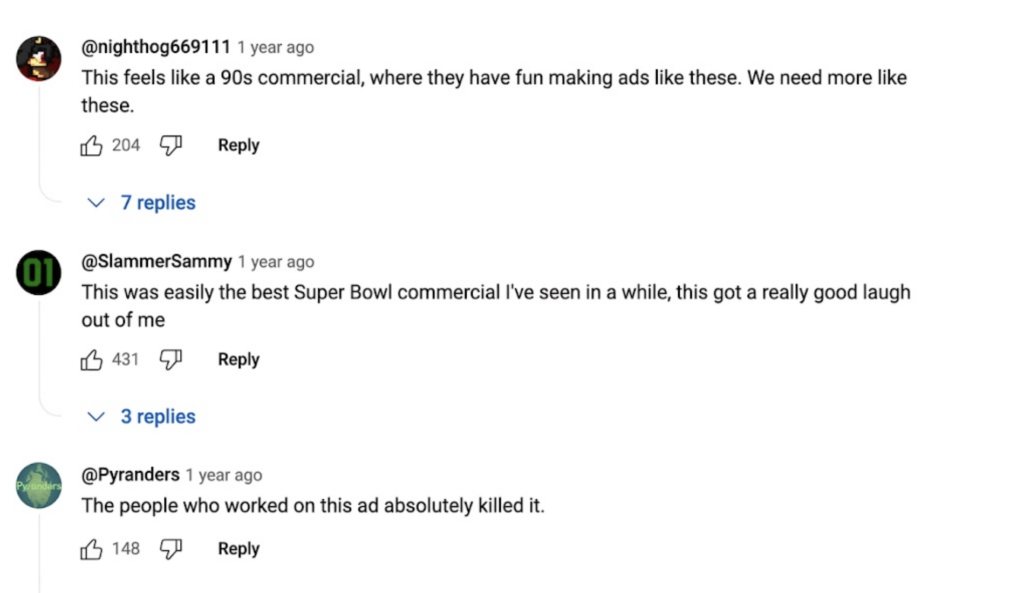
And… people really loved that mix:
Crash the Super Bowl (2025)
This is a user-generated advertising competition that turns consumers into commercial creators and voters.
Doritos asks fans to make the Super Bowl commercial themselves. That sentence is the campaign. Simple, risky and extremely on-brand.
The program reaches two groups at once: consumers who enjoy participating in Doritos culture and aspiring creators attracted to one of advertising’s biggest stages.
For the 2025 revival, Doritos accepted fan submissions, selected 25 semifinalists, narrowed the field to three finalists and let fans vote. The winning creator received $1 million plus a trip to New Orleans for Super Bowl LIX. The scale also has history behind it. During the final edition of the earlier run, Doritos received nearly 4,500 submissions from 28 countries.
The campaign generates consumer participation, creator advocacy, earned conversation and Super Bowl visibility while reinforcing Doritos as a brand willing to let fans shape its public image.
Why it worked: Doritos had made participation meaningful. Fans were not asked to upload a selfie for a vague chance of being reposted. They were competing for real airtime, substantial prize money and professional exposure. The stakes increased the quality and cultural value of participation. The brand also turned the selection process itself into content, extending attention long before the winning spot aired.
Crash the Super Bowl is only one chapter in Doritos’ relationship with the event.
Doritos Rainbow and #PrideAllYear
Doritos Rainbow is a recurring, multi-market campaign and product platform tied to Pride Month, first launched in Mexico. It combines limited-edition packaging, donation-based promotions, and emotional brand films that support LGBTQ+ causes. What started as a seasonal Pride activation has since evolved into a year-round brand platform called #PrideAllYear, extending the message beyond June with additional content like a Mother’s Day film celebrating two-mom families.
Why it worked: Doritos Rainbow succeeded because it became genuine infrastructure for the brand. Mexico was the first country in Latin America to launch Doritos Rainbow, and the platform became one of the most important brand moments in that market. The extension into #PrideAllYear performed strongly in its own right: the launch film for the platform was viewed more than 19 million times, generated over 1.95 million interactions, and achieved 81% positive sentiment on social media. A related 2020 holiday-season film in Mexico, built around a father accepting his son’s boyfriend at Christmas, reinforced the same values through storytelling rather than sponsorship messaging, and pulled more than 14 million YouTube views in its first two weeks alone.
Doritos Crash Course
Doritos Crash Course is an advergame, a full video game built around the brand rather than a game with ads bolted onto it. Developed by Wanako Games for Xbox 360 in 2010, it’s a free, downloadable 2.5D side-scrolling platformer in which players race their Xbox avatar through an obstacle course, competing on a global online leaderboard. The game later spawned a sequel, Doritos Crash Course 2, and included in-world advertising billboards promoting that follow-up title.
Why it worked: The game borrowed the brand’s aesthetic values like speed, boldness, fun, a slightly chaotic sense of humor, and built the entire play experience around them, which researchers argued made it a pertinent advergaming example because the game’s rules and look, not just its logo placement, carried the brand’s meaning. As a free download distributed directly through the Xbox platform, it reached players with minimal friction, at a moment when in-game advertising and branded entertainment were still a novel way for a packaged-food brand to show up inside youth culture rather than interrupt it.
#DoritosFlatLife
#DoritosFlatLife is a TikTok-native content campaign, not a repurposed TV ad. Doritos built the entire concept around TikTok’s specific mechanics, short-form sketches, hashtag challenges, duets, and stitching, depicting mundane “flat life” moments that get interrupted or improved by Doritos. Users were invited to post their own #DoritosFlatLife videos for a chance to win prizes, and the brand actively duetted and replied to user content rather than just broadcasting at the audience.
Why it worked: Sales rose 30% in the campaign’s first month and continued climbing to an 80% increase within three months. Engagement was just as strong: the campaign content generated 45 million impressions, 11.5 million likes, and more than 430,000 comments and shares, and sentiment analysis of the comments found that 70% of the audience response was positive, 20% neutral, and only 10% negative, according to same source. The researchers attributed the success to three overlapping factors: the hashtag challenge format that turned every viewer into a potential creator, influencer collaborations that extended reach into established fan bases, and a consistent, near-daily posting rhythm that kept the campaign visible in TikTok’s feed algorithm rather than letting momentum die between posts.
Doritos Advertising Campaigns: What Makes Them Work?
Looking across Crash the Super Bowl, Doritos Rainbow, Crash Course, and #DoritosFlatLife, a pattern emerges that has little to do with the specific channel and everything to do with a shared creative discipline.
Here’s what successful Doritos campaigns tend to have in common.
👉🏻 Every campaign above can be explained in a single sentence: let fans make the Super Bowl ad; support the causes our audience cares about; put the brand inside a game instead of around it; make everyday boredom funnier with Doritos.
None of these ideas need a slide deck to understand. That simplicity is what makes each concept easy to extend into hashtags, merchandise, follow-up content, and international adaptations without losing the plot.
👉🏻 Even Doritos’ more emotionally serious work, like the Rainbow platform’s family-acceptance films, tends to arrive at its message through an unexpected turn rather than a direct pitch. The brand’s comedic instincts are sharper still in campaigns like Crash the Super Bowl, where recent creative has leaned into self-deprecating humor, literally showing fans’ harshest comments about old Doritos ads inside the new ones. Surprise keeps content shareable in a feed environment where predictable advertising gets scrolled past in under a second.
👉🏻 Audience participation. This is the throughline across nearly every campaign in this article. Crash the Super Bowl hands over the actual ad slot. #DoritosFlatLife hands over the content format. Even Doritos Rainbow invites people to share their own stories under the #PrideAllYear banner. Doritos treats its audience less like viewers and more like a distributed creative department. Which not only produces cheaper content at scale, but also content that feels more credible than anything an agency could manufacture on its own.
👉🏻 There’s a fourth, quieter ingredient that ties these three together: restraint. Doritos rarely tries to say everything at once. Crash the Super Bowl doesn’t attempt to also launch a new flavor or push a cause message in the same 30 seconds. It stays focused on one mechanic, fan-made comedy, and lets that mechanic carry the whole campaign. Doritos Rainbow, in turn, doesn’t lean on humor at all; it commits fully to an emotional register and stays there. That discipline is easy to underestimate, but it’s a large part of why each platform feels distinct rather than like a diluted version of “the Doritos campaign” repeated with a different coat of paint.
It’s also worth noting what Doritos’ successful campaigns tend to avoid:
They rarely rely on hard-sell language, discount messaging, or direct comparisons to competitors like Tostitos or private-label chips. Even the brand’s competitive edge in the market (that dominant U.S. tortilla-chip share) is never the subject of the advertising itself. The message is almost always about the audience’s identity, sense of humor, or values, with the product positioned as the medium for expressing them rather than the message itself.
How Doritos Uses Localization in Global Marketing
Doritos operates in more than 40 countries, and its central creative and marketing challenge is holding onto one consistent global identity, bold, a little irreverent, built on shared flavor and fun, while still feeling native to wildly different cultural contexts. Consumer research drives this geographic customization, with both flavors and messaging adapted to regional tastes, media habits, and cultural moments rather than simply translated from the U.S. playbook. Two markets show this localization strategy particularly clearly: Mexico and Japan.
Doritos Marketing Campaigns in Mexico
Mexico isn’t just another international market for Doritos. Actually, it’s a market with particular cultural weight, given the tortilla chip’s roots in Mexican cuisine, and it’s treated accordingly. Mexico represents a crucial market given the product’s tortilla chip heritage, and the local marketing team has been given latitude to build platforms that don’t exist anywhere else in the Doritos world.
The clearest example is Doritos Rainbow, which as noted above launched first in Mexico in 2015 and 2016 before expanding regionally, raising funds for LGBTQ+ organizations and building goodwill across Latin America through campus tours, music pop-ups, and festival sampling that turned digital buzz into real-world trial.
Mexico’s team has also produced some of the brand’s most emotionally driven storytelling globally, including the 2020 holiday film about a father accepting his son’s relationship, and a related 2023 campaign called #FailingIsForTheBold, aimed at Mexican and broader Latin American teens. That campaign reframed failure as a normal, even valuable, part of growing up rather than something to be ashamed of, with PepsiCo Foods Mexico’s senior marketing director describing the goal as helping bold people learn to face their own fears. More recently, in mid-2025, Doritos launched “We’re Out of This World” across Mexico and the U.S. simultaneously. A campaign built around the idea that being different isn’t just tolerated by the brand, it’s celebrated, showing that Mexico’s creative work increasingly travels north rather than the reverse.
The through-line across these Mexico-specific campaigns is emotional storytelling over product demonstration.
Audience is primarily Mexican and broader Latin American Gen Z and millennial consumers. Message is identity and self-acceptance, framed through Doritos’ “bold” values. Creative execution is long-form emotional video content, distributed on YouTube and social, rather than the humor-first approach that dominates U.S. Super Bowl work. The brand objective is to deepen emotional loyalty in a market where the product category itself already carries cultural meaning.
Doritos Advertising in Japan
Doritos’ relationship with Japan looks different again. Less about emotional brand films, and much more about flavor-led product marketing paired with pop-culture-referencing creative built elsewhere in the world.
Doritos actually arrived in Japan in 1987, more than 20 years after its U.S. launch, and rather than exporting American flavors wholesale, Frito-Lay leaned into flavor localization as its primary marketing lever. Japan now has more than 30 limited-edition Doritos flavors that don’t exist anywhere else, including wasabi soy sauce, takoyaki sauce, avocado and cheese, and taco-flavored chips, many of which are explicitly marketed as “kikan gentei” (limited-time-only) releases designed to create urgency and repeat visits to convenience stores.
Frito-Lay’s broader Asia strategy relies on locally sourced ingredients and flavors tailored specifically to each market, including Japan, Indonesia, and India, reflecting a regional palate that favors bold, unconventional flavor combinations.
Interestingly, some of Doritos’ most Japan-inflected advertising hasn’t come from Japan at all. In 2020, Doritos Brazil launched a Wasabi flavor with a campaign built almost entirely in Japanese, referencing decades of Japanese pop culture, from 1960s monster movies to modern anime.
That campaign is a useful signal about how Doritos treats localization globally: cultural specificity, even borrowed cultural specificity, is treated as a creative asset worth investing real research into, rather than a shortcut to be approximated.
Taken together, Doritos’ Japan story says about product-as-marketing: limited-run, hyper-local flavors that function as ongoing news events for convenience-store shoppers, supported by advertising elsewhere in the world that borrows Japanese aesthetics to reinforce the brand’s reputation for boldness and originality.
Doritos Marketing in the US vs. Mexico vs. Japan
| Brand positioning | “For the Bold” — irreverent, mass-culture confidence | “For the Bold,” reframed as self-acceptance and identity | Flavor innovation and novelty, borrowing global “bold” branding |
| Cultural context | Super Bowl and mainstream pop culture as the dominant stage | Deep tortilla-chip heritage; strong LGBTQ+ advocacy platform (Doritos Rainbow) | Convenience-store snacking culture; strong appetite for limited-time novelty flavors |
| Creative approach | Humor, self-aware comedy, user-generated ad contests | Long-form emotional storytelling and social-issue campaigns | Product-led marketing; borrowed pop-culture aesthetics from partner markets (e.g., Brazil’s Wasabi ad) |
| Main channels | TV (Super Bowl), TikTok, YouTube, creator partnerships | YouTube, social video, experiential/campus activations | Convenience-store retail, packaging, limited regional media |
| Audience connection | Participation — fans literally make the ads | Representation — fans see their own identities reflected in the story | Discovery — fans chase limited-edition flavors as novelty and social currency |
| Localization signal | Sets the global brand platform (“For the Bold”) that other markets adapt | Originates global platforms (Doritos Rainbow started here) before they scale outward | Adapts flavor R&D and packaging almost entirely to local taste, largely independent of U.S. product line |
The comparison shows that Doritos doesn’t localize by simply translating U.S. ads; it lets different markets lead on different tools. The U.S. leads on cultural-moment advertising, Mexico increasingly leads on emotional brand platforms that later scale globally, and Japan leads on product-led marketing through flavor R&D. For marketers managing multi-market brands, that’s a more sustainable model than forcing every region to run the same campaign with subtitles.
Doritos’ communication mix has always blended traditional and digital media, television and print advertising for scale, alongside social platforms and sponsorships for engagement, but the balance has shifted decisively toward digital, and specifically toward formats built for participation rather than passive viewing.
Social-First Campaigns and Real-Time Content
Doritos’ digital presence spans Instagram, TikTok, YouTube, Facebook, and X, with content built specifically for each platform’s native format; not repurposed TV spots. On TikTok in particular, the brand has committed to creating engaging content, running contests, and collaborating with influencers as an ongoing practice rather than a campaign-by-campaign decision.
This real-time, always-on posting rhythm is what allowed #DoritosFlatLife to reach the engagement numbers cited earlier, consistency, not just clever concepts, kept the campaign visible in TikTok’s feed algorithm over the full length of its run.
User-Generated Content and Audience Participation
Crash the Super Bowl remains the most extreme example of Doritos handing creative control to its audience, but the instinct shows up at smaller scale constantly; hashtag challenges, duet prompts, and fan-art reposts are now a baseline expectation of Doritos’ social strategy rather than a special campaign mechanic. This matters commercially because UGC tends to read as more credible than brand-made content to the exact demographic Doritos is chasing, and it dramatically lowers content production costs at scale.
Influencer and Creator Collaborations
Doritos has moved from occasional influencer partnerships to something closer to a standing creator program. Ahead of Super Bowl LIX, the brand’s senior director of marketing described a deliberate strategy of building long-term relationships with a mix of micro-influencers, macro-influencers, brand ambassadors, and local college-campus influencers.
The plan explicitly extends beyond the Super Bowl itself, with additional creator content produced throughout the year to keep the relationships, and the content pipeline, active outside the campaign’s single biggest moment.
Gaming, Entertainment, and Digital Culture
Doritos’ relationship with gaming culture goes back to Doritos Crash Course in 2010, but it has continued in newer forms, including product innovations aimed squarely at gamers. Doritos Silent, a low-crunch chip designed for gaming sessions and video calls, used minimalist, dark-toned packaging specifically because it reflects gaming hardware aesthetics — keyboards, mice, consoles — rather than the brand’s traditional bright, high-contrast look, signaling that the target audience here skews toward gaming and esports culture specifically, not just “young people” broadly.
The Role of Product Innovation in Doritos Marketing
As we stated and displayed above, for Doritos, FMCG marketing campaigns don’t just address media buys. New flavors and packaging act as recurring, self-generating PR moments that spread organically. Where a typical FMCG brand might launch two or three new products a year and support each with a dedicated campaign, Doritos treats flavor development almost like a content calendar: a steady drip of small, low-cost news events that keep the brand in conversation between the big, expensive moments like the Super Bowl.
As you know, attention is the scarcest resource in modern marketing campaigns, and a single annual push (no matter how well-funded) can’t hold an audience’s interest for fifty-one other weeks of the year. Product innovation fills that gap. A limited-run flavor doesn’t need broadcast media spend to travel; it needs to be interesting enough that a shopper photographs the bag and posts it themselves.
New Flavors and Product Launches
Doritos’ flavor pipeline moves constantly, and each new release functions as a fresh reason for media coverage, taste-test content, and social chatter. Current market data shows this strategy paying off in measurable ways: Doritos menu appearances (in restaurants and foodservice) are up 19.71% year-over-year, with 10.4% more Doritos items per operator, showing the brand’s flavor innovation extending its reach well beyond the retail chip bag.
Limited Editions and Scarcity
Limited-edition and seasonal flavors like Halloween’s Candy Corn, Valentine’s Day releases, and Japan’s rotating “kikan gentei” flavors work because scarcity does the marketing on its own. A flavor available for a short, defined window naturally creates urgency and word-of-mouth that an always-available product simply can’t generate. Fans who track down a limited flavor are also far more likely to post about the find, turning product scarcity into organic social content.
Brand Collaborations and Cultural Moments
Doritos regularly attaches itself to cultural moments outside its own category, music partnerships, celebrity collaborations, and appearances in film, TV, and video games… Specifically to increase brand visibility in spaces its core audience already spends time in. The Cool Ranch flavor’s TV spot featuring Sam Elliott and a Lil Nas X-scored dance sequence is a recent example of this approach: the ad borrows a musical moment the audience already knows and layers Doritos into it.
The strategic value of product innovation, in other words, it’s about giving the brand a constant supply of new “attention hooks” that don’t require a full campaign brief to generate coverage.
What Marketers Can Learn From Doritos’ Marketing Strategy
✔️ Build a recognizable brand personality. “For the Bold” is a filter every campaign has to pass through, whether that’s a comedy sketch, a Pride-month film, or a video game. Brands that define a clear personality early make every future creative decision faster and more consistent.
✔️ Design campaigns for participation.The highest-performing Doritos campaigns we listed here, Crash the Super Bowl and #DoritosFlatLife, both hand the audience a specific, low-friction way to participate rather than simply asking them to watch. Before greenlighting a campaign, ask what the audience is actually invited to do, not just what they’re shown.
✔️ Adapt global brand ideas to local culture. Doritos doesn’t run one global campaign with local dubbing. It lets Mexico lead on emotional storytelling, lets Japan lead on flavor R&D, and lets successful local ideas, like Doritos Rainbow, graduate into global platforms. Brands operating in multiple markets should build the same kind of two-way flexibility into their marketing structure.
✔️ Connect advertising with cultural moments. Whether it’s the Super Bowl, Pride Month, or a gaming trend, Doritos consistently times its biggest pushes to moments when its audience is already paying attention to something else, then finds a genuine way into that conversation.
✔️ Keep the product visible inside the creative idea. Even in a video game with no explicit “eat the chip” mechanic, researchers noted Doritos still built the game’s tone, pace, and humor around brand values rather than treating the game as a separate entertainment property with a logo attached. Entertainment-led marketing only works if the entertainment still feels like the brand.
✔️ Use entertainment without losing brand recognition. Comedy sketches, advergames, and hashtag challenges all risk becoming “just content” that could belong to any brand. Doritos avoids this by keeping its bright red-and-orange visual identity, product shots, and “For the Bold” tone consistent across every format, so entertainment value never comes at the cost of recall.
For brands looking at other major FMCG players’ approaches to the same challenge, it’s worth comparing notes with how Coca-Cola approaches marketing, how Pepsi structures its own marketing strategy as Doritos’ sister brand under PepsiCo, or the broader patterns across beverage marketing strategies, and Nescafé’s marketing campaigns.
Frequently Asked Questions About Doritos Marketing
What is Doritos’ marketing strategy?
Doritos’ strategy centers on a consistent “For the Bold” brand identity, expressed through participatory campaigns (like Crash the Super Bowl), heavy investment in social and creator content, constant flavor innovation used as a PR tool, and market-by-market localization that lets different regions lead with different creative approaches.
Who is Doritos’ target market?
Doritos primarily targets 18-to-34-year-olds, with the heaviest emphasis on Gen Z and younger millennials who see themselves as adventurous and expressive. The brand also maintains broader appeal to families and casual snackers, since it holds roughly 79% share of the U.S. tortilla chip market and can’t rely on a single age group alone.
What are Doritos’ main marketing objectives?
Doritos’ stated objectives include maintaining its market-leading position within Frito-Lay’s portfolio, increasing brand visibility through high-impact and digital campaigns, and sustaining consumer interest through ongoing product innovation, while adapting messaging to regional preferences without breaking global brand consistency.
How does Doritos advertise its products?
Doritos blends traditional television advertising (most visibly during the Super Bowl) with heavy investment in digital and social platforms, sponsorships of sports and entertainment properties, influencer and creator partnerships, and branded entertainment like advergames.
What are the most successful Doritos marketing campaigns?
Crash the Super Bowl is Doritos’ most studied and longest-running success, having produced ads that repeatedly topped the USA Today Ad Meter and drove measurable sales increases. #DoritosFlatLife on TikTok and the Doritos Rainbow/#PrideAllYear platform are the strongest recent examples of digital-first and cause-driven success, respectively.
Why are Doritos advertising campaigns so popular?
Because they’re built around participation rather than passive viewing. Fans who submit Super Bowl ads, post #DoritosFlatLife videos, or share their own Pride stories become active promoters of the brand, which tends to generate more authentic engagement than traditionally produced advertising.
How does Doritos market itself in Mexico?
Doritos Mexico leans into emotional, long-form storytelling around identity and acceptance, most visibly through the Doritos Rainbow platform (which launched there first) and holiday films addressing family acceptance of LGBTQ+ relationships, alongside youth-focused campaigns like #FailingIsForTheBold.
How is Doritos advertising different across international markets?
The U.S. leans on cultural-moment advertising and fan-made content; Mexico leans on emotional brand storytelling and social-cause platforms that often scale globally afterward; and Japan leans on flavor innovation and limited-edition product releases as its primary marketing tool, supported by pop-culture-inspired creative produced elsewhere in the world.






























.jpg&h=630&w=1200&q=100&v=1a56ad72fe&c=1)