‘Egrets, While War’
Five poems on aging, desire, disenchantment, and persistence The post ‘Egrets, While War’ appeared first on Tricycle: The Buddhist Review.
 BigThink
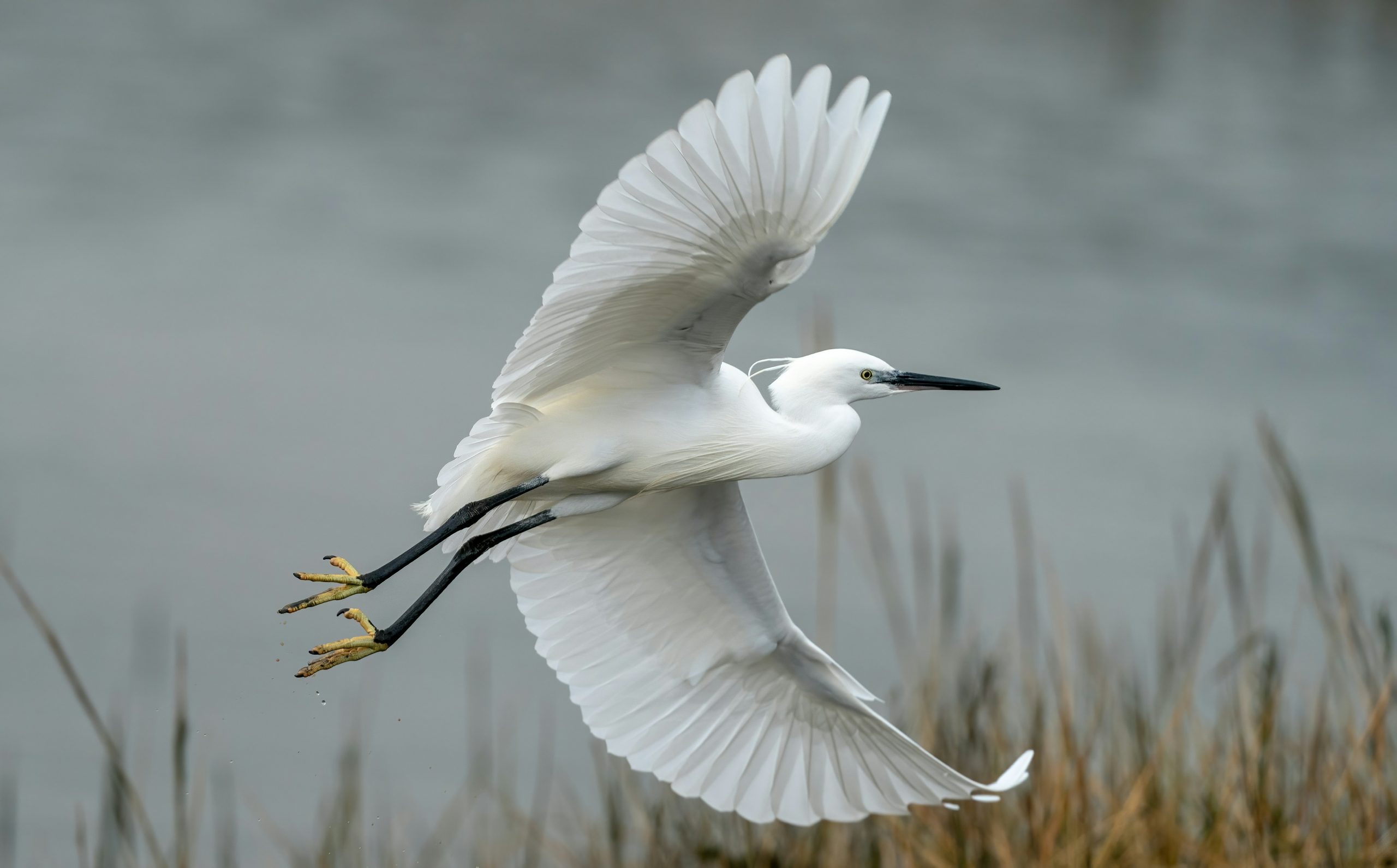
Five poems on aging, desire, disenchantment, and persistence
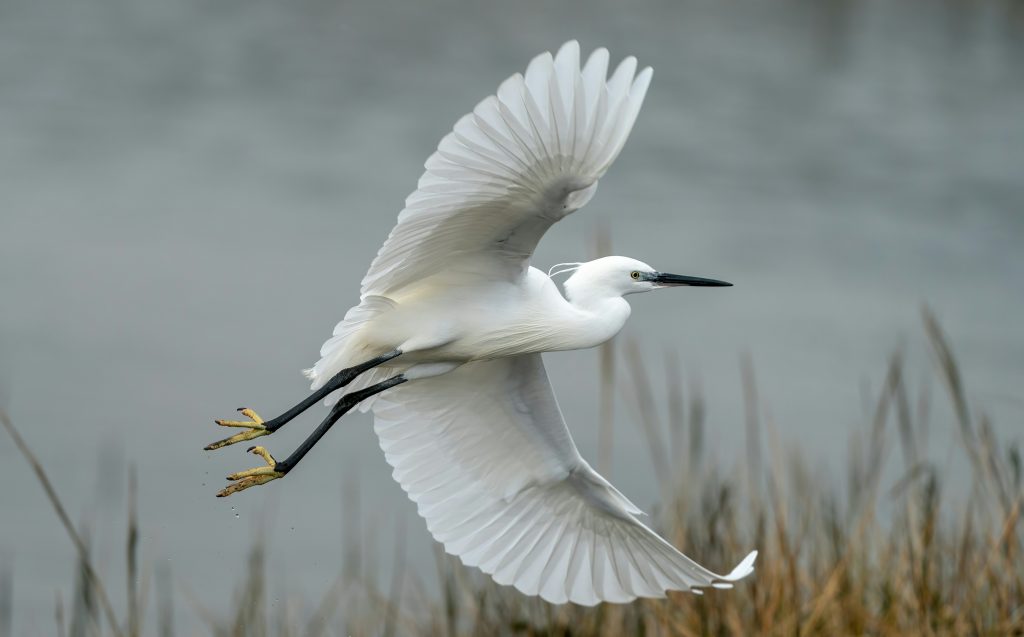 An egret in flight. | Photo by Bob Brewer.
Poet Tishani Doshi’s fifth collection of poems stems from an unlikely place: her fascination with birds.
“Of all the creatures we share the planet with, birds seem to me utterly unknowable,” the poet and dancer told the Hindustan Times. “Lion, beetle, bandicoot—somehow, I can imagine my way into them, perhaps because of their terrestrial nature. But with birds, there is this magical quality of flight. Most birds occupy the realm of sky, and this wingedness is a marvel.”
Doshi’s new book, Egrets, While War, takes this avian curiosity as a starting point to examine the mysteries and terrors of our world. Through sonnets for the dodo, the last passenger pigeon, and the 10th-century tantric school of poets known as mattamayura, or drunken peacocks, the collection explores questions of extinction and survival, as well as the relationship between beauty and violence. This duality is present in the book’s title, and she describes the title’s comma as “a hinge between beauty and horror, the dichotomies of living.” Doshi’s writing exists precisely at this hinge, resisting easy binaries and instead holding space for contradictions and the messiness of existence.
In poems that stretch from the mythic past to visions of present and future apocalypse, Doshi points to the ways that wonder and astonishment can exist alongside violence and asks how poetry can be a tool for survival and resilience in the face of existential threats of our age. “Writing a poem can be a hugely optimistic act,” she says. “It may not be able to alter reality in a measurable way, but it has the power to land inside another person and take up residence, which is its own kind of magic.”
–Sarah Fleming, senior editor
A Stupa for the 49th Year of Life
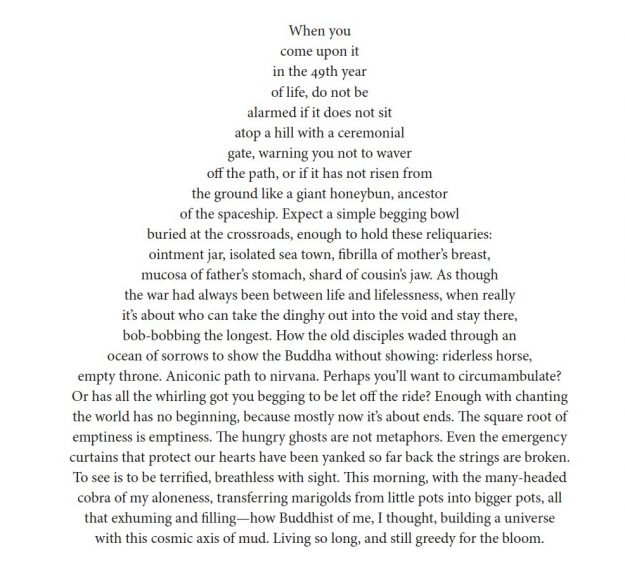
Wasps at the Faucet
February, and there are wasps
at the faucet, flying in droves at dusk
to collect water to cool their nests.
They must carry each drop between
their legs without getting their wings
wet. It is a dance we do—me with a broom,
thrusting it between them as though
it were a pitchfork on fire. Their brief
confusion on the battlefield before
surging forward again. If only we could
turn away from each other in disenchantment,
renounce our harvest of sorrows. But here
is the world, egging us on with acres of low
grass, the beginnings of a silver tooth
of moon. Retreat, attack, on your knees.
This is your husk of time, decide.
In the scattering between thirst
and death, what will it be?
The School of Drunken Peacocks
Morning on the beach, and nothing
in the world feels true, except for the dog
charging into this muster of peacocks,
the heft of their strange cylindrical bodies
suddenly weightless—apeiron of limitless
feathery blue. The old poets who asked,
How many more sunsets can a heart endure?
They knew emptiness. How it lurks around
the visible world. Vanishing, then reappearing,
like a pebble in your shoe. Some see eternity
in the water of a cow’s hoofprint, others in the eye
of a glassy bead. Perhaps the moray eel, too,
wanted to live forever, was declaring The Singularity
Is Near as a fisherman hooked its lip
and cast it ashore. There—in the branches
of the Indian silk cotton—starlings drink from wide
pink saucers, gem-studded petals, mighty
cupbearers! The whole inebriated tree, tenderly
unsteady in this moment of brief blazing splendor.
For those of us who live in time, all we have
is the power to shrink these moments. Smaller,
smaller, until those moments live in us.
I was a girl once, thirsty-lipped squab, skittering
around for a place of her own. The past is the only
immortality we can claim. Some nights,
when the disk of moon is full, I understand.
Egrets, While War
In the garden, egrets are doing their stalking
dance, and it’s easy to see how they are really
feathered dinosaurs flown in through a hole
from the past. Somewhere, a city under siege
remains sleepless. The dirge of loss recovery
loss loss loss continues. I cannot say
why other people’s family portraits fill me
with such tectonic longing. Ancestors
who stepped from ocean to land, shedding fin,
tail, gill, to transform into a symphony
of great-aunts and -uncles. We bury clues
of our dispossession—bony-plated language,
heart scarab. Our task is to march on. To rise
and leave the apple orchard, throw stones
at marauders who threaten to tear up
the carpets. Father will file a missing person
report while spring carries on with its hedonism.
It is pointless to resist the pull of our fruiting
bodies. Whatever we fear has already happened.
Will keep happening. If we could just wake
to fullness in a delta with the berry-red lips
of an amorous god upon us. Climb trees
to listen to heartbeats. But here, the earth
remains leashed to mystery—clay fingerprint,
fragment of jaw. The sea retracts her tongue
like a warning. Winged creatures lurch
and soar. Whiteness, then vanishing.
I Am the Last Poet of the Village
after Sergei Yesenin
I am the last poet of the village
to sing of the gloom of late afternoon,
the love-sulk of dusk. Feel my amphibian
skin. Tell me how the next life will be filled
with jars of barley. I can lay down my scythe
to calm the storms, but the storms have their own
homelands to get to. Take my broom, my fingernail,
write how everything that was golden-hued
is going or gone. Dams are breaking—lonely
like the rest of us. When I am found, pray
my belly is full, so they may understand
we believed in the harvest. We, who wove
baskets for fish and guided our loves to sanctuary
in the dirt with deer-tooth necklaces;
who carried poems in our pockets
as though they were tiny scepters,
keys to a radiant palace.
♦
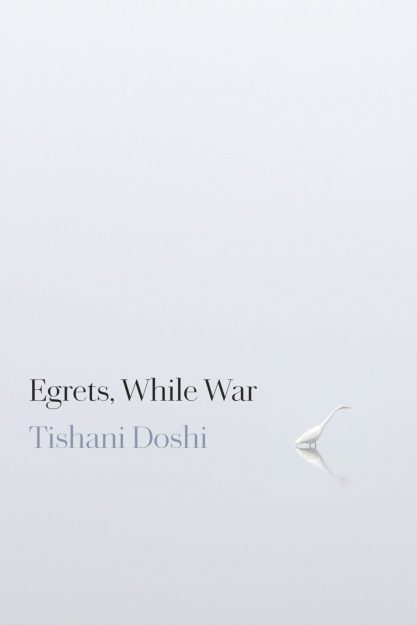
From Egrets, While War, copyright 2026 by Tishani Doshi, used by permission of Copper Canyon Press, www.coppercanyonpress.org.

Thank you for subscribing to Tricycle! As a nonprofit, we depend on readers like you to keep Buddhist teachings and practices widely available.
This article is only for Subscribers!
Subscribe now to read this article and get immediate access to everything else.
Already a subscriber? Log in.






















.jpg&h=630&w=1200&q=100&v=c0f97a310e&c=1)