From the Academy: Death
How Buddhist traditions contemplate mortality, confront impermanence, and ritualize the final moment. The post From the Academy: Death appeared first on Tricycle: The Buddhist Review.
 Fransebas
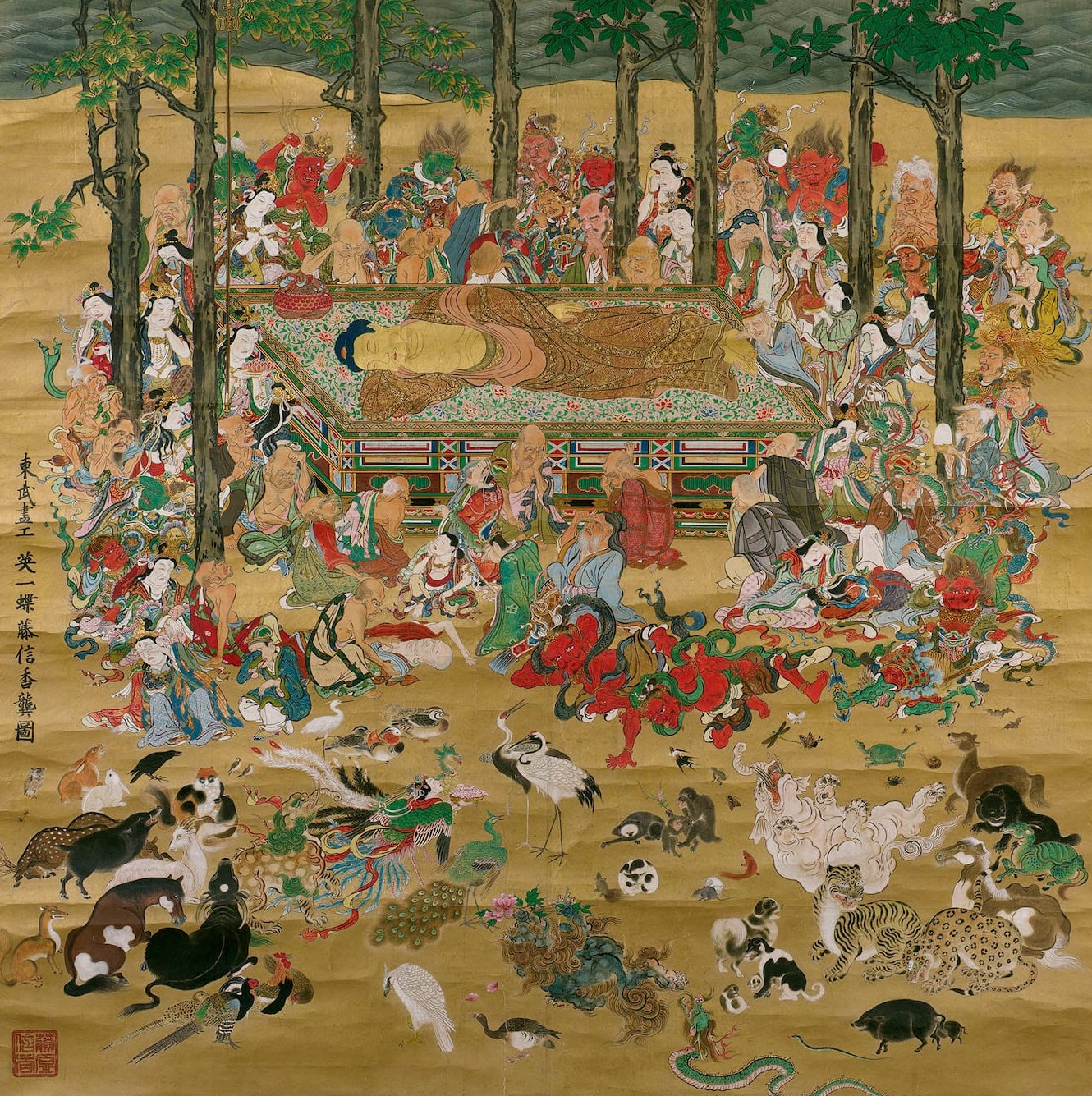
How Buddhist traditions contemplate mortality, confront impermanence, and ritualize the final moment.
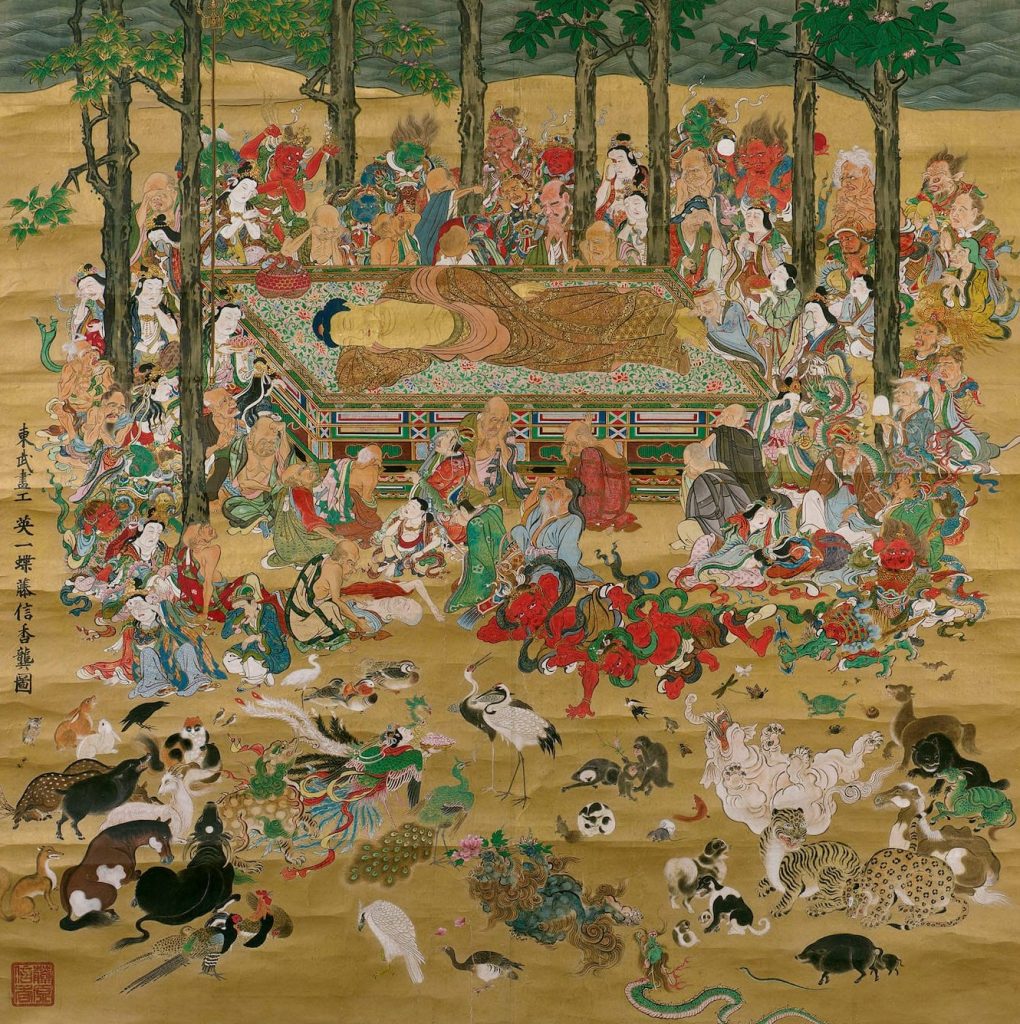 Hanabusa Itcho, Death of the Historical Buddha, 1713. | Fenollosa-Weld Collection / Museum of Fine Arts, Boston
From the Academy is a monthly email newsletter for Premium subscribers, developed in collaboration with Tricycle’s resident Ho Family Foundation Buddhism Public Scholar. Each issue offers a scholarly take on a key topic in Buddhist thought and practice, with further readings and videos for exploration. Select issues are published here for the wider Tricycle community.
Death sits at the origin of the Buddhist path. Canonical texts recount that Siddhartha Gautama, upon encountering old age, illness, and death, renounced his privileged life and set out on his path to liberation. Awareness of mortality is both a fundamental existential concern and a catalyst for pursuing freedom from suffering and samsaric existence.
Buddhist teachings also hold that all conditioned things are impermanent, which reframes death as an ever-present feature of human experience rather than a single tragedy at the end of it. Sustained attention to impermanence loosens fear and attachment well before the final moment arrives, enabling us to approach death with clarity and wisdom.
The Buddha’s Death
Narratives about the Buddha’s death reveal a variety of attitudes toward human mortality. His attendant, Ananda, openly mourns the loss of his teacher and companion, while other monks remain composed, treating his death as a confirmation of what the Buddha taught. These narratives also present his death as parinirvana, his final liberation.
Grief is not dismissed as an emotional obstacle. These stories hold it alongside the recognition that death is inevitable and, in the Buddha’s case, a release, integrating it within broader teachings on impermanence and the cessation of rebirth.
Facing Death
Buddhist traditions offer diverse practices for confronting mortality directly, most of them focusing on death’s certainty and the unpredictability of its timing. These include contemplating death, corpse meditations, and visualizations such as those in Tibetan bardo or Pure Land teachings, which train practitioners to hold death steadily in view as intrinsic to human existence. These practices aim to arouse samvega, the sobering urgency of impermanence that motivates practice. Recollecting death also helps clarify priorities, encouraging us to use our time wisely.
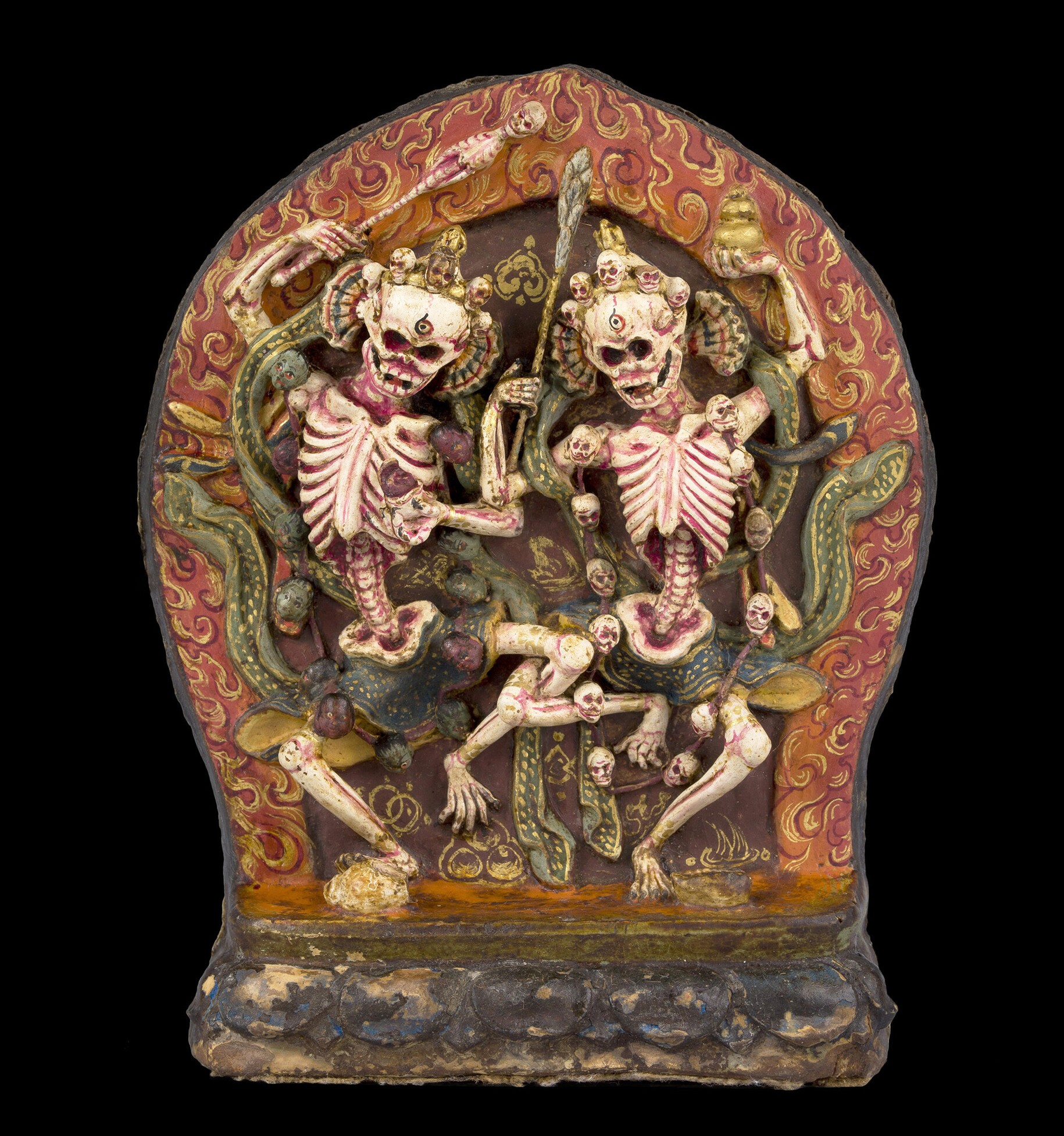 Enlightened beings called Citipati, or “Lords of the Charnel Grounds,” who preside over cremation grounds where tantric practitioners meditate among the dead. Terracotta, Tibet, 18th century. | Rubin Museum of Art / Photo: Wellcome Collection
Rituals at the Moment of Death
The moment of death itself has long been treated as critical. Deathbed rituals, including chanting and deathbed ordination in medieval Japan and the Tibetan consciousness transfer known as phowa, aim to guide the dying person’s mind and to influence their postmortem destination. The Japanese monk Kakuban (1095–1143) detailed methods for sustaining right mindfulness at the moment of death, reflecting a widespread belief that ritual precision could contribute to a favorable rebirth.
Extended funerary and postmortem rites have long provided crucial economic support for temples and ritual specialists. Presiding over them and interpreting signs, such as the absence of bodily decay or the presence of relics produced during cremation, also reinforced religious authority and the status of Buddhist lineages and institutions.
Contemporary Practices
Buddhists still draw upon traditional practices to address mortality. Mindfulness of death, Theravada chanting rites, and Japanese Zen mortuary ceremonies stand in some contrast to prevailing American funerary customs, where embalming, cosmetic restoration, and discreet interment keep the body at a distance and its management in professional hands. Buddhist practice tends instead to engage mortality directly. In recent decades, Western practitioners have taken up hospice chaplaincy, death-awareness retreats, and academic-clinical dialogues that bring teachings on impermanence into conversation with ethical end-of-life care.
It is not clear how much of this deathbed practice survives the move to hospitals and hospices. Such rituals assume a trained community and a cosmology in which the destination matters. What carries over and what drops away is still being worked out.
Additional Resources
Jacqueline Stone, “Right Thoughts at the Last Moment: Buddhism and Deathbed Practices in Medieval Japan,” lecture at St. John’s College, 2025. In this talk, the eminent scholar Jacqueline Stone explores the medieval Japanese belief that a mindful death could shape one’s postmortem destiny. Shuyin, “Waiting on the Dead,” Buddhistdoor Global, 2018. An article on Buddhist Myanmar funerary practices and their financial impact on the poor. For a more comprehensive exploration of the topic, see Mu-Lung Hsu, “Making Merit, Making Civil Society: Free Funeral Service Societies and Merit-Making in Contemporary Myanmar,” Journal of Burma Studies vol. 23 no. 1, 2019. Maurice O’C. Walshe, “Buddhism and Death,” Access to Insight edition, 1978/2005. Walshe, the late German-language scholar and Buddhist leader, covers the basics of Buddhism and death (and a bit more) in his now-classic exposition from both academic and practitioner perspectives.
Thank you for subscribing to Tricycle! As a nonprofit, we depend on readers like you to keep Buddhist teachings and practices widely available.
This article is only for Subscribers!
Subscribe now to read this article and get immediate access to everything else.
Already a subscriber? Log in.




















![AEO checker tools that measure answer engine visibility [2026]](https://53.fs1.hubspotusercontent-na1.net/hubfs/53/aeo-checker-1-20260903-3858273.webp)


.jpg&h=630&w=1200&q=100&v=c0f97a310e&c=1)