How to Blow Up an eCommerce Business With Facebook Ads
Are your Facebook ads generating clicks but not customers? Want to stop wasting budget on the wrong audiences at the wrong times? In this article, you'll discover a four-stage system for building Facebook ad accounts that generate consistent profit...
 JimMin
Are your Facebook ads generating clicks but not customers? Want to stop wasting budget on the wrong audiences at the wrong times?
In this article, you'll discover a four-stage system for building Facebook ad accounts that generate consistent profit and scale predictably.
This article was co-created by Sam Piliero and Michael Stelzner. For more about Sam, scroll to the end of this article.
Two Things That Hold Back Your Facebook Ads
Sam Piliero identifies two things that keep most advertisers stuck.
The first is obsessing over efficiency metrics.
Return on ad spend and cost per acquisition are useful guardrails, but they don't tell you what's actually going into your pocket. Sam argues that the real goal is profit, more specifically, contribution margin.
For most eCommerce brands, a 10–20% profit margin on revenue is a healthy target. A business generating $1,000 in revenue and keeping $100–$200 of that is in good shape. Chasing a 10x ROAS might feel impressive, but a 2.2 ROAS that lets you spend aggressively, acquire a large customer base, and benefit from the lifetime value and word-of-mouth that compounds over time will often build a far larger business.
The second is a misconception of control.
Many advertisers either over-engineer their accounts with dozens of campaigns pulling in different directions, or they do the opposite and hand everything to the algorithm, hoping it figures things out. Sam argues there's a deliberate sweet spot between those two extremes and that getting it right is what makes scaling possible.
The upside of doing this well is significant. Among The Moonlighters' current clients, five businesses arrived roughly a year prior, spending less than $30,000 per month on ads and generating less than $100,000 per month in total revenue. All five are now in the $50 million-plus revenue range. Sam is careful to note that these are not typical results, but they illustrate what happens when a brand commits to the system, keeps investing in creative, and focuses on customer lifetime value rather than short-term efficiency metrics.
The framework Sam uses is called the M4 Method, a proprietary four-stage system built around account structure, creative, deep dives, and scale. Some stages overlap, but they build on each other, and the order matters.
#1: The M4 Method for Facebook Ads: Account Structure
Sam describes the account structure as the foundation of the house. Great creative, a compelling offer, and a strong product can still underperform if they're dumped into a disorganized account.
Structure is what turns good inputs into sustainable, scalable results, especially when you try to manage a fatiguing ad.
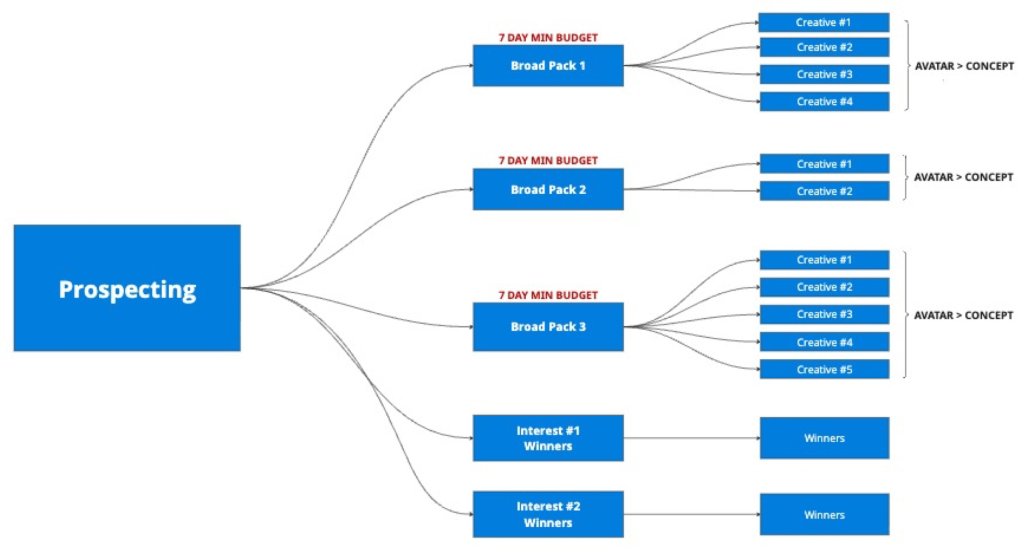
In a simplified, all-in-one setup, the only lever you can pull is the pause lever. With multiple packs and ad sets in place, you have two additional tools: value rules and ad set budget minimums and maximums.
A value rule can adjust how the algorithm treats certain ad sets based on performance signals. Ad set minimums and maximums let you cap how much a declining ad can consume while simultaneously guaranteeing a floor of spend goes to newer, untested packs.

Which AI Moves Actually Matter?
That's what every marketer is wrestling with now. New AI strategies, new tools, new takes every week — but no clarity. Most marketers and business owners are trying to figure out AI alone.
The AI Business Society is your trusted guide. Get expert-led training you can put to work immediately. Plus a community of marketers sharing what's actually working.
The result is a system where budget flows toward fresh performers automatically rather than continuing to pile into whatever ad dominated last month.
Set Up a Prospecting Campaign
The core of Sam's structure is a single prospecting campaign set to campaign budget optimization (CBO). This campaign houses multiple ad sets, which Sam calls “packs.” Each round of creative gets its own pack. The CBO setting lets the algorithm allocate the budget freely across packs, directing spend toward whichever ads are most likely to convert at any given moment.
Set Up a Retention Campaign
Alongside the prospecting CBO, Sam runs a retention campaign targeting existing customers. This separation is critical: as spend increases, it tells you exactly where your money is going — to new customers, engaged prospects, or people who have already purchased — rather than letting everything blur together in one account.

Set Up Two Optional Campaigns
Two optional campaigns round out the structure. The first is a retargeting campaign for people who have engaged with the brand but haven't purchased.
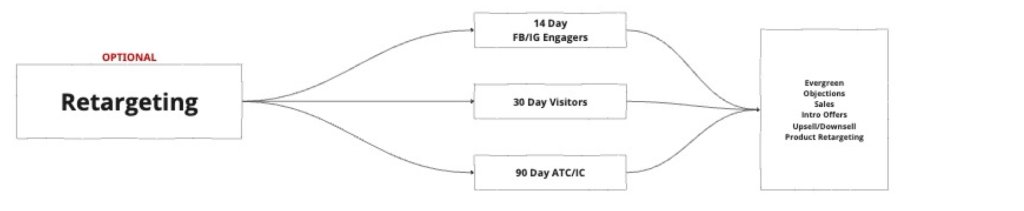
The second is a scaling campaign that forces spending specifically against the three to five top-performing ads in the account.
#2: The M4 Method for Facebook Ads: Creative
Once the account structure is in place, creative becomes the most important variable. Sam describes it as the body of the car; you need both the engine (structure) and the body (creative) working together for the vehicle to move.
Prior to Meta's Andromeda algorithm update, targeting choices largely determined who saw your ad. Now, the content of the ad itself signals to the algorithm who should see it. What your ad says determines who it reaches. This means broad, generic creative underperforms.
The ads that work are problem-solution specific: identify a specific customer avatar, speak directly to their problem, and position your product as the unique solution to that particular problem.
For example, a back brace brand that runs an ad saying “back brace for back pain” is competing for everyone. The same brand running an ad specifically for construction workers who deal with chronic back pain from lifting and bending, and showing people who look like construction workers, reaches a far more qualified audience.
Design Problem-Solution Ads
The goal is to manufacture hits. Sam defines a hit as any ad that performs above your ROAS target and captures 10% or more of total account spend. Most advertisers' hit rates aren't great, which is why volume matters: produce more creative, and you increase the odds of a hit.
Here are three tips to help beginner and experienced advertisers:
Find Creative Inspiration: To see which ads your competitors are running, Sam points to the Facebook Ads Library and competitive research tools like MagicBrief. Sort for the ads that have been running the longest and carry the highest impression counts; longevity is a strong proxy for performance. Use those ads as inspiration, then adapt the concept for your own brand and audience.
Match Creative Format to Your Funnel: Currently, video outperforms for top-of-funnel prospecting. For the middle and bottom of the funnel, both images and video work, with the emphasis shifting from attention-grabbing to solution-focused.
The format Sam's team sees working best is semi-professional UGC. This format is created from detailed scripts sent to micro-influencers (roughly 1,000 to 20,000 followers) who know how to produce reels. The brand provides the key phrases and talking points; the creator fills in the rest with their own experience and delivery. A package from a creator at this level typically costs a few hundred dollars and produces content that feels native to the feed.
Iterate on What's Already Working: Sam pushes back on the idea that every new ad needs to look completely different. When an ad is performing well, the first move is to build slight variations of it.
3 Days of World-Class Training—Zero Travel!
Couldn't make it to Social Media Marketing World and AI Business World this year? Get all of the great content at a fraction of the price with a Virtual ticket.
That’s full access to recordings of every keynote, workshop, and session—the ones people travel thousands of miles to see. Don't wait. Get your Virtual ticket and enjoy actionable content that you can watch anytime, anywhere.
If a simple thumbs-up image with a headline is your best-performing ad, start by making a second version with a slight change: a different setting, a different outfit, a different headline, or a different product on the talent.
For video, swap the hook while keeping the body, or keep the hook and swap the body. A different influencer delivering the same core message is another variation that frequently extends a winning concept.
These iterations are far more efficient than starting from scratch each time.
#3: The M4 Method for Facebook Ads: Deep Dive Analysis
Most advertisers spend the same flat amount every day of the week. Sam argues this is leaving significant money on the table.
The idea behind deep dives came from his time at BarkBox. For eight consecutive Monday mornings, Sam walked into the office and told his team they'd had another great weekend — meaning ad performance was exceptional on Saturdays and Sundays. It took him two months to recognize that it wasn't a coincidence. Consumer behavior for that brand shifted on weekends, but the ad account lacked a mechanism to capitalize on it.
Every business has patterns in when it converts best. Pet brands tend to spike on weekends because people are home with their animals. Gift-related products often perform best on Monday and Tuesday as customers plan ahead for the weekend. The patterns vary, but they're almost always there, and most businesses never look for them.
Sam's team attributes roughly 20% improvements in ROAS or equivalent reductions in cost per acquisition specifically to this stage of the process.
Analyze Your Ad Data to Find When and Where Your Business Performs Best
Pull 90 to 180 days of data, excluding outlier periods such as Black Friday, holiday sales, or major promotions. Focus on the evergreen baseline of roughly 260 non-sale days per year.
Next, break the data down by day of week, placement (feed vs. reels vs. stories), age, gender, and geography.
You're looking for a 20–30% difference in your core efficiency metric or conversion rate between segments. That's the signal threshold Sam uses to separate meaningful patterns from noise.
Once you find a high-performing day or segment, the right move is usually to spend more on it, not to eliminate the low-performing days entirely. Cutting underperforming days can hurt the funnel: impressions on slower days often drive conversions on stronger days.
A better approach is to lower budgets on underperforming days and increase them significantly on high performers, even if that pushes the ROAS on strong days down a bit. The goal is to acquire more customers at a profitable rate, not to protect a high ROAS on a low volume.
#4: The M4 Method for Facebook Ads: Scale
Scale only makes sense when the conditions are right. Sam is direct on this: you don't scale into poor ROAS or a dysfunctional account. You scale when performance is strong, and you want to capitalize on it.
Sam breaks scaling into three types.
Scale Vertically
Vertical scaling is simply increasing spend on your existing campaign because it's working.
Sam's approach is to increase in increments of 10–30% at a time, then wait two to three days before making another adjustment. This gives the algorithm time to recalibrate without triggering the learning phase unnecessarily. The window can be shorter for impulse-purchase products with low average order values, for something like a $25 phone case, next-day feedback is often sufficient.
Scale Horizontally
Horizontal scaling means creating new campaigns alongside your primary one.
Sam reserves this almost exclusively for promotional events such as sales, launches, or limited-time offers.
A separate campaign with its own budget runs for three to ten days and then ends. This keeps the account clean and prevents the algorithm from disrupting the always-on prospecting campaign.
Scale With A Twin Engine
Twin engine scaling is the combination of vertical and horizontal scaling used simultaneously, and it's where the biggest gains happen.
The loop works like this: identify any ad in the prospecting CBO that qualifies as a hit (above ROAS target, capturing 10%+ of spend), build iterations of that specific ad, and inject those iterations directly back into the prospecting CBO. At the same time, increase the overall budget on that campaign vertically.
The new creative iterations remain within the primary prospecting campaign rather than being spun off into separate testing campaigns, which would fragment the budget and limit the algorithm's ability to distribute spend efficiently.
When this loop runs correctly, ROAS stays stable as spend climbs. More customers get acquired at roughly the same cost, which is the compounding engine behind the $50M+ businesses Sam referenced earlier.
Pro Tip: One important exception to the volume-and-scale framework applies to brands that cannot fulfill demand even if they generate it. For example, a member of Sam’s community who sells dog treats and runs a supply-constrained operation: he simply cannot produce enough inventory to fulfill scaled demand.
For this type of business, the goal flips entirely: rather than acquiring as many customers as possible at a profitable rate, the priority becomes maximizing ROAS on a controlled volume of orders. Scaling spend aggressively would only create fulfillment problems and erode customer experience.
If this describes your business, the deep dives and creative work still apply, but the scaling stage looks different; the aim is efficiency per order, not raw customer growth.
Keep Your Eye on the King Goal
One concept Sam borrows from his BarkBox days ties it all together: the king goal. Every business should have one single north star metric, the number that defines success. At BarkBox, the phrase was “CAC is king,” meaning cost per acquisition was the only number that mattered.
If cost per click looked strange or CPMs were high but the king goal (say, a ROAS of 2) was being met, the right call was to ignore the noise and keep spending. All the other metrics are proxy metrics. They're useful for diagnosing problems, but chasing them at the expense of the king goal creates distraction and bad decisions.
Other Notes From This Episode
Connect with Michael Stelzner @Stelzner on Instagram and @Mike_Stelzner on X. Watch this interview and other exclusive content from Social Media Examiner on YouTube.Where to subscribe: Apple Podcasts | Spotify | YouTube Music | YouTube | Amazon Music | RSS
✋🏽 If you enjoyed this episode of the Social Media Marketing podcast, please head over to Apple Podcasts, leave a rating, write a review, and subscribe.
Stay Up-to-Date: Get New Marketing Articles Delivered to You!
Don't miss out on upcoming social media marketing insights and strategies! Sign up to receive notifications when we publish new articles on Social Media Examiner. Our expertly crafted content will help you stay ahead of the curve and drive results for your business. Click the link below to sign up now and receive our annual report!

Curious About How to Use AI?
Our newest show, AI Explored, might be just what you're looking for. It's for marketers, creators, and entrepreneurs who want to understand how to use AI in their business.
It's hosted by Michael Stelzner and explores this exciting new frontier in easy-to-understand terms.
Pull up your favorite podcast app and search for AI Explored. Or click the button below for more information.