How to Sit When You Are Sick
On the virtues of self-compassion and self-kindness when facing illness The post How to Sit When You Are Sick appeared first on Tricycle: The Buddhist Review.
 Astrong

On the virtues of self-compassion and self-kindness when facing illness
 Photo by Noah Silliman
A lot of people let their meditation practice slide when they get sick. But that’s a mistake. Meditating promotes healing, and it reduces the self-pity that makes being ill such a miserable experience.
Strategies
What happens to your meditation practice when you get sick? It’s tempting to take the day off, like you might do with work. Skipping work when you’re sick is sensible; you don’t want to spread an infectious disease to others, and it’s good to avoid making your illness worse by overexerting yourself. But neither of those things applies with meditation.
When Tibetan Buddhists are ill, they do more meditation, not less. Their reasoning is that the illness might be the result of previous bad karma, which they want to counteract with the good karma of meditation. Even if you’re skeptical about that rationale, meditating while sick is still a wise move, because meditation has been shown to boost the immune system and to reduce our perception of pain and discomfort.
Although we might tell ourselves that we can’t meditate while we’re sick, that’s not true. That’s just a symptom of self-pity. Even if we feel too poorly to sit up, we can meditate lying down. Meditating lying down isn’t ideal—it tends to lead to a less focused experience compared to sitting upright—but it’s much better than nothing. (Please don’t force yourself to sit upright in meditation if it feels like you’re exhausting yourself. Practice self-kindness.)
If you have a respiratory infection, you might find that bringing attention to your breathing triggers coughing spasms, so it might work better to direct your attention elsewhere—for example, by doing loving-kindness practice. Loving-kindness is also emotionally supportive, which is handy when you’re having a hard time. You can say to yourself things like “May you be well. May you be free from suffering. May you heal from this sickness. May you be at ease with discomfort.” You can send kind messages of support and encouragement to parts of the body where suffering is experienced. If your throat is sore, wish it well. If your lungs are full of mucus, wish them well. If you feel tired and achy, wish your whole body well. This is a practice of self-compassion, and it can help you support yourself through the challenge of feeling ill.
Self-pity is not the same thing as self-compassion.
Incidentally, self-pity is not the same thing as self-compassion. Self-compassion says, “May you be well,” and it reduces our suffering. Self-pity says, “Poor me, this is terrible,” and increases our suffering. One time when the Buddha was sick and in great pain he was challenged by the Buddhist incarnation of doubt, Mara, who taunted him for lying around uselessly. Essentially, Mara was trying to provoke the Buddha to self-pity. The Buddha replied, “I lie down with compassion for all beings.” He used his enforced rest as an opportunity to have empathy for others who are suffering. Recognizing that others are suffering too, and often much worse than we are, is a powerful antidote to self-pity. It helps us to put our own suffering in perspective. You have a sore throat, but someone else has a broken leg. You have the flu, but someone else has just learned they have cancer. If you have cancer someone else has just lost a child to cancer. In empathizing in this way, we’re counting our blessings. Our own suffering is real, but it’s usually much less catastrophic than we imagine.
“I meditate every day. It’s just what I do. It’s part of who I am. I meditate even when I’m sick.”
Going Deeper
One of the biggest misconceptions about self-compassion is that it’s selfish. The term does include the word self, so perhaps it’s not surprising that people get the wrong idea. The fact is, though, that a lack of self-compassion leads to a lack of compassion for others. If we don’t know how to show compassion to ourselves, we’re probably going to be too wrapped up in our own pain to be able to respond compassionately to other people. We just won’t have the bandwidth available for them.
The Buddha said of the first noble truth—the fact that there is suffering in our lives—that suffering is to be known. We often have suffering but don’t know it. We don’t recognize it for what it is. We don’t fully realize that it’s happening. And because we don’t know our suffering, we don’t respond to it appropriately.
We get so caught up in our stories that we fail to notice the fact that we’re in pain. Think about what happens when your computer is running slowly, for example. You probably think about how annoying it is, and wish the machine ran faster. You might think about whether or not you can afford a new one, or about how inept the software manufacturers are. This causes further suffering, so that we’re caught up in a closed loop: suffering leads to rumination, leads to further suffering. Caught up in the story, we’re unable to be kind and compassionate to ourselves. And when someone tries to engage with us at a time like this, we may well snap at them for interrupting us. We’re uncompassionate.
When we know our suffering—when we recognize the fact that we’re in pain or discomfort—we can drop our ruminations. We can think, “I’m frustrated right now. This frustration is a form of suffering. Maybe I should offer myself some support?” We can now turn toward to our suffering and offer it the support it needs. We can accept our pain, regarding it with kind eyes, talking to it in a soothing and supportive way, and even touching it reassuringly. Our suffering having been addressed, we’ve broken that closed loop. Even if the frustration is still there, we’re no longer tangled up within ourselves. Our attention is more open and able to be directed outward.
No longer in such a self-obsessed state, and having awoken qualities of empathy and compassion, those qualities become available for others. We’re less likely to regard them as intruding, and we’re less likely to snap at them. We’re more likely to meet them with empathy, recognizing that they, just like us, are feeling beings that dislike suffering and want to be at ease. And so we’re more likely to be kind to them, treating them with care and respect. If we sense that they are suffering, we’re more likely to show them concern and support.
Practicing self-compassion leads to compassion for others. Self-compassion is not selfish. It’s what frees us from selfishness.
◆
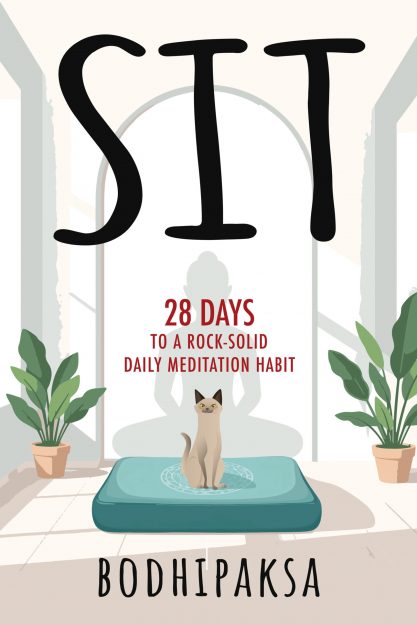
© 2026 by Bodhipaksa, Sit: 28 Days to a Rock-Solid Meditation Habit. Reprinted by arrangement with Wisdom Publications.

Thank you for subscribing to Tricycle! As a nonprofit, we depend on readers like you to keep Buddhist teachings and practices widely available.
This article is only for Subscribers!
Subscribe now to read this article and get immediate access to everything else.
Already a subscriber? Log in.