Inside ChatGPT’s Source Preferences: What Query Fanouts Reveal About AI Discoverability
Key Takeaways Most marketers optimizing for AI search visibility are focused on the wrong layer. They are tracking citations, which is the output. What they should be studying is fanouts, which is the input that determines whether a citation...
 ShanonG

Key Takeaways
A Peec AI study of 5 million query fanouts collected between April 1 and April 21, 2026 reveals how AI platforms rewrite and expand user queries before executing searches. ChatGPT consistently injects words like “best,” “reviews,” and the current year into queries, even when those terms were not in the original prompt. ChatGPT’s query fanouts containing “reddit” grew from roughly 0.15 percent to 3.68 percent between January and May 2026. ChatGPT uses Reciprocal Rank Fusion, meaning content that appears across multiple fanout searches scores higher than content that surfaces for only one. Fanout analysis should now be a standard part of AEO audits alongside citation tracking.Most marketers optimizing for AI search visibility are focused on the wrong layer. They are tracking citations, which is the output. What they should be studying is fanouts, which is the input that determines whether a citation is even possible.
A new analysis of five million query fanouts from ChatGPT, Perplexity, and Grok reveals how AI search platforms actually work behind the scenes, and what that means for how brands show up in AI-generated answers.
How Query Fanouts Actually Work
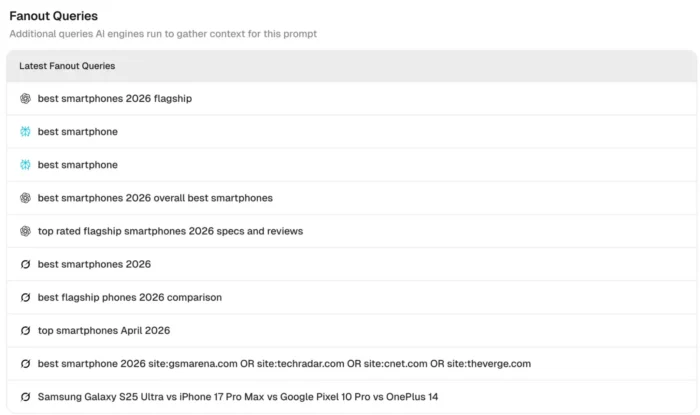
When a user asks ChatGPT a question, the model does not simply search for that exact phrase. It executes a set of related sub-queries behind the scenes, each exploring a different angle of the original prompt, then merges those results to build its response. That set of sub-queries is the fanout.
A question like “best project management tools for remote teams” might produce fanouts for “top project management software 2026,” “remote team collaboration features,” “project management pricing comparison,” and “enterprise versus small team project management tools,” all running simultaneously. The answer ChatGPT provides draws from all of those sources combined, not just from content that matches the original wording.
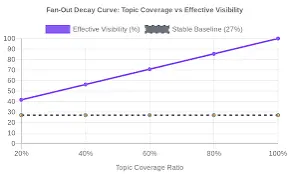
ChatGPT uses Reciprocal Rank Fusion to combine scores across these sub-queries. This means content that appears across multiple fanout searches is weighted more heavily than content that only surfaces for one. Covering a topic thoroughly from multiple angles increases your citation probability because content surfacing across more sub-queries scores higher under RRF.
What the Reddit Signal Actually Means
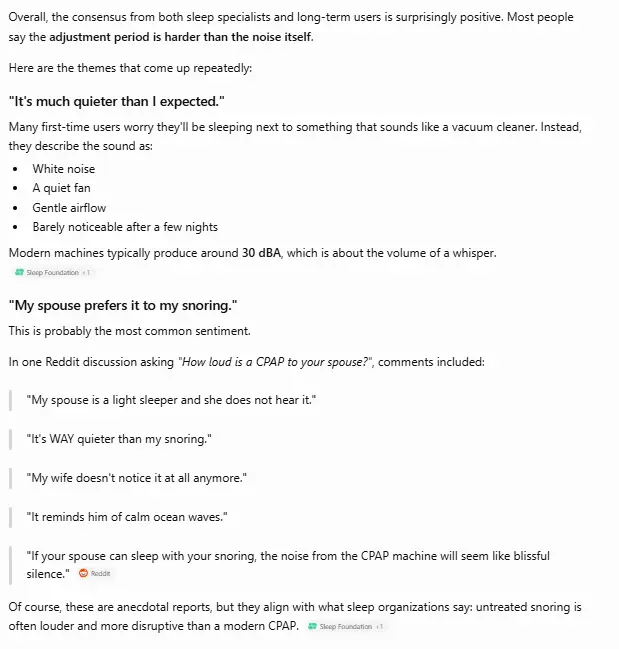
The most actionable finding from the fanout data is the rise of Reddit as a deliberate source. ChatGPT’s query fanouts explicitly referencing Reddit grew from approximately 0.15 percent to 3.68 percent between January and May 2026. This is not incidental. It reflects a pattern where AI systems seek out human-centered, experiential content that branded or editorial sources often do not provide.
Reddit provides something that polished brand content typically cannot: unfiltered customer sentiment, specific use-case discussions, and genuine peer-to-peer evaluations of products and services. AI systems appear to be recognizing that value explicitly, surfacing Reddit as a source for the kind of human validation that helps construct credible answers.
For brands, this creates two implications. First, your presence and reputation within relevant Reddit communities now directly influences what AI systems say about you. Second, the broader principle is that AI platforms are seeking out authentic experiential content as a distinct source type from authoritative or editorial content. Both matter, and they are sourced differently.
Fanouts Before Citations: The Right Audit Sequence
Most AEO work currently focuses on citation tracking: which AI platforms mention your brand, in what context, and with what sentiment. Citation tracking is valuable, but it is a lagging indicator. By the time a citation appears or fails to appear, the fanout decisions that determined it have already been made.
Fanout analysis is the leading indicator. It reveals which angles, source types, and content formats AI systems are actively looking for when a user asks a question in your category. Knowing that ChatGPT consistently injects “best,” “reviews,” and the current year into queries means you can build content that specifically addresses those retrieval patterns, beyond the surface-level keywords your audience uses.
The practical audit sequence should run from fanout to source type to citation. Start by identifying the fanout patterns for the high-intent queries in your category. Then assess which source types are being pulled for each fanout. Then determine where your content appears or fails to appear across those source types. The gap between where your content exists and where AI systems are looking is the optimization target.
What Reciprocal Rank Fusion Means for Content Planning
The Reciprocal Rank Fusion mechanism ChatGPT uses to combine fanout results has a direct implication for how content should be planned and structured.
Because content that appears across multiple fanout searches is scored higher than content that appears for only one, the brands most likely to earn AI citation are the ones that cover their core topics from multiple angles across multiple content assets. A single well-ranked pillar page is less effective under RRF than a cluster of interrelated content that addresses the same topic from different perspectives: a main guide, a comparison piece, a use-case breakdown, an FAQ, and a data-driven research piece.
This is not a new content strategy principle. Topical authority and content clustering have been standard SEO practice for years. What is new is the mechanism that rewards it. Under traditional ranking, a single highly authoritative page on a topic could outcompete a thinner content cluster. Under RRF, the cluster wins because it surfaces across more of the sub-queries AI executes when researching the topic.
For content planning, this means mapping your content against the likely fanout patterns for your most important queries, alongside the primary keyword. If ChatGPT consistently generates eight sub-queries when a user asks something in your category, and your brand has content that addresses two of them, your citation probability is structurally lower than a competitor that addresses six.
Structural Implications for Content Strategy
The fanout data reinforces several content strategy principles that have value independently of AI search, but are now especially important.
Comprehensive topic coverage matters more than individual page optimization. Because Reciprocal Rank Fusion weights content that appears across multiple fanouts, a brand that covers a topic from multiple angles including comparisons, use cases, reviews, and Q&A formats is more likely to earn citation than a brand that has one well-ranked page on the subject.
Listicles and comparison content are structurally favored. “Best” is the most commonly injected word in ChatGPT fanouts. Content positioned around “best for specific need” or structured as a comparison aligns directly with how AI systems rewrite queries before they execute them.
Third-party and community signals are a distinct optimization layer. Given the explicit Reddit preference emerging in fanout data, brands that generate genuine customer advocacy, encourage community participation, and maintain a real presence in relevant online discussions are building AI visibility through a channel that owned content alone cannot replicate.
FAQs
What is a query fanout?
A query fanout is the set of additional searches an AI system executes behind the scenes after receiving a user prompt. Rather than searching only for what the user typed, AI platforms rewrite and expand the query into multiple sub-queries that explore different angles of the original question.
Why does Reddit appear so frequently in ChatGPT fanouts?
Reddit provides a form of human-centered, peer-validated content that AI systems appear to treat as a distinct source type. Review-style, experiential content from community discussions provides a signal that branded editorial content typically does not, particularly around product sentiment, real-world use cases, and comparative user experiences.
How do I audit my fanout coverage?
Start by identifying the high-intent queries most relevant to your category. Then use a fanout analysis tool or inspect ChatGPT’s web search behavior to see which sub-queries it generates. Map your existing content against those sub-queries and identify where you have no representation. Those gaps are your content agenda.
Should I try to game Reddit to improve AI visibility?
No, and this will backfire. AI systems that are sourcing Reddit content for its authenticity will not reward manufactured or inauthentic participation. The value of Reddit as a source comes from genuine user experience, not brand-managed content. The right approach is to build products and services worth discussing, support customers effectively, and participate in relevant communities authentically.
Conclusion
The shift from citation tracking to fanout analysis is the next maturation step for generative engine optimization strategy. Citations tell you what AI said. Fanouts tell you what AI looked for. If you are already tracking AI brand visibility, fanout analysis is the natural next layer to add. Brands that understand the latter will be better positioned to influence the former.
The Reddit signal is the most actionable near-term finding. Authentic presence in relevant online communities is a measurable input to AI search visibility as well as a brand-building exercise. Building that presence consistently, through genuine customer advocacy and community engagement, is one of the highest-leverage investments a brand can make for AI discoverability in the current environment.