Meditation for Stress Relief: Science, Steps & Practices
✨ QUICK ANSWER Meditation for stress relief is a scientifically-proven practice that calms the nervous system, reduces cortisol (stress hormone), […]
 JimMin
✨ QUICK ANSWER
Meditation for stress relief is a scientifically-proven practice that calms the nervous system, reduces cortisol (stress hormone), and quiets racing thoughts within minutes. Research shows consistent meditation decreases anxiety 20-30% in 4 weeks, improves sleep quality, and lowers blood pressure. Beginners start with 5-10 minutes daily of focused breathing or guided visualization. No prior experience needed. Benefits accumulate with consistency — not intensity.
If you’ve ever felt the weight of stress sitting in your chest, making it hard to breathe — you are not alone.
Chronic stress has become the default state for millions of people. Work deadlines. Financial uncertainty. Relationship tension. Health concerns. Social anxiety. The news cycle. The constant ping of notifications. Our nervous systems evolved to handle occasional threats, but modern life delivers a continuous stream of low-level stressors that keep us in fight-or-flight mode for hours, days, weeks at a time.
The result: elevated cortisol, weakened immunity, insomnia, digestive problems, anxiety that hijacks your thoughts, and the sense that you are always one crisis away from falling apart.
Most people reach for solutions outside themselves: more coffee, stronger anxiety medication, expensive spa days, apps that promise “better sleep in 7 days.”
What few people realize is that the most powerful stress-relief tool is already inside you — and it activates through one of the simplest practices available: meditation.
This guide explains exactly how meditation works to relieve stress, which meditation techniques are most effective, how to establish a sustainable daily practice, and what you can realistically expect to feel within the first week, month, and year of consistent practice.
Whether you are a complete beginner, someone who has tried meditation and quit, or an experienced practitioner looking to deepen your stress-relief work — this guide walks through everything you need to know.
Meditation is a time-honored technique that centers the brain and results in reduced stress, anxiety and heightened consciousness. This technique has been in use thousands of years ago in one form or the other in different societies of the world, and today it is considered an effective measure against stress and in support of health.
There are a lot of meditation, but all of them are based on the following components: attention, breath, and silence. Meditation can be practiced at all levels, from a novice to an experienced meditator, and can easily be made specific to an individual’s life schedule.
To learn more about the forms of meditation and the benefits that are associated with each, one may visit Harvard University’s site.
THE STRESS CRISIS: Why Meditation Matters Now
Before exploring meditation solutions, it helps to understand the scope of the stress problem.
The Statistics on Modern Stress
According to the American Psychological Association’s 2024 Stress in America survey:
77% of adults report physical symptoms of stress 35% of adults report having difficulty managing stress 56% of adults report that work is a significant source of stress 43% of women report increased stress levels in the past year 65% of adults report that stress negatively affects their mental healthIn economic terms: stress-related absenteeism costs American employers over $550 billion annually in lost productivity.
The Physiological Cost of Chronic Stress
When you experience stress, your body releases cortisol and adrenaline — hormones that are genuinely useful for a genuine emergency (running from danger, responding to immediate threat). Your heart rate accelerates. Blood pressure rises. Digestion shuts down. Immune function decreases. Blood sugar spikes. This is the “fight-or-flight” response.
For acute stress (a one-time crisis), this response serves you. For chronic stress (the state most modern people live in), this constant activation becomes the problem itself:
Elevated cortisol (stress hormone) over months weakens the immune system, increases inflammation, disrupts sleep, and leads to weight gain in the belly area Chronic sympathetic activation (the nervous system in fight-or-flight) exhausts your body’s stress-response system, leading to burnout Suppressed parasympathetic function (the “rest-and-digest” system) means your body never fully recovers from stress — remaining in a state of vigilance 24/7 Elevated blood pressure increases risk of heart disease and stroke Disrupted sleep (from cortisol at night) creates a vicious cycle: poor sleep increases stress; increased stress worsens sleep Weakened immunity (from prolonged cortisol exposure) means you get sick more frequently and recover more slowlyThis is not a character flaw. This is not weakness. This is what happens to anyone’s body when it’s chronically exposed to stressors without a mechanism to actually recover.
HOW MEDITATION RELIEVES STRESS: The Neuroscience and Physiology
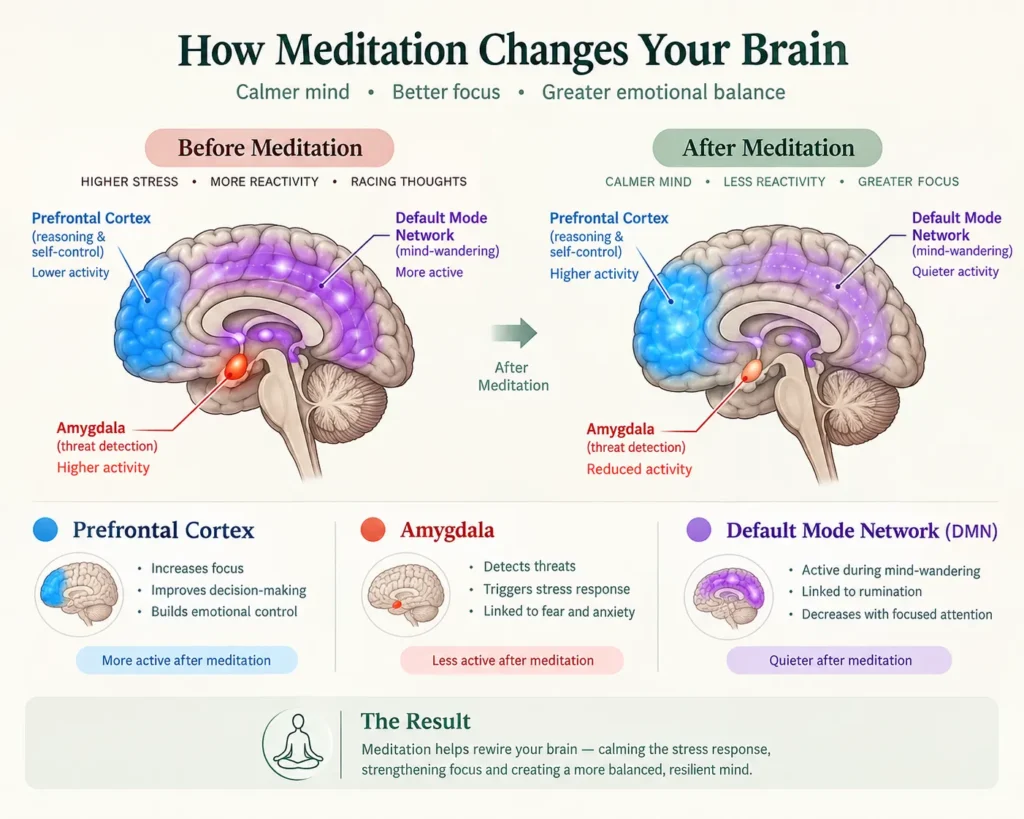
Meditation does not eliminate stressors — your job demands will still exist, bills will still need paying, difficult emotions will still arise. What meditation does is fundamentally shift how your nervous system responds to stress.
What Happens in Your Brain During Meditation
Neuroscience research using fMRI imaging shows that consistent meditation practice creates measurable changes in brain structure and function:
1. Reduced amygdala activity — The amygdala is the brain’s threat-detection center. It evolved to spot danger and trigger the stress response. In chronically stressed people, the amygdala is hyperactive, firing at perceived threats that are actually harmless (a critical email, an unusual noise, a worried thought). Meditation practice literally shrinks the amygdala and reduces its reactivity. Research from Massachusetts General Hospital found that just 8 weeks of meditation practice reduced amygdala gray matter density — meaning the threat-detection system becomes less hair-triggered.
2. Increased prefrontal cortex activity — The prefrontal cortex is the thinking, reasoning part of your brain — the capacity for conscious choice rather than automatic reaction. It’s what allows you to notice a worried thought and choose not to believe it. Meditation strengthens prefrontal cortex activation, giving you more access to rational, reasoned response rather than reactive panic.
3. Reduced default mode network activity — The default mode network (DMN) is what activates when your mind is not focused on the external world. It’s the network responsible for mind-wandering, rumination, and the internal narrative that generates anxiety (“What if I fail?”, “People think I’m incompetent”, “Something bad will happen”). Meditation directly quiets DMN activity — meaning fewer intrusive thoughts and less rumination.
4. Increased parasympathetic tone — The parasympathetic nervous system is the “rest-and-digest” system — the biological brake pedal. Meditation activates this system, decreasing heart rate, blood pressure, and cortisol while increasing the vagal tone (a measure of vagus nerve function — the main parasympathetic nerve).
What Happens in Your Body During Meditation
Simultaneously with these brain changes, meditation creates measurable physiological shifts:
Heart rate decreases by 5-10 beats per minute Blood pressure drops 5-10 mmHg (equivalent to some blood pressure medications) Cortisol decreases 20-30% (the stress hormone that drives so many stress-related diseases) Breathing rate slows from 12-16 breaths/minute to 8-10 breaths/minute Oxygen consumption decreases (indicating deep relaxation) Skin conductance decreases (your nervous system is no longer in threat mode)These are not subtle changes. These are the same physiological shifts that occur with medical interventions — yet accessible through a free, side-effect-free practice anyone can learn.
RESEARCH: What Science Says About Meditation for Stress
The scientific evidence supporting meditation for stress relief is robust and peer-reviewed:
Key Research Findings
Study 1: Cortisol Reduction (JAMA Psychiatry, 2014) A meta-analysis of 47 studies on mindfulness meditation found that participants practicing meditation for 8 weeks showed:
20-30% reduction in cortisol levels Significant anxiety reduction (comparable to some anti-anxiety medications) Improved sleep qualityStudy 2: Brain Changes (Psychiatry Research, 2011) Harvard researchers found that just 8 weeks of daily meditation practice produced:
Increased gray matter density in the prefrontal cortex (reasoning, emotional regulation) Decreased gray matter density in the amygdala (threat detection, anxiety) These physical brain changes correlated directly with reduced anxiety symptomsStudy 3: Heart Health (American Heart Association, 2017) Research on meditation and cardiovascular health found:
10-minute daily meditation reduced blood pressure as effectively as some antihypertensive medications Meditation reduced risk of heart attack and stroke in high-risk populationsStudy 4: Workplace Stress (Journal of Occupational Health Psychology, 2016) A study of office workers practicing 10-minute daily meditation found:
32% reduction in perceived stress 27% improvement in work-life balance 19% improvement in sleep quality Effects appeared within 2 weeks of practiceMEDITATION DEMYSTIFIED: What Meditation Actually Is (And Isn’t)
Before practicing meditation, many people hold misconceptions about what meditation is supposed to be:
What Meditation IS NOT
Meditation is not clearing your mind of all thoughts — This is the most common misconception, and it sets people up for failure. The goal is not to achieve a blank mind. The goal is to notice that thoughts are happening and not get caught in them. You will have thoughts. The practice is returning to the present moment when you notice you’ve been lost in thought.
Meditation is not achieving a special state or feeling — If you sit down expecting to feel “blissful” or “peaceful” and instead feel restless, anxious, or bored, you might think you’re doing it wrong. All of these experiences are fine. The practice works whether or not you feel anything special.
Meditation is not spiritual or religious — While meditation originated in spiritual traditions, it works equally well as a secular stress-management practice. The brain and nervous system don’t require religious belief to respond.
Meditation is not difficult — It doesn’t require flexibility, athleticism, or special ability. It just requires the capacity to sit quietly and pay attention.
What Meditation IS
Meditation is the practice of directing your attention to a single point (breath, mantra, sensation, sound) and, when your attention wanders (which it will), noticing this and gently returning to the point of focus.
That’s it.
The “stilling the mind” happens as a natural byproduct of this repeated return — not as something you force or achieve.
THE 5 BEST MEDITATION TECHNIQUES FOR STRESS RELIEF
Different meditation techniques work for different people. The best meditation is the one you’ll actually do consistently.
Technique 1: Breath Awareness Meditation (Most Accessible)
How it works: Sit comfortably and focus all attention on the natural breath — the sensation of air entering through the nostrils, the pause at the top of the inhale, the sensation of air leaving, the pause before the next inhale. When your mind wanders (it will), notice this without self-judgment and return attention to the breath.
Why it works for stress: The breath is the only nervous system function you can consciously control. By deliberately slowing and deepening the breath, you send a signal to your nervous system: “It’s safe to relax.” This directly activates the parasympathetic response.
Duration: 5-20 minutes Best time: Morning or during afternoon stress spike Equipment needed: None
Practical application: If you have 5 minutes, this is your meditation. If you have 20, this is still your meditation. Consistency matters more than duration.
Technique 2: Body Scan Meditation (Best for Physical Stress Tension)
How it works: Lie on your back (or sit if lying isn’t possible). Close your eyes and bring attention to the toes. Notice any sensations — warmth, coolness, tingling, tension. Mentally “scan” upward through the feet, ankles, shins, calves, thighs, hips, belly, chest, back, shoulders, arms, hands, neck, face, and head. The goal is not to relax but simply to notice what’s present.
Why it works for stress: Stress lives in the body as physical tension. By bringing conscious attention to where tension is held, the body naturally begins to release it. You cannot consciously relax a muscle you’re not aware of — the body scan creates that awareness.
Duration: 10-30 minutes Best time: Evening, before bed Equipment needed: Yoga mat or carpet
Practical application: This is the meditation to use if you wake up at 3 AM with racing thoughts. The gentle scanning will redirect your mind away from worry loops and toward present sensation.
Technique 3: Guided Visualization (Best for Beginners and High Anxiety)
How it works: Listen to a recorded guide that leads you through an imagined scenario — walking through a peaceful forest, sitting on a beach at sunset, floating through clouds. The guide uses detailed sensory description — what you see, hear, smell, feel. Your job is simply to follow along.
Why it works for stress: When you’re highly anxious, trying to focus on “just the breath” can feel impossible — your mind is too active. Guided visualization gives your busy mind something to do (following the scenario) while simultaneously activating the relaxation response. It’s like giving your anxious mind a productive job.
Duration: 10-30 minutes Best time: Anytime Equipment needed: Headphones, recorded guide (many free on YouTube and meditation apps)
Practical application: This is the meditation to start with if you’re skeptical that meditation will work. The guidance makes it much easier to stay present.
Technique 4: Mantra Meditation (Best for Racing Thoughts)
How it works: Sit comfortably and silently repeat a word, phrase, or sound — “Om,” “I am calm,” “Peace,” or any word that holds meaning for you. When thoughts arise, notice them and return to repeating the mantra. The mantra gives your mind an anchor — less abstract than following the breath.
Why it works for stress: The repetition of a mantra occupies the verbal/thinking part of your mind, preventing it from spinning into worry. The mantra itself can carry positive intent — “I am calm” or “I am safe” — which subtly shifts your nervous system’s interpretation of your situation.
Duration: 10-20 minutes Best time: Morning or during work stress Equipment needed: None
Practical application: If you’re someone whose mind constantly generates commentary, thoughts, and analysis, mantra meditation gives that mind something productive to do instead of spinning in worry.
Technique 5: Loving-Kindness Meditation (Best for Stress Related to Relationships/Self-Criticism)
How it works: Sit comfortably and silently direct phrases of goodwill toward yourself and others: “May I be safe. May I be healthy. May I be happy. May I be at ease.” Repeat these phrases, then direct them toward someone you care about, then toward a neutral person, then toward someone difficult, then toward all beings.
Why it works for stress: Much of our stress comes from self-criticism, relationship tension, and a sense of isolation. Loving-kindness meditation directly counteracts these by cultivating compassion. Research shows it reduces negative self-talk and increases feelings of social connection even when practiced alone.
Duration: 15-20 minutes Best time: When stress involves relationships or self-judgment Equipment needed: None
Practical application: If you find yourself ruminating about what others think of you or what you should have done differently, loving-kindness meditation dissolves these patterns by shifting your baseline from self-criticism to self-compassion.
STEP-BY-STEP GUIDE: HOW TO START A MEDITATION PRACTICE FOR STRESS RELIEF (8 Steps)
Setup (Steps 1-2)
Step 1: Choose Your Location Select a quiet space where you’re unlikely to be interrupted — a corner of your bedroom, a quiet room, a yoga mat in a park, anywhere that feels relatively peaceful. It doesn’t need to be perfect or specially designed. Just consistent. Your nervous system learns to associate that location with relaxation.
Step 2: Decide on Your Time Pick a specific time each day that you’ll practice — morning before work, lunch break, evening after dinner. Consistency in timing is as important as consistency in location. Your nervous system learns: “At 7 AM, we meditate.” This becomes easier each day because your body anticipates the practice.
Positioning (Step 3)
Step 3: Sit Comfortably You can sit in a chair (feet flat on ground, back unsupported or lightly supported, hands resting on thighs), cross-legged on the ground with a pillow under your hips, or lie on your back if you’re doing body scan meditation. The key: your body should be comfortable enough that you’re not distracted by pain or numbness, yet alert enough that you won’t fall asleep (unless you’re doing sleep meditation intentionally).
Spine is ideally upright (not collapsed or tense), head neutral, shoulders relaxed away from ears.
Beginning the Practice (Steps 4-6)
Step 4: Set an Intention (Optional but Powerful) Before you begin, take 5-10 seconds to set a simple intention: “I am practicing to calm my nervous system,” or “I am here to find peace,” or simply “I am present.” This tiny framing shift signals to your mind and nervous system what this time is for.
Step 5: Close Your Eyes and Begin Focusing Choose your meditation technique (breath, body scan, mantra, or guided visualization). Begin directing your attention to your chosen focus. Take 3-5 deeper, slower breaths to signal to your nervous system: “It’s safe to slow down now.”
Step 6: Return Your Attention Repeatedly (This Is the Entire Practice) Your mind will wander — to thoughts of your to-do list, to physical sensations, to random memories, to worries. This is not a problem. This is not failure. This is what minds do. When you notice your attention has wandered (and you will notice, sometimes after 30 seconds, sometimes after 5 minutes), simply and gently return your attention to your breath/mantra/sensation without self-criticism.
This returning is the practice. Each return strengthens your capacity for present-moment awareness. You are not failing when your mind wanders. You are succeeding every time you notice this and return.
Closing the Practice (Steps 7-8)
Step 7: Gradually Return Your Attention to the Room As your meditation time comes to an end, don’t suddenly jump up. Slowly deepen your breath. Notice sounds in the room. Gently open your eyes. Sit for 10-20 seconds before standing. This gradual transition protects your nervous system and preserves the calm you’ve cultivated.
Step 8: Notice Without Judgment After you meditate, you might feel peaceful, energized, restless, emotional, or completely unchanged. All of these responses are fine. The benefits of meditation accumulate with practice — not with how you feel in individual sessions. One meditation might feel “successful” and another might feel like your mind was too busy to calm down. Both are equally valuable.
MODIFICATIONS: MEDITATION FOR DIFFERENT STRESS SITUATIONS
Meditation for Stress at Work
The Challenge: You’re at your desk and stress is escalating — meeting coming up, email from your boss, deadline pressure.
The 3-Minute Solution:
Close your eyes (yes, at work — most people won’t notice) Take 10 slow breaths, extending each exhale longer than the inhale (e.g., inhale for 4 counts, exhale for 6) On each exhale, mentally say “calm” or “release”This works because extended exhales directly activate parasympathetic response. You don’t need 20 minutes. Three minutes of intentional breathing resets your nervous system enough to handle the stress more effectively.
Meditation for Nighttime Stress (Insomnia)
The Challenge: You’re lying in bed and your mind is replaying the day, worrying about tomorrow, unable to sleep.
The 15-Minute Solution:
Lie on your back, eyes closed Begin a body scan — notice sensations from toes to head When your mind wanders to worry, gently return to the body scan If you fall asleep during the scan, that’s successThe body scan is especially effective for sleep because it redirects attention away from thoughts and toward bodily sensation, which naturally leads to sleep.
Meditation for Acute Stress or Panic
The Challenge: You’re in an acute stress moment — heart racing, breathing shallow, anxiety spiking.
The 5-Minute Solution:
Stop what you’re doing Place one hand on your heart, one on your belly Take 5 slow, deliberate breaths With each exhale, consciously relax your shoulders, jaw, and bellyThe hand placement creates a grounding anchor. The deliberate slow breathing interrupts the panic cycle. This is emergency stress management.
COMMON OBSTACLES & HOW TO OVERCOME THEM
Obstacle 1: “My Mind Is Too Busy”
This is actually the most common statement people make after their first meditation. And it’s not a problem — it’s the point.
If your mind is busy, that means meditation is the exact thing you need. The busier your mind, the more valuable the practice of training it to return to the present moment.
Solution: Accept that your mind is busy. That’s why you’re meditating. Each time you notice your mind wandering and bring it back, that’s the work. You’re not failing when your mind is busy; you’re succeeding by practicing the return.
Obstacle 2: “I Fall Asleep During Meditation”
If you’re falling asleep, two things could be happening:
You’re sleep-deprived and your body is getting the rest it needs — this is actually fine You’re meditating at a time of day when you’re naturally tiredSolution: If you want to stay awake, meditate at a different time (morning is usually best) or sit in a more upright position. If falling asleep is happening consistently, your body is probably telling you that sleep is what you actually need — in which case, guided sleep meditation is a valid and powerful practice.
Obstacle 3: “I Don’t Have Time”
Most people interpret this as “I don’t have 20 minutes.” But you don’t need 20 minutes. Five minutes of meditation is genuinely valuable. Three minutes is better than zero.
Solution: Start with 3-5 minutes. Do this daily for a week. You will notice a difference. Once you notice the benefit, you’ll naturally want to extend the practice.
Obstacle 4: “It Doesn’t Work for Me”
Usually this means: “I tried meditation once or twice and didn’t feel immediately different.”
Meditation is not a one-time fix. The benefits are cumulative. Research shows meaningful changes appear after 2-3 weeks of consistent practice. Before that, you might not consciously notice anything.
Solution: Commit to 2 weeks of daily practice before deciding whether it works. The changes might be subtle at first — slightly better sleep, slightly less reactivity to frustration, slightly more patience. Over weeks and months, these small shifts compound into genuine transformation.
MEDITATION FOR STRESS RELIEF: Daily Practice Framework
Week 1-2: Building the Foundation
Duration: 5 minutes daily Technique: Breath awareness or guided meditation Goal: Establish the habit, not deep meditation
The first two weeks are about creating neural pathways and nervous system adaptation. You’re teaching your body that this is a time to relax. Five minutes is enough.
What to expect: Your mind will wander constantly. You’ll wonder if you’re doing it right. Thoughts might actually increase as you sit quietly (this is normal — you’re just noticing thoughts you usually ignore). Stick with it.
Week 3-4: Going Deeper
Duration: 10 minutes daily Technique: The same technique from week 1-2, or try a new one if you want Goal: Notice the first signs of shift
By week 3-4, most people notice something: slightly better sleep, slightly less reactivity, a moment of genuine calm during practice. This is real. This is your nervous system adapting.
What to expect: Meditation becomes slightly easier. You spend a bit less time lost in thought before you notice and return. The experience is still variable — some days feel “good,” other days feel “busy.” This variability is normal.
Week 5-8: Integration
Duration: 15 minutes daily, or 10 minutes twice daily Technique: Pick the technique that resonates most Goal: Begin to notice lasting effects throughout the day
By 4-8 weeks, research shows measurable changes: cortisol reduction, improved sleep, decreased anxiety. You’ll notice these not just during meditation but in how you respond to stress throughout the day. You’re more patient. You recover from frustration more quickly. Your baseline anxiety is lower.
What to expect: You’ll start to crave the meditation. It becomes genuinely refreshing rather than just “something to do.”
Months 2-3: Sustained Practice
Duration: 20 minutes daily, or your chosen duration Technique: Whatever works for you Goal: Meditation becomes integrated into your identity
After 8-12 weeks of consistent practice, meditation stops being “something you do” and becomes part of who you are. Your nervous system has learned this new baseline. Stress still happens, but you respond from a place of greater calm.
What to expect: Life stress that once would have derailed you for days now disrupts you for hours. You sleep better. Your overall sense of ease has shifted.
KEY TAKEAWAYS
Meditation for stress relief is scientifically proven — brain imaging shows amygdala reduction and prefrontal cortex strengthening within 8 weeks Cortisol (stress hormone) decreases 20-30% after consistent meditation practice, comparable to some medications Five minutes daily is enough to produce measurable benefits; consistency matters more than duration Your mind will wander — this is normal and expected; the practice is returning without judgment Five meditation techniques work best: breath awareness, body scan, guided visualization, mantra, and loving-kindness Physical positioning matters — sit upright enough to stay alert but comfortably enough to relax Best time is morning — sets calm baseline for the whole day; evening works well for sleep Immediate effects appear during meditation — reduced anxiety, lower heart rate, slower breathing, calm nervous system 2-3 weeks of consistent practice shows noticeable effects on stress resilience and sleep quality 8+ weeks of practice produces lasting neurological changes — meditation becomes easier, stress recovery faster Meditation is not clearing your mind — it’s noticing thoughts and returning to the present moment Common obstacle: “My mind is too busy” — this is exactly why meditation helps; each return strengthens your capacity Meditation complements but doesn’t replace prescribed anxiety medication; combined they work better Different techniques work for different people — if one doesn’t resonate, try another until you find your practice The only “wrong” meditation is the one you don’t do — consistency beats perfectionFAQ: MEDITATION FOR STRESS RELIEF
Q1: How Long Should I Meditate for Stress Relief?
Start with 5-10 minutes daily. Research shows meaningful benefits appear at the 5-minute mark. For deeper benefits, 20-30 minutes is ideal. Consistency matters far more than duration — 5 minutes daily is better than 30 minutes once a week. You can absolutely extend your practice as comfort increases, but shorter consistent sessions beat sporadic long sessions.
Q2: What’s the Best Time of Day to Meditate for Stress?
Morning is ideal (before checking email/news) because it sets a calm baseline for the entire day. Evening is the second-best option because it helps release accumulated stress before bed. Afternoon works if morning isn’t possible. The best time is whichever time you’ll actually do it consistently.
Q3: Can Meditation Replace Anxiety Medication?
Meditation is an excellent complement to medication, but should not replace prescribed treatment without consulting your doctor. Think of it as two-pronged: medication stabilizes neurochemistry; meditation trains the nervous system. Combined, they work better than either alone. Talk with your healthcare provider about integrating meditation into your treatment plan.
Q4: Will Meditation Make Me More Emotional?
Some people notice increased emotions when they first start meditating — tears coming up, anger surfacing, sadness becoming apparent. This is not meditation causing problems; it’s meditation revealing what was already there beneath the surface. This emotional release is actually healthy. As you continue practicing, these emotions move through and resolve rather than remaining suppressed.
Q5: How Soon Will I Feel Less Stressed?
Immediate effects (same-day): Reduced anxiety, lower blood pressure, slower heart rate, calmer breathing appear during and immediately after meditation. Notice these — they’re real and valuable.
Cumulative effects (2-4 weeks): Sleep improves, baseline anxiety decreases, you respond to frustration with more patience.Deep effects (8+ weeks): Lasting neurological and physiological changes occur. Stress resilience increases. You handle difficulties that once would have overwhelmed you.
Research shows: Measurable cortisol reduction appears by week 2-3. Brain imaging shows changes by week 8.
CONCLUSION
Stress has become the background noise of modern life — so constant that many people don’t even recognize it as a problem anymore. It’s just how things are. Heart racing at 7 AM before work. Jaw clenched through meetings. Stomach tight with worry. Racing thoughts at 2 AM. This is stress so normalized it feels like the default.
But it’s not the default. It’s a choice your nervous system is making in response to conditions that can be changed.
Meditation doesn’t change your external circumstances. Your job demands will still be there. Money will still be tight. Difficult people will still exist. But meditation changes your internal relationship to those circumstances — it shifts your nervous system from a hypervigilant threat-detection mode to a calm, grounded, resilient mode from which you can handle difficulty without it handling you.
This is not spiritual bypassing — pretending problems don’t exist. This is nervous-system biology. When your amygdala is quieted and your prefrontal cortex is strengthened, you make better decisions, recover from setbacks faster, sleep deeper, and experience less anxiety.
The research is overwhelming. The brain changes are measurable. The physiological shifts are real.
And the barrier to entry is nonexistent. No equipment. No cost. No special ability. Just five minutes, a quiet spot, and the willingness to sit still and breathe.
Your nervous system has been in overdrive. It learned to stay hypervigilant because survival seemed to depend on it. You can teach it something different. You can show it, through the repeated practice of meditation, that it is safe to relax. That it’s safe to trust. That stillness is not dangerous — it’s nourishing.
One meditation at a time. One day at a time.
The transformation happens not because you become a better person or achieve something special. It happens because you finally give your nervous system permission to do what it was designed to do: rest, recover, and return to its natural baseline of calm.
Start today. Meditate. Breathe. Notice how your body responds.
Your stress relief is waiting in the next breath.