Mindfulness for Food Systems Transformation
Looking to take his work beyond the walls of academia, an agroecologist turns to the teachings of Indigenous elders and engaged Buddhism. The post Mindfulness for Food Systems Transformation appeared first on Tricycle: The Buddhist Review.
 Troov
Troov
As a professor and codirector of the University of Vermont Institute for Agroecology, I view agroecology as a dynamic and aspirational field of knowledge. It seeks to create healthy, equitable, and resilient food systems through ecological, social, and political principles, and through embracing different forms of knowledge. At the core of agroecology is a commitment to work with farmers, social movements, and others involved in food systems work. And yet, after working for years to build a community of practice for collective learning within the university, I still had a persistent feeling that something was missing.
The cocreation of knowledge is central to agroecology, and, as such, my team and I sought to cultivate relationships with different communities for learning and practice. Yet, despite my team’s efforts, students and colleagues often voiced dissatisfaction over how we did our research or how we didn’t engage enough with social movements. Some of them felt that our academic work was too far removed from the difficult realities of those on the frontlines of sustainable agriculture and food. They wanted to be doing tangible actions with farmers practicing agroecology, or with the organizations advocating for them.
These concerns were not new to me, as I had also felt similarly when I was younger. I remember giving my doctoral program professors a hard time because I did not feel that their programs were applied enough. Seeking to deepen my knowledge of the social sciences, I came to the doctoral program at the University of California, Santa Cruz. And yet, while our program engaged with broader theoretical issues, it, too, had no courses on how to do social science research in the field, with farmers, so I had to learn that mostly on my own. Therefore, across my nearly thirty years in the academy, I have strongly advocated for the importance of both engaged research and teaching. As academics in agroecology, we invest time and resources to teach and learn with people, in the hopes that they will take these findings and use them to work for a better food system. However, we have no control over what students and participants will do with their learning, if anything at all. But we can make a difference in the present by reflecting and deepening our efforts on how we go about our teaching and research.
Previously, I had felt that there wasn’t a good enough intellectual or political explanation to address many of the concerns of my community. I was reminded of what Colombian sociologist Orlando Fals Borda describes as sentipensante (feeling-thinking), a concept he learned from riverine fishermen, which is a way of understanding the world through our minds and hearts, simultaneously. Through this notion, a deeper understanding can be attained only if you are able to both think and feel about it, especially when it comes to understanding nature. However, because the mind is what we use most in academia, I kept trying to explain our issues solely using my intellect. This only led to more frustration.
Among their shared concerns, people in our program spoke about how we needed to work harder on “living our values” or “holding ourselves accountable” or “doing the work right.” These conversations felt like we were going in the right direction, in terms of understanding what we wanted our academic work to achieve, but a sense of frustration in the community was not resolved. It was clear our collective wanted to engage in work that was going to directly contribute to making our food systems more equitable and sustainable, a complex and difficult task. But these reflections were especially challenging while embedded in the intense, competitive, and frequently unkind space of US academia, which mostly encourages debates over dialogue, with a focus on individual, versus collective, achievement.
There have been many tensions and battles fought in the field of agroecology. In the 1970s, as a relatively new, interdisciplinary field in the academy, early pioneers faced strong criticism from more conventional and disciplinary scholars. Critics dismissed agroecology as being unscientific or not rigorous enough. The notion of transdisciplinarity—engaging across various academic disciplines (e.g., agronomy and ecology) and with other forms of knowledge (e.g., Indigenous knowledge)—was not widely accepted at the time. It took a lot of effort to get agroecology established and recognized as a legitimate academic field. In addition, there were similar internal debates about what agroecology should cover—from those focusing purely on the ecology of agriculture to those wanting to engage with political issues in food systems. I often reflect on how some of my colleagues burned many bridges when engaging in those debates, and how egos regularly dominated over kindness when advancing our field in academic, social movement, and practice circles. I strongly felt that this was not the way that I wanted to pursue my own work but was unsure of what an alternative path could look like.
This all came to a head in 2021, when I faced some difficult challenges due to the transition of our community into a fully recognized university institute. This was occurring with colleagues that I cared for deeply, as we all faced major changes in the ways we had previously gone about our work. Issues included difficulties in assigning leadership roles, funding positions, and working through the global Covid-19 pandemic. I believe we all suffered during this transition. For me, this became one of the hardest moments in my professional career, and I came very close to the point of burnout and depression. I was angry with both myself and with my colleagues, and also judgmental. Unfortunately, I did not have the capacity to engage the issues with compassion and equanimity. Thankfully, a breakthrough also came at this time. It not only helped me deal with the situation but also deeply influenced the direction of my life and scholarship since.
I first encountered the Buddhist path through the kind voice and humor of Thien teacher and Plum Village founder Thich Nhat Hanh (fka “Thay”). The moment is still crisp and clear in my mind, as was the cold winter morning in Vermont where it all transpired. I was cleaning a geranium that we had brought inside to survive the winter and wanted to listen to a podcast while doing this chore. I had settled on the latest episode of On Being with Krista Tippett. Unbeknownst to me, Thay had transitioned just the week before, in Vietnam, and Krista was replaying an old interview with him she had conducted in 2003.
Thay’s words, depth, humility, and sense of humor immediately captivated me, but I could also relate to his life experiences. In the interview, Thay spoke about the war in Vietnam and the deep suffering that resulted from it. He also shared stories about his exile and the feelings of loneliness that arose when he had to resettle in France. These are experiences that I deeply connected with, as I grew up during the civil war in my native El Salvador and, at 19, left my country for the United States. Since then, and for the last forty years of my life, I have been an immigrant in several countries, finally settling with my family, in Vermont, in 2006. As an immigrant, I had first been drawn to work in agroecology to support Salvadoran smallholder farmers who had been historically marginalized and deeply impacted by the war. As such, Thay’s commitment to social justice and peace work resonated with me.
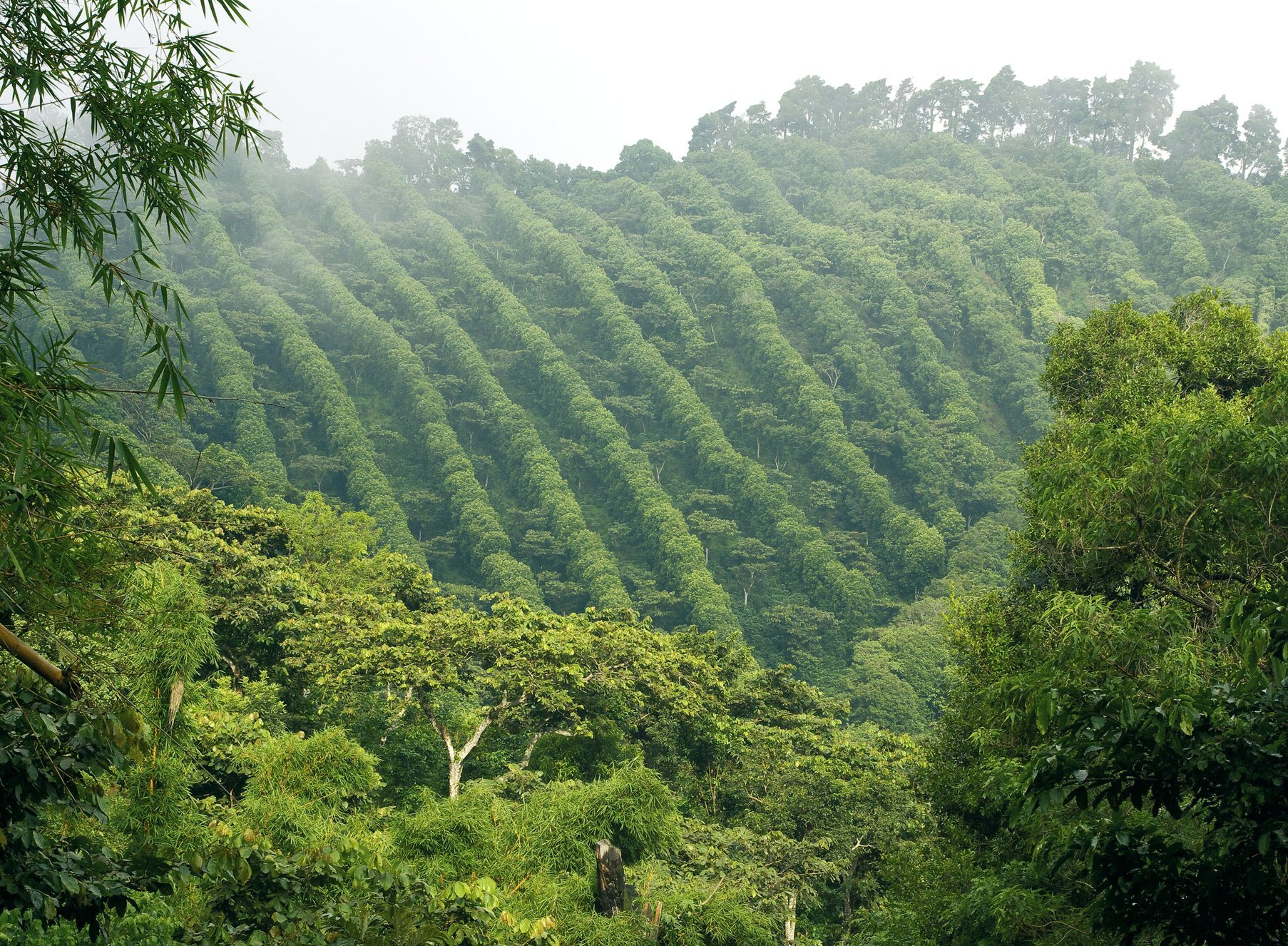
Growing up in El Salvador, I was fortunate to spend time in rural areas and by the ocean, finding meaning and solace through my connections with my environment and the natural world. Through my work, I have been able to get to know farmers and colleagues across Latin America, developing a deeper connection with the region and its ecology. I have spent a considerable amount of time with coffee-farming families and the landscapes that they manage. Most of them live in situations of material poverty, facing seasonal hunger and a general lack of basic infrastructure. Yet these same people have always been deeply generous with their time and knowledge, warmly welcoming me into their communities without expectations. Within these farming communities and landscapes, I have found a sense of peace and human connection, admiring how much importance is still placed on living harmoniously with nature and incorporating Indigenous traditions. In retrospect, my experiences with campesinos (Sp.: country people) and Indigenous farmers resonate with Thay’s teachings on “interbeing” and ancestral “continuation.” These communities view themselves as intrinsically tied to the land, the plants, and the landscapes where they live. They also continue to hold a connection and reverence to their ancestors and cultures. Although facing external pressure to change their agricultural and cultural practices, most of these farmers strive to maintain a livelihood that is in harmony with the earth and one another. Similar to Thay, who maintained a deep connection with his homeland of Vietnam even throughout his exile, I hold a glimmer of hope that one day I will be able to once again live and work within these coffee lands.
Embracing the Buddhist path through the Plum Village tradition has been deeply transformative for my personal and professional life. Practicing meditation, reading, and studying the teachings of the Buddha, as well as joining a sangha, have provided a way for me to better understand myself and others. It also helps me to look at my past a bit differently. Back in 2021, instead of bringing compassion to my own and others’ suffering, I was judging myself and being angry at my colleagues. I have come to better understand the suffering we were all feeling, and to let go of judging it. Until then, I had never engaged with a deeper spiritual dimension. My active intellectual engagement was frequently at odds with mindfulness and spirituality. Thankfully, my work with farmers, agriculture, and nature sparked a spiritual curiosity within me, which I could revisit periodically, especially when purely intellectual explanations failed to express the greater nuances of the problems at hand.
Engaged Buddhism in Agroecology and Food Systems Work
Food is a vital part of humanity’s survival and flourishing. Ensuring healthy, nourishing, and culturally appropriate food for present and future generations requires that we transform our current systems to ones that are equitable and sustainable for both people and Mother Earth. This aspiration is complex and I believe requires both individuals and collectives to engage in an inner transformation, so as to achieve broader impact. Similarly to how farmers embrace their strong interdependence with the earth, food systems movements will benefit from supporting deeper relationships with ourselves, our colleagues, and nature.
Agroecology is a field that emerged from Indigenous roots to seek alternatives to industrialized farm and food systems. I have found important resonances between my participatory agroecology scholarship and engaged Buddhism, but there is ample room for a deeper connection. For example, many in our institute use a Participatory Action Research (PAR) approach, which can be understood as doing research with people, for people. This approach requires researchers to be humble, and to be able to engage in deep and mindful listening, to fully understand the issues that people and places are facing. PAR seeks for research to inform concrete actions of benefit to people. Once we have reached a better understanding of the issues with those that are experiencing them, we can work together to take action. This echoes a well-known line by Thay, which I wrote on my office whiteboard: “Once there is seeing, there must be acting. Otherwise what is the use of seeing?” (Peace Is Every Step, 1992). I find a deep resonance between this phrase and my own research, which uses the tools of Buddhism to better understand reality but also wants to use this understanding to take action.
As agroecology has sought to be more holistic and transformative, it has also become more complex. This requires agroecologists to engage with concepts and actions that can be very personally challenging. Without a strong emotional or spiritual foundation, these issues can be hard to address. Although my community of practice sought to reckon with ideas of racial and social justice, it was not easy to put those notions into practice through a purely intellectual perspective. This work requires self-reflection and contemplation on how our backgrounds and lived experiences affect our current actions. Many of these concerns require collective understanding and action, which, in turn, calls for a commitment to work on how best to relate to others that are different from us. It invites us to look inward and examine our ego and individualism, and how this can get in the way of our aspirations for justice. And, taking inspiration from Thay, we are reminded that it is just as important to do this work with kindness and compassion for ourselves and for others. Unfortunately, I have repeatedly seen people be shamed about their ignorance or inaction on justice issues, something that led them to further retreat from the work, instead of engaging with it.
Cultivating Inner and Outer Transformation in Agroecology and Food Systems
Since I started walking the Buddhist path, I have aspired to bring the teachings to my work. This has only become more relevant as we increase our understanding of the complexity involved in transforming our current food systems into ones that are socially just and ecologically sound. By challenging those who work in food systems to focus on their inner dimensions, we can better engage in collective efforts for broader transformation. Embodying the practice involves opening up to an inner dialogue, as well as informing our immediate communities and broader systems on the importance of consciousness as a vital element to food systems transformation. The efforts that I am currently involved in include deepening my individual mindfulness practice, developing an emerging program on “Consciousness for Transformative Agroecology,”and collaborating with organizations that have a broader reach, including the United Nations Development Program’s Conscious Food Systems Alliance and the Garrison Institute’s Pathways to Planetary Health program. Last year, I also participated in a panel during the United Nations’ Food and Agriculture Organization’s Science and Innovation week in Rome, titled “Inner Capacities, Outer Impact: A Conscious Food Experience.” Starting with an eating meditation exercise, the panelists then shared their diverse experiences of practicing consciousness for food systems work in organizations across the US, Africa, and India. At home, within the Institute for Agroecology, we began starting our meetings with grounding practices and have conducted sessions on deep listening and compassionate speech, as well as on practicing humility.
By challenging those who work in food systems to focus on their inner dimensions, we can better engage in collective efforts for broader transformation.
The current opportunity for incorporating engaged Buddhism, and other consciousness approaches, into our food systems transformations is essential to ensure the health and flourishing of Mother Earth and its people. Although not without its challenges, a deeper weaving of consciousness and spirituality into our transformative agroecology efforts might just be the necessary ingredient that has been missing all along.
















![How Are Enterprise SEO Pros Measuring AI Overviews & LLMs? [Webinar] via @sejournal, @lorenbaker](https://cdn.searchenginejournal.com/wp-content/uploads/2026/09/ai-search-measurement-webinar-stat.png)