Renault Advertisement Campaigns & Strategy: An Automotive Brand Built Around Cars & Culture
No doubt, Renault’s advertisement is memorable enough to survive long after the media spend ends. Few automotive brands have moved as comfortably between product advertising and popular culture. Renault has sold compact hatchbacks through fictional French families, turned a...
 JimMin
No doubt, Renault’s advertisement is memorable enough to survive long after the media spend ends.
Few automotive brands have moved as comfortably between product advertising and popular culture. Renault has sold compact hatchbacks through fictional French families, turned a footballer’s charisma into a phrase associated with the Clio, made the rear design of the Mégane the centre of an entire creative idea, positioned the Duster around adventure and community, and built decades of Scénic communication around family life.
That history matters, but Renault marketing today is also changing greatly. Its current corporate direction puts product desirability, technology and customer experience much closer together. Under the Group’s 2026 futuREady strategy, Renault Group says it wants to become the European automotive reference with global reach. The plan is organised around growth, technology, operational excellence and trust, with product and customer experience central to the growth agenda.
With the Renaulution plan, Renault Group has built a clear and complementary brand portfolio and delivered a major product offensive across its brands, with 32 launches in five years, attracting new customers. The Group has accelerated its shift toward hybrid and electric technologies, successfully advancing the energy transition in Europe. The Group shifted from a volume-driven approach to a value-driven strategy, clearly setting itself apart from its European competitors. Since 2021, Renault Group has achieved a healthier and more disciplined go-to-market approach.
The scale behind that ambition is substantial. Renault Group reported €57.9 billion in revenue and 2.3 million vehicles sold in 2025. The futuREady plan we mentioned above calls for 36 new models by 2030, while its mid-term financial outlook targets a 5%–7% operating margin and automotive free cash flow of at least €1.5 billion per year on average.
Those numbers tell marketers something important. A modern Renault advertisement has to make a large and changing portfolio understandable, desirable and culturally relevant while supporting electrification, international expansion and longer customer relationships.
That is where this analysis begins.
What’s Inside: Secrets of Renault Marketing Campaigns
Renault Marketing Strategy: From Selling Cars to Building Distinct Brand Experiences Renault Social Media Strategy What Defines Renault Advertising Strategy? Renault’s 4Ps: Understanding the Marketing Mix Renault Uses Renault Advertising Campaigns Renault Clio — Papa & Nicole (1991) Renault Clio — Va Va Voom with Thierry Henry (2002) Renault Mégane — I See You Baby (2003) Renault Scénic — Loving Families for 25 Years (2021) Renault Mégane E-Tech Electric — From Horsepower to Electric Power (2022) Renault 5 Turbo 3E — More Electric and Powerful Than Ever (2025) Renault Clio Marketing: Making a Small Car Culturally Large Renault Mégane Marketing: Design Becomes Transformation Renault Duster Marketing: Adventure Needs Proof Renault Scénic Marketing: Owning the Family Territory Through Change What Brands and Agencies Can Learn From Renault Advertisement Strategy FAQ About Renault Marketing CampaignsRenault Marketing Strategy: From Selling Cars to Building Distinct Brand Experiences
Renault marketing works across several layers.
At the broadest level, the company needs a recognizable Renault brand. Underneath that sits model-level positioning: Clio cannot communicate exactly like Duster, just as Scénic cannot communicate exactly like Mégane.
A Renault car advertisement usually works hardest when it finds a human interpretation of a product characteristic. Like:
Clio becomes youth, style, freedom and French personality. Mégane can become design and technological change. Duster becomes exploration and capability. Scénic becomes family life.This sounds simple. In automotive marketing campaigns, it is anything but. Specifications are easy to put in a media plan; distinctive meaning is harder. So, Renault’s strongest campaigns find a creative territory that people can remember without needing to remember an equipment list.
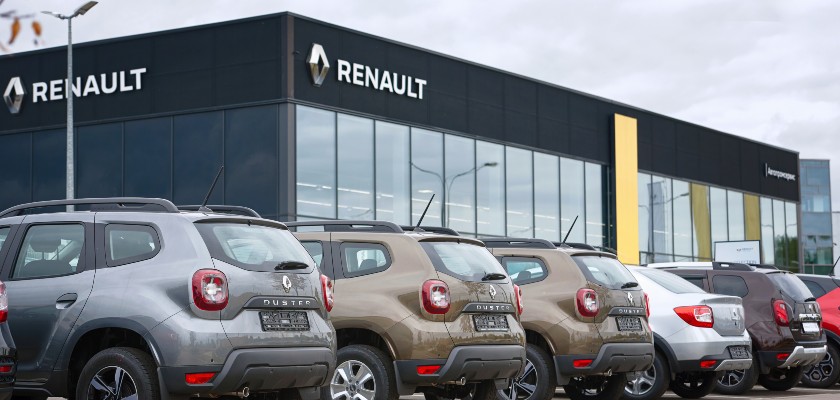
Renault is taking marketing well beyond ads and social feeds by treating the physical dealership floor as a core brand touchpoint. Much like how premium manufacturers like Mercedes strictly control their showroom atmosphere, Renault’s 2025 multi-brand site guide focuses on clear customer paths and distinct brand spaces. Even inside shared retail environments, the setup ensures the Renault experience stays sharply defined, easy to navigate, and true to the brand.
As part of its marketing plan, the brand takes the customer experience further. Renault Group has more than 9,000 distribution sites worldwide, and the company wants to extend customer relationships across a roughly 10-year vehicle lifecycle while reducing total distribution costs by at least 20%.
And advertising gets the customer interested. The broader Renault marketing system has to carry that interest through exploration, purchase, ownership, service, resale and potentially the next vehicle. That is a much bigger job than producing a memorable television commercial.
Renault’s social media strategy goes way beyond reaching eyes; it actually bridges the gap between big-budget advertising and everyday customer conversations. Buying a car takes time:
Someone sees a flashy ad 👉🏻 watches a walkthrough video 👉🏻 compares specs, scrolls through owner comments 👉🏻 eventually books a test drive.
Renault’s social content connects all those scattered moments. A 30-second TV spot can only sell one big idea, but social channels let you unpack the story; using short clips, design details, and behind-the-scenes content to turn quick interest into real desire. Let’s be more specific:
Cars are visual products, but buyers need practical details. Not by just reposting TV commercials in vertical formats, Renault uses social media as a layered showroom with the following:
Cinematic films that capture quick attention. Short vertical clips that highlight specific design moments. Walkaround videos that show how cabin tech works in daily life. Creator content that adds honest, human credibility.What’s more, Renault uses influencer and creator partnerships to show how vehicles fit into daily routines, from family trips to rapid-charging stops. Creator selection is tied directly to the vehicle’s specific job. A performance model pairs with driving and engineering channels, while a family EV relies on practical lifestyle creators. For automotive marketing agencies managing these accounts, creator strategy starts with the vehicle proposition rather than follower counts alone.
What Defines Renault Advertising Strategy?
Looking across Renault’s historical and current work, several characteristics emerge.
First, Renault repeatedly gives individual models distinctive personalities. The company does not depend solely on a master-brand message and paste it onto every vehicle.
Emotion usually lands way before engineering. Just like Volkswagen marketing‘s habit of putting human moments ahead of technical specs, Renault frames vehicle features through stories people get instantly, keeping the car at the center without reading like an owner’s manual.
Third, music is often structural, not decorative. The Mégane’s rear-end campaign, the Scénic’s family storytelling and newer electrification campaigns all show how music can become part of the memory architecture of a Renault advertising campaign.
Fourth, Renault has repeatedly used French identity without trapping itself inside France. In UK advertising especially, Frenchness has been converted into humour, style, romance and cultural contrast.
Fifth, the strategy increasingly links emotional advertising with digital targeting and customer data. Promotion across television, radio, print, social platforms and websites, with digital campaigns targeting audiences through interests, behaviours and online activity.
This combination matters since Renault’s strongest historical assets were built in mass media. Its current marketing environment demands that those assets also work across social, video, CRM, dealerships, apps and digital commerce.
Renault’s 4Ps: Understanding the Marketing Mix Renault Uses
Product
A broad portfolio spanning compact cars, SUVs, crossovers, hybrid and electric vehicles, with model-specific identities
Advertising can address very different consumer needs without asking one model to represent everybody
Price
Competitive positioning, finance, incentives and market-specific offers support accessibility
Price communication can convert brand interest into immediate purchase consideration
Place
Dealerships, service centres, digital platforms and increasingly connected customer journeys create multiple points of access
Distribution becomes part of the customer experience, not just logistics
Promotion
TV, online video, social media, PR, experiential work, sponsorship, CRM and sales promotions can be combined
Renault can balance long-term brand building with short-term demand creation
The product element is particularly important.
Renault’s product strategy gives marketing teams clear territories to work with. For example, compact cars can appeal to urban drivers and young professionals, SUVs and crossovers can appeal to families and people seeking space and versatility, and hybrid or electric models can appeal to consumers interested in technology and environmental impact.
Price then makes that positioning commercially actionable. This is classic lower-funnel automotive marketing: product desirability creates interest; finance reduces a purchase barrier.
The place is equally strategic. Renault Group’s implementation guide argues for readable customer journeys and clear individual brand identities across multi-brand sites. Digital channels add another layer, allowing consumers to research vehicles before entering a dealership.
Promotion ties the system together.
So, we can say that a brilliant Renault advertisement is only one part of the marketing mix. Creative communications perform better when the product proposition, price architecture and customer journey support the promise being advertised.
Renault Advertising Campaigns
Before listing the campaigns, let’s make something clear: this isn’t just a roundup of Renault ads that went viral. We filtered these campaigns through four specific lenses:
cultural memory, strategic value, strong positioning, proven longevity.The result is a blend of vintage and modern work. Some campaigns defined pop culture; others show how product design can directly drive creative execution. The Duster shows how to turn a local market opportunity into a thriving community, while the Scénic highlights the long-term payoff of sticking to a clear emotional theme. Every case study brings a different lesson to the table.
Renault Clio — Papa & Nicole (1991)
We are starting with a legend!
The Papa & Nicole Renault Clio advertising campaign is actually serialized lifestyle storytelling focusing on a father and daughter, French scenery, humour, independence, and the recurring exchange between its two central characters.
The campaign presents the Clio through a highly romanticized British view of French life. Instead of spending most of the commercial explaining horsepower, boot capacity, or fuel consumption, the car becomes part of Nicole’s freedom and personality. So, the advertising gives the Clio a world that audiences want to enter.
Renault itself describes Papa & Nicole as an immensely successful, long-running part of Clio’s advertising history. The company says Clio has sold more than 16 million units since 1990, illustrating the enormous scale of the model behind these campaigns.
Clio’s 33-year-young advertising saga is as remarkable as the car itself – which is France’s best-selling model (at 16 million units and counting), “has got everything of a great car” in a very real sense, and has inspired myriad adverts and slogans since 1990.
Why it worked
It built recognizable characters and allowed them to develop over time. Repetition created familiarity without requiring identical stories. The campaign also gave British audiences an accessible shorthand for French charm. According to reporting on the campaign’s later revival, the original work helped Renault sell around 300,000 Clios over seven years. The final wedding instalment reportedly attracted 23 million viewers, showing how far a car campaign had crossed into entertainment culture.Renault Clio — Va Va Voom with Thierry Henry (2002)
This is a different advertising mechanism from Papa & Nicole.
Papa & Nicole builds a fictional universe. Va Va Voom builds a linguistic asset.
This is personality-led brand communication designed to associate the Clio with charisma, energy, desirability and a distinctly French sense of cool. Thierry Henry became central to that communication in the UK, helping Renault move the Clio’s image toward a broader audience.
Once a phrase becomes strongly connected to a brand, every repetition can reactivate previous advertising investment. Renault later extended the concept into digital activity, asking consumers and celebrities what represented “Va Va Voom.”
Why it worked
The phrase was flexible enough to live beyond one execution. Renault could attach it to celebrity, driving pleasure, style and social participation. During a later digital extension, a Facebook competition attracted more than 7,000 entries in its first month, while related YouTube content generated more than 770,000 views, according to Marketing Week.Renault Mégane — I See You Baby (2003)
The famous Renault Mégane advertisement built its creative idea around one of the car’s most distinctive physical features, that is, its rear design.
The execution connects shots of moving bodies with Groove Armada’s “I See You Baby,” using humour and visual repetition to make the Mégane’s shape impossible to miss.
It is provocative product advertising. More importantly, the provocation comes directly from the design.
Why it worked
The campaign worked because creative form and product form were tightly connected. Viewers did not need a detailed explanation of the Mégane’s styling because the entire commercial directed attention toward it. The execution became controversial: 139 viewers complained, and the UK television regulator restricted the commercial from airing before 7:30 p.m. Controversy itself should never be treated as proof of effectiveness, but the campaign demonstrated exceptional distinctiveness. “11 of the 139 complainants reported that children – between the ages of two and six – had copied either the language or the dance moves,” according to The Guardian.Renault Scénic — Loving Families for 25 Years (2021)
The Scénic 25th anniversary campaign is emotional brand storytelling centred on a very stable strategic territory, we mean, family.
The film moves through love stories and family relationships, connecting romantic, parental and familial love to the vehicle’s long history as a family car.The proposition is that Scénic belongs inside family life.
As we mentioned above, the brand launched the campaign around the model’s 25th anniversary. At that point, four generations of Scénic had sold more than 5 million vehicles.
Why it worked
It drew on positioning that Renault had earned over decades. Scénic was introduced as a pioneering compact MPV, so the family association was grounded in product history. Renault refreshed its expression with that campaign. The emotional story widened the definition of family while preserving the model’s central role. That made heritage useful instead of nostalgic for its own sake. This became even more valuable as Scénic transitioned into an electric vehicle. The current Scénic E-Tech maintains family-car positioning while adding an all-electric proposition and a WLTP range of up to 625 km.Renault Mégane E-Tech Electric — From Horsepower to Electric Power (2022)
The Mégane E-Tech campaign is cinematic transition advertising. The campaign depicts the movement from combustion-era horsepower toward electric mobility, using horses as a visual metaphor before revealing the electric Mégane.
Renault describes the Mégane E-Tech Electric as the first model of its Renaulution-era “Nouvelle Vague” and launched the campaign across 23 European countries.
Why it worked
Electric mobility can easily become technical communication about battery capacities, charging and range. The campaign gave audiences a simpler cultural transition: horsepower becomes electric power. The official Renault UK video has accumulated more than 7 million views on YouTube, providing a useful indication of the campaign’s digital reach. The broader strategic point matters too. Mégane becomes a vehicle through which Renault communicates modernization.Renault 5 Turbo 3E — More Electric and Powerful Than Ever (2025)
This is heritage-led performance advertising, but it does not treat heritage like something that belongs in a museum. Renault takes the attitude of the original Renault 5 Turbo and Turbo 2 and pushes it into electric performance.
With that campaign, this is not Renault trying to make an electric car look sensible. Quite the opposite. The communication says electric performance can still be loud in personality, dramatic in design and connected to motorsport history.
Why it worked
Renault used heritage as creative fuel; the original Turbo gave the new model credibility, while electric technology gave Renault a reason to make the story new. The launch also created genuine demand around an extremely limited product. Renault reported 500 reservations in the first three days after reservations opened earlier in 2025. The YouTube film itself also gained significant reach: Renault UK’s official upload had passed 23 million views by July 2026.Renault Clio Marketing: Making a Small Car Culturally Large
Clio deserves its own section because it demonstrates the long-term value of brand memory better than almost any Renault model.
As already mentioned above, since 1990, Clio advertising has moved through comedy, romance, celebrity, music, fashion and electrification without abandoning its personality.
Renault’s own retrospective calls out campaigns including “Papa & Nicole,” its French “everything of a great car” advertising, later cinematic storytelling and the “Oh l’Amour” work. By 2023, Renault said Clio sales had passed 16 million units globally, as we mentioned in the campaigns section.
The strategic lesson is continuity without creative stagnation. For marketers, that is a good example of separating brand code from campaign execution: The execution can change. The meaning should accumulate.
Renault Mégane Marketing: Design Becomes Transformation
Mégane shows a different trajectory.
As you may know, historically, its advertising could lean into provocative styling. Today, Mégane E-Tech has become part of Renault’s technology and electrification story. That model positioning has to evolve with the product. Take the “From Horsepower to Electric Power” campaign as an example: It uses automotive heritage as the starting point for the transition.
Legacy can become a barrier if marketing treats innovation as a rejection of the past. Renault’s Mégane communication uses history to explain the future. That makes the transition feel evolutionary even when the underlying technology changes significantly.
Renault Duster Marketing: Adventure Needs Proof
Duster’s strategic territory is more functional and rugged. That means Renault’s positioning becomes stronger when consumers can see the car travelling, exploring and participating in experiences.
The Gang of Dusters approach is useful precisely because it transforms a positioning statement into owner behaviour.
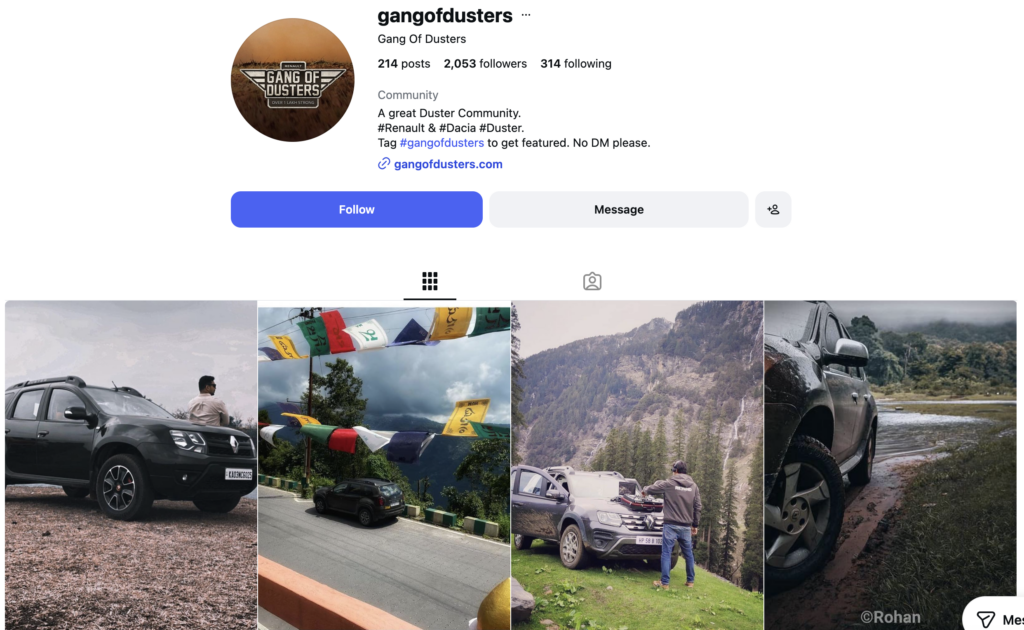
The latest generation shows how valuable that accumulated identity remains. Renault describes Duster as a symbol in India and says the nameplate has attracted almost two million customers worldwide since its global launch.
For agencies, Duster demonstrates a fundamental rule of automotive marketing: if your proposition is capability, consumers eventually expect evidence.
Experiential marketing, owner communities and credible use cases can provide that evidence.
Renault Scénic Marketing: Owning the Family Territory Through Change
Scénic presents perhaps the most interesting positioning challenge of the four models.
The traditional MPV market changed dramatically as SUVs became dominant, like the Range Rover. Renault could have abandoned Scénic’s historical identity. However, it retained the family territory while changing the product architecture.
Renault’s own history describes the original Scénic as an innovative compact family vehicle, including three independent rear seats and a cabin organised around children and parents. Today’s electric Scénic can therefore talk about range, sustainability and technology without having to invent an entirely new reason for existing.
What Brands and Agencies Can Learn From Renault Advertisement Strategy
Renault’s history offers several lessons, but one stands above the rest: distinctiveness compounds.
Papa & Nicole accumulated meaning because Renault returned to recognizable characters. Va Va Voom accumulated meaning because Renault owned a phrase. Mégane’s famous campaign focused attention on a product characteristic competitors could not credibly copy. Duster connected its adventure proposition with owner experiences. Scénic kept returning to family life as the product evolved.There is also a second lesson: heritage works best when it has a current job.
Renault revived Papa & Nicole decades after the original campaign, this time using fathers and daughters to support the electric Mégane. The nostalgia was not merely retrospective. It was used to introduce something new. Ipsos and Effie UK reported that this revival increased Renault purchase consideration by 52% in three months.That is the difference between remembering old advertising and using memory as a marketing asset.
A third lesson concerns segmentation.
Renault can use differentiated marketing to address compact-car drivers, families, SUV audiences and environmentally conscious consumers with separate propositions. For brands managing multiple product lines, this is critical: One master campaign cannot solve every positioning problem. The master brand should provide coherence. Individual products still need reasons to be chosen.FAQ About Renault Marketing Campaigns
What is Renault’s marketing strategy?
In the simplest terms, Renault marketing strategy combines product differentiation (mostly well-known models), audience segmentation, individual model positioning, digital and physical CX, finance and promotional activity. It combines differentiated targeting across demographics, lifestyles, behaviors, and locations, supported by digital channels and traditional media. For marketers & brand owners, Renault is best understood as a portfolio marketing system, where the master brand provides credibility and heritage while individual models receive distinct audience propositions.
What is Renault’s advertising strategy?
Apart from overall marketing efforts, Renault advertising strategy uses emotions and storytelling, like recognizable creative assets, music, cultural references, model-specific positioning, and increasingly integrated digital communication. Its strongest advertising converts a product truth into an easy-to-remember cultural idea. Clio represents personality and freedom; Mégane has used design and technological transition; Duster uses adventure; Scénic owns family mobility. The company also uses both broad brand communication and targeted model campaigns, allowing Renault to build awareness while addressing specific customer segments.
What are the most successful Renault advertising campaigns?
Among Renault’s most important campaigns are Papa & Nicole and Va Va Voom for Clio, the “I See You Baby” work for Mégane, Duster’s launch and adventure positioning in India, and Scénic’s long-running family communication. Success takes different forms. Papa & Nicole became part of British popular culture and reportedly helped sell around 300,000 Clios across seven years. Duster helped establish a compact-SUV segment in India and has exceeded 200,000 Indian sales, according to Renault.
How does Renault’s marketing mix support its global brand strategy?
Renault’s marketing mix supports its global brand strategy by keeping the brand recognisable while adapting to local markets. Its models target different needs, pricing and finance reflect local buying habits, dealerships and digital channels shape the customer experience, and campaigns are tailored to local audiences. This helps Renault operate as one global brand without communicating the same way in every country.
How does Renault market models such as the Clio, Megane, Duster, and Scenic?
Renault gives these models different emotional and functional territories. Clio marketing emphasizes style, personality, youth and accessible desirability. Mégane communication has moved from distinctive design toward technology and electrification. Duster focuses on SUV capability, adventure and freedom. Scénic centers on family life, space and, increasingly, electric family mobility. With that approach, the brannd can operate a broad portfolio without making every Renault car advertisement feel identical.
How does Renault adapt its advertising campaigns for different car models and target audiences?
Renault starts with the role of the model and then connects it to a relevant audience need. Compact models can target urban drivers and young professionals, SUVs can address families and adventure-oriented customers, and electrified vehicles can focus on environmentally conscious and technology-oriented audiences. Geography adds another layer. Renault can alter pricing, media, financing, cultural references and dealership activity according to local conditions while retaining recognizable model positioning.









![How to Create a Social Media Report in 7 Simple Steps [+ Free Templates]](https://www.hubspot.com/hubfs/social-media-report-1-20240724-2630720-1.webp)
![Marketing Budget: How Much Should Your Team Spend in 2025? [By Industry]](https://www.hubspot.com/hubfs/how%20to%20spend%20your%20marketing%20budget_featured.webp)
_1.png)












.jpg&h=630&w=1200&q=100&v=c0f97a310e&c=1)