Physician, Heal Thyself
How two Zen monks are bringing the dharma into a medicine system in crisis—and why it may be exactly what the doctor ordered The post Physician, Heal Thyself appeared first on Tricycle: The Buddhist Review.
 ValVades
“The truth of suffering is to be compared with a disease, the truth of the origin of suffering with the cause of the disease, the truth of cessation with the cure of the disease, the truth of the path with the medicine.”
—Buddhaghosa, Visuddhimagga XVI (trans. Bhikkhu Nanamoli)
For more than two millennia, the Buddha has been called the great physician, the four noble truths his diagnosis and cure. There is an old Buddhist proverb that says that the study of the dharma without its practice is like a person who reads a prescription for medicine but never takes the drug. The metaphor of medicine runs deep in Buddhist culture.
Can the dharma work, then, as medicine for actual doctors—as healing for our healers?
The Crisis
The American health care system is living through what the U.S. Surgeon General has called a workforce crisis of historic proportions. The root causes are well-documented: crushing workloads, electronic health record fatigue, inadequate staffing ratios, and the particular anguish of “moral injury”—the psychological damage caused by bearing witness to suffering while feeling powerless to act on one’s deepest ethical commitments. Also at play is a professional culture that has historically discouraged health care workers from acknowledging their own suffering. Yet exhausted physicians are approximately twice as likely to be involved in patient safety incidents, with personal consequences including increased risk of suicide, problematic alcohol use, and leaving the profession entirely.
Proposed solutions include administrative reform, staffing legislation, wellness apps, resilience seminars, and more. A recent meta-analysis, however, found no significant improvements from existing interventions in real-world clinical practice and called for a more nuanced understanding of what effective treatment actually requires. A growing body of research suggests the ancient contemplative traditions of the dharma have something to offer.
What the Research Shows
Cognitively-Based Compassion Training, developed at Emory University and rooted in the lojong, or mind-training, tradition of Tibetan Buddhism, has been linked to lower stress hormones, stronger immune response, decreased rumination, and activation of the brain’s pleasure circuits. Broader mindfulness-based approaches descended from Buddhist practice also show consistent results: Meta-analyses of mindfulness-based interventions for health care professionals find small but statistically significant reductions in physician burnout and stress. This research has largely unfolded under the banner of secular wellness. Jon Kabat-Zinn’s Mindfulness-Based Stress Reduction program—the most widely studied of all these approaches—was deliberately designed to be doctrinally neutral, its Buddhist origins carefully backgrounded. The fellowship founded by two Zen monks in 2021, however, hasn’t shied away from its foundations.
The Fellowship
“May I be the medicine and the physician for the sick. May I be their nurse until their illness never recurs.”
—Shantideva, Bodhicharyavatara, ch. 3
Koshin Paley Ellison and Chodo Robert Campbell are the cofounders of the New York Zen Center for Contemplative Care. Since 2021, their Contemplative Medicine Fellowship has been training physicians, nurse practitioners, physician assistants, and other health care professionals like midwives. The fellowship runs for twelve months and fosters a genuine community, built around primary texts, guided practice, and sustained inquiry. There are two in-person retreats: an opening retreat at the Garrison Institute in New York, and a closing graduation retreat. Between monthly sessions, fellows work through a library of recorded teachings on the four noble truths and the eightfold path. There are readings, small group work with a physician mentor and staff facilitator, as well as individual practice discussions with Koshin and Chodo. Twice a month, thought leaders join the fellows, and the year culminates in a capstone integration project, where participants work to integrate and apply the knowledge, skills, and experiences gained throughout the program to solve a real-world problem.
The range of those capstone projects reveals the fellowship’s wide array of ambitions. One physician from rural Tennessee transformed his medical practice office into a space where patients and staff could gather weekly to contemplate poetry. A nurse practitioner built her capstone around biometric wearables for self-regulation, like external mindfulness supports, establishing what she called a zendo within her medical school: clinicians meditating together tracking how the practice changed their physiological data. A physician in San Antonio photographed patients holding each other’s hands—her project a meditation on the loss of touch in modern medicine.
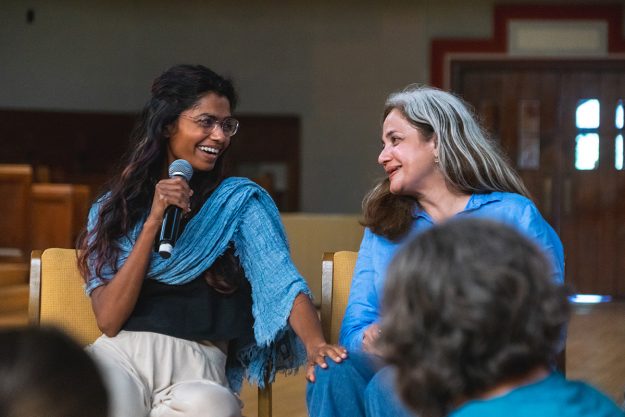 The 2024 Contemplative Medicine Fellowship’s closing retreat at the Garrison Institute, Garrison, NY. | Images courtesy Mahyar Hassid.
“Two-thirds of the curriculum is intrapersonal and interpersonal,” Chodo explains. “Only one-third is clinical. The practice—the inner work—is the biggest part. We’re not just teaching people techniques for the hospital. We’re teaching them how to actually inhabit their own lives.”
The program’s founding impulse goes back more than two decades, to a physician named Russell Portenoy, who saw something in the way the two monks moved through the world—literally, how they walked down a hospital hallway—and said: That is what I want my team to learn. Over the following years they taught in medical schools in Japan, England, and Amsterdam, everywhere hearing the same report: Physicians and clinicians were burning out, leaving medicine, or dying by suicide at alarming rates.
When Covid struck, they responded. “We realized that was our moment,” Koshin recalls. “We need to put a stake in the ground and offer something meaningful—grounded in Buddhism and Zen—and really bring it out into the world.”
The Evidence
For all its countercultural texture—Zen monks, dharma talks, meditation retreats—the Contemplative Medicine Fellowship has been subjected to rigorous empirical scrutiny. The first peer-reviewed study, published in the journal Explore in 2024, examined the inaugural 2021–2022 cohort using the Maslach Burnout Inventory (MBI), a widely used measure. Before the fellowship, participants showed emotional exhaustion scores significantly higher than a normative population of over 6,000 medical personnel. After completing the year, all three MBI subscales showed statistically significant improvement: Emotional exhaustion fell, and personal accomplishment—the sense of meaning and efficacy in one’s work—increased significantly. Post-fellowship, participants’ emotional exhaustion scores had returned to the level of the normative group. The study was recognized with a 2024 CommonSpirit Health Physician Enterprise Academic Excellence Award and was subsequently featured in Mayo Clinic Proceedings.
“We’re not just teaching people techniques for the hospital. We’re teaching them how to actually inhabit their own lives.”
A second, expanded study—published in Explore in 2025—followed the 2023–2024 cohort using three measures: the Maslach Burnout Inventory, the electronic Physician Well-Being Index (ePWBI), and the Dispositional Positive Emotional Scale for Compassion (DPES-Compassion). The results showed that emotional exhaustion dropped. Participants entered the fellowship with above-average distress scores, and by the end of the year, their scores had declined to align with the national average. Work-life integration, assessed as a standalone measure, improved significantly. Perhaps most striking were the compassion findings. The DPES-Compassion scale—which measures a clinician’s felt capacity to notice and respond to others’ suffering—increased significantly across the cohort. Afterward, 92.5 percent reported the fellowship had been valuable for their professional development, 96.3 percent reported a meaningful sense of community, and more than half rated the fellowship a perfect 10 out of 10 on likelihood to recommend.
The largest single shift across all measured items was on the question of whether participants could practice medicine in a way consistent with their personal values. This is precisely the terrain of moral injury. The fellowship did not change the health care system. What it changed was each clinician’s capacity to inhabit that system without losing themselves in it.
Across all three cohorts studied—eighty-three clinicians in total—the pattern has held. Emotional exhaustion decreased in every cohort. Depersonalization decreased in every cohort. The consistency of effect across different practitioners, specialties, and years suggests something more than cohort-level noise.
The Surgeon and the Midwife
Andrew Grose has been an orthopedic trauma surgeon for twenty years. He is, by most measures, exactly the kind of high-functioning, high-producing physician the medical system is designed to valorize.
“I was looking for a way to deepen my spiritual practice within my medical practice,” he says, “not have them disjointed and separate. I am happiest when everything is part of a spiritual practice. And since getting out of training, so much of medicine has been trying to unpack the bad habits I acquired in training, and get back to: Who am I, and what is the impulse to do this work for and with people?”
What he did not anticipate was finding, within a cohort of physicians and advanced practice nurses, a mirror for his own interior experience. “I was surprised within the cohort that we all seemed to be struggling with the same things.” A WhatsApp group from his cohort is still active. People post when there’s a problem, or a joy. Ninety-six percent of all fellowship participants reported a meaningful sense of community as an outcome of the year.
“What makes medicine so hard is that it’s cognitively demanding under time pressure, production pressure, [it entails a] high cognitive load. It’s very hard to care for the people around you outside of the patient, or even to care for myself.” The fellowship gave him language and practice for the impossible double bind at the heart of his work: responsibility without the conditions to fulfill it. “Those moments are the hardest. And the answer—drop by drop, day by day, in Koshin’s words—is just [to] keep meeting the present moment just as it is. Just keeping doing this.”
Lena Soo Hee Wood is a certified nurse-midwife and mindfulness practitioner working as a laborist for several practices in Portland and Silverton, Oregon, and a Zen student at Dharma Rain Zen Center, a community with a longstanding tradition of equal value for lay and monastic practice. Wood says among the things she valued is “the ability of the teachers and fellows to acknowledge burnout as a foundational reality, to say: Yes, we know this is the water you’re swimming in, and we’re here to explore how contemplative practice can help you remain rooted in what’s important.”
What stayed with her is “the teaching of being in the moment—truly being in the moment, being with the person in front of you, being with your patient, being with your colleague. Throughout the fellowship, I think they very skillfully built in different experiences in a really intentional way, to help us slowly walk our way a little deeper each month into what it actually means to live in the moment—even when it’s painful, even when it hurts, even when it asks you to sit with incredible suffering.”
“That’s something we see every day in our work. It’s not going to go away. The systemic issues aren’t going to go away just because I did a yearlong fellowship. I didn’t come out with some magic toolbox. But that groundedness—the ability to be present, and to trust that the practice is there—that’s what I really got.”
“Attending physicians are called attending because that’s what they do—they attend to their patients,” says Wood. “But I always thought the phrase ‘paying attention’ [wasn’t] quite right. We’re really gifting our attention. And by practicing mindfulness on our own, we’re strengthening that capacity to gift our attention to the people in our care.”
The Mud and the Gold
“One thing I found is how deeply the four noble truths impacted the fellows,” Chodo says. “We frame the curriculum around: In life there is suffering; here are its causes; there is a cessation; here is a path. And they really take that on. They work from that ground in their actual clinical practice.” The research supports this intuition: The item showing the largest shift in the 2025 study was values-aligned clinical practice—which is precisely what the eightfold path is for.
“What struck me—even with the superstar surgeons, the ones with enormous personalities—when you get them in here, you watch the mud fall away. Like a golden Buddha statue that’s been buried in the river, and someone finally cracks the mud it’s hidden underneath. That’s what happens in a dokusan, in a deep retreat. Underneath all that armor, there’s this incredible human being.”
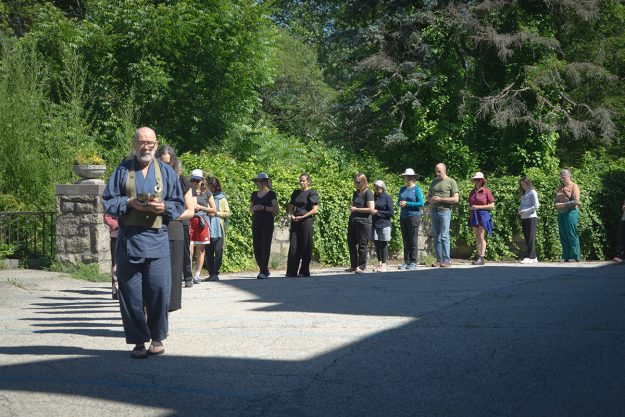 The 2024 Contemplative Medicine Fellowship’s closing retreat at the Garrison Institute, Garrison, NY. | Images courtesy Mahyar Hassid.
Koshin traces the fellowship’s deepest roots to that first conversation with Russell Portenoy, when the physician told them: “One day, you should really do it. Really offer Buddhist medicine—for overwhelm, anxiety, fear, all of it.”
“It’s so sweet to think: Russ, we finally did it,” Koshin says. “Zen has become more mainstream. And so it’s beautiful to be completely out in the open—straight-up dharma, in a medical fellowship, with physicians and nurse practitioners and physician assistants reading primary texts as curriculum, with us helping them understand it as medicine and to experience it.”
“Chodo and I, as monks, made a vow to put our lives on the altar,” Koshin says. “To be able to do this offering feels like it reaffirms that vow.”