PPC / SEM Tips for Franchises: A Guide for Google Ads
Key Takeaways If you’re running a franchise, keeping your brand consistent while still letting each location shine is the lifeblood of your business. That’s where franchise pay-per-click (PPC) advertising can help. With PPC advertising, you can drive targeted traffic, generate leads,...
 Kass
Kass
Key Takeaways
Franchise PPC campaigns must balance brand consistency with local customization to maximize ROI. Geo-targeting improves conversion rates by refining ad reach at the city, state, or neighborhood level, reducing wasted spend. A strong keyword strategy combines branded terms for brand protection and non-branded terms for customer acquisition. Budgeting and bidding strategies impact cost efficiency, whether corporate manages the budget, franchisees control their own spend, or both share responsibility. Tracking key metrics like click-through rate (CTR), conversion rates, and return on ad spend (ROAS) helps refine campaigns and increase returns. AI-powered campaign types like Performance Max and AI Max for Search now drive franchise PPC performance, including placement inside AI Overviews, so campaign structure and ad copy quality matter more than ever.If you’re running a franchise, keeping your brand consistent while still letting each location shine is the lifeblood of your business. That’s where franchise pay-per-click (PPC) advertising can help.
With PPC advertising, you can drive targeted traffic, generate leads, and increase visibility at national and local levels. It’s also a tried-and-true strategy, even as Google Ads becomes more AI-driven. Recent changes like the rollout of AI Max for Search campaigns, the planned upgrade of Dynamic Search Ads (DSA) into AI Max, and the phaseout of Enhanced cost-per-click (CPC) are giving marketers new opportunities, but also creating some uncertainty around control, campaign structure, and optimization. PPC can still get entrepreneurs to where they want to go, but unlike single-location businesses, franchises face unique hurdles.
Who controls the budget—corporate or franchisees? How do you maintain a unified brand voice while personalizing ads for different locations? And how do you prevent franchisees from competing against each other for the same keywords?
The key to franchise PPC is strategy. I’ve worked with franchise brands running anywhere from 10 locations to more than a thousand, and the ones that win at PPC all have a clear system for who runs what. Whether you’re managing campaigns at the corporate level, giving franchisees control, or using a hybrid model, the goal is to maximize ROI without wasting ad spend.
This guide breaks down everything—from keyword research and geo-targeting to budget allocation and tracking success—so your franchise can dominate paid search.
Understanding the Franchise PPC Model
Franchise PPC campaigns can be structured in three ways: corporate-managed, franchisee-managed, or hybrid. Each has its strengths and drawbacks. Choosing the right one depends on your brand goals and market dynamics.
Corporate-Run PPC Campaigns
When the corporate office manages paid search for franchises, the focus is on brand consistency and centralized control. Ads are uniform, budgets are allocated from the top, and campaigns are optimized at scale. This is great for brand protection and cost efficiency, but it can limit franchisees’ ability to target local customers effectively.
Franchisee-Managed PPC Campaigns
This model allows individual franchisees to run their own PPC campaigns, giving them full control. While this improves local relevance, it can lead to inconsistencies in brand messaging and even keyword competition between franchise locations, driving up costs unnecessarily.
Hybrid Model
The hybrid model is often the best approach. The brand’s corporate office provides creative guidelines and high-level oversight, while franchisees have control over local targeting and budget allocation. This keeps brand messaging consistent while giving franchisees room for local customization, maximizing reach and conversions.
No matter which model you choose, effective PPC management for franchises requires maintaining a consistent brand experience while allowing room for local customization. A scattered franchise PPC strategy weakens performance, but a structured, well-coordinated approach can deliver strong, measurable results.
Keyword Research for Franchise PPC
PPC success starts with choosing the right keywords. For franchise paid search, this means striking a balance between national reach and local relevance. You need to target high-intent keywords that attract both broad and location-specific searches.
Branded vs. Non-Branded Keywords
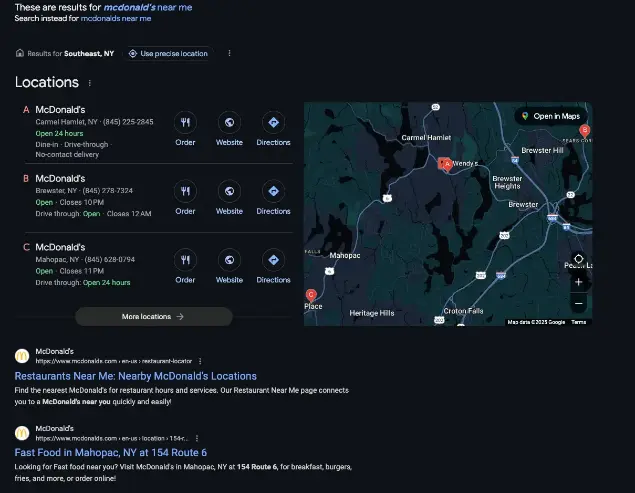
Branded keywords (e.g., “Subway near me,” “McDonald’s delivery”) are essential for protecting brand visibility and driving customers already looking for your franchise. These should be managed by corporate to prevent franchisees from bidding against each other, thereby unnecessarily increasing costs. They are also essential for competitor defense and general brand visibility at the national/corporate level.
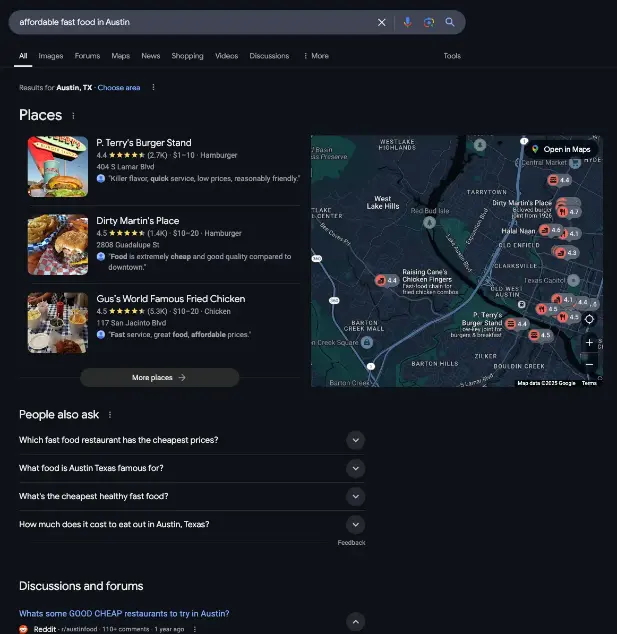
Non-branded keywords (e.g., “best sandwich shop in New York,” “affordable fast food in Austin”) help capture new customers who aren’t searching for a specific franchise. These are great for local franchisees to target because they drive discovery and increase conversion rates.
Competitor Bidding Strategy
Another strategy is bidding on competitor names. If someone searches for a rival franchise, your ad can appear alongside it. This can work well but must be done carefully. Some brands have strict policies against it, and any bidding here will incur an expensive CPC penalty for targeting their brand terms. A less risky tactic would be to bid for your competitor’s keywords.
Automating Keyword Optimization
Managing franchise PPC keywords at scale can be time-consuming. Tools like smart bidding in the Google Ads platform help optimize bids, adjust keyword strategies, and reduce manual effort while keeping campaigns competitive.
Google’s AI Max is also a great tool for automating your keyword strategy. The platform offers keywordless targeting, which automatically matches your ads to relevant searches without manual keyword lists. For franchise campaigns, AI Max can expand reach efficiently, but it needs strong negative keyword lists and tight geographic controls to prevent ads from serving outside location boundaries or on irrelevant queries.
Structuring PPC Campaigns for Multi-Location Franchises
A well-structured franchise PPC campaign does more than allocate budget. It organizes ad groups, targeting settings, and landing pages to optimize performance across locations. Even within a corporate-run, franchisee-managed, or hybrid model, campaign structure determines how efficiently ads are served, how budgets are spent, and how local audiences are reached.
Here are the best approaches to structuring franchise PPC campaigns:
1. Account-Level Structuring
Franchise PPC accounts can be structured in one consolidated account managed by corporate or in separate accounts for each location:
Single corporate-managed account: This keeps control centralized and simplifies brand consistency, but can make local customization harder. Individual franchisee accounts: These allow each location to tailor targeting, but can cause inconsistencies if not monitored closely. Hybrid approach: A corporate account oversees strategy while franchisees manage localized campaigns within sub-accounts.2. Campaign-Level Structuring
Inside each account, campaigns should have one of the following structures to avoid overlap and increase relevance:
Location-Based Campaigns: Each franchise location gets a dedicated campaign, making it easier to customize keywords, ads, and bids based on regional search trends. Service-Based Campaigns: Useful for franchises that offer multiple services (e.g., cleaning, landscaping, tutoring). This ensures budget is distributed based on service demand. Audience-Based Campaigns: Dividing campaigns based on customer behavior (e.g., new vs. returning customers) helps tailor messaging and bidding strategies.Within each campaign, ad groups should reflect specific keyword themes to improve relevance and quality scores:
Geo-Specific Ad Groups: If running a campaign for multiple locations, create ad groups that focus on specific cities, neighborhoods, or service areas. Product/Service Ad Groups: Organizing by offerings helps franchises with diverse services or menu items. Competitor Ad Groups: Bidding on competitor keywords? Keep those in a separate ad group to monitor performance without affecting broader campaigns.4. Budget & Bidding Considerations in Multi-Location Campaigns
Even with the right structure, budget allocation determines success:
Corporate-Level Budgeting: A set monthly budget allocated per location based on search volume, competition, and past performance. Performance-Based Budgeting: High-performing locations receive more ad spend, while low-performing areas get optimized for better efficiency. Geo-Bidding Adjustments: Locations in highly competitive markets may need higher bids to remain visible, while locations in lower-competition areas can reduce bids to improve efficiency.Performance Max and AI Max for Franchise Campaigns
Performance Max and AI Max for Search are changing how companies build franchise PPC campaigns. Performance Max distributes your assets across several Google channels using Google’s AI, which makes it useful for franchisees who want broad local reach without juggling separate campaigns. AI Max layers search term matching and asset optimization onto traditional Search campaigns, giving you stronger query coverage without the manual keyword bloat.
Both shifts tie into Google’s planned DSA upgrade to AI Max, which begins for Automatically Created Assets (ACA) and broad match campaigns in September 2026 and rolls out to remaining DSA starting in February 2027. If you rely on DSA to fill keyword gaps for franchise locations, now is the time to test AI Max directly. Run both in parallel for 30 to 60 days so you have performance data before the forced migration hits.
My recommendation is to start with AI Max on your highest-performing Search campaigns, then test Performance Max for new market expansion.
Geo-Targeting and Localized Ads
Franchise PPC campaigns must reach the right audience at the right location. Geo-targeting makes that possible by serving ads only to users in specific areas, reducing wasted spend and increasing conversions, like the McDonald’s example below.
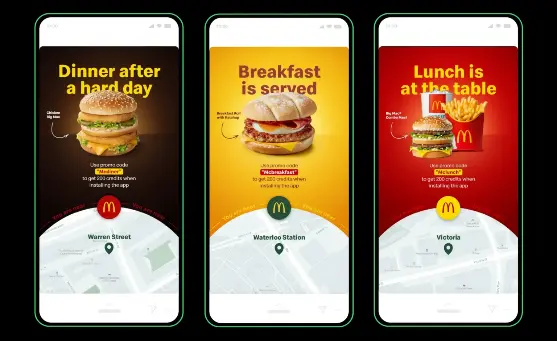
Source: https://www.hunchads.com/blog/ad-localization-complete-guide
Types of Geo-Targeting for Franchise PPC
Radius Targeting: Serves ads to users within a set distance from a franchise location. Useful for local foot traffic and service-based franchises. City-Specific Targeting: Targets users searching within a particular city. Ideal for franchises with multiple locations in a metro area. State-Level Targeting: Broadens reach to an entire state. Best for franchises with fewer locations but strong statewide demand.Geo-targeting works best when ads speak directly to the local audience. A franchise in Chicago shouldn’t use the same ad copy as one in Miami. Location-specific language, offers, and landing pages improve engagement and conversion rates.
Performance Max and AI Max support location targeting, but the behavior differs from standard search. For franchise campaigns, set “Presence: People in or regularly in your targeted locations” rather than “Presence or interest” to minimize geographic bleed. Verify in your campaign reports that impression share is concentrated in intended service areas to get the best results.
Best Practices for Localized Ads
Include city or neighborhood names in ad headlines and descriptions. Use call extensions with local phone numbers. Customize landing pages with location-specific offers, hours, and testimonials.A franchise PPC campaign that combines precise geo-targeting with tailored ad content will always outperform a generic nationwide campaign.
Budgeting & Bidding Strategies for Franchise PPC
Franchise PPC success depends on spending the right amount in the right places without wasting budget. Competitive markets require higher bids to stay visible, while lower-competition areas may need less aggressive spending. A flexible budget model helps high-performing locations scale up while reallocating funds from underperforming areas.
Whichever budget structure you chose earlier (corporate-controlled, franchisee-managed, or hybrid) should inform how you bid. Corporate-controlled budgets give you centralized spending power and stronger brand consistency but less local flexibility. Franchisee-managed budgets let individual locations invest more aggressively in high-performing markets, but risk inconsistent spend and execution. The hybrid model splits the difference: corporate sets budget floors, ceilings, and guardrails, and franchisees adjust within those limits based on local performance data.
Focus your bidding strategies on driving efficiency within that framework.
Bidding Strategies for Franchise PPC
Automated Bidding: Adjusts bids based on performance trends, optimizing cost per acquisition (CPA) and ROAS. Google deprecated Enhanced CPC for Search and Display campaigns in March 2025, so the Smart Bidding strategies most franchises rely on now are Target CPA, Target ROAS, Maximize Conversions, and Maximize Conversion Value. Competitor Bidding: Targets users searching for rival franchises, though this must be done strategically to avoid legal and brand reputation issues. Seasonal Bidding Adjustments: Allocates more budget during peak seasons (e.g., holiday promotions, summer sales) to maximize conversions. Geo-Bidding: Helps franchises spend more in competitive markets while reducing bids in areas with lower competition, improving cost efficiency.A smart budget allocation and bidding strategy helps franchises optimize ad spend, scale campaigns, and drive better ROI without unnecessary waste.
Ad Copy & Landing Page Best Practices
A great PPC ad gets clicks. A great landing page turns those clicks into customers. Franchise PPC campaigns need ad copy that stays on-brand while feeling local. Generic ads won’t convert, and mismatched landing pages frustrate users. A seamless experience from ad to landing page improves engagement and conversion rates.
Best practices for franchise PPC ad copy include:
Stay consistent: Adhere to brand voice while adding local relevance. Use localized CTAs: Instead of “Visit Our Store,” try “Get Fresh Pizza in Dallas Today.” Highlight unique value: Mention promotions, delivery options, or local perks. Include location extensions: A physical address and phone number improve trust and CTR. A/B test: Try out different headlines, CTAs, and layouts to identify what converts best in each location. One format note: Responsive Search Ads (RSAs) are now the only standard Search ad format available, since Google retired expanded text ads in 2022. RSAs let you supply up to 15 headlines and four descriptions, and Google’s AI rotates the best-performing combinations. Google also now offers AI-generated headline and description suggestions directly inside the RSA builder, which can speed up creative testing for franchises managing dozens of location-specific ads.Franchises looking to scale PPC efforts without managing every aspect in-house can also work with experienced PPC agencies to optimize ad copy, landing pages, and conversion rates.
Since landing pages typically are your last touch point before customers make a buying decision, you’ll want to make sure they’re well-optimized. Key landing page features you should focus on include:
A headline that matches the ad copy for continuity. Location-specific details (address, phone, hours, testimonials) for credibility. Fast load speed (under three seconds) to prevent drop-offs. Clear CTA (buy, book, call, get directions, etc.) that drives action. Mobile-friendly design, since most franchise PPC traffic comes from mobile users.This example from Cinnabon showcases their newest product with an attention-grabbing headline, an easy way to find your location, and a clear CTA to order.
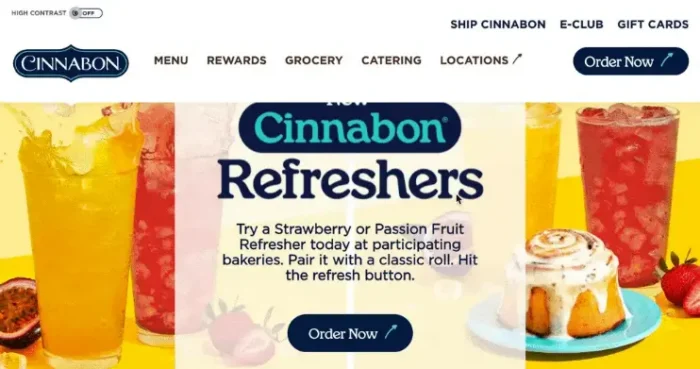
Source: https://www.webfx.com/industries/franchises/website-examples/
Ads in AI Overviews: What Franchise Advertisers Need to Know
Paid ads now appear integrated inside AI-generated overview summaries at the top of search results. These placements are served through existing Google channels like Search, Shopping, and Performance Max campaigns with no separate setup required, as long as you’re using AI-powered targeting.
This matters for franchises because local service and product queries often trigger AI Overviews. A location bidding on “best [service] near me” may see its ad appear inside an AI Overview rather than in a traditional ad slot. Ad copy quality carries more weight in this placement, so location-specific headlines and offers tend to outperform generic brand copy when sitting alongside synthesized content.
You don’t need to optimize separately, but you should monitor impression share by placement type in your campaign reports to understand how much traffic is coming from this format.
It’s also worth keeping an eye on adjacent formats. OpenAI began testing sponsored placements in ChatGPT for free and lower-tier users in early 2026, while Perplexity pulled its ad experiment over trust concerns. Franchise paid strategies will increasingly need to account for these surfaces as they mature.
Tracking & Measuring PPC Success for Franchises
PPC success is about conversions, revenue, and long-term customer value. When you’re focusing on PPC or other paid strategies, you’re actually in the realm of search engine marketing (SEM). It’s an important distinction, because the metrics that matter differ from SEO vs. SEM, so tracking the right ones ensures franchise owners use their ad spend to support the factors that are critical to improving their ROI.
Essential PPC metrics for franchises include:
CTR: Measures how compelling ads are. A low CTR means weak ad copy or irrelevant targeting. Conversion Rate (CVR): Tracks how many clicks turn into leads or sales. A high CTR with a low CVR signals a problem with landing pages. ROAS: Shows how much revenue ads generate compared to spend. A low ROAS means budget needs reallocation. Cost Per Acquisition (CPA): Helps gauge efficiency in converting leads. Lower CPA = better ad performance. Customer Lifetime Value (CLV): Helps franchises determine how much they can afford to spend on acquiring a customer and optimizing long-term profitability.Use these tools for tracking franchise PPC:
Google Analytics: Tracks user behavior after clicking ads. Call Tracking Software: Monitors phone leads from PPC. CRM Integration: Connects PPC data to sales and customer retention.Here’s what success could look like:
Let’s say a multi-location fitness franchise wanted to improve its PPC performance. Instead of running a one-size-fits-all campaign, they could restructure their strategy to separate local and national efforts.
Here’s how a campaign like that might play out:
Refined geo-targeting to focus ads on high-intent local audiences, reducing wasted spend. Customized ad copy for each location, incorporating city names and locally relevant promotions. Adjusted keyword bidding by prioritizing high-converting terms while lowering spend on broad, expensive keywords. Optimized landing pages to match ad messaging, streamlining the user experience and boosting conversions.As a result, their ROAS jumped 45 percent in three months, while landing page improvements increased conversion rates by 20 percent. This structured approach enables franchises to scale PPC campaigns effectively while maintaining brand consistency and driving local results.
Accurate attribution is getting harder as third-party cookies are becoming less popular. Originally, Google was in favor of full-on deprecation of cookies. While that decision has since been reversed, Google is still taking a “user choice” approach to data tracking.
For franchise campaigns, configure enhanced conversions at the location level rather than only at the account level. Server-side tagging through Google Tag Manager can make conversion tracking more reliable by routing conversion data through a server container before it’s sent to Google. This helps reduce reliance on browser-based tags, which can be limited by client-side tracking restrictions and may undercount leads.
Common PPC Mistakes Franchises Should Avoid
Franchise PPC campaigns often fail due to avoidable mistakes. Here are the biggest issues and how to fix them:
Poor Budget Allocation: A one-size-fits-all budget doesn’t work for franchises. Some locations face higher competition and need more aggressive ad spend, while others may waste budget on low-converting keywords. Fix: Use performance-based budget allocation. Analyze conversion rates and ROAS by location and shift funds to high-performing areas while cutting spend where PPC isn’t delivering results. Ignoring Local Customization: Corporate-managed campaigns often miss local intent. A gym franchise running the same ad nationwide might work in some cities, but local markets have different customer expectations. Fix: Allow location-specific ad copy while keeping branding consistent. Franchisees should have input on promotions, seasonal messaging, and localized offers to improve engagement. Competing Against Other Franchisees: Franchisees bidding on the same keywords without structured coordination drives up costs and reduces ROI. Fix: Use keyword exclusions and bid limits to prevent franchisees from competing against each other. Corporate can manage branded keywords while franchisees focus on non-branded, local intent keywords. Skipping Negative Keywords: Without negative keywords, franchises waste ad spend on irrelevant traffic. A fast-food franchise bidding on “best burgers” might get clicks from job seekers looking for fast-food jobs. Fix: Regularly update negative keyword lists to filter out job-related searches, competitors’ names, and non-converting terms. Ignoring Performance Data: PPC isn’t set it and forget it. Many franchises keep spending on underperforming campaigns because they fail to track key metrics. Fix: Use automated bidding and AI-driven optimizations to adjust bids in real time. Leverage Google Analytics, call tracking, and CRM integrations to connect PPC efforts to actual sales. Over-Relying on AI Campaign Automation Without Geographic Controls: With Performance Max and AI Max, campaigns can serve ads outside location boundaries if targeting is set to “presence or interest” rather than “presence” only. Fix: Audit geographic impression distribution monthly and implement location-based negative targeting where ads are appearing in unintended areas.Franchise PPC can drain budgets or fuel business growth. The difference comes down to eliminating these mistakes, making data-driven adjustments, and refining strategy over time.
FAQs
Is Google Ads good for franchises?
Yes. Google Ads works well for franchises because you can run brand-level campaigns alongside location-specific ones, capturing both broad awareness and high-intent local searches. The platform’s geo-targeting and ad customizers make it easy to serve the right offer to the right market without building hundreds of separate accounts.
How do you use Google Ads for franchise marketing?
Structure your account around your franchise model. Use a corporate-managed account with sub-campaigns per location or give each franchisee their own account under a manager account (MCC). Lean on location extensions, geo-targeting, and shared budgets to keep things efficient.
How do you set up a PPC campaign for a franchise location?
Start with location-specific keywords, set a tight geo-radius around the franchisee’s service area, and write ad copy that includes the city or neighborhood. Connect Google Business Profile for location extensions, then layer in call tracking to attribute leads back to the right unit.
How do franchisees keep up with SEO and SEM algorithm changes?
Subscribe to Google’s Search Central blog and follow industry sources like Search Engine Land. Better yet, partner with an agency that monitors changes for you, so updates get tested before they affect performance.
Conclusion
Franchise PPC in 2026 comes down to three things: structured campaigns, local targeting, and consistent measurement. The fundamentals haven’t changed, but the tools have. Performance Max, AI Max, and ads inside AI Overviews are reshaping how franchise locations compete for clicks, and the brands that adapt fastest will capture the most value.
If you’re managing PPC for a single franchise location or coordinating campaigns across hundreds, the playbook is the same. Match your campaign structure to your management model, keep ad copy locally relevant, and track the metrics that tie spend to revenue.
Are You Using Google Ads? Try Our FREE Ads Grader!
Stop wasting money and unlock the hidden potential of your advertising.
Discover the power of intentional advertising. Reach your ideal target audience. Maximize ad spend efficiency.











![[SEO & PPC] How To Unlock Hidden Conversion Sources In Your Sales & Marketing Funnel via @sejournal, @calltrac](https://www.searchenginejournal.com/wp-content/uploads/2025/03/featured-196.png)