Reevaluating the Job of Our Generation
Native Hawaiian Zen master Norma Wong on the role of oral traditions, wholeness, and her new podcast, The Horizon Story The post Reevaluating the Job of Our Generation appeared first on Tricycle: The Buddhist Review.
 Koichiko
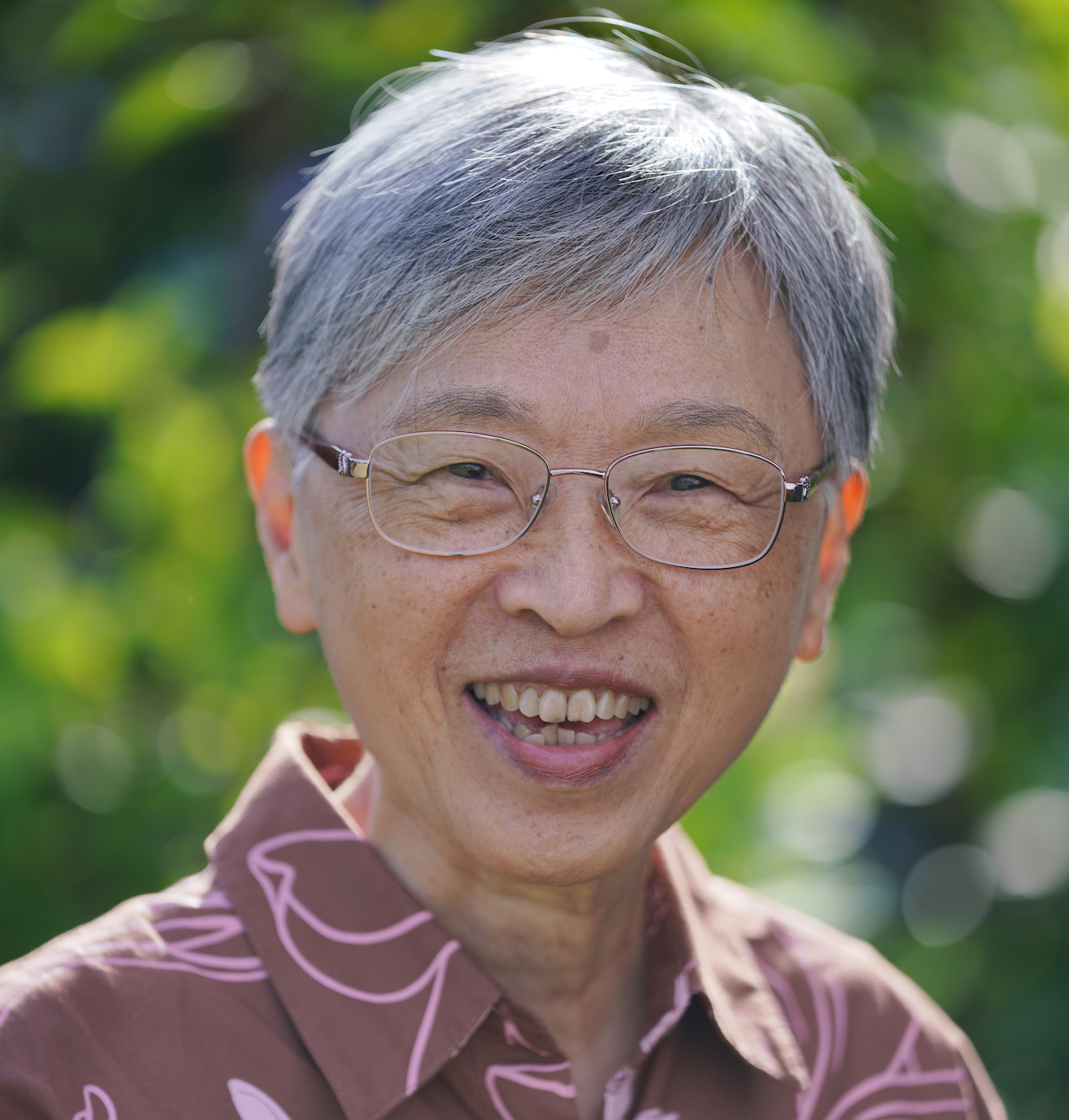
“We are the ancestors of descendants yet to come,” writes Norma Ryuko Kaweloku Wong Roshi in her most recent book, Who We Are Becoming Matters: The Courage, Wisdom, and Aloha We Need in the Timeplace of Collapse.
Wong herself is a descendant of Native Hawaiian and Hakka Chinese ancestors. As the abbot of Anko-in, an independent branch temple of Daihonzan Chozen-ji, she was a student of the late Tanouye Tenshin Rotaishi. Wong—who is also a former member of the Hawaii state legislature, having worked in electoral politics for over thirty years—is now the host of a new podcast called The Horizon Story, which she describes as a reminder to reclaim the agency, interdependence, and indigeneity that we need to look into the future and move toward the horizon. Wong recently spoke with Tricycle’s editorial assistant, Kami Nguyen, about its release.
What was your inspiration behind starting The Horizon Story podcast, and what messages are you trying to put out into the world through this medium? Well, as you can tell, I’m an old person. And even though it is a foreign medium to me, what I appreciate about doing the podcast—which is being done both as an audio podcast and as a YouTube video series—is that there’s something about it that mimics the oral tradition, which is the notion that you would be with people, and you would tell stories, and you would converse, and that that would be the way in which knowledge and wisdom would be translated across generations. And so, in some ways, at least on a personal level, I feel that, even though I am unable to see the people who are on the other side listening.
In your first few episodes, you speak with a couple of your longtime collaborators, including Nan Stoops and Naalehu Anthony. Can you tell me about your relationships with them and the work that you have done together? Nan Stoops and I met each other about fifteen years ago. Nan has long done work in the area of gender-based violence and the work of whether we can address human issues differently—not just to take care of the trouble after it has been caused but to get to the root of the issue—this is a question that Nan and I have been in conversation about. And so she’s become a good friend. I would say, first of all, she’s a friend, and second, she’s a collaborator.
Naalehu Anthony, I also first met at about the same moment, in 2011. Naalehu is a native Hawaiian man twenty years my junior. I knew his parents. It is really a gift to me that I would be able to collaborate so closely with someone who would be the generation of a child of mine if I had had children. We do work together in Hawaii, and he is also very gifted in the area of communications, and especially in the area of telling the stories of Indigenous peoples. And so that’s part of the work that we do together.
Your book, Who We Are Becoming Matters, came out earlier this year, and your previous book, When No Thing Works, came out in 2024, both during very specific and difficult times for our country. How did you intend for each of those books to meet the moment of when they were published or when you wrote them? When I wrote When No Thing Works, I was observing the country but also the world, reaching a moment when it was becoming clearer and clearer—in many aspects—that what we had built up over time was no longer meeting the challenges we were facing. And there was also the way in which our ability to be in relationship with each other was deteriorating considerably. Although I had some luck and published When No Thing Works right at the moment of a consequential election, the truth is that no matter what happened in that election, we would have still been in a bit of trouble as peoples. We were in a bit of trouble then as we are now because of the ways in which we are held so tightly in a binary, unable to see the wholeness in each other, and unable to see the possibility of wholeness in the world. And so, as someone who is both a Buddhist practitioner as well as someone who’s been engaged in the work of community and policy, this moment is cause for us to reevaluate what our job is. What is our generational job? And by generational, I mean all the people who live on the planet at this moment. What is our generational job?
 Norma Wong with her book Who We Are Becoming Matters. Photo courtesy Jamila Silver
Can you expand on what your definition of wholeness is when you talk about the world that we live in and what we could be? Every being, whether they are human or not, is born whole. Even if you are imperfect, even if you have flaws of some kind. We either sabotage our wholeness, or the wholeness gets taken away by circumstances and conditions, all of those kinds of things. Say we lose our connection to each other, and we lose our connection to the universe as a whole. Which is also part of that aspect of wholeness, right? Wholeness is not something that we may be able to gain independently of anything else. So this interrelationship that we would have, that we would naturally have at the moment that we were born, is something that, if you do not keep cultivating it or if you don’t keep moving toward a better representation of it, could cause you to lose yourself and be divided into various parts. One of the ways that you could divide yourself in various parts would be that your physical self, your spirit self, and your intellectual self could be entirely separated from each other. And that would be a way in which you would move away from wholeness.
In your books you also include quite a bit of poetry. And you’ve said that worldview can often be better expressed through culture and poetry and art rather than analytical storytelling or narrative. Can you tell me more about what you mean by that, and how you came to become a poet as well? I think as adults, we lose the natural poetry that we have as children. And so for an adult to re-find, to rediscover their artist’s voice, their creative voice, their poet voice is about returning to the way of knowing that you had as a child. From a Buddhist perspective, we would call this the beginner’s mind. If you sit in the beginner’s mind—which you don’t have to have only as a beginner—then the world as you see it is not as much the way in which you have judged it or analyzed it to be so but a way in which you observe it and wonder about it. That wonderment doesn’t have to be only about a glowing perfection. You could wonder about things that are not working at all. Why is it dark when it should be light? And that place of discovery, I think, is best held in art, whatever matter it could be. But I’m certainly not an original thinker in that regard. It’s like what happened in ancient China. At the moment that Buddhism came from India to the place that we now know as China, it met a fruitful period that had come through the discovery of the Dao. And in that, philosophically, they actually trusted the expression of the philosophy if it came through art rather than if it came through your narrative voice or your literate voice, because when you add an analysis to something, you remove the mystery of it. And it is in the mystery that we can best figure things out, rather than having things figured out at the onset.
When you add an analysis to something, you remove the mystery of it. And it is in the mystery that we can best figure things out, rather than having things figured out at the onset.
I read that you came to Zen Buddhism around the same time as the Hawaiian Cultural Renaissance. Can you tell me more about that time in your life? All of that was just happenstance. The happenstance was that I was living at a moment as a teenager and as a young adult when, in Hawaii, there was a great renaissance of the native Hawaiian culture across the board. It impacted how we thought about our own identity. It included a renewed interest in Hawaiian music and art, as well as the rediscovery of ancient ways of doing things, including open ocean navigation. It also included the rediscovery of the competency of our language, language revitalization. So all of that was happening at this really, almost pregnant moment across the islands, across the peoples. And it was in that period of time that I was also introduced to the person who would become my spiritual teacher.
What I was very much attracted to about that, was that the Zen Buddhist ways of knowing were very similar to Indigenous ways of knowing. At that point in time I hadn’t been a deep reader of Buddhist philosophy. I wasn’t yet someone who was a seeker or any of those things. But the notion that you would find ways to cultivate your internal stillness in order to be one with all that is around you, and to be able to hear, without explanation or judgment, the natural sounds around you, would be exactly how I would have believed that my native Hawaiian ancestors would have lived. And to have this notion that you could do it in modernity and you could do it at a time when, regardless of whatever fraughtness there may have been about the political identity of indigeneity, whether or not we have recognition or not, whether we are in a struggle around lands or not, all of those kinds of things, you could still come to that experiential place that would be so close to that of your native ancestor. This insight for me was an entire renewal. And so for me, there was never a matter of choosing. And I appreciated that as well. No one ever said that that was something I would have to do. To choose between my Indigenous ways and my chosen spiritual path.
That’s really interesting how those parts of your story intertwined. In the podcast you also talk about how an origin story illuminates who you are rather than determines who you are. What does illumination really mean when you’re saying that who we are becoming matters? I think of illumination literally rather than metaphorically. Whoever it is that we think we are is different if we stand in a room that is shrouded in darkness than if we put ourselves right in the sunlight, in the light of the sun. We will notice things that are different. Our energy would also be different. I think illumination is both internal and external. It’s like light meeting light. And I believe that light wants to meet light. So if you are feeling down, if your spirit feels low, it’s an internal condition, but the agency you have is to place yourself facing the best source of illumination that you can. That could be literal light, or it could be something that’s beautiful, something that’s inspirational. It could be music. It could be the sound of laughter. It could be the taste of something delicious. And that could awaken something. Because you are no longer isolating the possibility of who it is that you are, becoming less timid.
Being from Hawaii, like from a lot of islands, I would imagine the effects of climate change are more greatly noticeable and impactful. How does Buddhism and your Indigenous identity help you to reckon with the realities of climate change, especially in this place that you’re so connected to? Well, certainly you’re reminded about change, the constancy of change, that impermanence is not an analytical thing. It brings home those particular concepts with sharp clarity. But it also brings you into that space where you must ask the question as a being who notices that, what is your responsibility to it? What is your responsibility? I mean responsibility in terms of actions, practical actions in the world, but also responsibility to be in relationship with other humans, and the challenge of such big change. So your individual actions count. But much more importantly right now, I believe, is whether humanity will arise. And so to be a part of the human community is a sangha requirement. Sangha should not just be the Buddhist practice community. What is the sangha of humanity? And I would say, from a Zen Buddhist perspective, that perhaps this is one of the moments that all of these hundreds of years of continuous practice by generations of peoples was intended for.
Last, I wanted to ask about your history of public service and how that work influenced the way in which you engage with your community now as a teacher? Well, people come to me with all kinds of questions. When I was in public service—policy was the area of my interest—the broad range of questions that people might lay in front of me could stretch across the full ocean. I was fortunate to have started my spiritual path at almost the same moment as I started my public life. And because I did that, I’ve never thought of them as being separate from each other. I never thought of them as being somehow antithetical in terms of values or ways. In both practices, I felt the necessity to essentially be true to the human cause in relationship to the universe that we live in as the ultimate issue that we would need to deal with irrespective of whatever the specific, smaller issue might be. It gave me a way, when I was in public office, to think more broadly but also to have a measure of compassion for myself and for other people. And to have an easier time making difficult decisions. A much easier time. I will say to you, I have no idea what the next moment will call upon me for, because being on a podcast is very much like reentering public life. So we’ll see what happens along those lines. But certainly my goal in walking the public spiritual pathway is to help remind people that, irrespective of your particular station in life, you have a responsibility for the inner part of you and how that is in a relationship to your greater service to humankind. I know now that, in an interesting way, that comes easily to me, and what I hope to do is to make that come easily to other people as well.