Referral Traffic Is Declining for Smaller Publishers: What This Means and How to React
Key Takeaways Referral traffic is down, and smaller publishers are absorbing the sharpest declines. Some have seen traffic drop by as much as 60 percent over the past two years. That is not a temporary dip from an algorithm update. It...
 ShanonG
Key Takeaways
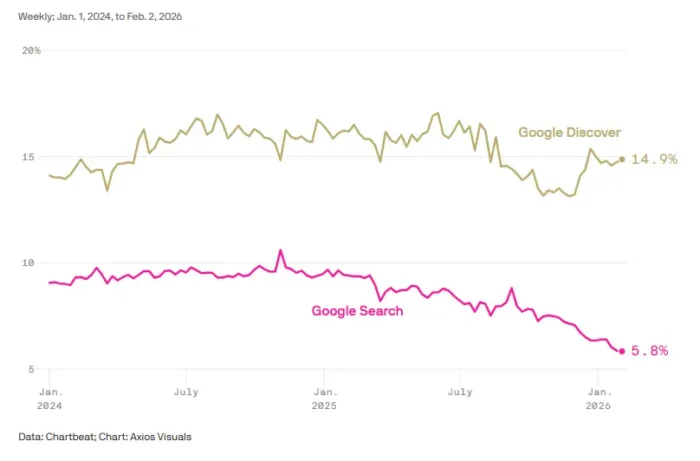
Chartbeat data tracking more than 2,500 news sites globally shows Google search referrals declined 33 percent in 2025, with small publishers (fewer than 10,000 daily page views) seeing 60 percent declines over two years. AI platforms are compressing multiple sources into single answers, driving a rise in zero-click behavior that bypasses publisher sites entirely. A top search ranking no longer guarantees a visit. AI summaries can satisfy the query without the user ever clicking through. Building owned audiences through email, social, and direct relationships is now a core distribution strategy, not a supplement to search. Content structured for AI discoverability (clear, well-organized, factually grounded) is the new version of ranking on page one.Referral traffic is down, and smaller publishers are absorbing the sharpest declines. Some have seen traffic drop by as much as 60 percent over the past two years. That is not a temporary dip from an algorithm update. It is a directional change in how audiences find and consume content online.
The driving force is straightforward: AI-generated answers are satisfying queries that used to produce clicks. Users get what they need from a synthesized summary and never visit the source. The publisher who ranked for that query, optimized for it, and built content around it gets nothing.
Understanding why this is happening and what to do about it is urgent for any publisher or content-driven brand relying on search as a primary traffic source.
Why This Is Happening
It used to be that answering a search query meant earning a click. A user typed something into Google, saw a list of results, and visited a site. Publishers built their entire distribution model around capturing those visits.
AI Overviews, ChatGPT, Perplexity, and similar platforms have disrupted that chain. Instead of surfacing a list of links, they deliver a synthesized answer assembled from multiple sources. The user gets what they came for. The click never happens.
The data on this is significant. According to Similarweb, zero-click searches increased from 56 to 69 percent between May 2024 and May 2025. For queries where a Google AI Overview appears, the zero-click rate hits between 80 and 83 percent. Pew Research found that users clicked on results only 8 percent of the time when AI summaries appeared, compared to 15 percent when they did not. That is a nearly 47 percent relative reduction in click-through from the presence of AI summaries alone.
Smaller publishers absorb the impact more severely than larger outlets. Chartbeat data reported in March 2026 breaks this down clearly: small publishers with fewer than 10,000 daily page views saw 60 percent declines in search referral traffic over two years. Medium publishers with up to 100,000 daily page views saw 47 percent declines. Large publishers saw 22 percent declines.
Scale and brand recognition provide a partial buffer, but even major names have not been immune. Business Insider saw organic search traffic fall 55 percent between 2022 and 2025. HuffPost lost half of its search referrals over the same period.
Ranking at the top of search results used to mean something close to guaranteed visibility. That relationship has broken down. Visibility no longer guarantees influence.
Why the Old Playbook Falls Short
The formula that drove publisher growth for the past decade was consistent: create content that ranks, capture organic traffic, monetize that traffic. SEO was the engine and search was the distribution channel.
That engine is still running, but far less reliably than before. Reuters Institute survey data from early 2026, covering 280 media leaders across 51 countries, found that most publishers now expect to put less effort into traditional Google search this year. Media executives worldwide fear search engine referrals will fall another 43 percent over the next three years.
The publishers navigating this period well are not the ones with the best keyword strategies. They are the ones with direct audience relationships that do not depend on any algorithm to survive. Strong email lists, consistent social presences, and loyal readerships keep them stable when search referrals drop. Publishers without those foundations are feeling the decline most acutely.
Continuing to optimize exclusively for traditional search while ignoring how AI discovery works is a compounding mistake. The channel has already shifted, and waiting for it to shift back is not a strategy.
What to Do Now
The response requires action on two fronts simultaneously: protecting your direct audience relationships and adapting your content for how AI surfaces information.
Build owned channels as your primary distribution. Email is the most durable investment you can make. A subscriber who gets your content in their inbox is completely insulated from AI summaries, algorithm changes, and shifts in how Google decides to handle any given query type. The data supports this: publishers sent 28 billion emails in 2025, reaching over 255 million readers, with average open rates exceeding 41 percent. That outperforms most social media content by a significant margin. Build your list. Send consistently. Give people a genuine reason to keep showing up.
Social media supports direct distribution, but the goal is consistent presence that builds recognition, not chasing reach. Regular posting across the platforms where your audience already spends time keeps you visible through channels that do not depend on search referrals. Chartbeat data shows social referrals were flat or slightly up in 2025, with X up 15 percent and Facebook up 9 percent year over year. Those are not transformative numbers, but they represent channels that are holding while search declines.
Earned media and press relationships matter here too. Coverage in credible third-party publications builds the kind of authority signals that make your content more likely to be cited in AI-generated responses, which is the new version of organic discoverability.
Optimize your content for AI citation, not just search ranking. There is a real upside to the AI traffic story that most coverage misses. Brands cited in AI Overviews earn 35 percent more organic clicks and 91 percent more paid clicks than non-cited brands for the same queries, according to Seer Interactive data.
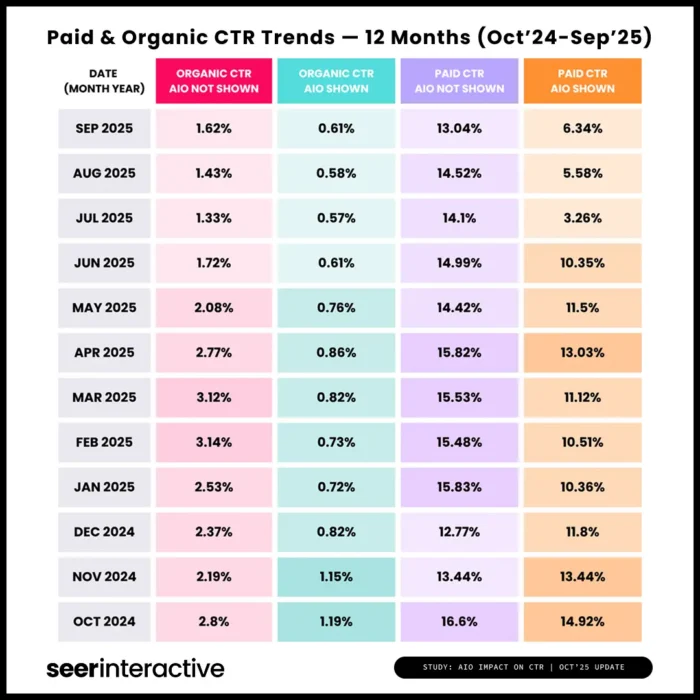
Being cited by AI systems is not a consolation prize. It is becoming a primary visibility driver.
Clear structure, direct answers to specific questions, and accurate, current information make your content easier for AI systems to pull from and surface. Practical, utility-focused content (guides, how-to articles, explainers) generates more page views per article from AI referrals than other content types, suggesting that practical resource content is more likely to earn a citation from an AI system.
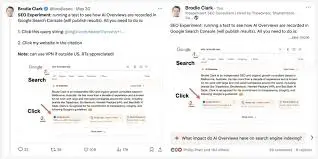
Think about what questions users in your category are asking AI tools right now. If your content is not appearing as a cited source for those queries, that is a gap to close through targeted content work. Google added dedicated AI search tracking to Search Console in mid-2025: use the Search Appearance filter to see your performance in AI Overviews specifically, and let that data guide your content priorities.
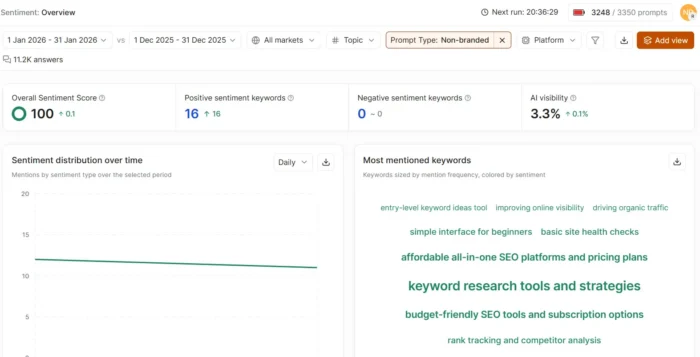
Monitor your AI presence actively. Check regularly what major AI platforms say when users ask questions your content should be answering. Track changes over time. If you are being misrepresented, omitted, or replaced by less accurate sources, you have a visibility and reputation problem that content strategy needs to address. Platforms like Writesonic have a sentiment feature to help gauge how your brand or a client’s brand is being portrayed.
Thinking About The Bigger Picture
The 60 percent traffic decline some publishers have experienced did not happen overnight, and it has not reversed. AI platforms generated over a billion referral visits in mid-2025, a 357 percent year-over-year increase. Even so, AI referrals still account for less than 1 percent of total web traffic, because the volume of search traffic absorbed by AI is so large.
The brands and publishers that adapt their distribution mix now, investing in owned audiences while making their content AI-discoverable, will be in a far stronger position over the next two to three years than those holding out for a search traffic recovery that may not come.
FAQs
Is search traffic gone for good?
Not gone, but fundamentally changed. Certain query types will always generate clicks: transactional searches where users intend to purchase, navigational searches for specific sites, and research queries requiring depth beyond what AI summaries provide. The shift is in emphasis: optimizing for AI citation and direct audience relationships is now a higher priority than chasing organic keyword rankings, particularly for smaller publishers without the domain authority to compete in contested niches.
What types of content still drive clicks from AI-influenced searches?
Practical, utility-focused content generates more AI referrals than editorial or opinion content. Guides, how-to articles, and detailed explainers are more likely to earn AI citations. Transactional content tied to specific purchase intent also continues to drive clicks because AI summaries do not fully satisfy the need to complete a purchase.
How do I know if AI is affecting my traffic?
In Google Search Console, go to Performance, then Search Results, and use the Search Appearance filter to select AI Overviews. This shows impressions and clicks specifically for queries where AI summaries appear. Impressions holding steady while clicks decline is the clearest signal of AI Overview impact.
Should I be investing in Answer Engine Optimization (AEO)?
Yes. AEO and traditional SEO share significant overlap: content structure, technical optimization, and authority building all remain relevant. The shift is in emphasis. Clear structure, direct answers, factual accuracy, and third-party credibility signals are the factors that most influence AI citation.
Conclusion
The 60 percent decline in search referral traffic for smaller publishers is not a fluctuation. It is a signal of where information discovery is going. The publishers still performing have strong brands, direct audience relationships, and content that AI systems want to cite.
Building those same assets is the path forward for any content-driven brand. Diversify your distribution, optimize for AI discoverability, and treat owned channels as your foundation rather than your backup plan.