
Rehearsing Death in Bangkok
Wrestling with thoughts about her parents’ mortality, a writer runs through her own life cycle at a particularly macabre Thai café. The post Rehearsing Death in Bangkok appeared first on Tricycle: The Buddhist Review.
 ValVades
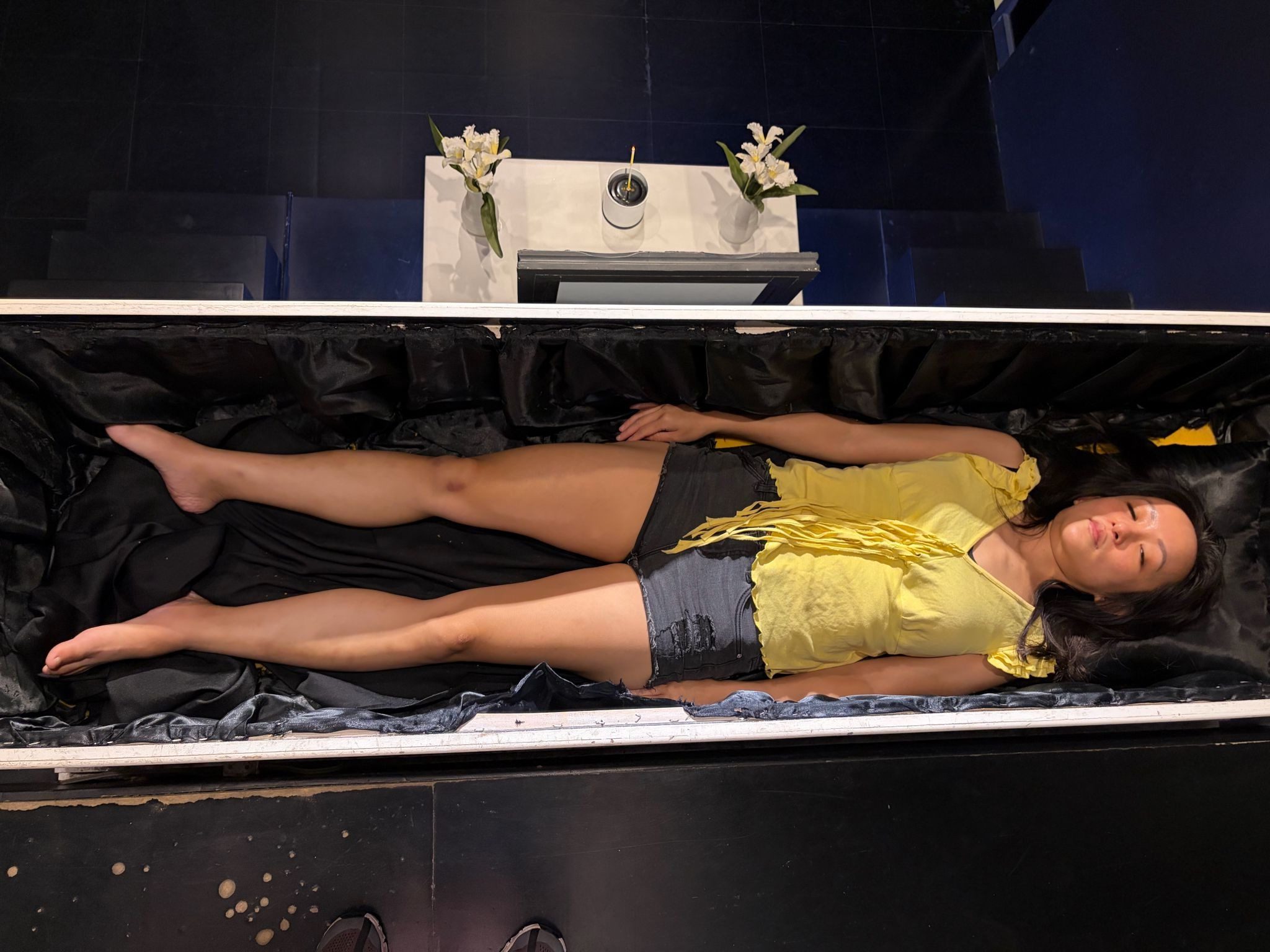
Bangkok has a café where you lie in a coffin. I’m visiting while my mum has cancer.
Up until recently, I had spent my life convincing myself that death had rules. For instance: One friend’s mum was six years older than mine when she passed away, and so, by that logic, Mum must have at least another six years left. Another reason my parents couldn’t die yet was that my grandmother was still alive and, typically, kids should outlive their parents. But, unfortunately, death doesn’t abide by rules.
My whole life, I had always had an almost obsessive fear about my parents dying. I remember, at school, my crayon pausing over a princess’s dress during art class while my two younger brothers reached for lollies at the local milk bar. Seeing them, it was easy to imagine a stranger taking their hands and solemnly leading them out the door. I’d blink until the image dissolved, then press my crayon back into the tiara. Even then, my imagination was always outrunning reality.
To make matters worse, as a child, my dad worked night shifts, which only added to my worry. A typical scene might involve me restlessly tossing and turning in bed while the clock’s second hand ticked to 4:27 a.m. Outside, tires would grind against gravel. I could hear the metal scrape and the lock click as boots landed heavy in the hallway. Only then would the knot come undone. Only then was the dark safe enough for sleep.
But the relief never lasted. This anxious spiraling came to a head in 2026, when Mum received her third liver cancer diagnosis. Doctors had told us that she had been in remission for some time. Later, they concluded that two tumors had actually been there all along. I had spent a lifetime rehearsing loss. When the threat became real, the rehearsal hadn’t helped.
Her clinical trials began in Melbourne. A folder of drug schedules clung to the fridge beneath a magnet of my brothers and me with Santa. As it happened, I already had a trip to Thailand booked and on my calendar.
The same fear I held as a youth was now with me in adulthood.
During her trials, every scan carried two futures: one where Mum came home, another where she didn’t. My mind raced. In my head, I lost arguments to her about my taste in men. She always had opinions about whom I dated. I remember my mum’s assessment of my first boyfriend, a chronic crier, a verdict she delivered what feels like one geological era ago: “Have a baby with him and you’ll have two babies crying.”
In old photos, Mum was hot. I wanted to know the names of all the boyfriends she had before Dad. My thoughts skipped between the stories I had never asked her to tell me about and the future she might never see. Currently, one of my brothers is using dating apps looking for love, hoping to build a family of his own. I want her to see him become a father. Anticipatory grief asks you to mourn someone who is still alive.
Enter: Bangkok’s Death Awareness Cafe.
A receptionist serves me Thai pink milk tea with a small dish of assorted nuts and crisps.
“Buddhist philosopher Veeranut Rojanaprapa opened this café in 2018,” the receptionist tells me. She sweeps a hand around the room. “People get angry and greedy. They take too much. Most Thais are Buddhist. When you’re aware of your own death, you do better.”
A lofty goal for a place next to a petrol station.
All my life, my family didn’t have firm answers about death. Dad grew up in Malaysia; Mum in Hong Kong. We weren’t religious. But a Buddha statue watched over our home.
When I was 17, we traveled to Kuala Lumpur with Dad’s sister’s family. She had converted to Christianity soon after migrating to Australia. We visited my grandfather’s memorial. One by one, my parents, two brothers, and I offered him food and bowed our heads. We believed that the people who had loved us in this life would continue to walk beside us.
My aunt held back.
Dad frowned. “What are you doing?”
She kept her hands at her sides. “I only pray to God now.”
He jabbed a finger at the photograph. “This is our dad.”
His words returned to me inside the Death Awareness Cafe. To Dad, love did not end with death. Our ancestors were more likely to care for us than a distant God we had never met and whose existence we couldn’t prove. This conviction shaped the way he lived. After his father was killed by a drunk driver, Dad never touched alcohol again. My aunt, on the other hand, came to believe God was the sole creator and that praying to anyone else was a sin.
Love simply took a different form.
The café’s first display cycles through funerary rites from around the world. In Tibet, some mourners carry their dead up to mountaintops for what they refer to as sky burials, where vultures consume the body. Within Vajrayana Buddhism, it is believed we return to nature in this one final act of compassion. A generosity I didn’t have. I couldn’t imagine offering up Mum.
A nearby panel describes sati, a historical Hindu practice that requires some widows to die on their husbands’ funeral pyres. Men had somehow escaped this particular test of “devotion.”
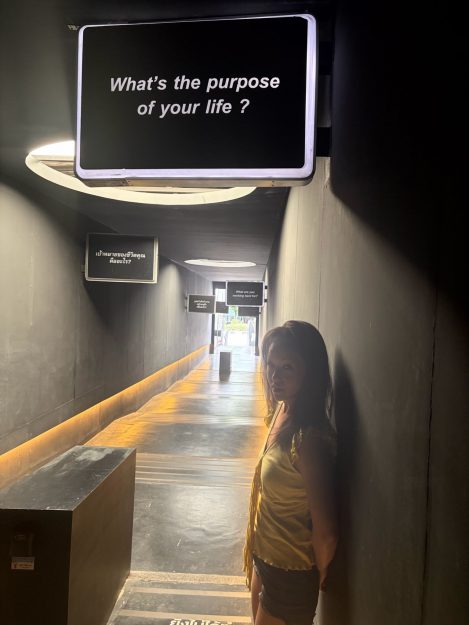
The receptionist then ushers me to a beanbag while an orientation video introduces the café’s four exhibits: Birth, Elder, Pain, and Death. My existential crisis came with cushioning. The walls catalog deaths that should have come with a laugh track. One man died in his sleep after a cow crashed through his roof. The coroner noted how the cow sustained no injuries. Another man suffered a fatal heart attack while laughing at an episode of the British sketch comedy show The Goodies. His widow later wrote to the producers, grateful the last thing he felt was joy.
Her letter stayed with me. Mortality rarely announces itself. Neither does grace. Perhaps, in rehearsing death, I’d been overlooking life.
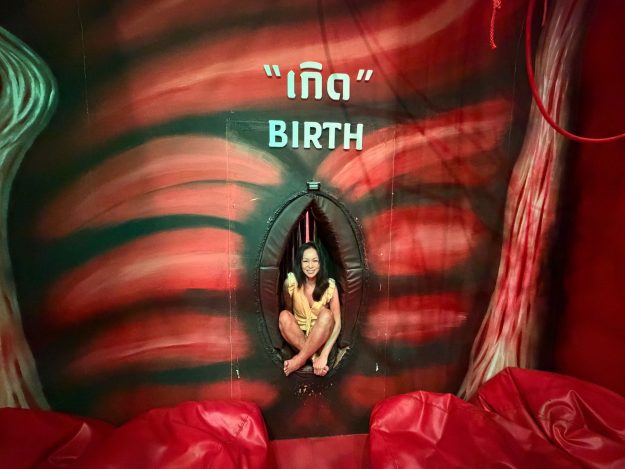
The Birth exhibit asks me to begin again. I curl inside a giant crimson womb. Mum had once carried me to the start of my life. If only I could carry her away from the end of hers.
The enlightenment continues. Some people travel to Bangkok for the nightlife and temples. I crawled through a birth canal.
Some people travel to Bangkok for the nightlife and temples. I crawled through a birth canal.
At the next exhibit, I age forty years in under a minute. Gray wig. A weighted vest. Sandbags strapped to my wrists and ankles. Clouded glasses. I felt personally attacked by gravity.
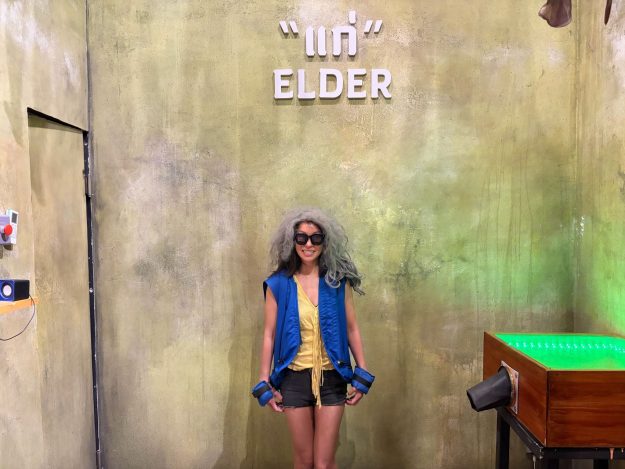
Decades had gone into calculating how much time I had left with the people I loved. Somehow, I had missed them growing older.
During our first family trip in fifteen years, the signs were everywhere. Mum and Dad needed more breaks. They rested halfway through the fifteen-minute walk from Beijing’s hutongs to our hotel. Dad blamed the arthritis in his neck. At Hong Kong’s Ocean Park, they waved us off and sat down with panda ice creams. In Kuala Lumpur’s Petaling Street, Mum’s face flushed within thirty minutes. Lunch at an air-conditioned Michelin-starred noodle shop moved from 1:00 p.m. to 11:00 a.m.
How many quiet losses had they borne without a word, reassuring us that they were fine?
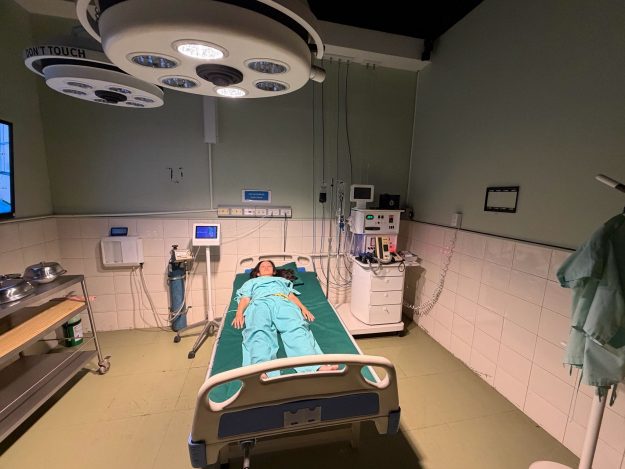
The Pain exhibit answers with a fake ICU I check into for fun. I slip into a medical gown and lie on the hospital bed. Surgical lights. Heart monitors. IV drips. Silence.
The questions arrive uninvited. Had I written a will? No. I’d catastrophized every worst-case scenario yet never the paperwork. Who would speak for me if I couldn’t? My brothers? They made better decisions and were less likely to panic-google my symptoms. Did I want to be resuscitated if survival meant a life I wouldn’t recognize? Might as well spend my afterlife annoying my brothers.
I’d never turned the question around. Years had gone into imagining losing my parents. Almost none went into imagining what they’d do if they lost me.
The café experience ends on a high note: a white coffin. A raised platform, black walls, white flowers, and burning incense recreating the environment of a funeral parlor. I climb the steps and lower myself into the casket. The lid closed. Darkness. I couldn’t even see my own hand. I waited for some profound insight to present itself. Instead: What if I can’t get out?
My anxiety eventually found a new assignment: Time.
I thought I understood it. Birthdays, graduations, and family milestones marked the years. Yet so much could change while everything looked the same.
For six years, we’d believed Mum’s cancer was gone. Then doctors had found two tumors, including a four-and-a-half-inch mass they had overlooked on previous scans.
Liver cancer had survival rates and statistics. The scans had measurements and dates. None of them accounted for her laugh. The way her small nose widens, her cheeks lift, and her crooked teeth appear, revealing the mischievous girl who had lived long before she became my mother.
At restaurants, she kept slipping food from her plate onto ours, ignoring our protests that she should eat it herself. Even as adults, we were still her babies. Dad believed the same held true in reverse. We never stopped belonging to the people who came before us.
At age 17, I stood before my grandfather’s memorial. “Grandpa, I need a favor. I’m a few points short of getting my arts and commerce degree.”
Four days later, my acceptance email arrived. The university had lowered the required score after years without change.
The first person I wanted to tell was Dad. “I prayed to Grandpa for a miracle. Maybe he intervened.”
Dad beamed. “You asked him for that? See, Grandpa is still here.” He tucked me into his side. “Your aunt shouldn’t have switched providers.”
He had always assumed the universe agreed with him.
Maybe my grandfather helped. Maybe coincidence did. Dad never needed proof. The possibility was enough.
Death awareness wasn’t about practicing goodbye but noticing the people that are still here. Mum ringing to check if I’d eaten became part of what I no longer took for granted. So were the afternoons she spent shortening my pajama pants because, at five foot two, every pair insisted on sweeping the floor.
For years, I’d braced for the worst. But the life I’d been trying so hard to protect was already unfolding in moments like these.
Bangkok was my third solo trip. Dad was yelling before I left. My brothers disappeared overseas all the time without a word of objection.
He was still going at it when I came home. “You could’ve been scammed. Abducted. Murdered.”
Mum cut in from the kitchen. “Take note, it’s not me yelling at you. Just your dad. I’m quite liberal.”
I want to be there for all of it.




















-1.png)
