Sunday Schoolers Onstage: Using Vesak to Highlight the Younger Generation
Mihiri Tillakaratne reflects on her temple’s unusual Vesak celebrations, and how giving youth the space to share their understanding of the dhamma can create a new generation of Buddhists The post Sunday Schoolers Onstage: Using Vesak to Highlight the...
 Hollif
Vesak represents many things to Buddhists: celebration, refuge, community, and more. For my temple, Vesak means the kids get to show off their knowledge!
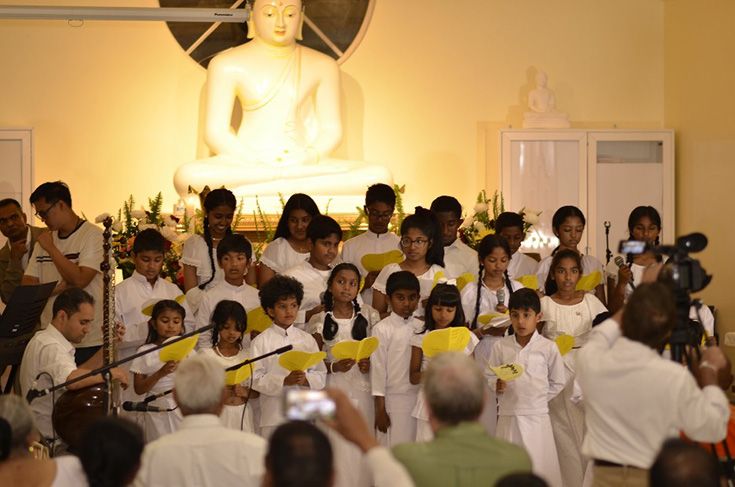
I’ve always known that there’s something special about my Sri Lankan Buddhist temple, Dharma Vijaya Buddhist Vihara in Los Angeles, but during Vesak, its unique approach becomes clear. Most Sri Lankan Buddhist temples in Southern California mark Vesak with one day of religious sermons and devotional singing by youth. Dharma Vijaya, however, celebrates Vesak as a multi-day weekend festival, with only Sunday being reserved for traditional Vesak activities. Saturday is devoted entirely to the youth, with events spanning from the mid-morning until the night. Every event is performed by the younger generation, spanning from preschool to high school students, with even children as young as three participating.
It wasn’t always this way, though.
In the early nineties, my Ammi (“mother”) was one of the first lay principals of Dharma Vijaya’s Sunday school. Her proposal that the children sing Sri Lankan Buddhist devotional songs, or “bhakthi gee,” in Sinhala during the Vesak celebrations started a hullaballoo.
“In allowing the kids a voice and a stage to demonstrate their knowledge and skills, the temple creates young people who truly live each day according to Buddhist teachings.”
Before this, only the congregation’s adults, all immigrants to the U.S., sang onstage while the kids sat in the audience, bored. As I grew older, Ammi wanted kids to be more involved in Vesak.
No one believed she could pull it off, and none of the other parents thought it would work, thinking it was a waste of time and energy. “How can these kids who don’t know a word of Sinhala sing Sinhala songs?” they asked. “These children are American! They can’t do it!” Even the supportive monks were skeptical.
Ammi was persistent, though, and as Sunday school principal, she had the authority to make it happen! My Ammi and Tatti (“father”) transliterated each song into English script, while her more musically inclined friends helped with arranging the songs. Most importantly, they translated each song, so we kids would know what the heck we were singing!
I remember the songs still, particularly Danno Budunge, or “dan-no bu-dhun-gay” as it was transliterated on our lyrics sheets. The translated meaning under each line told us we were singing about the importance of the city of Anuradhapura in Sri Lanka’s Buddhist history.
We kids practiced during Sunday school in the weeks leading up to Vesak. Ammi cleverly got us to practice even when we weren’t at the temple. The adults recorded songs onto multiple cassette tapes, distributing them amongst each family. Ammi gave the parents explicit instructions to play the tapes during car rides: to and from school, while running errands, and anytime kids would be in the car.
At the time, there were only two Sri Lankan Buddhist temples in the area (now, around 20!), so our congregation commuted from all over Southern California. Everyone had at least a 30 minute drive or longer each way to the temple—plenty of practice time. I remember carpooling with my friends, cassette tape playing and our parents singing along with us, helping with pronunciation, during our weekly treks to the temple through the ubiquitous LA traffic.
Ammi’s plan, of course, was a rousing success, and now all the Sri Lankan temples in Southern California have kids singing bhakthi gee. Ammi showed ‘em all it could be done! She trusted in the children’s abilities to sing in a language that they very little of knew or didn’t know at all. “Trust in the next generation. They can do it!” she said.
This trust continues in Dharma Vijaya’s current Vesak celebrations, which are very different from my childhood. For over 20 years, the temple has held multiday Vesaks, ensuring that one day is for the younger generation, organized by the younger generation of Sri Lankan monks.
The youth-focused day begins with Pali chanting contests for pre- and elementary school aged children, speech contests for middle and high schoolers, a debate involving multiple teams, a play in Sinhala, and devotional songs performed by the multigenerational Sunday school community. One or two adults, former Sunday school students born and/or raised in the U.S., emcee the event.
Vesak always has a large audience, including monks and nuns from other Asian American temples, representatives of local and state government, and representatives from the Sri Lankan government. However, these dignitaries aren’t given the mic—it’s the kids on stage showing off their expertise in the dhamma. One nun I spoke with who judged the Pali chanting contest shook her head in amazement and went, “Wow, these kids!”
I’ve emceed Vesak several times, and judged various essay contests, speech contests, and debates over the years, and like her, I’m always so impressed. These kids don’t do rote memorization; instead, they understand complex Buddhist concepts at a young age. I’ve heard some of our tweens use terms like kalyanamitta accurately in casual conversation. These kids really know their stuff!
Monks at most Buddhist temples are the religious authorities on the Pali canon for their communities, but at Dharma Vijaya, kids are encouraged to study Pali scripture. Students are asked to write on specific suttas for the Vesak essay contests, and Sunday school activities include discussing Pali canonical texts. In being given a role reserved for clergy, the younger generation becomes a mouthpiece for transmitting Buddhist teachings.
Since many people who may not attend the temple regularly (or even those who attend other temples) come to Dharma Vijaya’s Vesak celebrations, these contests are not only a learning experience for the students involved, but also a way for non-Sunday school and non-participating youth to absorb Buddhist teachings. Dharma Vijaya’s Abbot, Venerable Walpola Piyananda, always says, “They won’t listen if it’s me. But they will listen if it is another child like them.”
During these contests, the kids learn more than Buddhist concepts. In Ven. Piyananda’s book, Sharing Buddhism in the Western World, he shares one teen’s response to a Vesak essay competition prompt, “How I feel about my temple.” Buddhist concepts, she says, “could be taught at many other pansals (“temples”) and Sunday schools, however there is something unique I learned at Dharma Vijaya, and that was how to do public speaking.” During her very first speech contest, she writes, “I was in second grade and public speaking was not in my curriculum, but it didn’t matter because I found help and got my speech done. It took me years to be confident in giving speeches. In fact, I don’t think I was confident in public speaking until this last Vesak, which was 11 years after my first one!”
In addition to learning public speaking and leadership skills, the knowledge the kids demonstrate during Vesak infuse their lives even after they have left Sunday school. Recently, I ran into an auntie whose children, now in their mid and late twenties, used to participate (and won!) several Vesak contests. She told me how the lessons they learned at Dharma Vijaya have influenced their worldview. When considering career options after undergrad, both refused some of her suggestions, like using their engineering skills to create machinery for the U.S. military. They told her their chosen careers should promote ahimsa and a right livelihood. They also read Buddhist books on their own, still wanting to learn, especially since they don’t have Sunday school anymore to foster their Buddhist study.
Dharma Vijaya’s Vesak celebrations have changed throughout the years. Now, instead of the cassettes of the nineties, there are shared Google Sheets with links to YouTube videos of songs. However, one thing remains the same: in allowing the kids a voice and a stage to demonstrate their knowledge and skills, the temple creates young people who truly understand, but most importantly, live each day according to Buddhist teachings.

Mihiri Tillakaratne (she/her) is a former associate editor at Lion’s Roar. She has a PhD in Ethnic Studies and Gender, Women, and Sexuality (UC Berkeley), a M.A. in Ethnic Studies (UC Berkeley), and a M.A. in Asian American Studies (UCLA). She learned Pali and studied Sinhala Buddhist nationalism in post-independence Sri Lanka at Harvard. Mihiri is the director of I Take Refuge, a documentary on Sri Lankan American Buddhist identity, and the founder of Sri Lankan Americans for Social Justice.