The Buddha Was a Revolutionary
Psychedelic Sangha founder Chris Kelley on approaching art as a mahasidda and the useful fictions of mind-altering substances The post The Buddha Was a Revolutionary appeared first on Tricycle: The Buddhist Review.
 Astrong
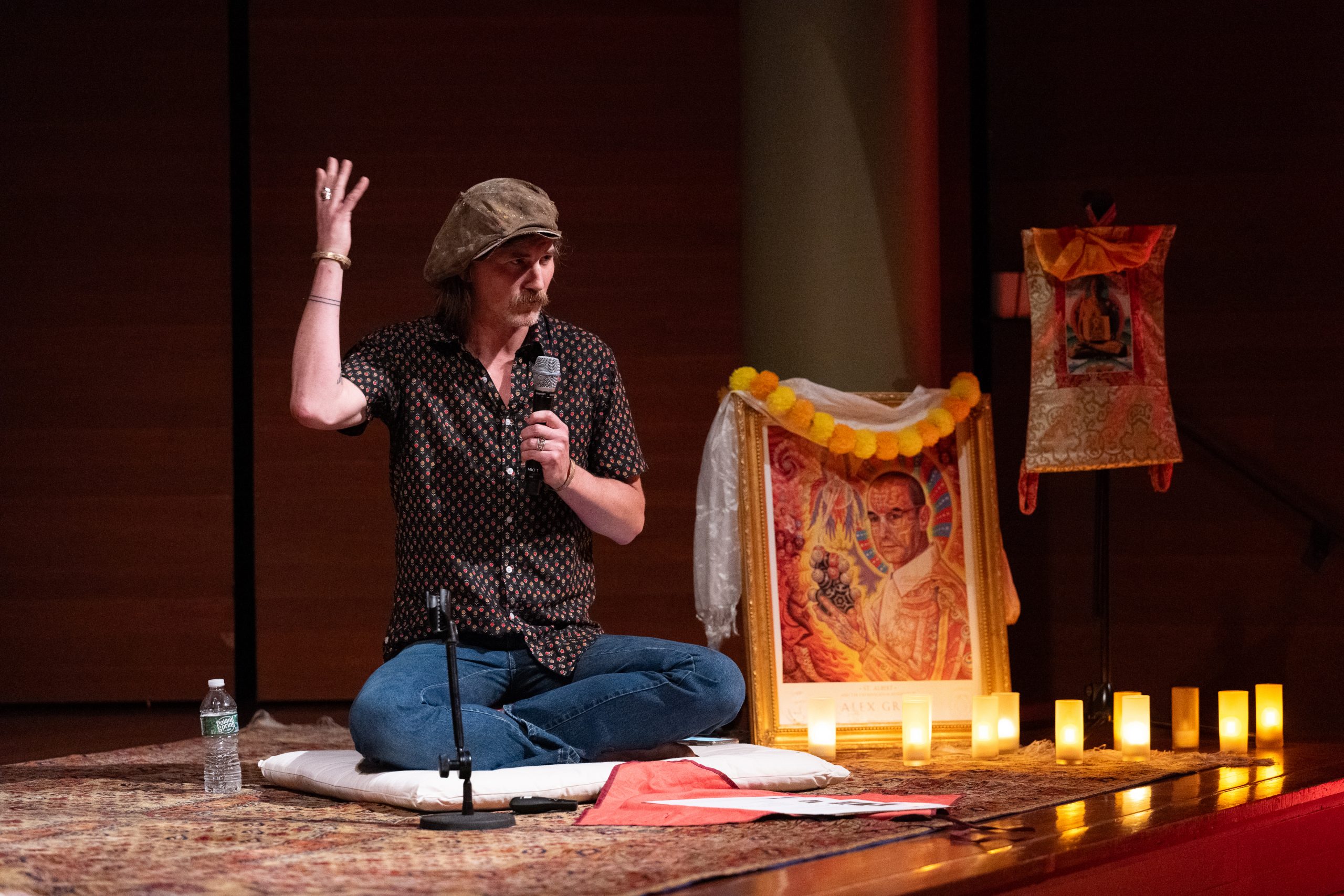
Chris Kelley has never been afraid to challenge conventional thinking. He’s performed prostrations across every bridge in New York City as a performance art project, organized a chöd ritual set to heavy metal music, and founded Psychedelic Sangha, a home for “misfit seekers” interested in both dharma practice and consciousness exploration.
He considers himself, in the language of poet Anne Waldman, an “outrider”: a figure on the edges of the mainstream who challenges and expands the boundaries of what’s accepted—part of the ancient tradition of the mahasiddha (tantric lay practitioners, with whom Kelley draws a parallel to the idea of the modern psychonaut) that goes back to the time of the Buddha himself.
This year marks his fifth year teaching The Buddha’s Revolution, a popular course at Eugene Lang College at the New School in Greenwich Village—once the vibrant epicenter of New York City’s counterculture—exploring Buddhism as a radical movement through history.
Many of his ideas challenge Buddhist orthodoxy, and that’s precisely the point.
 Scene from Psychedelic Sangha’s “Severing Ego” event at Judson Memorial Church. | Photo by Christopher Bruno
The course is built on a deceptively simple insight: that Buddhism has always been a revolutionary force, not just a spiritual practice. Shakyamuni Buddha himself was the original spiritual revolutionary—a man who abandoned wealth and power to seek truth for himself, and who rejected the caste system, the authority of the Brahmins, and the prevailing concept of the self, to propose something radical: the reality of suffering, and the possibility of liberation through the inner development of the individual.
The Buddha’s inward psychological turn, and the rise of the monasticism that it sparked, was radical in its time. Each subsequent turning of the wheel of dharma, Kelley argues, brought forth another revolution: not just philosophical but societal, turning the dominant paradigm on its head. That spirit of revolution is encoded in the very language of the wheel turning: “It’s a somatic metaphor,” Kelley says.
At a time when Buddhism has become integrated into the cultural mainstream and when meditation is frequently reduced to solely being seen as a wellness tool, the countercultural spirit and origins of the dharma are easy to forget.
But what’s never changed through history, through every turning and cultural assimilation of the dharma, is the true aim of Buddhism: the liberation of the mind. And liberation—freedom from the constraints of the established order—is, of course, what revolutionary movements are all about.
After attending Kelley’s lecture on the second turning and Nagarjuna’s revolution of “radical emptiness,” I sat down with Kelley for a lively, wide-ranging conversation on keeping Buddhist counterculture alive, psychedelics and the power of pure view, and the disruptive resonance between the dharma and the avant-garde art.
Your course explores the three turnings of the wheel of dharma as revolutionary movements in Buddhism. In class, you described the turning of the wheel as a “somatic metaphor,” that each turn presents a philosophical and societal revolution. How does that framing help us see the history of Buddhism differently? I’ve been in this Buddhism game long enough to know that words are weird, and the face value of those words may reveal itself through further practice and understanding. You’ve got the four noble truths, the three turnings. . . . There are endless lists in Buddhism. George Dreyfus used to joke, “There is no God in Buddhism. There are just lists.”
I asked myself: This turning thing, is it a metaphor? When you’re turning a wheel, it’s revolving. One circle is a revolution. I just loved that this was the case. It seemed, from a translator’s point of view, that there’s etymological compatibility here. Each turning of the wheel is a revolution in and of itself. It’s like physics. How do you get this thing moving? It’s hard, and all these forces are against you. You’ve gotta go against the grain. You’ve gotta get this thing moving that is inert, and then see how long you can keep it going before it’s inevitable, before it becomes ineffectual. Because the turning becomes the consensus reality; it becomes the paradigm. It’s what Foucault would call the episteme shift.
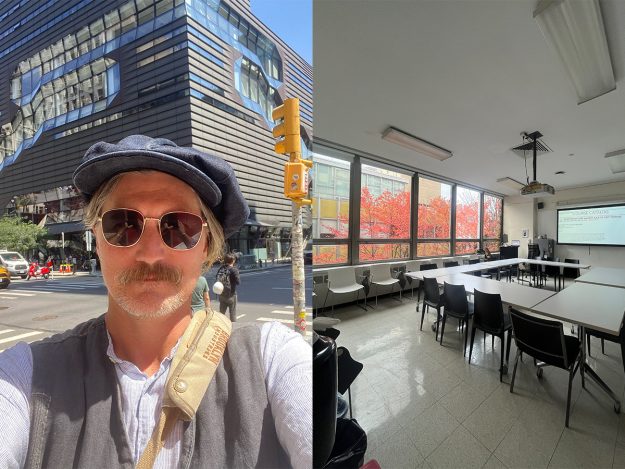 Left to right: Chris “Doc” Kelly, taking a selfie in front of the New School; Kelley’s classroom at the New School
There was a moment in the course when I realized how radical and revolutionary monasticism was in the first turning. It doesn’t have that resonance now, but back then, [what we think of as] monasticism wasn’t a thing. It was like Thoreau going to Walden. If you study Thoreau, eventually you’re like, This was no big deal. His mom was doing his laundry, he was a stone’s throw from civilization. But it was pretty scandalous to do this very un-American thing of not working and fucking off to the forest to do absolutely nothing. That’s radical. Now we look back, and he seems like a pretty posh yogi, not this heroic mahasiddha. But he totally was.
You’ve long been a countercultural presence in the Buddhist world. What inspired your approach to Buddhism, and this course in particular? I grew up Gelug. My family got involved in Buddhism—specifically my mother’s sister, who to me was the coolest person in the family. She was a hippie; she left Boston behind and went to Santa Cruz. When I started to get interested in Buddhism in college, it was the Gelug form, and the path was pretty clear for me: to follow in her footsteps. And I did.
It really wasn’t until more recently, when I’ve been taking teachings outside of the Gelug tradition, that it clicked that the version of tantra I was getting was divorced from the body, the very thing that tantra is about. And it was wedded so much to emptiness that it left you feeling like, How do you move past this foundationless thing? Where’s the foundation?
For me, psychedelics became a foundation. It’s a kind of Cartesian thing: What do I know from experience? I know this psychedelic experience is spiritually charged and beneficial. I just know it. I come away . . . feeling like I’ve transformed. So that’s a foundation. And then also getting in touch with the real tantra.
A lot of this was fodder for the course in my own sense that Buddhism needs a wake-up call: We need to be less about orthodoxy and more [about] risk-taking—not risk-taking in the ways that have created controversies around sexual misconduct but risk-taking in the very innocuous ways that are somehow threatening to tradition. Let’s do a chöd ceremony with rock ’n’ roll musicians—or, better yet, heavy metal musicians.
 Scene from Psychedelic Sangha’s “Severing Ego” event at Judson Memorial Church. | Photo by Christopher Bruno
That feeds into the philosophy of the course in terms of revolution, but it’s also part of my personal world where I do these events: music events and creating spaces for safe psychedelic experiences. I really do believe that psychedelics and these kinds of bodily immersive experiences are totally in line with the mahasiddha tradition, the tantric lay practitioner tradition.
In addition to your Gelug upbringing, you have an academic background and earned your PhD under Bob Thurman at Columbia. There seems to be a real tension in your own path between honoring tradition and challenging orthodoxy. How do you navigate that today? With Buddhism, I always felt like it needed it to be passionate and moving for it to work for me. I’ve never been interested in religion for religion’s sake. It had to have that passion. It had to have that emotive aspect, which supports pure view—this idea that you’re living in an alternate, magical reality. It is very much analogous to art and the creative process, and the idea of collapsing your imaginative art world into your life. There’s no boundary between the two.
But these are hard fucking things to deal with. There’s no easy answer. The annoying thing about Buddhism is that it’s all about the middle way, and figuring shit out for yourself. But that doesn’t mean you go rogue. The guru is supposed to be your sanity checkpoint. The guru is a lot of different things, but in this context, it’s the guy or gal who calls you out on your bullshit and says, “OK, now you’re just antagonizing the orthodoxy.”
I think a mature relationship to orthodoxy allows you to see your own transference. In my case, I saw very clearly that I had an ax to grind with orthodoxy. At a certain point, it wears off and you don’t care anymore. That’s when you can see the difference between a chip-on-your-shoulder motivation and something more enlightened.
In the course syllabus, you describe Shakyamuni Buddha as a revolutionary figure who was challenging the dominant religious authority of his time. You also describe important Buddhist figures like Nagarjuna and Milarepa as “spiritual revolutionaries.” What does it mean to you to be a spiritual revolutionary? I think it’s having a suspicion of reality, and to be—for better or worse—compelled like a splinter in the head to think about these metaphysical, tectonic issues that maybe a lot of people are thinking about, but it doesn’t seem that way. And more to the point, society doesn’t want you thinking that way. So there is an inherent revolutionary quality to that, to what I describe as cognitive liberty.
What does that mean to you—cognitive liberty? It’s a term that’s often used in the psychedelic community. It resonates differently in different contexts. I came across the term through psychedelic literature, where it largely means your freedom to alter your consciousness however you see fit. You have a right to that private domain of the self. Whatever you choose to subject it to, it’s your human right to do that.
For me, cognitive liberty in the context of Buddhism is also equating psychedelic experiences with meditation. Both are tools for altering your consciousness, and they do it in different ways, but they also do it in ways that are similar and compatible. You’re free to alter your perception through meditation, through yoga, through asceticism—it’s all the same thing.
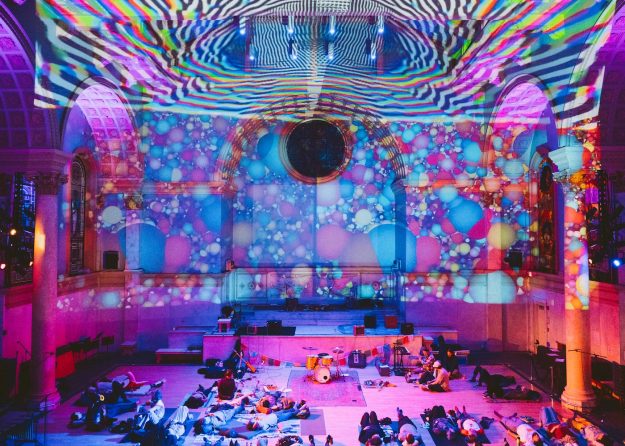 Scene from Psychedelic Sangha’s “Severing Ego” event at Judson Memorial Church. | Photo by Christopher Bruno
But in a human rights context, it takes on this idea of freedom of thought and the ability to be an outsider; or as Anne Waldman says, an “outrider.” This is part of the focus of my fall course, Buddhism and Avant-Garde Art, and also the Psychedelic Buddhism Conference, which is looking at the artist as the modern-day mahasiddha. Particularly, an avant-garde artist is always suspicious of reality. They’re suspicious of institutions too. The real avant-garde don’t do their exhibitions at MoMA. They’re much more punk than that.
It’s the freedom to have thoughts that are not necessarily in line with consensus reality. Like if you’re a tantra practitioner who’s practicing pure view, you’re actively imposing another reality on top of the one that you’re instinctually compelled to see. I tell my students, it’s like a reconditioning.
Jack Kornfield has said that LSD “prepares the mind for Buddhism,” and Alan Watts described both as part of a comprehensive philosophical quest. You’re the founder of Psychedelic Sangha and have done significant work at the intersection of Buddhism and psychedelics. What do you say to the criticism that psychedelic experiences are another play of appearances in the mind rather than an experience of genuine liberation? To me, it’s all creation stage tantra where you’re using these things to get your head around the philosophy. It’s a point of reference.
In phenomenology, it’s a bit like—fuck philosophy, just get into the subjectivity, the feeling part of things. So, yes, psychedelics are totally a fake enlightenment, but it’s like any other useful fiction. Everything is fiction, right? It’s an extremely useful fiction.
Psychedelics are totally a fake enlightenment, but it’s like any other useful fiction.
I know it’s not real, but it’s also just as real as any other useful fiction that I’m using, like making my meditation room special or setting ambiance with incense. And so it does all come back to magic. These are all the tools of magic. Magic is the imposition of will on reality, which is what artists do; they mold reality. Go to any artist’s home and you will see a living mandala. The whole place is a canvas.
I’m interested in your experience teaching Buddhist philosophy to Gen Z, who have inherited a meaning crisis and a set of existential threats that define their experience of the world. Are they resonating with Buddhist philosophy as a way through? Is there anything that seems to particularly resonate for them? I see this class as a place of cognitive liberty. I’m a fan of John Cage—he was a professor at the New School and ran a music composition class that attracted many nonmusicians: performance artists, painters, anybody who was an artist working in any particular form. What Cage was setting up was an incubator, a refuge for cognitive liberty. That’s how I run my classes. I want kids to feel like they’re not in just another class.You’re in a space that’s revolutionary.
Emptiness is what seems to really make a difference for them. I can see it in how they engage—there’s this sense of, This is something I should understand. They just nod along and fake it, Oh, emptiness, sure. And then somewhere in the second turning, with Nagarjuna, when you get into “form is emptiness, emptiness is form,” you see something go off in their heads. Like, Oh, that’s not what I thought. This is more interesting.
Then something happens that’s kind of beautiful: learning to sense the presupposition inside a question. The famous story is the Brahmin philosopher who comes to the Buddha with all these big metaphysical questions, and the Buddha says nothing. His students ask why he didn’t say anything, and he says: Every question was a setup. If I’d said yes or no, he would have clung to that and gotten the wrong idea.
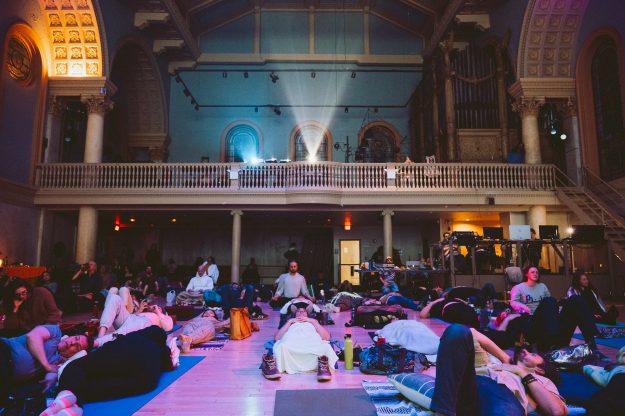 Scene from Psychedelic Sangha’s “Severing Ego” event at Judson Memorial Church. | Photo by Christopher Bruno
That sensitivity to presuppositions, as far as I’m concerned, is the main thing students take from this course that’s useful. Everything else is kind of storytime and having fun with Buddha. But the thing that makes a difference in their lives is that ability to apply emptiness thinking to problems and to their own cognition. Being able to identify their own assumptions—that ends up being not just about Buddhism but just good scholarship. Being aware of your own sociological orientation, your own clinging.
Ultimately, what I’m teaching—as good scholarship and good Buddhism—is the ability to see your own presuppositions. Not necessarily get rid of them, because you can’t. But you can know what they are. You can catch them when they come up.
As mindfulness and meditation have become fully part of the cultural mainstream, they’ve lost their revolutionary edge and are often put to work preserving the capitalist status quo. This is happening with psychedelics too. Do you think the dharma can be reclaimed as a genuinely revolutionary, liberating force? Are there places you see this already happening? I think people are reclaiming it all the time. I see people claiming enlightenment and having real experiences all the time. They are finding those points of liberation. One of my teachers, Lama Justin von Bujdoss, does dark retreat and talks about being in total darkness. Then, at some point, the mind creates light, and everything becomes illuminated. People will just be weird and have those kinds of experiences! Maybe a drug triggers it, but it could be anything.
 Scene from Psychedelic Sangha’s “Severing Ego” event at Judson Memorial Church. | Photo by Christopher Bruno
I also think Lama Rod Owens is doing a very good job of this. He talks a lot about ancestry—it’s not an emptiness kind of talk. What I found with Lama Rod’s teachings is this reclaiming of your genetic and epigenetic ancestry—this trauma that we are carrying all the time. That’s really radical to me. With the Buddhist element, it’s a very different way of analyzing self and getting to know more about your being.
What about art—do you see the potential for liberation there? You’re a performance artist, and you’re teaching a course on Buddhism and avant-garde art this fall. Art is where you can be a mahasiddha. The art world is where you can really get away from orthodoxy and experiment.
Art is where you can be a mahasiddha.
[After seeing Anne Waldman perform once], I thought, Let’s become dharma artists and see what we can do and have fun with this. We did an event where we opened with performance art and smashed a statue of the Buddha—“If you see the Buddha, kill him.” Oh my God, it was amazing. It was so liberating. We bought this porcelain Buddha from Home Depot—a garden Buddha. I didn’t account for the porcelain shattering like glass, so when we did it in this performative environment, my hands were bloody afterward. There was this really visceral, intense feeling you get only from, like, the body and performing, and, like, putting yourself in this weird, different space. For me, art is that space.