The Flow of Life
Two friends discuss attachment, impermanence, and the subtle joy that Buddhist practice makes possible. The post The Flow of Life appeared first on Tricycle: The Buddhist Review.
 Hollif

This conversation is excerpted from What Are You Waiting For?, a newly translated dialogue between the Austrian journalist Irmgard Kirchner and her longtime friend Santacitta Bhikkhuni. The two have known each other since long before Santacitta left behind a career in avant-garde dance theatre to become a Theravada monastic, teacher, and co-founder of Aloka Vihara in California.
***
We have been friends for more than forty years. I have observed profound changes in you since you began to practice Buddhism. Would you say that, for you, Buddhism is a path of healing? Definitely: every spiritual path is. It offers healing from ignorance or delusion.
How would you explain delusion to a non-Buddhist? Greed, hatred, aversion, jealousy… these states of mind are expressions of delusion. People are usually concerned with wanting more of one particular thing or less of another. Holding on or pushing away, not wanting to have – both of these patterns are variants of attachment. Attachment distorts reality, since it is an attempt to stop a flow. If you stand in an actual river and attempt to stop the flow of water, pressure builds up. The water begins to swirl around and is no longer on its natural course. This leads to a distortion of what is really there.
In Early Buddhism, one speaks of the four vipallasa, the four distortions of perception:
• seeing what is impermanent (anicca) as permanent (nicca)
• seeing what is painful (dukkha) as pleasant (sukha)
• seeing what is without a self (anatta) as a self (atta)
• seeing what is not beautiful (asubha) as beautiful (subha)
Can you give a concrete example from your own development to illustrate liberation from delusion and attachment? I have developed more trust in the flow of life as it is. I am aware of the lure of consumer society, but at the same time, there are many things I no longer get involved with. It is clearer to me than ever that my contentment and the subtle joy that it brings do not come from the things I possess. You can own the most amazing things and still be desperately unhappy. I have fewer needs and thus more freedom. Buddhist practice promises freedom from attachment and thus freedom from mental delusions and the resulting distortions.
If you apply this to your everyday life, then you have less stress in the here and now. You feel less pressure to earn a particular level of income in order to be able to buy all these things whose importance is drummed into you by the advertising industry.
You spoke about attachments that should be overcome. I can also become attached to things that cost nothing—for example, I can take pleasure in a butterfly or a flower. Of course, you can take pleasure in the butterfly and the flower, and therefore do not need to become attached.
For me, it is difficult to tell the difference. People say that Buddhism turns away from life in the here and now, since life is suffering, and turns towards another dimension. This is a wrong interpretation or translation, from the time when Buddhism was first encountered by the West. The expression dukkha was translated as ‘suffering’. However, dukkha actually means ‘unsatisfactory’. The word dukkha consists of two parts: du is a negative word and means something like ‘not fitting’, while kha describes the hole in the middle of a wheel, into which the axle is inserted. If the axle does not fit into the hole, the wheel will wobble, and it will be a bumpy journey. That is what dukkha actually means. And this unsatisfactory quality is not inherent in phenomena themselves—rather, it is the result of particular expectations regarding such phenomena.
There is nothing that can satisfy you in the long term. This recording device, this chair, and everything else in this room will, at some point, break and stop working. All things are unsatisfactory, so you cannot base your happiness on a thing or on another person. Of course, you can enjoy everything in the moment, as long as it gives you pleasure, but, if possible, do so without becoming attached to it, if you want to avoid the resulting stress that this brings.
The four noble truths are often compared to the diagnosis of a doctor. The Buddha can be seen as a spiritual doctor who can heal the illness of delusion. At the start, the diagnosis is that there is dukkha or the experience of suffering. A mind that is not fully awakened attaches to things, resulting in stress and suffering. Every person who lives with a little mindfulness will see that everything in life is constantly changing. Therefore, there is nothing that can satisfy you permanently—that is the first realization. To live is to experience discomfort. We cannot really control our own lives.
The second truth concerns the origin of dukkha. What is the germ, the pathogen that has caused this illness? It is attachment. Attachment and suffering or stress arise simultaneously: inadequacy is not a quality inherent in phenomena, but rather a result of attachment.
The third truth is an answer to the question about what constitutes a realistic and healthy condition. It means seeing things as they really are, without becoming attached to them. This is freedom from dukkha.
The fourth truth is the noble eightfold path: the treatment plan for achieving the third noble truth, health, by truly following the doctor’s prescription.
So, there is no contradiction between Buddhism and the joy of living? No, none at all. Joy is, after all, one of the seven awakening factors: Without joy, there is no awakening. One can also experience joy without attachment, that is, joy in the moment. Yesterday I was sitting in my friend’s garden when a huge flock of starlings suddenly flew over us. I heard the beating of their wings and felt a deep happiness. And then they were gone. That is true joy—in the moment. You can be happy and grateful to be able to experience something like this, without necessarily hoping that it will come back soon.
If I have no attachment, am I automatically living in the moment? Yes, and this leads to a quite different quality of joy, a subtle joy that is not based on the senses. If you contemplate this with a clouded mind, then you will most likely not be able to understand it. If you experience some kind of sensory pleasure and, at the same time, worry that it will pass, that is not actual joy.
If you experience some kind of sensory pleasure and, at the same time, worry that it will pass, that is not actual joy.
Such an attitude is marked by fear, and this fear blocks the path to true happiness. If you are in the flow of life, then enjoyable things will surface again and again. Joyful moments will occur, even if you are very ill or poor.
When I think of the impermanence of all things, it brings me to a dilemma. In the long term, everything will dissolve, and we will all return to dust. Our human species will disappear from the planet, other species will come, and at some point, the sun will go out. Why should I bother making any effort? For example, for the sake of social justice, the climate crisis, or biodiversity? When your mother is ill, you don’t say ‘I don’t need to look after her since she’s going to die one day anyway.’ If that was our attitude, we could all annihilate ourselves straight away. As long as we can, and out of kindness, it is always appropriate to try to alleviate suffering. This also corresponds to the four divine abidings (brahmaviharas), which are so important in Buddhism and which are also called the four immeasurables:
• loving-kindness (metta)
• compassion (karuna)
• gladness (mudita)
• equanimity (upekkha)
Having equanimity in the face of what takes place in the world is often misunderstood. Equanimity does not mean not caring, but has a lot to do with courage.
You are open to everything, even if it is frightening or too exciting. You always have the same courage to say: yes, I can engage with this. That is a central part of the Buddha’s teachings—to recognize how you relate to your own experience. You cannot change the natural laws, but, to the extent that it is viable, you can muster the greatest possible goodness and kindness and carry on practicing. In doing so, you are also doing yourself a favor, since you are training your mind positively and thus reducing your ego. When you die, these mental habits will have a good influence on your next birth. You are the greatest beneficiary, and, at the same time, it is also good for others or for the person you are looking after. In this way, every situation in life can be our teacher.
♦
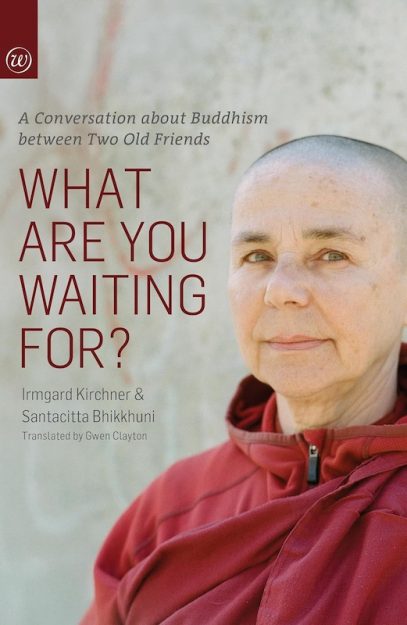
From What Are You Waiting For? A Conversation about Buddhism between Two Old Friends. © 2026 Irmgard Kirchner and Santacitta Bhikkhuni © 2026 English translation by Gwen Clayton. Reprinted with permission from Windhorse Publications.

Thank you for subscribing to Tricycle! As a nonprofit, we depend on readers like you to keep Buddhist teachings and practices widely available.