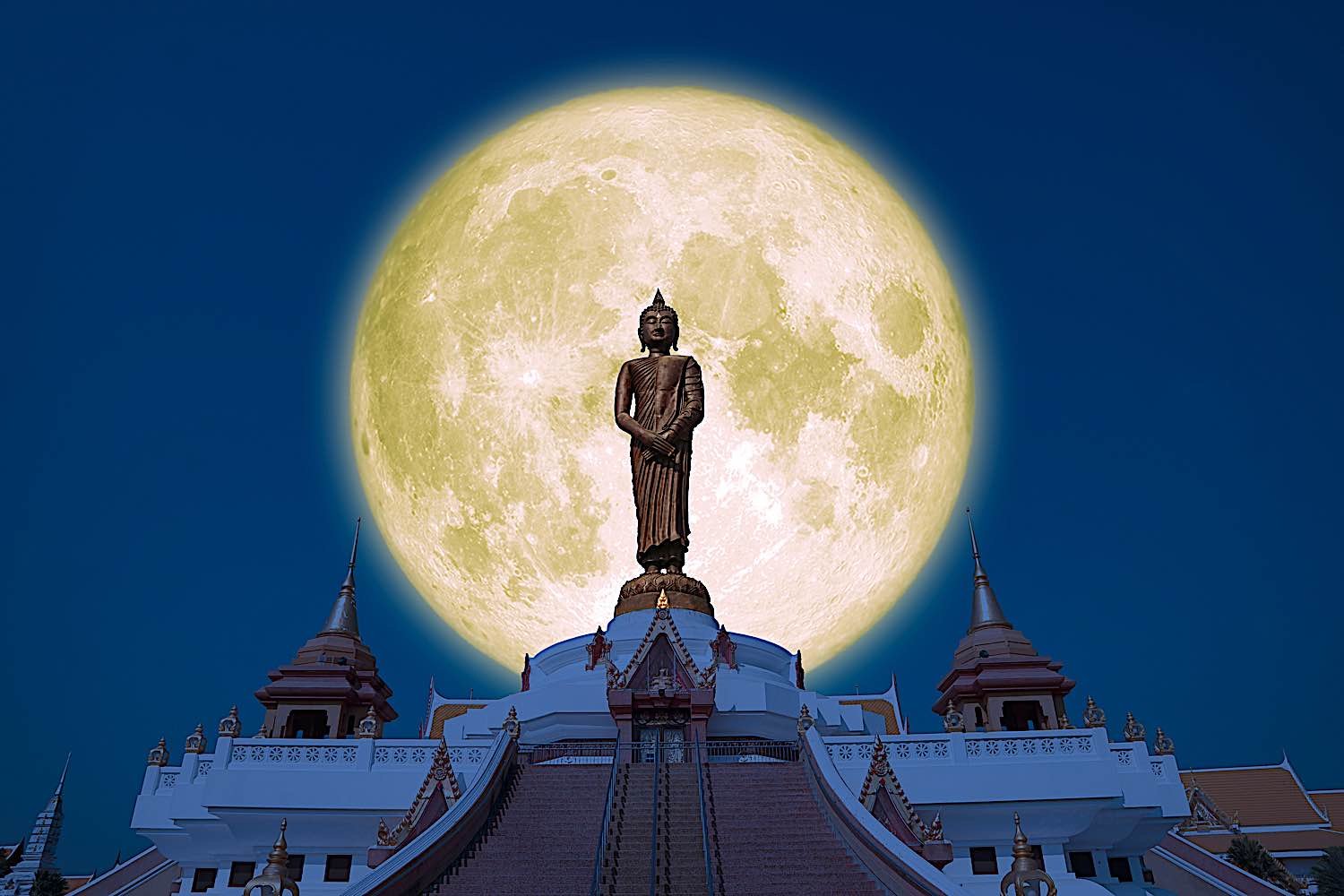
The Vow Verse to Arouse Aspiration
Forgetting and not forgetting The post The Vow Verse to Arouse Aspiration appeared first on Tricycle: The Buddhist Review.
 Hollif

The following chapter is from Reading the Heart Sutra by Hiromi Ito, originally published in Japanese in 2010 and translated into English below for the first time by Jeffrey Angles. A renowned poet, Ito first came to national prominence in Japan in the 1980s for her groundbreaking writing about pregnancy, childbirth, and female sexuality. In Reading the Heart Sutra, she examines a number of Buddhist texts and reflects on them in the context of her own life as she navigates motherhood, loss, and caring for her aging parents. Over the course of the next year, Tricycle will be publishing the English translation of the book serially, with one chapter released each month. Read the first three chapters here, here, and here.
***
There’s something I want to get done before it’s too late.
Something I want to get done while my father is still alive.
Something I want to get done while he’s still able to read.
Dad is alive, but maybe he’s dead.
He even says it himself. “I’m alive, but maybe I’m really dead—all I do the whole day is sleep.” I’m not quoting him to badmouth him in any way. It’s just that he’s waiting for the grim reaper, but for some reason, he hasn’t shown up yet. The same goes for Mom. Her life is already over, but death is taking its time. The situation is the same for them both, but still, they keep going.
Dad lives alone.
Mom did all the housework until three years ago. He didn’t lift a finger. He was a husband—a good husband, but in that generation, husbands just left everything up to their wives. Dad was a typical man that way.
Three years ago, Mom started to lose feeling and movement in her arms and legs. The cause was unclear. Some doctors said she probably had a stroke. Some said she might have neuropathy or varicosis, but the diagnosis was never entirely clear. In the end, she wound up in the hospital, never to check out again. She spends her days just lying there in bed.
Mom was always difficult to be around.
Nothing in her life ever worked out the way she wanted. Not with her daughter or her husband. Not in her daily life or even her own thoughts. And when things didn’t go well, she got irritated and took it out on the people around her. All my memories of Mom are of her acting testy or upset.
Once she was bedridden, however, it was flat-out impossible for things to work out like she hoped. She couldn’t eat like she wanted, sleep like she wanted, use the toilet like she wanted, or even scratch her body like she wanted. But she understood that, so somehow, awareness of her situation allowed her to relax. Once she started letting go, she became a better listener, even though she might seem out of it part of the time. Sometimes she even offers advice, even though her comments are usually somewhat irrelevant.
I go from California to visit my parents every couple of months. Each time I see Mom, she seems a little more relaxed, a little more out of it, and a little quieter. It’s like she’s slowly being purified somehow.
Occasionally, I think, gosh, she looks like my mother, but I never knew Mom to be so calm. Is that really her? I take a good look, and sure enough, it is. She recognizes me and talks to me with nostalgia in her voice. She listens to everything I’ve got to say. It’s her alright.
I’ve blurted out all sorts of things by Mom’s bedside—things about my husband, things about my daughters, things about Dad who’s been behaving like a child ever since she checked into the hospital, seeking my affection like a little child who wants to have their mother around.
My family is always on my mind, but most of the time, I don’t have anyone to talk to. I’m usually forced to deal with family problems myself or wait until things resolve on their own.
At first, I was worried about Mom being so cut off from the world that I spent a bunch of time looking for things to talk about with her. I wanted to give her some stimulation so she’d feel more connected to the world, but when I tried talking about various things, what she cared most about was my stories about family.
The only thing really left in her mind was family. When I talked about it, Mom listened more attentively than anyone—more than Dad who is always drowning in loneliness, and more than my husband who is always drowning in work. Mom even tried to offer advice, even though it usually missed the point. For me, though, it didn’t feel like I’m talking to my mother as much as whispering into a pot or a hole, which silently absorbs my words. But no, she did talk back. After swallowing everything up, she did respond.
It was only after she became bedridden that she has finally been able to help me out.
It was only after she became bedridden that I realized how wonderful a mother can be, even if she couldn’t get out of bed.
Everything is impermanent, however. Her dementia has progressed. She’s no longer able to understand the intricacies of her daughter’s and granddaughter’s lives. As a result, I’ve started telling her less. I simply mention whether things are going well and if everyone is in good health.
No matter what I talk about, Mom responds the same way. She thinks the same way. She launches into the same series of complaints about our relatives I’ve heard so many times that I can hardly stand it.
I ask, when did all this happen?
Most of the people she gripes about are long dead. Mom complains about things her sister-in-law said thirty years ago. About a feud with her mother-in-law thirty-five years ago. About a quarrel with her older sister fifty years ago. I should probably just shut up and listen, but her griping grates on me so much I can’t help butting in.
You’ve got to be exaggerating.
She must’ve said something nice to you at some point, right?
But Mom keeps complaining. So-and-so said this, so-and-so said that. So-and-so did something terrible to me—oh, it was so hard, oh, it was so awful.
As she goes on, I find myself increasingly on edge. I’m thinking about her demise. Death hasn’t come for her yet but will soon. To tell the truth, I feel like I’m also just barely scraping by. That means that when I start getting irritated, I have a hard time keeping my trap shut. I cut her off in a harsh tone of voice.
Mom, gimme a break.
It’s time to forget all that.
Surrounding Mom are other old women even worse off than her. Sometimes they flail around in their beds and shout. If they start shouting, they don’t stop. Mom complains about the noise. A bunch of old people lie in the next room, even more incapacitated than Mom. They don’t budge an inch. They just lie there, eyes shut, mouths open, and tubes coming out of them everywhere.
People are slow to die in our day and age.
Mom will probably end up like them one day.
She sometimes says, “I’d rather just die,” but no sooner do the words leave her lips than she thinks better of it and adds, “but that would just upset your father.”
She tells me, “My little sisters used to say, ‘You can’t die first and leave a man behind,’ but both their partners are dead, so I suppose it’s okay for them to go now.”
Both her younger sisters are old and weak.
She’s got one older sister too. She’s even older and weaker.
All three sisters have lost their spouses. They could go at any time, but even so, all three keep living.
The older sister who is so old and weak is, of course, my aunt.
She didn’t have any children of her own, so she poured all her love on me. We used to go to her house to hang out and spend the night, but when it came time to go home the next day, I’d be distraught. I’d break down in tears, and she’d put a stuffed animal in my arms, saying, “Look, here’s a little friend for you to take home. I’ll lend him to you ’til you come back next time.” I walked away crying, too sad to look back over my shoulder. She watched as the car pulled away.
Even though I didn’t turn to look, I felt like I could see her. I suppose this is what you call the “mind’s eye.” I was staring at her with my mind’s eye once when I heard Mom whisper to Dad, “I don’t know why she’s got to tell Hiromi she’d ‘lend her’ a stuffed animal. Why not just give it to her? My sister never acts like a grown-up, no matter how old she is.”
Even though I was just a little girl, I thought Mom’s argument was way off base. The stuffed animal comforted me, serving as a sort of a substitute for my aunt. It was effective because it belonged to her. Not just that, it smelled of her too. Holding onto it, I knew I’d survive until the next visit. That much was clear to me.
I loved that aunt, but when I was in elementary school, she and her husband moved to Osaka. After that, I lost touch with her. Yes, to paraphrase the sutra I mentioned in the first chapter, I have created so much bad karma in my past.
Last year, I went to visit her for the first time in decades. Her husband had an advanced case of Alzheimer’s, so after some time in a nursing home, he eventually landed in a hospital. My aunt has been living on her own for years.
The moment the door to her tiny apartment swung open, I detected the same familiar smell as at her old place. She emerged from the darkness, teetering on her feet and holding onto things for balance. She’d grown old and frail.
I went to the hospital with her. My younger cousin was already there.
“Uncle, Shiromi-chan is here to see you.” He pronounced the “hi” in my name sort of like the English word she, adding the S-sound you hear in the local Tokyo dialect.
My uncle didn’t respond. My cousin told me he was always like that.
This cousin was the son of a different aunt. He lived nearby, so he took care of his mother’s older sister—my aunt, in other words—and her husband too. He ended up caring for them simply through happenstance, just because he and his wife happened to live nearby. Realizing that made me feel terrible. By leaving them on their own, I was developing bad karma—all through my own beginningless greed, anger, and delusion, as the sutra says. After all, this aunt had loved me so much when I was a little girl.
A doctor stopped my cousin in the hall and started talking to him about giving my uncle a gastrostomy. That means creating an opening in the stomach to insert nutrition directly into the body. The doctor said that without it, my uncle wouldn’t last much longer.
My first thought was why? If he’s going to die, let him die. Dying is the natural course of things.
Of course, it wasn’t my place to say anything. I might have an opinion, but I am just a niece. Someone closer to him wouldn’t feel the same way. So, the doctor gave him a gastrostomy. He lived for an additional few months then died.
After that, I started calling my aunt from time to time.
Remember, I was calling my father all the time. I had a hard time finding things to talk about even with him. Just imagine how hard it was for me to find things to talk about with my aunt, who I hadn’t been in contact with for decades.
Even so, when I called her from California, her voice brightened. “Ah, nothing makes me happier than getting a call from you.”
All of this, I now avow and repent.
My father and my aunt were both born in the same month of the same year. When I called her on birthday, I asked her how old she was. “87!” she said. “Can you imagine? Just terrible!”
A few days later, I called Dad on his birthday and asked the same question. “85,” he said.
Even if they were born in the same month of the same year, was it possible for one to slip past the other? Of course not. I did the math and realized they were both 86.
The next time I called my aunt, I told her she was 86, not 87. She just said, “Oh, really?” The next time I called my Dad, I said the same thing. He responded with a disinterested, distant, “Is that so?”
Both were misrepresenting their age without really knowing it, but when you get to be their age, numbers don’t matter much anymore. There’s not much difference if you’re 85, 87, 97, or even 127.
How long is Dad going to last? How long does my aunt have left? How many more long years will they spend in their loneliness?
When I think about this, I get so despondent that I hardly know what to do with myself.
Dad lives alone. Every morning, a home helper comes in for an hour and a half to do things around the house. Apart from that, he’s always alone, whether he’s awake or asleep. Each time I come back to Kumamoto, I see how weak he is. He has a hard time carrying on a conversation, and he’s unsteady on his feet. Over the course of the few weeks I stay, he warms up, gets used to talking again, and his conversational abilities start to return. Even his face brightens up.
There’s a TV channel that shows historical samurai dramas all day long. It doesn’t matter where you start in a samurai film, they’re not hard to follow. The channel seems to have an intoxicating effect on him. He lives in front of that thing. If he gets bored, he picks up a samurai novel. Or he’ll watch sumō on TV. Or baseball. Or the news. The news is constantly changing. Nothing lasts. What happened yesterday is forgotten today. Everything is impermanent.
A few years back, I published a book called The Thorn Puller that describes the difficulties of trying to care for my family in California while taking care of my elderly parents on the opposite side of the Pacific. Dad read it. He told me, “Partway through, the book was hard for me to read, but the end left me with a ray of hope. It made me feel like we might be able to go on living forever.”
I think he was reading a little too deeply into it. He wasn’t exactly right, since the book is at least partly about the difficulty of aging, but he wasn’t entirely wrong either, considering he and my mother were still alive at the end.
Dad used to be really interested in my life. More recently, that interest seems to have waned, but his comment about reading the book showed me he wasn’t completely disassociated. I was embarrassed to know he’d read about himself in my book, but I suppose I was happy he’d even read it at all. It was a sign. Dad’s still alive.
However, everything is impermanent. His interest didn’t last for long.
A little while later, The Thorn Puller won a major literary prize. Actually, not just one, but two. I tried to talk to him about it, but I don’t think he understood just how rare and special it is to win two huge prizes. For some reason, the sounds of the word prize didn’t seem to register in his ears.
I tried shouting. “I won the Murasaki Shikibu Prize. The-Mu-ra-sa-ki-Shi-ki-bu-Prize,” but he just looked back at me blankly. It didn’t even look like he was even trying to understand. When I shouted, “I won the Hagiwara Sakutarō Prize too. The-Ha-gi-wa-ra-Sa-ku-ta-rō-Prize,” I got the same response.
Not knowing what else to do, I changed the subject and started talking about the Edo period police official Hasegawa Heizō—the hero of one of his favorite series of samurai novels. He had no problem responding to that. He might forget his own daughter’s book, but he had no trouble remembering the details about what Hasegawa Heizō ate in just about every volume of those damn books.
Recently, I realized something interesting. Sometimes when Dad is talking to me, he uses the word “Mom” to talk about his wife. He doesn’t do this consciously of course. Sometimes when talking about my daughters, he accidentally calls them by my name, “Hiromi.”
So, who am I then? There’s a part of me that wants to ask, but I’m too afraid to hear the answer. It’s an unsettling twist, as if real life is imitating mythology.
As I worked to accept all this, a thought occurred to me.
Even if Dad forgets the identity of his 52-year-old daughter, he’ll never forget the 3-year-old he once held so lovingly in his lap. He’ll never forget what a cute little girl I was. And that, I suppose, is enough.
These days, I’m obsessed with death.
It doesn’t matter what I’m reading. My eyes linger on any mention of it.
Back in the old days, people usually had simple deaths in their 40s and 50s. It makes me wonder why we’re forced to die the way we do today. People keep on dragging along, slowly dying but unable to die completely, withering away like a plant. Why put up with this?
No one thinks seriously about death. No one thinks about how we should die, nor what death really is. Everyone just tries to put it out of their minds.
Everyone seems totally unprepared. During the 1960s and 1970s, everyone had an attitude like in Jimmy Buffett’s “Margaritaville”—I know I shouldn’t keep on wasting my time, but here I go doing bad stuff anyway. It was like despondency was their religion. No, that’s a bit misleading. It’s like despondency had filled in the space that religion would have occupied in the past. I’m reminded of the end of Frank Sinatra’s “That’s Life”—“I’m gonna roll myself up in a big ball and die”—or the Rolling Stones singing, “I got no expectations.”
When I was growing up, I heard people expressing resignation and desperation all the time, but no one ever taught me the Buddhist expressions you might use when feeling that way. I didn’t learn the nenbutsu, Namu Amida Butsu—“I place my trust in Amitābha.” I didn’t learn the passage from the Flower Garland Sutra that goes Nenpi Kannon-riki—“I call on the power of Avalokiteśvara.” I didn’t learn the passage in the Dhammapada that goes Shoaku makusa—“Avoid all evil”—and I certainly didn’t learn the Heart Sutra with its gate gate incantation at the end.
However, when I trace my way backward through these texts, I feel like I understand things better. I use the word “trace back” here, but in reality, I felt like I’m fumbling my way through the texts, following a super poorly marked trail like Hansel and Gretel’s breadcrumb path through the forest.
The sutras have served as guides to people since time immemorial, so I thought that if I studied them, I might be able to look death in the face. So, I started reading about the Buddhist canon. The books I read didn’t stay with me. They were boring. They didn’t lead me to enlightenment. There was something fishy about them. I might be at fault, but I’m myself. I’m the center. I am who I am. Having finally grasped a hard-won sense of self, how could I possibly let it go? I’d be left with nothing. I’d be completely undone.
However, here I am, confronted with my father’s situation. He’s right in front of me, dying but unable to die completely. Living but unable to live completely. The same is true for Mom and my aunt.
They loved me dearly. They took care of me. Now death is approaching, and they don’t know what to do. It’s like Mom, Dad, and my aunt are wandering through the bardo, the intermediate stage separating death and rebirth in the next life. It’s good, I suppose, that they’re suspended. That means they’re still alive, but I keep wondering what they need to prepare for their journey across death’s doorstep.
In my searches, I came across a verse. It is typically described as a 發願文 or “Vow Verse”—in other words, a verse written arouse aspiration for enlightenment and rebirth in the Pure Land.
願弟子等
臨命終時心不顛倒心不錯亂心不失念
身心無諸苦痛身心快樂如入禪定聖眾現前
乘佛本願上品往生阿彌陀佛國
到彼國已得六神通入十方界救接苦眾生
虛空法界盡我願亦如是
發願已至心歸命阿彌陀佛
May it be that when the time of death approaches
For us, your disciples, our minds do not turn upside down
Do not fall into confusion, and do not lose composure
May there be no suffering in body or mind
May body and mind be at ease as in meditation
May the holy assembly appear before us
May we attain birth in the highest land of Amitābha Buddha
With the power of the Buddha’s original vow
May we obtain the six supernatural powers
May we enter the worlds of the ten directions and
Bring deliverance to suffering beings
As long as emptiness and the dharma-realm endure
This shall be our vow—this vow we have made
With utmost sincerity, we take refuge in Amitābha Buddha
I understand this verse originally appeared in the collection Liturgy for Rebirth written by Shandao, a founder of Pure Land Buddhism in China. I understand his thought exerted a great deal of influence on Japanese Pure Land philosophy. (Here I go again. I’ve become the mayor of “I-Understand-Land” again.)
Shandao lived from 613 to 681. That means his life overlapped with Xuanzang (602–664), the Buddhist pilgrim who went to India and translated the Heart Sutra as well as lots of other things into Chinese. That means he lived during the era described in the Chinese classic Journey to the West, starring the Monkey King Sun Wukong and Pig Monk Zhu Bajie. That means the Vow Verse and Xuanzang’s translation of the Heart Sutra are from the same time. That means all of this happened around the same time as the ancient Japanese Prince Shōtoku (574–622) and the statesman Soga no Emishi (?–645). Thinking through this helps these things feel a heck of a lot closer—at least for me since I’ve had so much fun over the years reading about Chinese legends and Japanese history through manga.
This verse is an example of what’s known in Sanskrit as a gāthā, which basically means “poem.” Even if you’re unfamiliar with the sutras, this definitely feels poetic. Of course, poetry is my profession, so I feel comfortable and even enjoy reading things like this. After scouting around on the net for a while, I discovered the original source.
But hold on a second. Right before the Vow Verse, there was another verse called the Sunset Impermanence Verse, also by Shandao. I was struck by this one. Here it is.
諸衆等聽説
日沒無常偈
人間怱怱營衆務
不覺年命日夜去
如燈風中滅難期
忙忙六道無定趣
未得解脱出苦海
云何安然不驚懼
各聞強健有力時
自策自勵求常住
Let all assembled here this recitation
Of the Sunset Impermanence Verse:
Humans hurry day in, day out, managing many affairs
Never noticing lives and years slipping away, day and night
Like a lamp in wind, who can say when it will go out?
Busily, they wander the six realms, with no fixed destination
Not yet liberated, not yet escaped from the sea of suffering
How could they feel ease or leave behind alarm or fear?
All of you listening, while still strong and energetic
Spur and rouse yourselves so you may dwell in the eternal
Let me paraphrase this in my own way.
The Verse of Impermanence, the Setting of the Sun
Listen
Listen to this verse
Describing the impermanence of all things
Which fade away like the sun must set
Our lives are as short-lived
As the flame of a candle
Caught in the wind
Karma carries us through life after life
Through death after death
And still, we are not enlightened?
And still, we fail to escape suffering?
How can we be so complacent?
How is it we feel no fear?
Listen
Now, while you are strong and sound of mind
Think ahead about death
The death still to come
I find myself wondering how my father will die. I decided to ask his doctor.
“If he stays the course, he might keep living without developing any serious disease, but his legs will grow weak. Even so, I imagine he’ll want to keep living there on his own, all alone. He’s going to lose more and more motion. He’ll need to have his home helper come more often. Eventually, he’ll probably catch a cold or flu then develop pneumonia. Or, maybe something will get caught in his throat.”
When he’s eating, things already get caught in his throat.
“The older people get, the easier it is for them to choke. When their ability to swallow gets too weak, the only choice is to feed them through a tube.”
I imagine the helper arriving one day to make him breakfast, then finding him, with an “Oh no, Itō-san!,” lying on the ground. Is that how he’ll end up?
“Probably,” the doctor said.
May it be that when the time of my father’s death approaches . . .
May it be that his mind does not fall into confusion nor lose its composure, may there be no pain, may his heart be at ease so that he does not suffer all alone in death . . .
May it be that he thinks, ah, I’m about to die, my final years have been lonely but such is fate, I led a relatively good life, I had a wonderful wife, I loved my daughter when she was a little girl, she may have grown up to be unreliable and here I am spending my final moments all alone, but that’s life, that’s how things are, she tried her best to be a good daughter, and that ought to be good enough for me . . .
As I look at the Vow Verse, I realize the part starting with “Buddha’s original vow” wouldn’t mean anything to Dad at all. He’s never spent any time thinking about the Pure Land, the Buddha, or the like. I try to imagine him surrounded by the Buddha and his community of sacred followers, then being carried smoothly off toward the Pure Land Paradise like he’s riding in a limousine. However, I think it is already too late for that. It will be enough if he can die relaxed, collected, at ease, and at peace.
He lived the very best way he knew how. He went to war and came back an utterly broken man, then during the fast-paced postwar period, he managed to protect his wife and raise a little girl even though he was a fly-by-the-seat-of-your-pants kind of guy. As his daughter, I think he did a great job. That’s why I want to point him in the right direction. I want him to meet death while his heart is at peace.
I hope that in his final moments, he remembers the Vow Verse, which I have rewritten for him here. I hope that as he breathes his last, these words bring him comfort and clarity.
A Vow Verse, to Arouse Aspiration
I humbly request
That at death’s door
I do not grow flustered or upset
Nor lose my peace of mind
That body and mind remain calm
And free from suffering
May it be as Buddha wishes
That I die well
That my heart is as calm as if I have seen
Buddha before my very eyes
Buddha coming to take me away
Buddha wanting to help me and all the others
May I reach the Pure Land and find the power
To return to the world and help those who suffer
As long as people are lost
As long as it takes
As long as it requires
I will make this request
This is what I wish for—
With body and mind
I firmly believe
We all will be saved