Who Is the Real Thich Minh Tue?
The making of a Buddhist folk hero in the social media age The post Who Is the Real Thich Minh Tue? appeared first on Tricycle: The Buddhist Review.
 Hollif
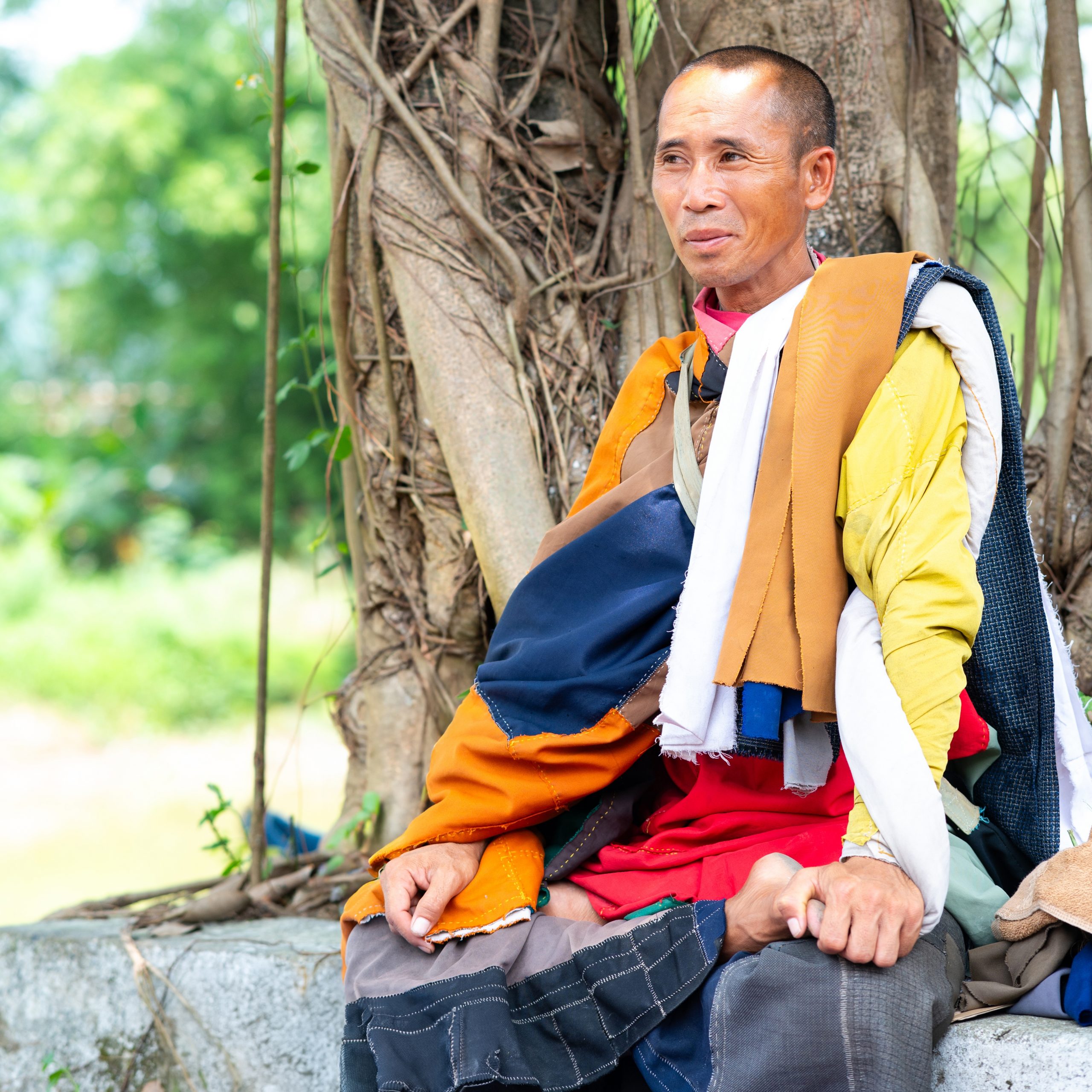
It was in early 2022, as the world was still settling into its new rhythms in the wake of the Covid pandemic, that videos of the mendicant calling himself Thich Minh Tue first started appearing on my social feeds. At first, he was sighted only from afar, but his features were distinctive and recognizable. He was a thin, diminutive man; his scalp was shorn like a bhikshu’s; but he was dressed in an atypically colorful robe, a stitched-together patchwork of tattered cloths and linens in a dizzying chaos of random patterns and textures. His skin had browned under the tropical sun, his bare feet calloused and blackened from the dirt and asphalt and grimy muck of auto exhaust he trod through daily. These were short clips of sightings from across the road or at the opposite end of a long bridge, with some explanatory text set to inspiring traditional music, overlain with the ubiquitous filter of sparkling starbursts raining down the screen that normally accompanies the TikToks, Instagram Reels, YouTube Shorts, and other short-form content populating Vietnamese-language Buddhist social media. The subtitles in one of these early shorts explained, This solitary mendicant, called Thich Minh Tue, has been seen traveling barefoot from city to city. When asked where he is going, he says he is following the Way of the Buddha. Delight forms a smile on his lips, he places his hands together, bows his head, and then turns away, proceeding onward to the next city.
Sightings of the mendicant quickly ballooned on social media into a viral sensation. Crowds began to cluster around him. The videos sweeping through my social feeds suddenly showed Minh Tue up close, wearing a wide and toothy grin, as he spoke to small crowds of young people about the buddhadharma. I could see some of the devotees in the crowds crying as they listened attentively with palms pressed reverently together. In the comments, among the usual praises to the Buddhas Sakyamuni and Amitabha, there were people talking about miracles and blessings. The arrival of this barefoot ascetic in his colorful tattered robes to your town or city was a sign of great auspiciousness, they said. One woman reported that she had taken her ailing elderly mother to pay respects to Minh Tue as he passed through their town, who then recovered back to full health just days later. Other comments remarked about how the rains would stop, the clouds would part, and rainbows would stretch across the sky as the devas rejoiced upon his approach. Some would even note wild creatures emerging from their dens and caves and nests, to congregate along roadsides in order to catch a glimpse of Minh Tue and his technicolor dream-robes.
This early enthusiasm echoes a lot of what we know about how the legendary reputation of Budai developed—the plump and jovial 10th-century Chan monk first mentioned in the Jingde Records of the Transmission of the Lamp, and often recognized as an emanation of Maitreya Bodhisattva. According to tradition, Budai was ordained at Yuelin Temple in Zhejiang Province, where his mummified whole-body relic is said to still be enshrined today. Little is known of his early Buddhist activities or training, but he ended up becoming a wandering monk, carrying a cloth sack containing alms and other effects. Owing to his distinctive appearance and a reportedly constant joyful demeanor, he cultivated a popular reputation of equal parts veneration and mystique. Budai would gather up toys found along his journey and distribute them to children he encountered. His constant laughter was so infectious that, as legend has it, it was impossible not to feel drenched in joy while in his presence. When he arrived in a town, folk stories state that the rains would stop, the clouds would part for him, and rainbows would stretch across the sky. Animals would peacefully congregate along roadsides, bowing their heads to him in reverence, knowing they were graced by the presence of a true bodhisattva. According to legend, if Budai crossed through town wearing wet sandals, rain would fall soon afterward; if he instead crossed through town wearing wooden clogs, then rains would stop and the skies would be clear and sunny for days following his arrival.
It’s difficult to look at the sensationalism surrounding Thich Minh Tue, along with the reports of miracles following in the wake of his virtue, and not see the lore of a contemporary Buddhist folk hero developing in real time in front of our very eyes. In the beginning, much of the viral attention surrounding Minh Tue was rooted in the ascetic’s enigmatic mystique—who was he? Was he a monk? Was he affiliated with a temple? What to make of all the reports of miracles? The comments sections of videos that featured him swelled with activity. What began as mild novelty and fascination became equal parts wonder and reverence. Clips of Minh Tue simply approaching from a distance dwindled, more and more videos appeared that had been recorded from within the throngs of young devotees surrounding him in the cities and towns he visited. No matter the questions asked, his responses were often the same: He encouraged lay practitioners to keep to the precepts and ten wholesome actions, to read and chant the sutras, and to venerate the Buddha.
As Minh Tue’s popularity continued to grow, the question of his status in relation to institutionalized Buddhism began to take on a greater share of the commentarial activity on social media. He can’t be a monk—he doesn’t wear a kasaya, claimed one remark. The holy life is not demarcated by superficial signifiers but by actions in accordance with the buddhadharma, another would counter. The arguments cycled and recycled. The algorithms took notice, yanking up any posts featuring or even mentioning Minh Tue to the tops of people’s feeds, exposing his quiet pilgrimage to significantly more eyes, ensnaring more and more people to begin chiming in on the controversy. Minh Tue, being a hermetic wanderer, remained blissfully unaware of this growing crescendo of content about him. Influencers, particularly those based in the diaspora, began leveraging the virality of the topic. Eventually, Minh Tue was asked directly about his status, and he responded with the statement, “I have no house; I have no temple; I belong to no sangha; I am no one’s master.” He explicitly did “not consider [himself] a monastic.” Minh Tue clarified that he had been ordained as a novice into the Theravadin order but found the rigidity and structure of monastic life unsuitable for the path he was seeking. Finding inspiration in some of the Buddha’s earliest instructions to practice the thirteen dhutangas—a set of ascetic practices the Buddha declared to be aligned with the Middle Way, consisting of: (1) wearing only robes made of discarded cloths; (2) owning only three robes maximum; (3) eating only donated alms food, rejecting full meals offered in temples or by lay followers; (4) collecting alms from all houses equally, and not just wealthy ones; (5) subsisting strictly on a single meal a day; (6) eating only out of the begging bowl, refusing the use of dishware; (7) refusing to accept additional alms after being sated; (8) residing in the forest; (9) residing under trees without a roof; (10) when not residing under trees, residing in a tent fashioned from one’s robes; (11) residing in the charnel grounds or graveyards; (12) finding satisfaction in any type of sleeping arrangement; and (13) constant walking, standing, or sitting, refusing to lie down—Thich Minh Tue disrobed and set off to practice the dhutangas on his own in solitude, slinging over his shoulder a new patchwork robe stitched together from a myriad of discarded cloths in the manner that one such dhutanga exhorts. That might have been the end of this particular controversy—lay hermits practicing Buddhist asceticism, while rare, are not unheard of in Vietnamese history and culture—but not long afterward, the state-endorsed Vietnamese Buddhist Sangha (VBS; Vietnamese: Giao hoi Phat giao Viet Nam) also released its own statement on the matter, citing growing concern over the media sensation surrounding Minh Tue. In it, the organization reaffirmed that Thich Minh Tue was not an ordained monastic or affiliated with any Buddhist institutions or organizations associated with the Vietnamese Buddhist Sangha.
Despite this being consistent with Thich Minh Tue’s own statement, this notice set off a firestorm. Social media influencers in the Vietnamese diaspora rushed to chime in with an opinion, regardless of whether or not they had covered Buddhist topics before. Far-right voices who never trusted the VBS in the first place took the opportunity to decry claims of religious oppression; far-left nationalist voices then responded with equal vitriol, accusing Minh Tue of being a dissident. The arguments roiled on for weeks, half the Vietnamese world calling him a saint and miracle worker, with the other half calling him a grifter and con man. Social media algorithms again percolated this controversy to the tops of everyone’s feeds.
Though the most hostile responses represented the few and fringe occupying the political extremes, the Vietnamese Buddhist Sangha’s involvement was still a contentious matter, even among more moderate voices, and it transformed the Thich Minh Tue social media phenomenon from a quirky viral fascination within the Buddhist community into an intense political battlefield.
 Minh Tue in March 2025. | Photo via Cuong Pham / Wikimedia Commons
The VBS was first formed in the years immediately following the country’s reunification, in a merger of the Unified Buddhist Church of Vietnam (UBCV; Vietnamese: Giao hoi Phat giao Viet Nam Thong nhat) that had been operating in the southern Republic of Vietnam and the Unified Buddhist Association of Vietnam that had been operating in the country’s north. The UBCV itself was initially formed in the wake of the 1963 Buddhist Crisis, when the Buddhist majority engaged in a crescendo of protests against the religious oppression from the US-backed South Vietnamese government. It assembled together most of the various Buddhist traditions present in the Republic of Vietnam into a unified association that could collectively organize and advocate for the rights of Buddhists.
After the reunification of Vietnam, most of the organizations and communities that had fallen under the UBCV opted to merge with the Unified Buddhist Association of Vietnam to form today’s Vietnamese Buddhist Sangha. However, many refused to cede any authority to the communist government, and so the UBCV continued to operate with its head monastics placed under house arrest in the newly renamed Ho Chi Minh City. Thich Nhat Hanh, exiled to France by the oppressive Diem regime years earlier, founded an independent spiritual successor, the Eglise Bouddhique Unifiée du Vietnam, which was the early foundation for what would become Plum Village. In the United States, another spiritual successor was formed under the name the Vietnamese American Unified Buddhist Congregation. Some of these satellite organizations still look to the temple in Saigon as their central authority even today. At present, the UBCV and VBS maintain a tenuously respectful relationship with each other, as the old political tensions between communist and liberal ideologies peter out with the younger generations. The VBS, belonging to the Vietnamese Fatherland Front, the nation’s largest union, is sanctioned by the government, while the UBCV is officially banned and unrecognized. In spite of this, the leadership within each association tend to generally have kind words and a respectful demeanor toward each other, sharing an unspoken acknowledgment: that there is need for both a Buddhist association within Vietnam’s system of socialism, as well as need for an independent association that can more easily interface and integrate with Vietnamese Buddhists in diaspora among the globalized capitalist world. The two associations occasionally enter dialogue toward reconciliation, and, for brief moments here and there, a remote possibility of unification hangs in the air. And yet these moments of hopefulness and optimism are always punctuated with the UBCV’s persistent criticism of the VBS as a propaganda arm of the communist party, or the occasional show of force from the constabulary against UBCV-aligned temples—a harsh reminder that, in Vietnam, the state is always the final authority.
But, half a century after the nation’s reunification, for so many of the Vietnamese that experienced it, the war has never ended. Among the young Gen Z devotees that built up the viral phenomenon, Thich Minh Tue is a holy man, an inspiring figure committed to practicing the path laid down by the Buddha, independent of the droll and bureaucratic systems of institutional Buddhism. To the wartime generation, he is either a valiant and defiant crusader leading a spiritual war for democracy and freedom, or he is a capitalist grifter and dissident preying on those of genuine faith and threatening to disturb over fifty years of political stability. In this age, where anyone with an opinion and a smartphone can become an influencer, each population projects the monk that they personally need to believe in onto Minh Tue’s patchwork robes.
And so when the VBS released their statement denying the wandering ascetic Thich Minh Tue’s status as a monastic, the UBCV released its own statement in opposition to the state-sponsored sangha’s letter. They declared that Thich Minh Tue’s prior ordination status and his continued practice of the thirteen dhutangas since his formal disassociation from institutional Buddhism are sufficient grounds for him to be considered a “monk” (Vietnamese: tu si). As the controversy continued to bubble throughout 2024, Thich Minh Tue’s fame and virality only increased with it. His appearance in one town drew massive crowds, blocking traffic and choking off intersections.
In May of that year, one of the lay devotees following Thich Minh Tue collapsed due to heatstroke as they passed through Quang Tri Province. He was rushed to the hospital but did not survive. The summer heat continued its oppressive brutality over the next several days. Then, as Thich Minh Tue and his followers passed through Thua Thien Hue Province, several more were reported to have fallen with heatstroke, the crowds so thick that the ambulances had trouble moving through the area—luckily, though, everyone who was hospitalized recovered on this occasion. In response to these incidents, the Vietnamese government deployed a police escort to accompany the pilgrimage, and also blockaded media outlets from having access to Thich Minh Tue, citing the need to protect both the ascetic and his followers, as well as to prevent the exploitation of the “Thich Minh Tue phenomenon” by seditious social media influencers. By early June, the Vietnamese government had reportedly convinced Thich Minh Tue to agree to stop his pilgrimage through the country in order to ensure the public’s safety. The UBCV accused the state-sponsored sangha and government officials of attempting to isolate Thich Minh Tue from the Buddhist public in an effort to assert the state’s control over Buddhism. Not long afterward, Vietnamese authorities released a statement announcing that Minh Tue had “voluntarily retired” from ascetic life.
Devotees and supporters of the UBCV were quick to point out that Xuanzang was also considered a dissident when he went on his pilgrimage, citing the Tang dynasty travel ban that the 7th-century Chinese monk famously violated in order to retrieve Buddhist scriptures from Nalanda. And like Budai, Xuanzang’s travels were also fodder for miraculous folktales, accruing to the legendary figure like wind gathering dust. Legendary tellings of his pilgrimage detail stories of Xuanzang having to magically defend against demons, being abducted by cannibals, and routine encounters with spirits and animals needing mystical intervention. At some point not long after Xuanzang’s life, the legendary tellings of his journey added in a monkey companion who served as Xuanzang’s protector. Like the stories of Thich Minh Tue parting rain clouds upon his arrival into a town, there is a story associated with Xuanzang that effectively tells of this same miracle in the inverse—in this story, the Tang capital has been suffering from a severe drought for weeks, and the court tells the emperor that famine is imminent. The Tang emperor then calls upon Xuanzang, who is instructed by Guanyin to recite the Heart Sutra, after which the sky darkens with rain clouds and a deluge drenches the Tang capital incessantly for three days. The famine is prevented; hundreds of thousands of lives are saved. The emperor bestows upon Xuanzang the title of “Tripitaka Master,” and the pilgrim monk’s criminal violation of the Tang dynasty travel ban is revised within public consciousness as always having been both divinely and imperially sanctioned from the start.
Like Xuanzang, Thich Minh Tue was not going to allow the government to dictate how or where he could practice his faith. In December of 2024, contradicting the state’s claim of retirement, the wandering ascetic set off on a very publicized barefoot pilgrimage to Bodhgaya, the site of the Buddha’s awakening. This time, he was accompanied by thirty additional sympathetic monks. Once again, throngs of lay followers emerged to accompany him. As he left Vietnam, crossing into Laos and then Thailand, international Buddhist media finally gained access to him and have been closely following his progress. In February of 2025, Thich Minh Tue and his cadre of pilgrims began approaching the Myanmar border, with apprehension about the danger of the ongoing civil conflict there. From Myanmar, they would have crossed Bangladesh, and then into India, with only a short distance to Bodhgaya. By March, however, the path was deemed too dangerous, and the group decided to travel southward and cross the border into Malaysia instead. This forced the trek to take a detour by sea into Sri Lanka, from Singapore, in early April of that year. Finally, on April 25, the group was able to reach Bodhgaya, where they stopped to practice for several months. In early September, they proceeded onward to Sarnath, the site of the Buddha’s first sermon; on September 25, the pilgrims arrived at Lumbini, the Buddha’s birthplace, in Nepal. This has been the last official update as of this article’s writing in the spring and summer of 2026. While his official website, handled by a lay attendant, has not provided any official updates on the monk’s whereabouts since September 2025, a host of YouTube channels maintained by lay followers continue to post videos and shorts, keeping people updated. As of publication time, Minh Tue seems to be traveling from Lumbini to other sites around Nepal, with the most recent update being Minh Tue’s participation in a Vesak celebration in Lumbini.
Now, a couple of years out from the height of the controversy, much of the vitriol in online discourse has subsided. With Thich Minh Tue being outside the reach of the Vietnamese government, a lot of the initial fascination from those with political agendas has faded away, and most coverage has again become confined to Buddhist communities looking to Thich Minh Tue’s dedication of practice and discipline with reverent and devotional awe. They still speak of miracles, of psychic power, of healing, layering new lore onto Minh Tue’s image in what very well could amount to the organic emergence of a Buddhist folk hero in real time. His barefoot pilgrimage from Vietnam to Bodhgaya, his signature patchwork robe and toothy grin, the reports of healing and psychic power that follow in his wake—this all mirrors the accretion of legend that surrounded Budai and Xuanzang in the centuries after their deaths. Social media may be accelerating the rate at which folklore of this kind has historically developed, but we are still fueled by the same deep reverence and longing for a sage who walks among us—whose very presence feels like a blessing.