7 Steps to Build a Marketing Strategy That Actually Works in 2026
With all of the platform changes and tech advancements, it’s easy to feel like you’re always a step behind. Buyers can discover brands in countless ways without ever visiting their website. Tracking and attribution are becoming murkier, which makes...
 Lynk
Lynk

With all of the platform changes and tech advancements, it’s easy to feel like you’re always a step behind.
Buyers can discover brands in countless ways without ever visiting their website.
Tracking and attribution are becoming murkier, which makes it harder to know what to prioritize.
Everyone is telling you to use AI, or you’re out of business tomorrow.
You constantly need to adapt. And many times, without the data to show whether you’re making the right calls.
The good news is, you don’t need more tactics or fancier tools.
You need structure.
Below, you’ll find a step-by-step framework you can use to build your marketing strategy for 2026.
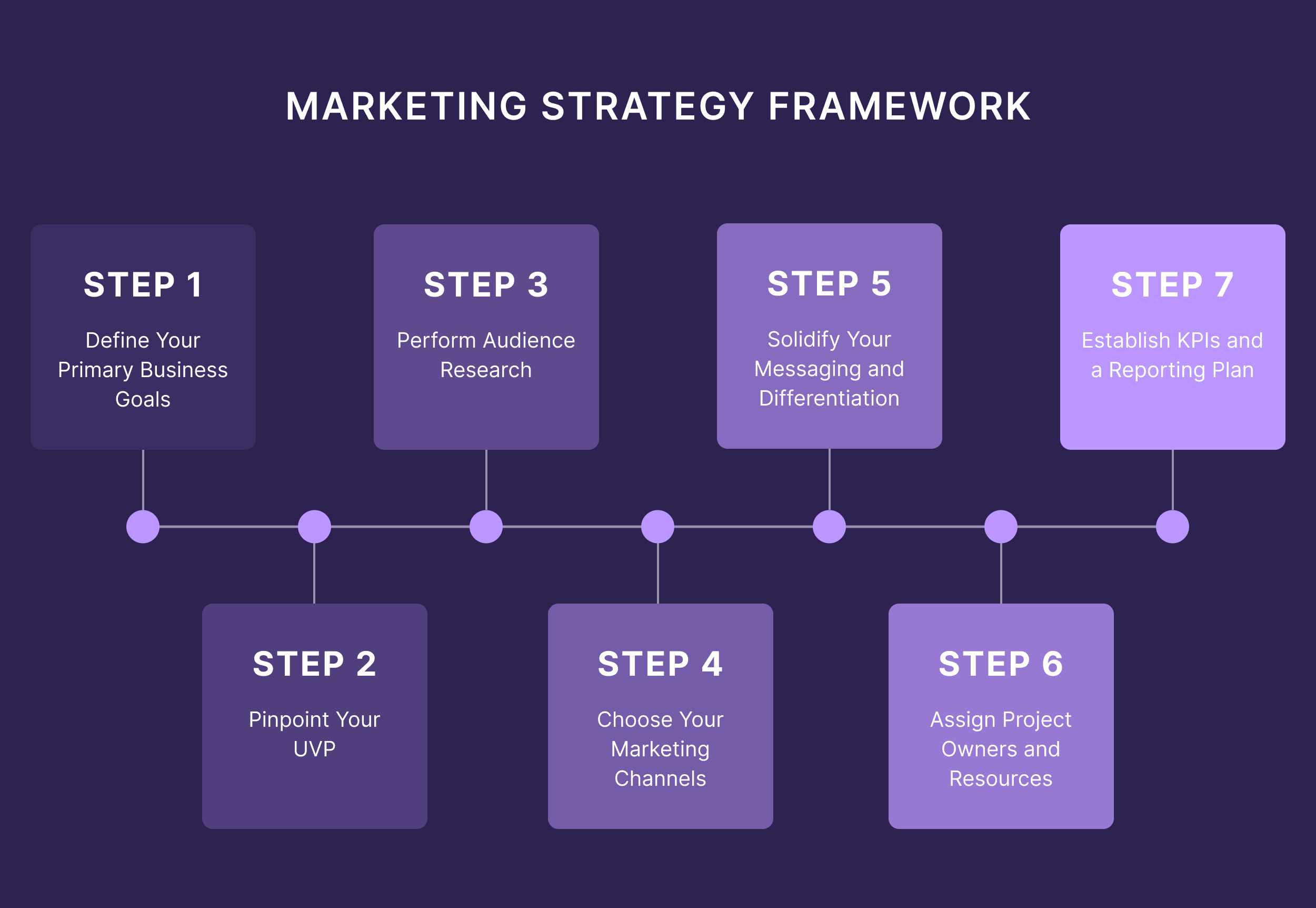
It doesn’t matter where you’re starting from. These steps will guide you toward a strategy that’s documented and built for sustainable growth.
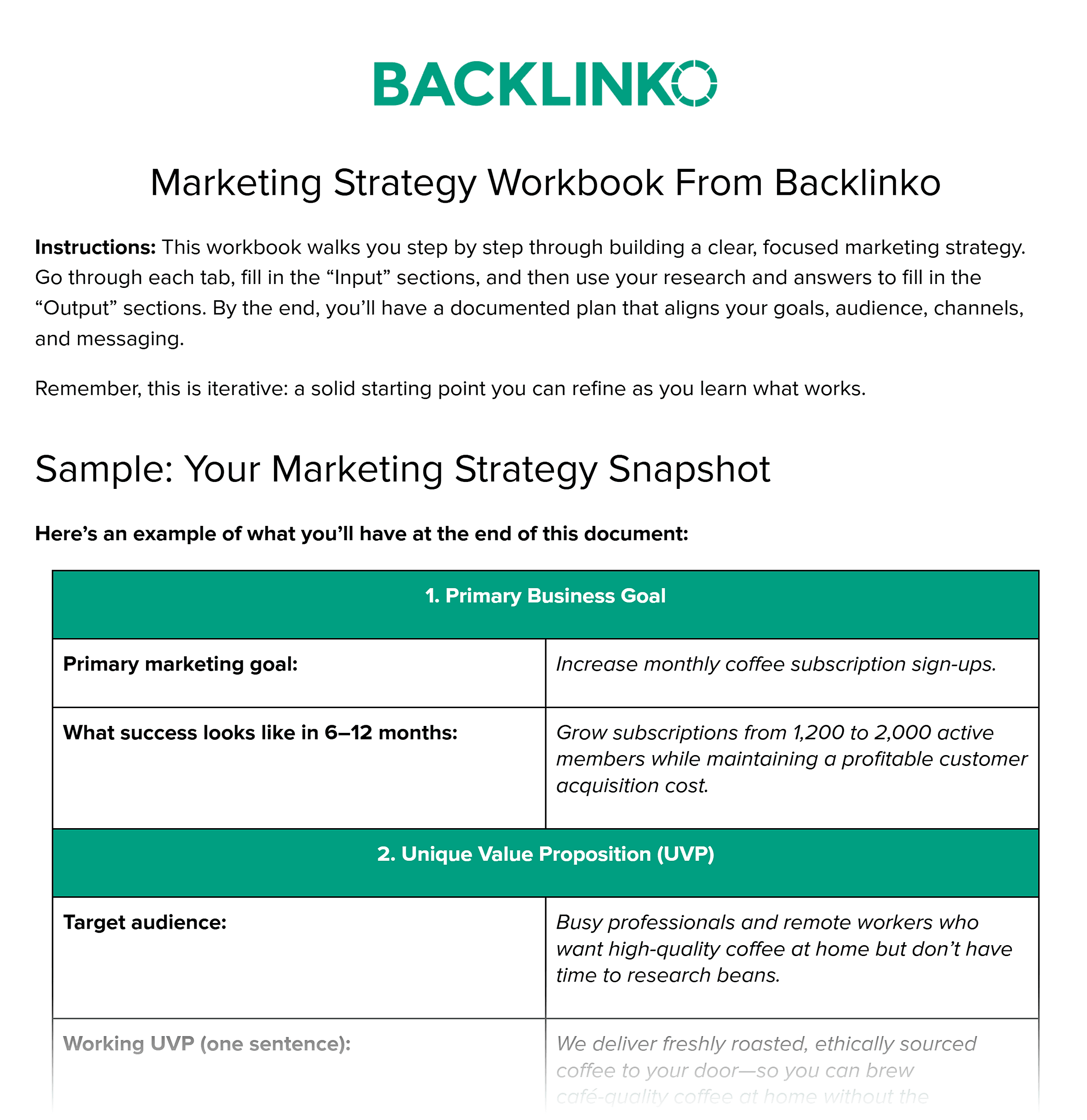
As you work through each step, use our Marketing Strategy Workbook to capture your decisions as you go.
Step 1: Define Your Primary Business Goals
You can only choose channels, messaging, and KPIs once you know what goal you’re supporting.
Of course, revenue growth is almost always the overarching goal.
But most marketing strategies ladder up to that larger goal by supporting things like:
Demand generation Brand awareness Retention or expansionTo define your own primary marketing goal, work through these steps:
Name the real problem marketing needs to solve right now: Is the issue volume? Lead quality? Retention? CAC? Awareness? Be specific. Choose one primary goal: Over the next 6-12 months, what single outcome should marketing influence most? Identify 1-2 secondary goals (optional): You can support these goals, but not at the expense of the primary goal. Turn this into a SMART goal and pressure-test it: Pick a goal that you can measure and achieve in a set amount of time.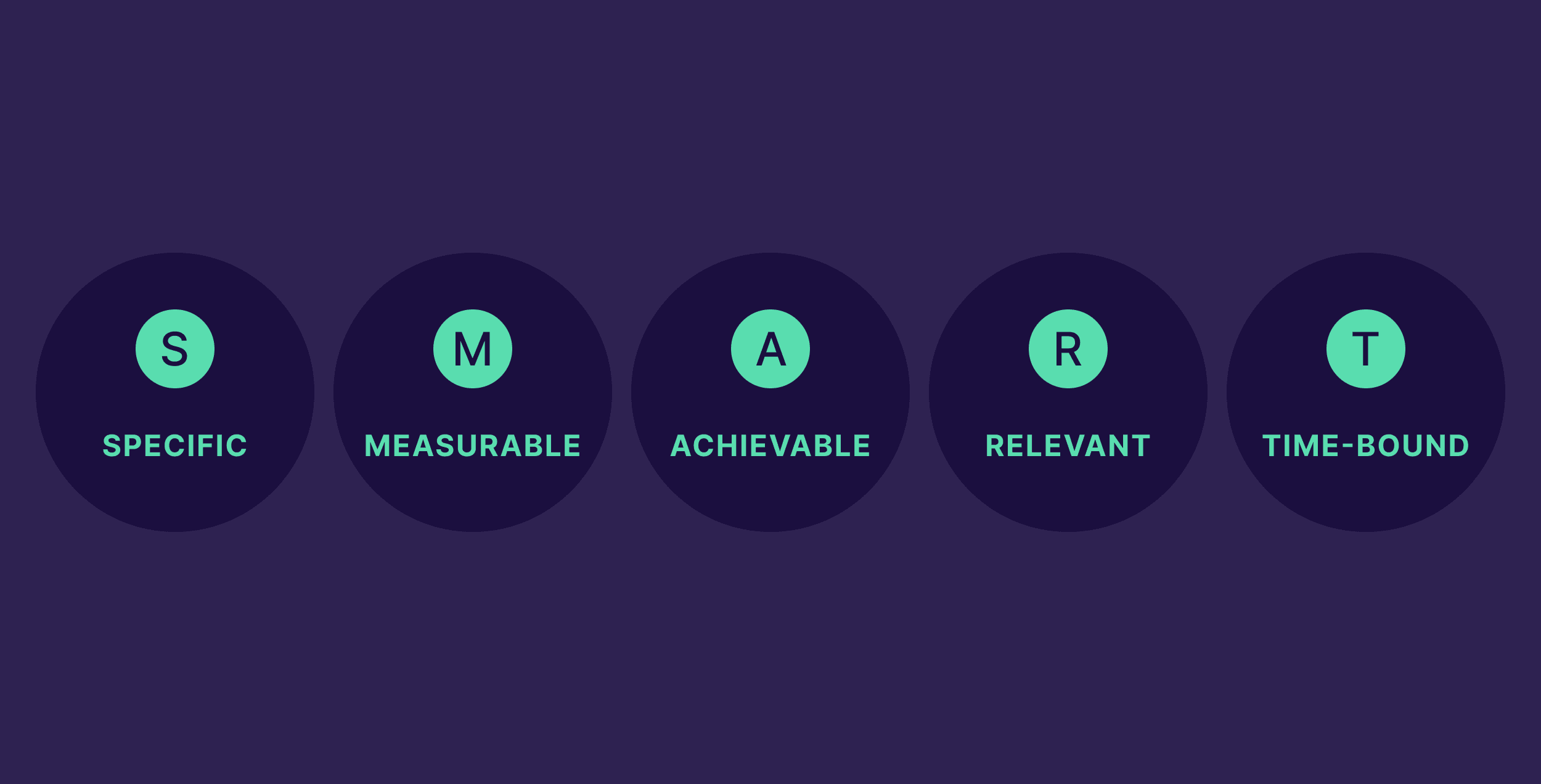
Of course, the “right” marketing goal depends on your situation.
Early-stage companies need momentum. Growth-stage teams focus on scalable demand. More mature companies might focus on efficiency, retention, or expansion.
The goal you choose sets the direction for every decision that follows.
Here’s an example:
In 2020, Fireflies.ai launched with a small team and limited marketing budget. They needed to drive user adoption and growth, fast.
So, they chose a strategy that focused on product-led, word-of-mouth growth. One of the best drivers: make it easy and worthwhile to refer new users.
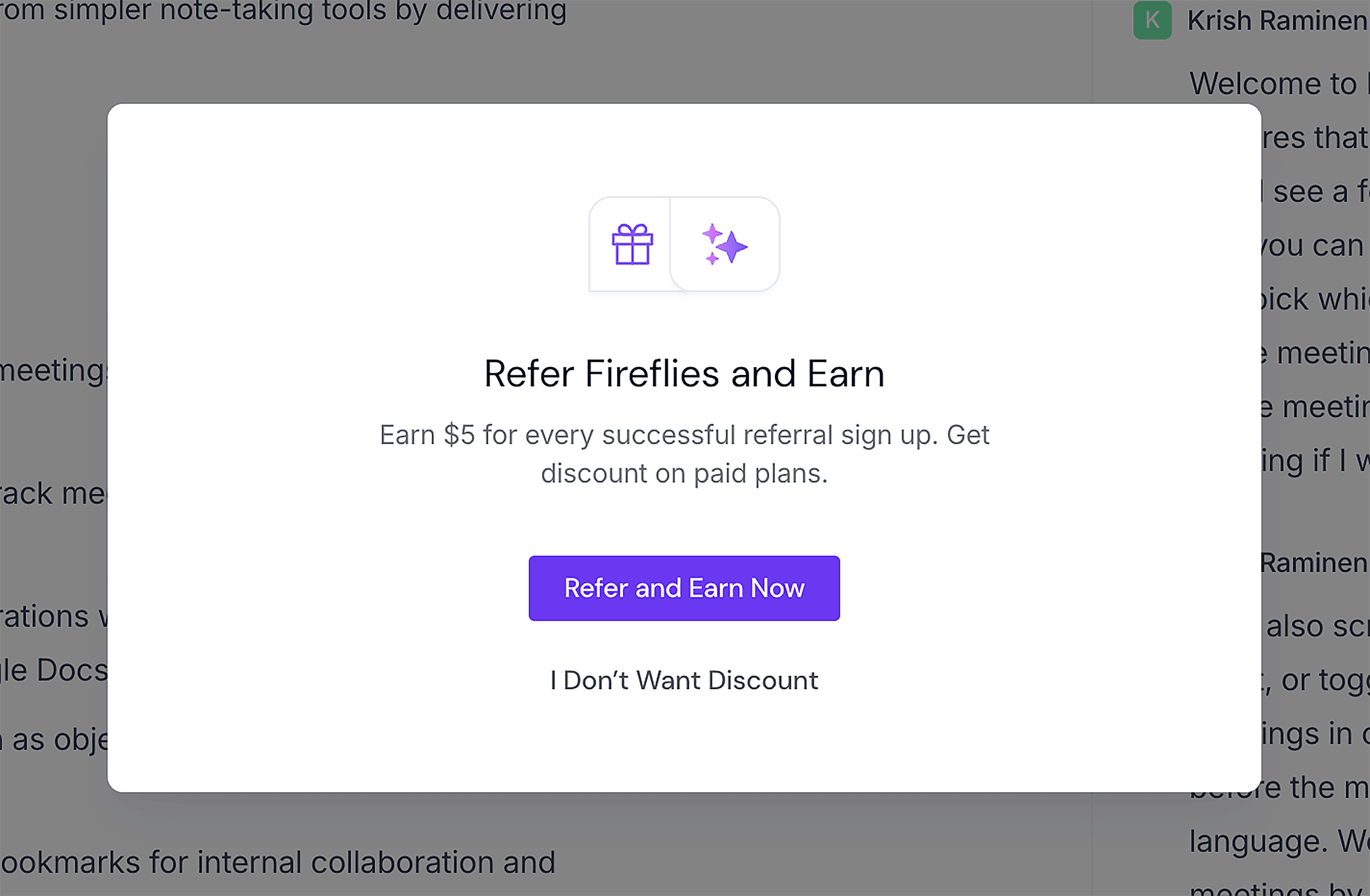
They skipped popular tactics like paid acquisition, brand campaigns, and traditional demand gen funnels.
Why?
Because their resources, product design, and business stage made product-led growth the highest-impact path.
Their goal dictated everything else, including how they tracked success. Fireflies.ai co-founder and CEO Krish Ramineni talked about this. He said success was measured with:
Increased product usage More users inviting Fireflies’ AI notetaker into their meetings Organic mentions across the webWith this strategy, they were able to grow to over 10 million users, without ever using paid ads.
Before you choose channels or tactics, you need the same clarity Fireflies had. What outcome does marketing actually need to drive right now?
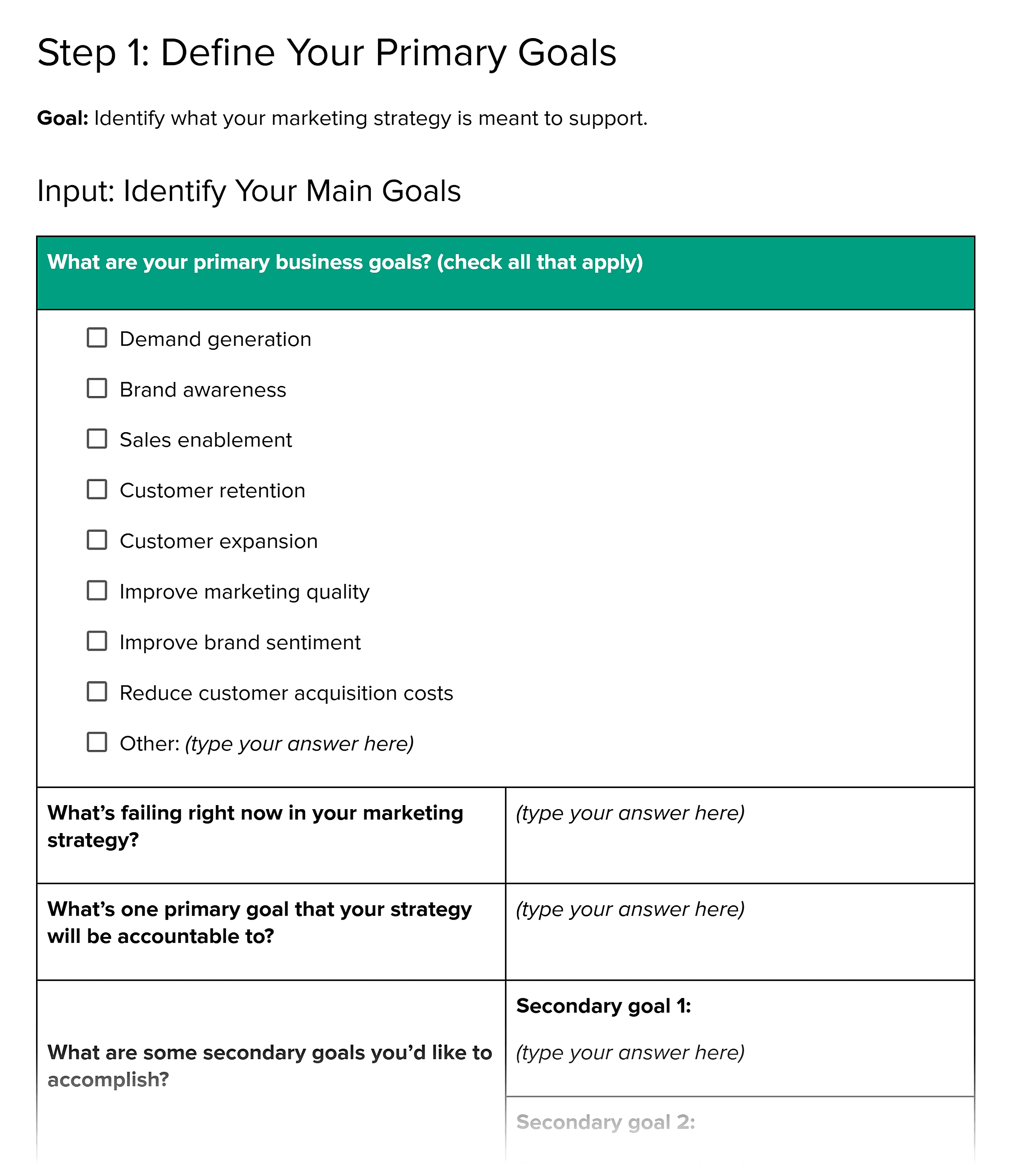
To go even deeper, answer the questions in Step 1 of our Marketing Strategy Workbook.
Step 2: Pinpoint Your Unique Value Proposition (UVP)
A strong unique value proposition (UVP) answers one question:
Why should someone choose you over the best alternative?
In other words, what makes your business meaningfully different from your competitors?
Here’s how to figure it out:
First, identify and analyze your best customers.
The most obvious candidates are the customers who renew subscriptions or keep purchasing from your brand.
But don’t forget your brand evangelists. Who is out there recommending your products regularly?
Once you’ve built that list, ask yourself:
What do these customers have in common?
Your UVP usually lives where you deliver the most consistent, measurable results.
Next, identify the core outcome. What real-world result do those customers get?
Go beyond the surface-level benefits. Think about what changes in your customers’ daily routine. How does your product affect their daily life? How does it impact their business?
Is it smoother communication? Fewer mistakes? Less stress? Better data? Stronger performance?
Anchor your UVP to a real outcome.
Then, define your defensible difference.
Now ask: what allows you to deliver that outcome better or differently than alternatives?
That could be:
Proprietary data A specific process Product architecture Speed Category specialization Pricing structure Brand trust CommunityBe specific. “Easy to use” and “innovative” don’t count unless you can prove why.
Finally, pressure test your analysis.
Ask yourself: If we disappeared tomorrow, what would our best customers struggle to replace?
That point of friction is your real differentiation. It means your UVP isn’t something interchangeable with any other brand in your industry.
Once you have this, your UVP becomes the baseline for the rest of your marketing strategy. It’s a foundation for your message that shows up over and over again.
Doordash is a great example of this. Their tagline is: “Everything you crave, delivered.”
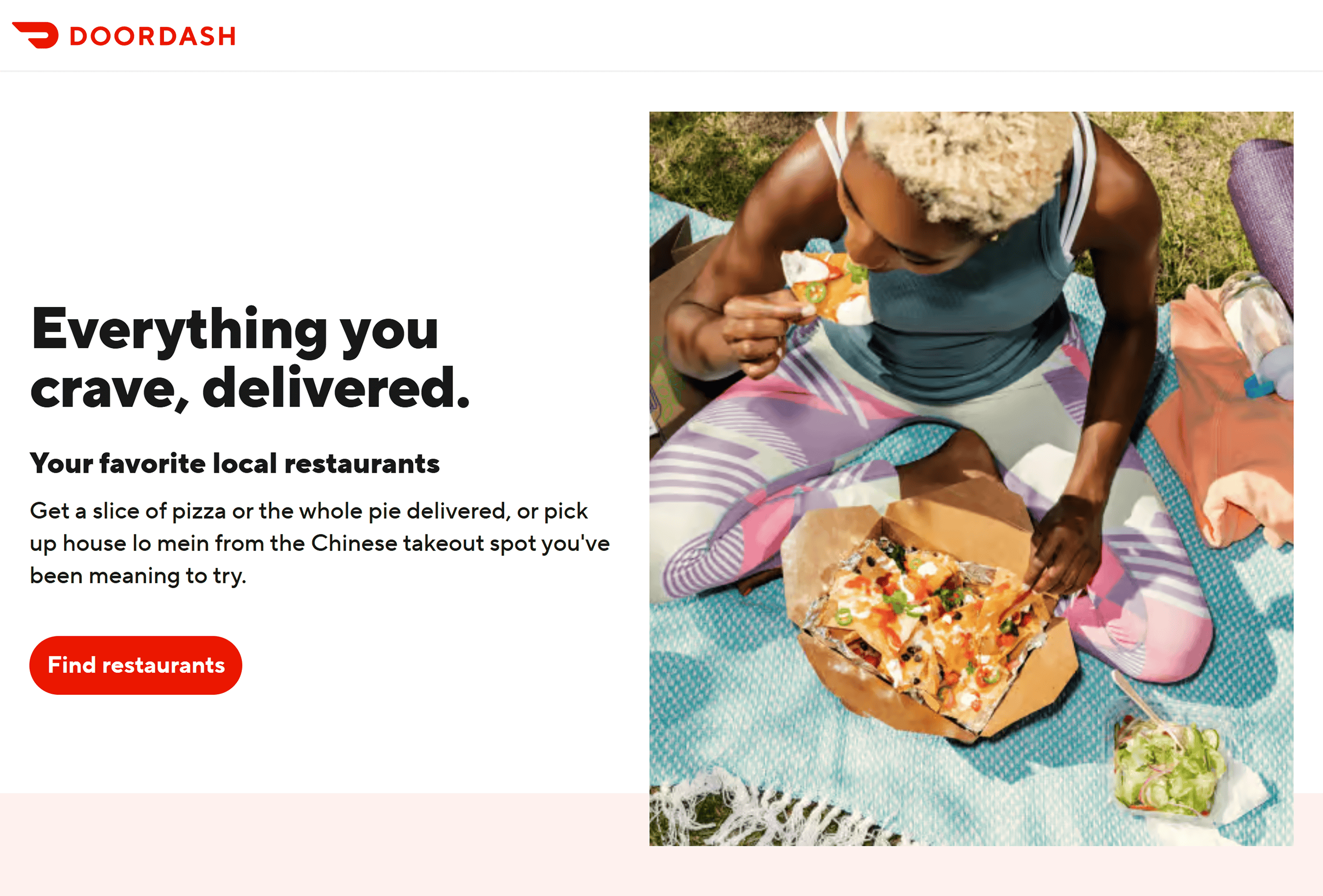
This simple UVP defines:
The audience state (craving) Breadth (everything) Outcome (delivery convenience)The same story shows up everywhere.
Homepage messaging. App story copy. Email newsletters.
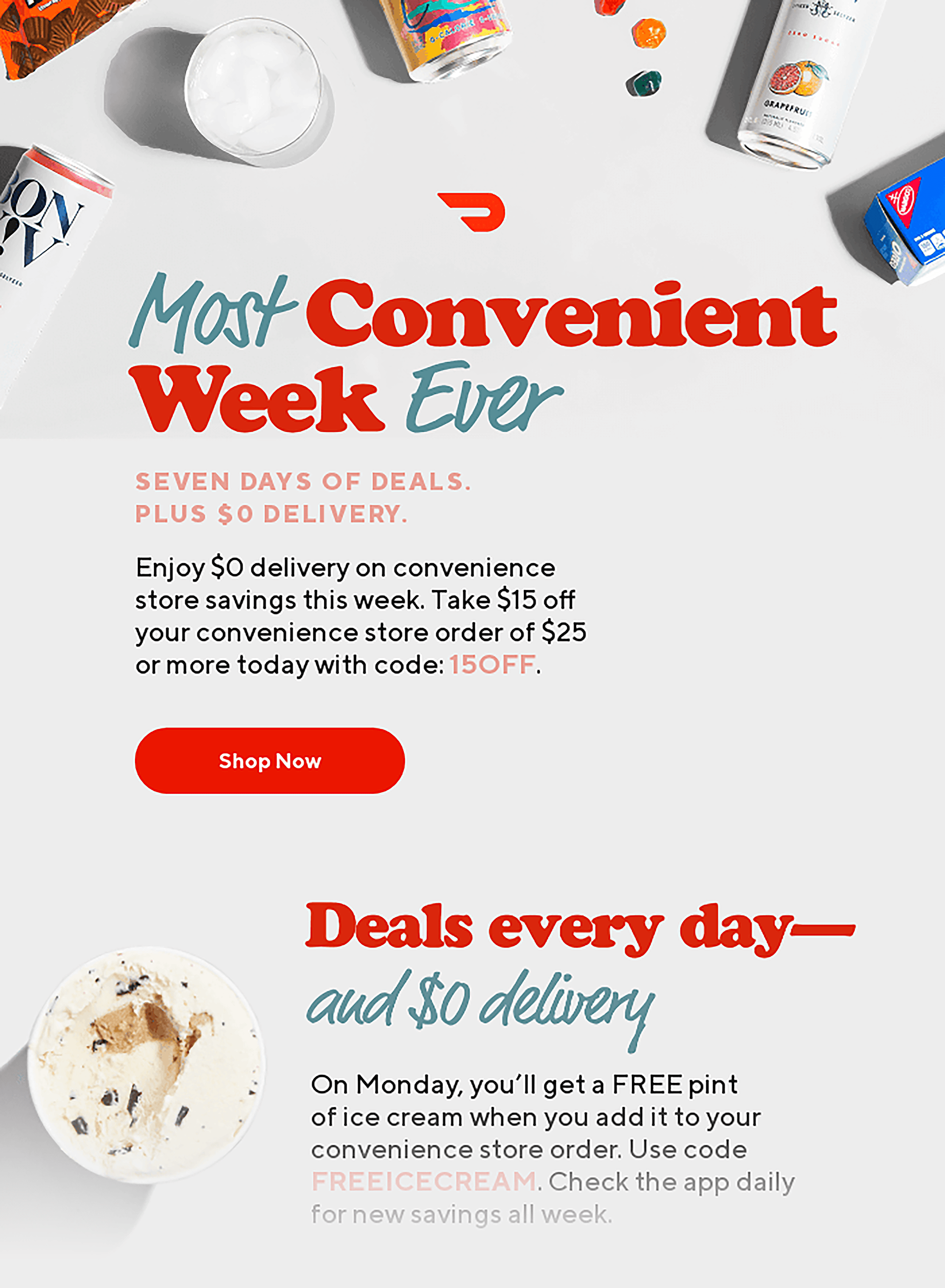
The result of having that solid UVP?
DoorDash reinforces one idea: we’re the easiest way to get what you want, when you want it.
That’s the kind of core benefit you want your audience to remember.
Step 3: Perform Audience Research
Your UVP is your hypothesis.
Now, it’s time to validate it.
We have a full guide to audience research, so save that for later. In the meantime, here are three places to gather information:
Customers Market perception Competitors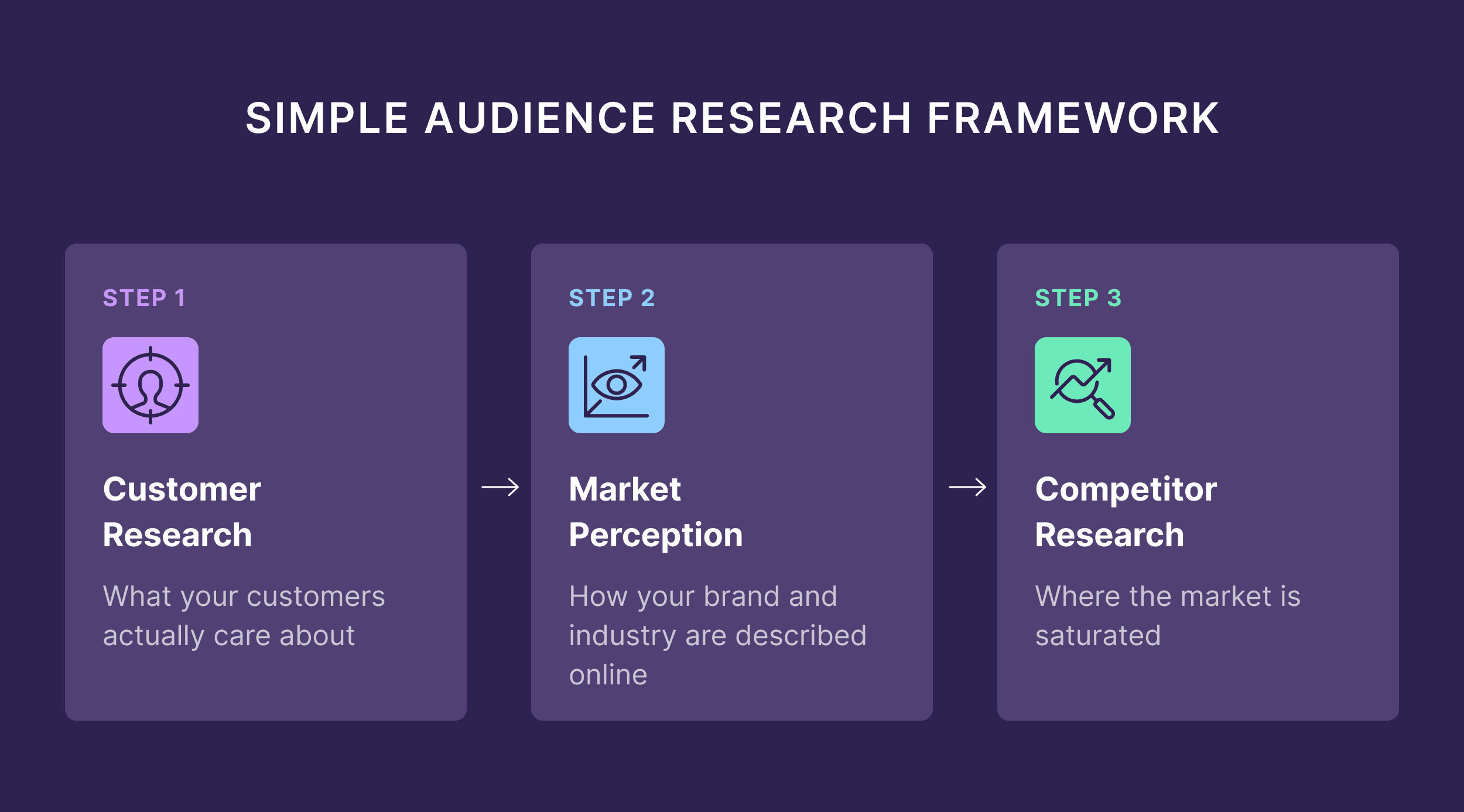
First, let’s start with customer research.
Your goal: understand what your customers actually care about.
Start with a segment of your customers, ideally the high-value customers you identified in Step 2.
Then, answer these four questions:
What problem consistently pushes them to look for a solution? What triggers that search? What objections slow down decisions? What words do they use to describe the problem?You don’t need months of research.
Start with even just two or three customer conversations to understand how buyers describe their challenges. Talk to your sales or customer success teams to learn about top objections, misunderstandings, or decision blockers.
Next, dig into the market perception of your brand and industry.
Start with social media research. Search on relevant Reddit threads, skim through YouTube comments, or read reviews on third-party sites.
As real people describe the problems they’re facing, pay attention to the emotional language and repeated frustrations. Learn from the criteria they use to compare similar products.
Conversely, when someone recommends your brand specially, what’s the context?
For example: I searched for mentions of Omnisend in an email marketing subreddit. And I learned that the brand is often brought up in conversations about email marketing for ecommerce brands.
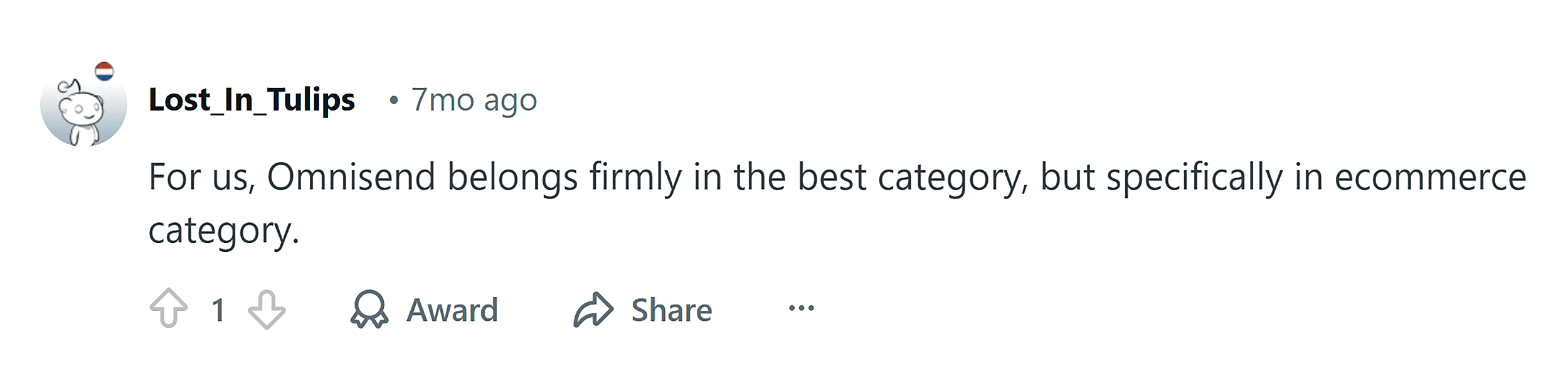
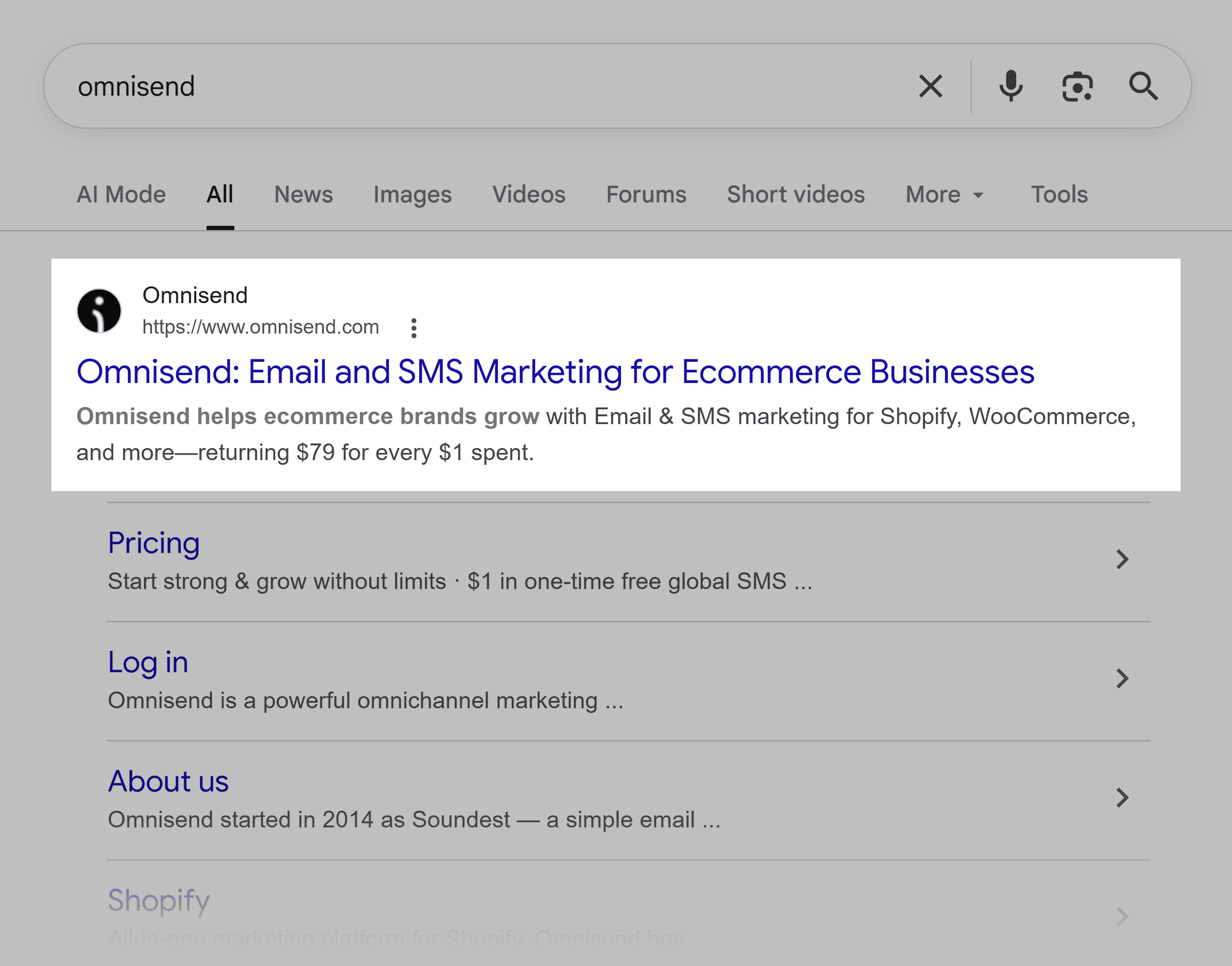
Given Omnisend brands itself as email marketing software for ecommerce, this lines up.
You can also use Semrush’s AI Visibility Toolkit to learn how your brand is perceived by LLMs.
Essentially, Semrush runs AI searches for prompts related to your business and gathers a crowdsourced opinion of your brand.
Because LLMs are informed by how your brand appears across the web, this serves as a useful way to gauge both how your brand is perceived online and what the LLMs specifically are telling your target audience about your brand.
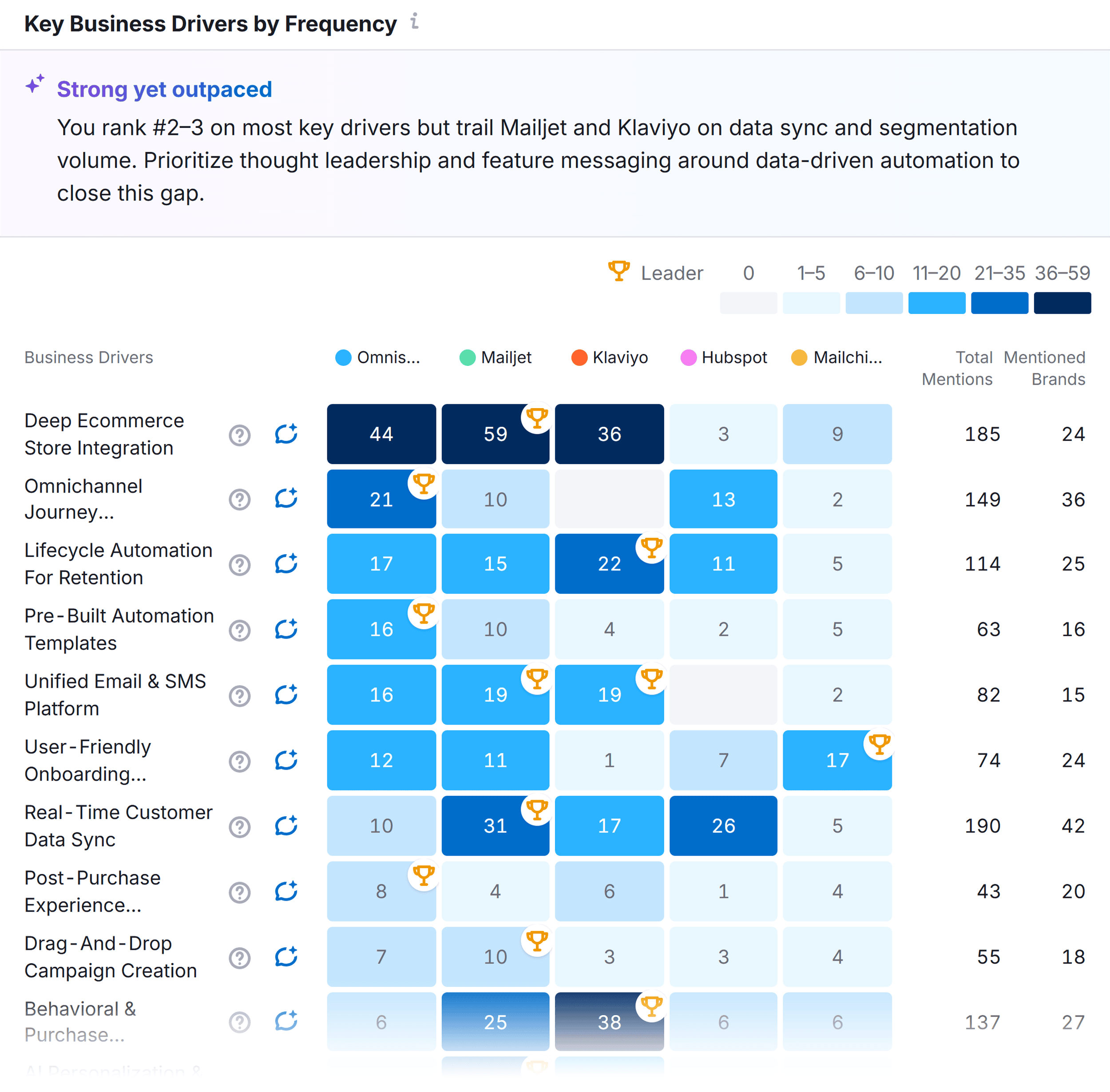
Head to the “Brand Performance” dashboard, then scroll to see “Key Business Drivers” to see the topics your brand is associated with in AI answers.
When I analyzed this data for Omnisend, I found that one of their top drivers is deep ecommerce store integration. Which aligns perfectly with what I saw earlier on Reddit.
When you’ve gathered this data, you can use it to pressure test your UVP from Step 2.
Do customers mention the differentiator you identified? Do they value the outcome you thought was most important? Are they choosing you for the reason you expected?Lastly, competitor research can add another layer to this by telling you what’s already being said in the market.
For example, content marketing agency Animalz paid attention to competitors. They noticed that other agencies were competing for the same SEO-driven keywords.
Meanwhile, their ideal clients — CMOs and founders — cared more about experience-driven insight than traffic volume.
So Animalz leaned into what only they could offer: insights from hundreds of content programs.
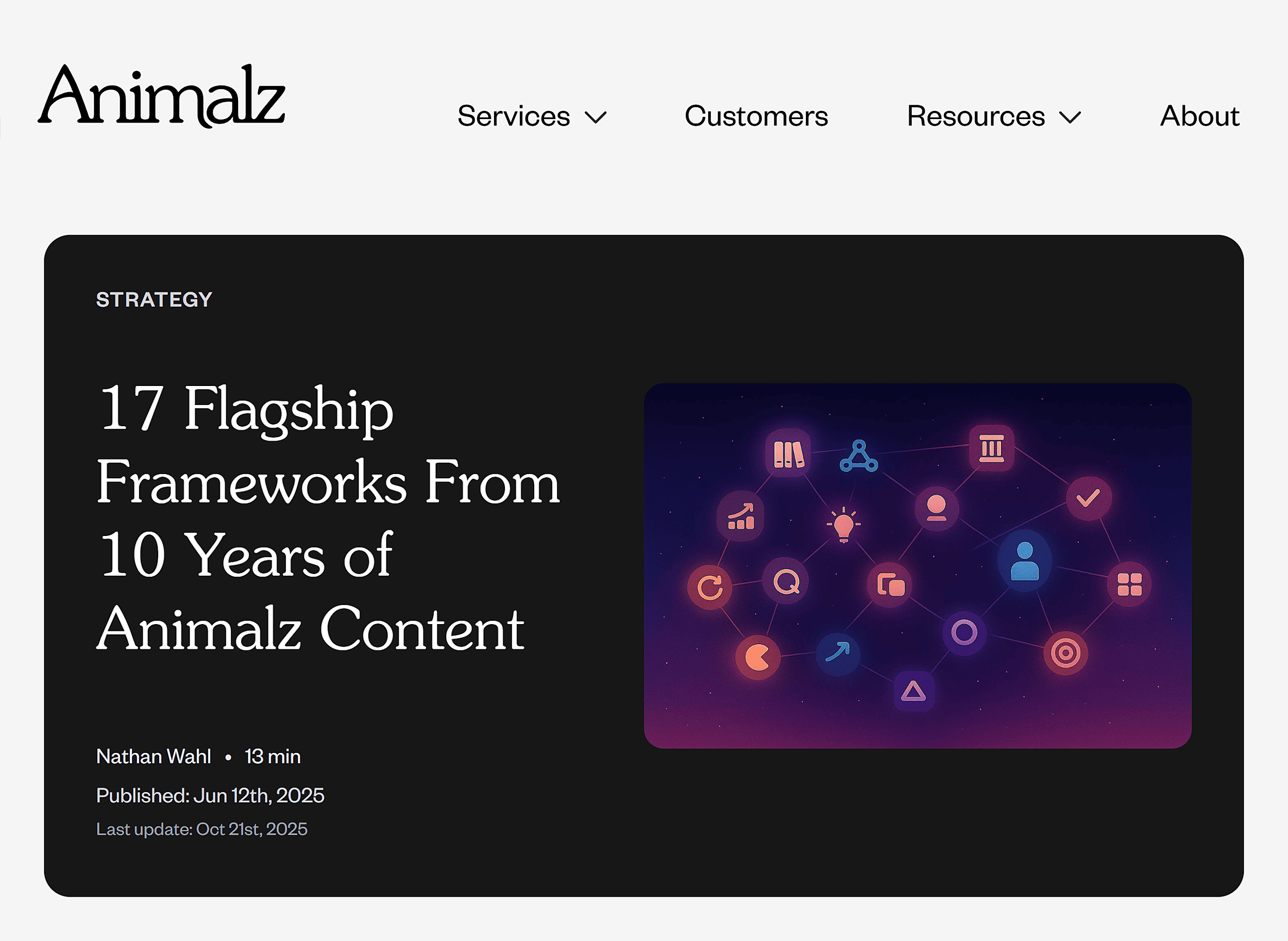
They focused on original research, experience-driven frameworks, and thought leadership — not search volume.
The result? Fewer generic visitors, more high-quality leads. According to their homepage, their client list includes the likes of Google, Amazon, Airtable, and Atlassian.
That’s the goal here. Understand the audience. Study the landscape. Then, position yourself where you’re both relevant and differentiated.
By the end of this step, you should be able to clearly state:
The core problem your audience is trying to solve The trigger that pushes them to act The language they use The top objection(s) you must addressThat’s enough to inform channel decisions and messaging — without drowning in data.
Step 4: Choose Your Marketing Channels
You can’t reasonably “be everywhere.”
Every channel has different mechanics, expectations, and resource demands. So, choose a small number of channels based on:
Where you audience already spends time Which channels best support your primary goal What you can execute consistently with your current resourcesHere’s what major channels can look like in practice:
Email marketing: High-ROI channel for nurturing, retention, and revenue expansion. It’s one of the most accessible channels to start with. And data shows consistently high conversion rates (2.8% for B2C and 2.4% for B2B).
HubSpot uses educational newsletters to deliver value first. Then, they naturally route engaged readers toward tools and upgrades.
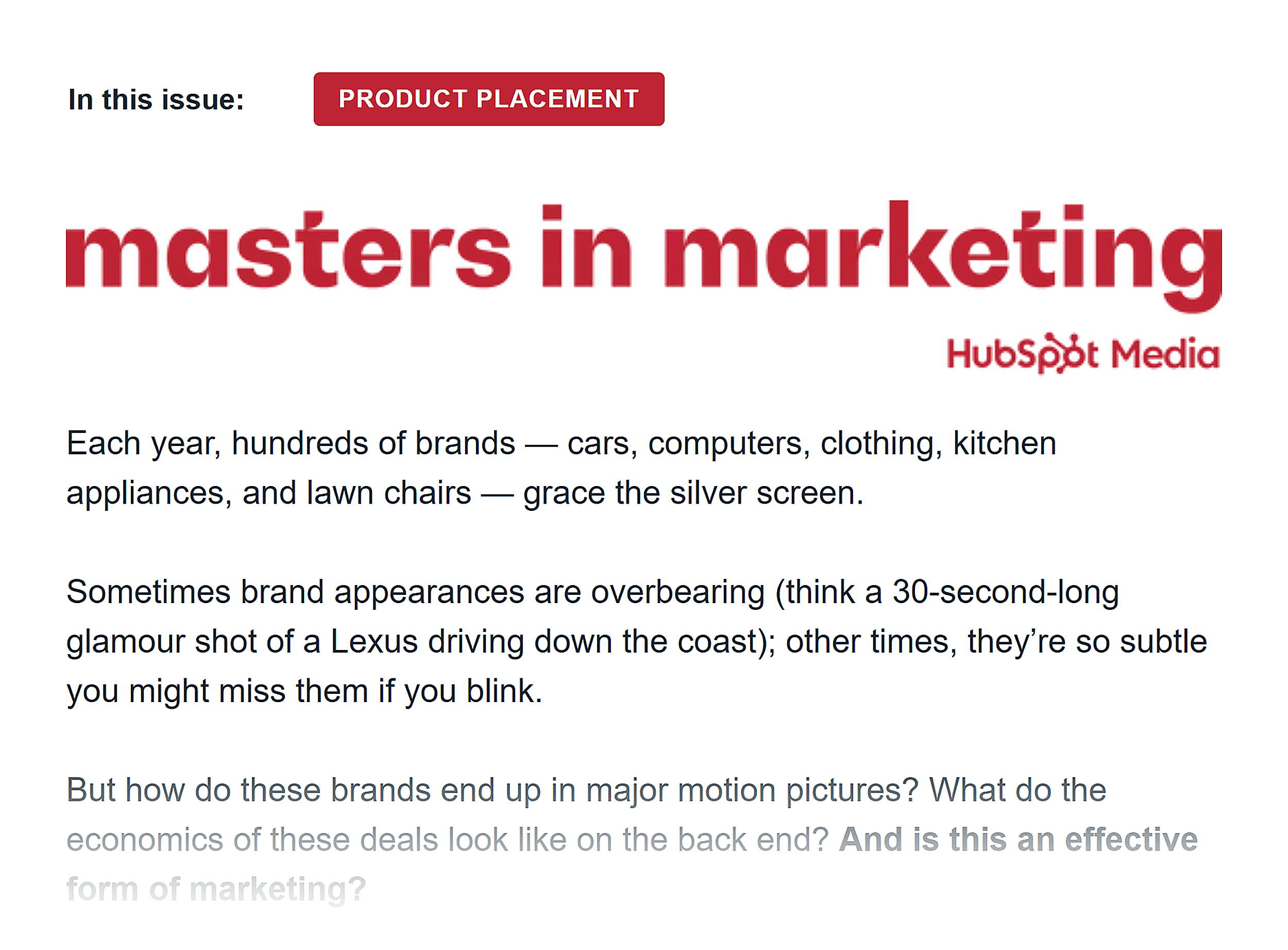
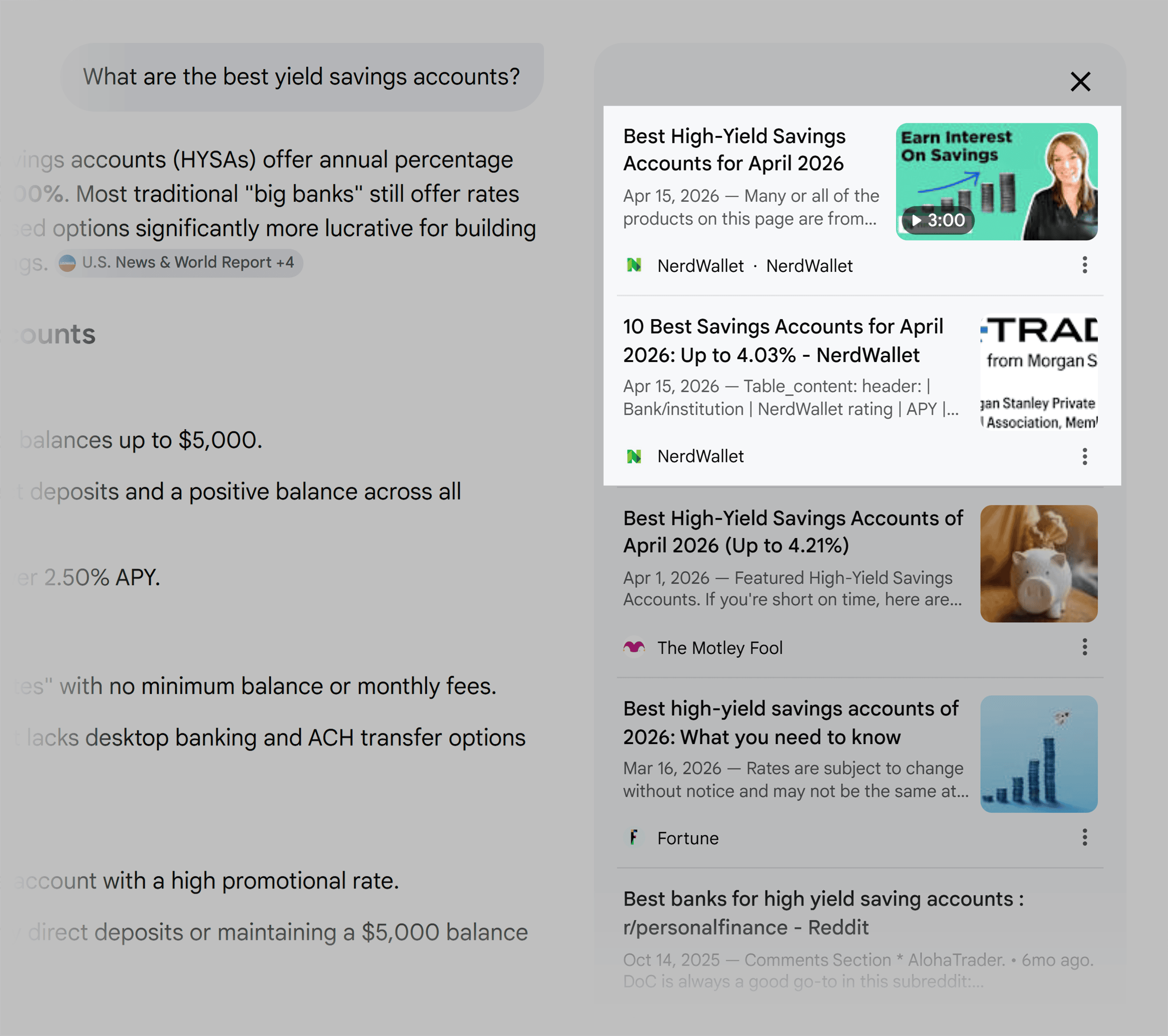
Search (SEO + AI Optimization): When done well, long-form, evergreen content can drive results that compound over time. The key is to optimize for both traditional SEO ranking and AI summaries. Structure content clearly so it’s understood and surfaced — even in zero-click environments.
NerdWallet does this by publishing structured, comparison-driven guides. These rank in search and appear in AI answers. That builds visibility even when users don’t click.
Social media marketing: Platform-native content is built for discovery and engagement. It requires knowing your audience deeply, and playing into the right trends.
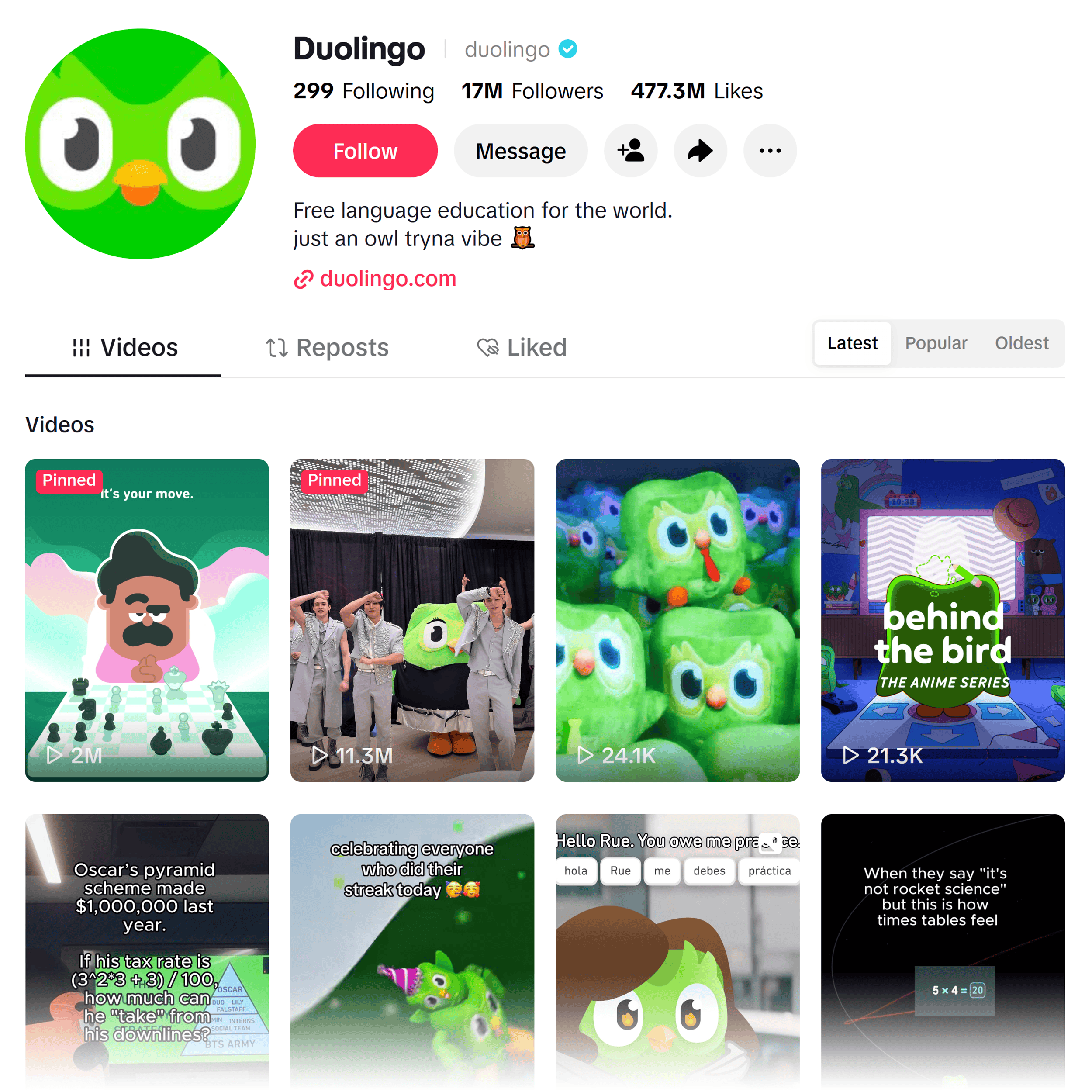
One of the most well-known examples of a brand that does this well is Duolingo. Their TikTok and Instagram content leads with humor. Over the years, it’s built massive awareness without traditional selling.
Affiliate and influencer marketing: Leverage trusted voices to expand reach and credibility.
Glossier does this by partnering with creators. This builds authentic recommendations into growth.

Paid advertising: Best for speed and high-intent capture. Requires budget discipline and clear measurement.
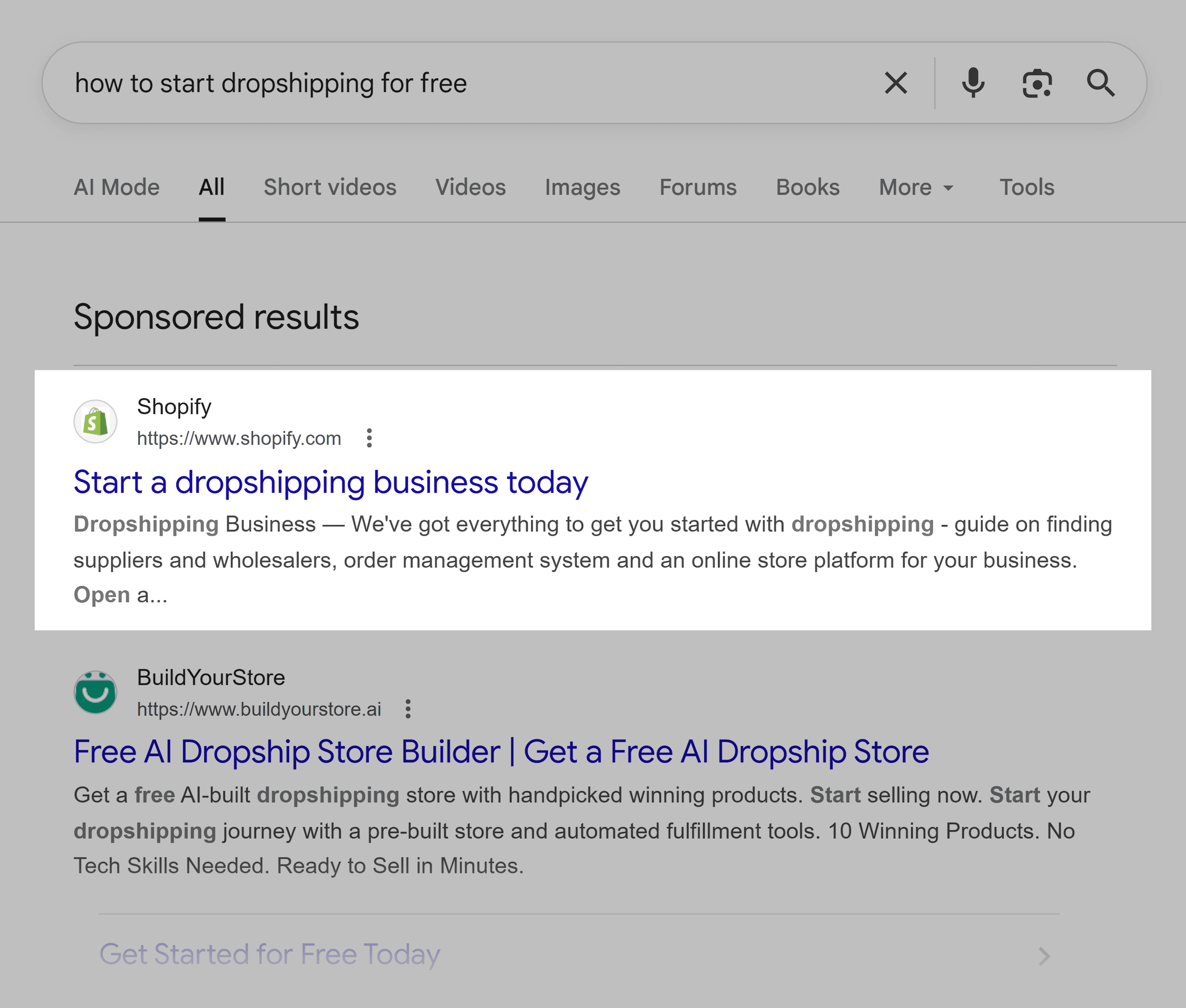
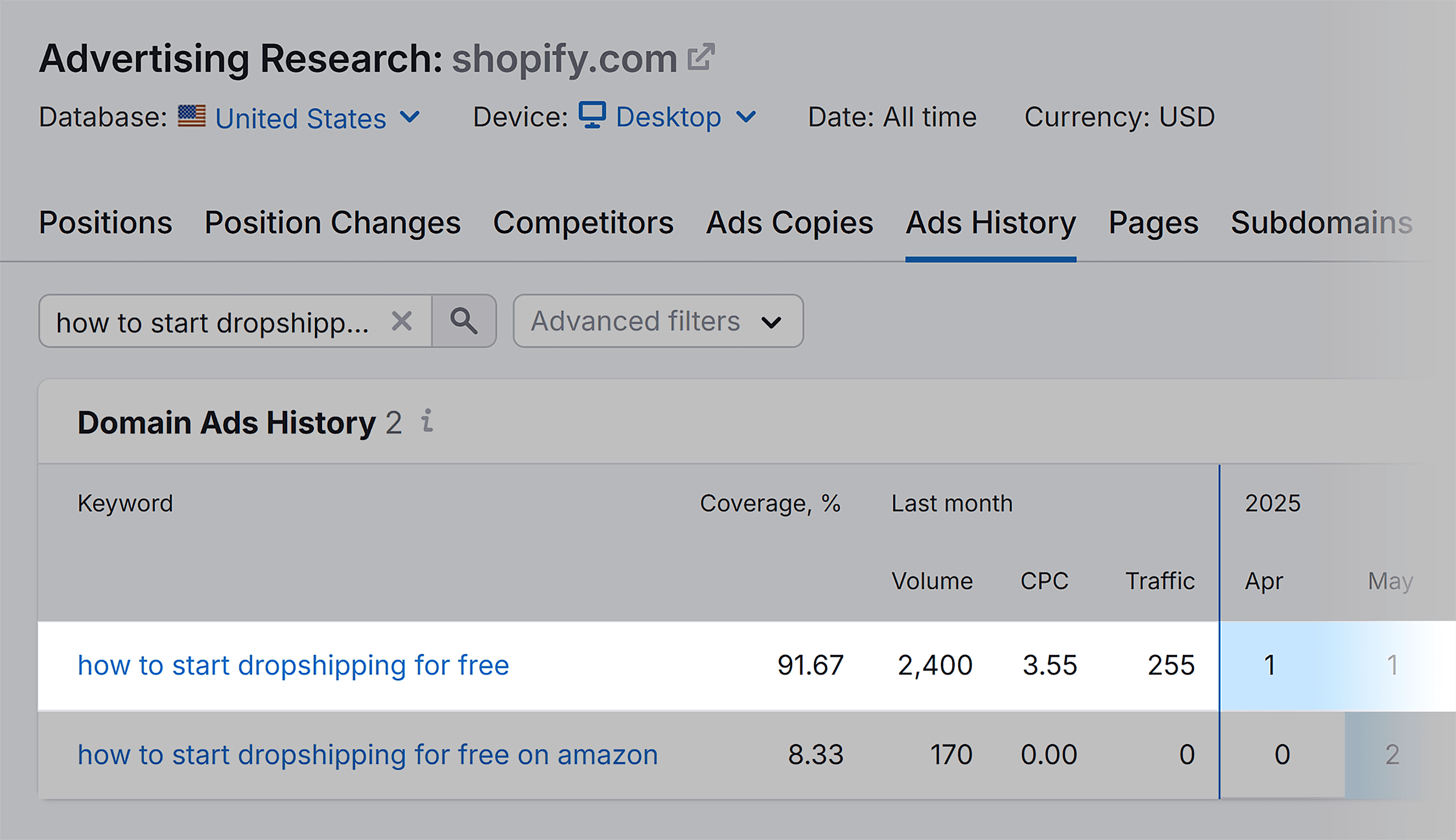
Shopify uses paid search to capture intent from searches like “how to start dropshipping for free”
And this likely pays off, considering Shopify has been bidding on the keyword (and ranking as the top ad) for the past year:
Customer and community marketing: Build owned spaces that compound trust and advocacy. It’s a big time lift, but it can pay off in the long run.
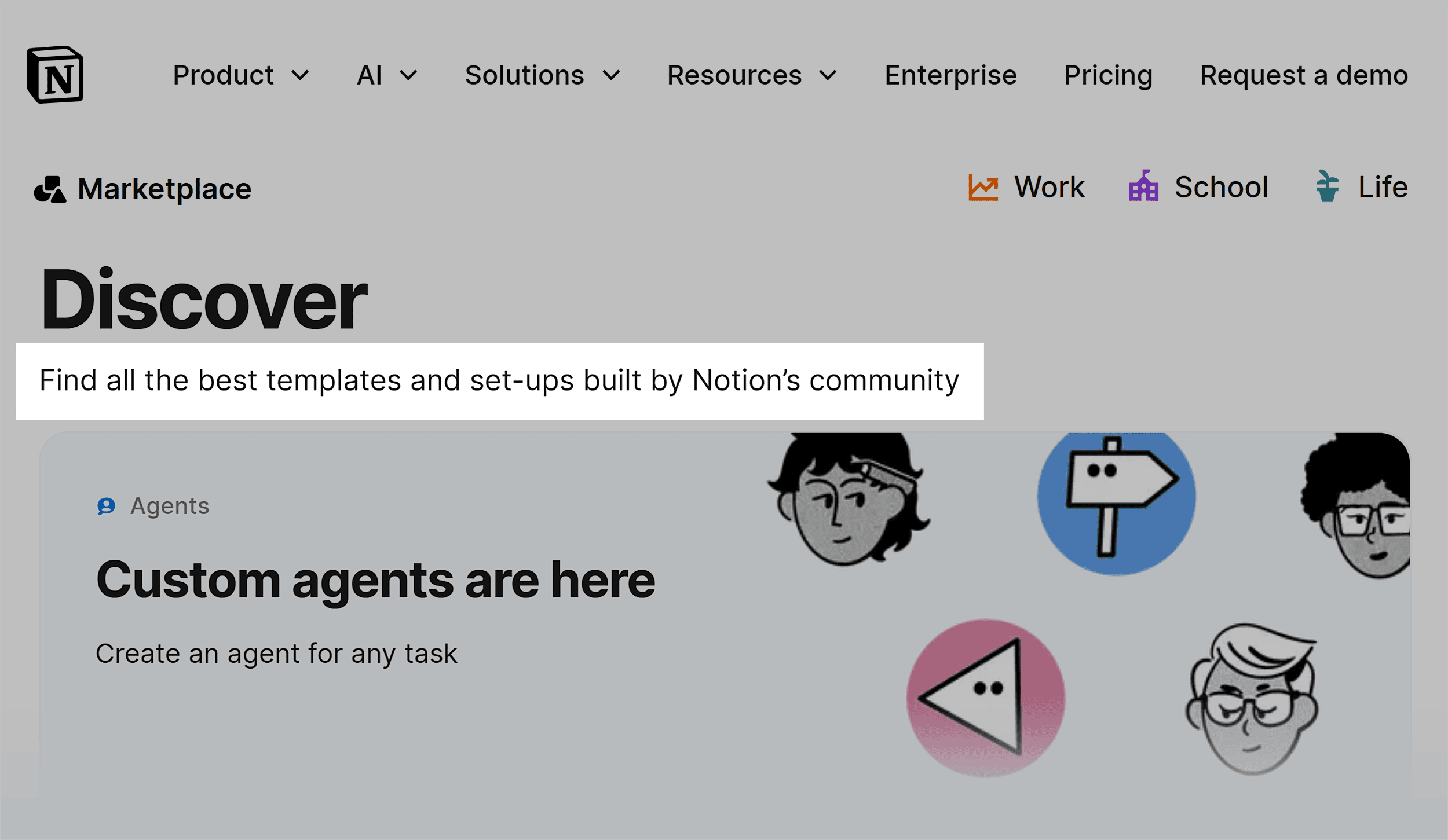
Notion supports user-led communities and templates. They’ve built a marketing engine that turns customers into educators and evangelists.
With these channels in mind, it’s time to narrow your focus.
Ask:
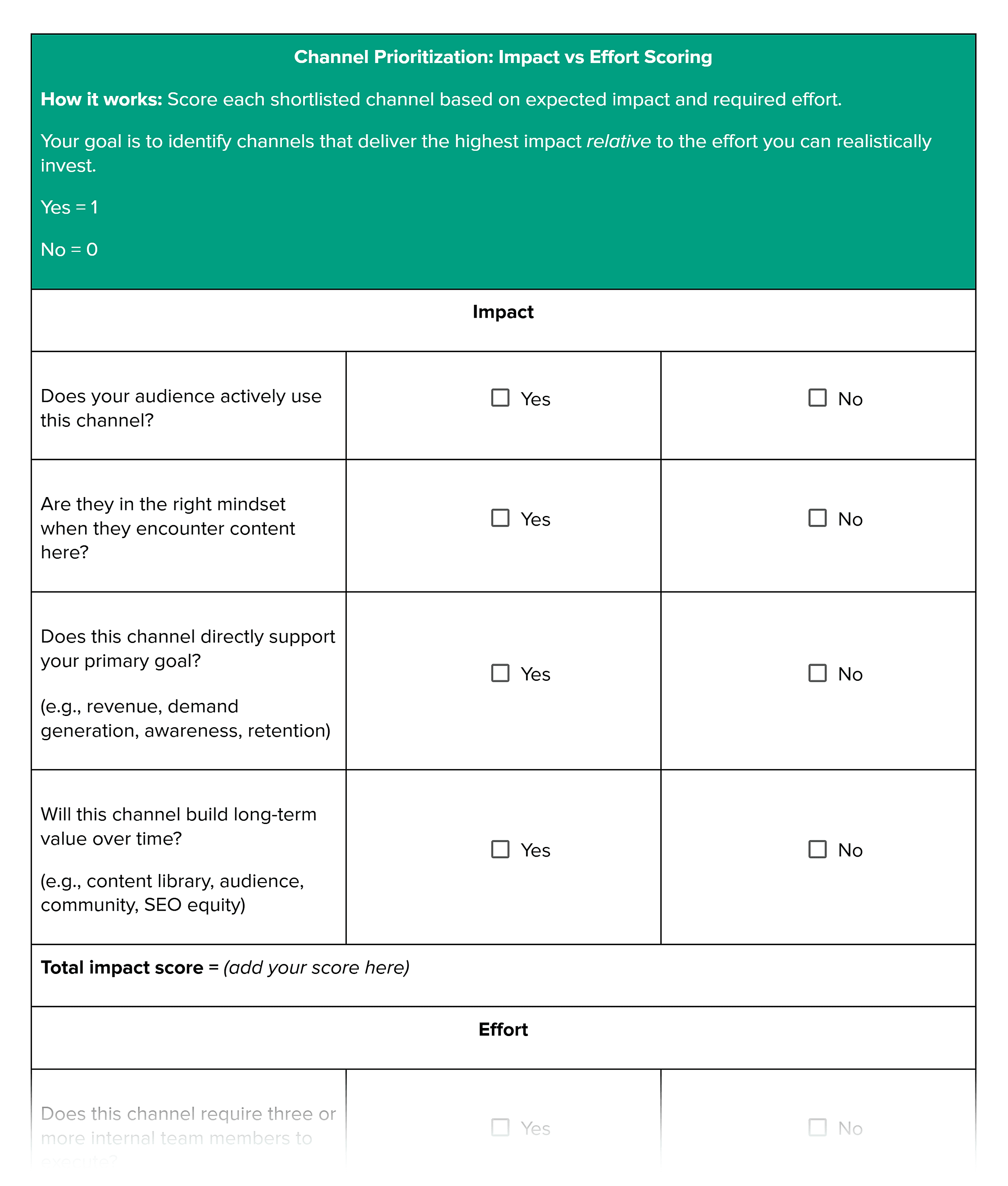
Does my audience actively use this channel? Does this channel support my primary goal directly? Do we have the skills and resources to execute this well? Can we sustain this for at least 6-12 months?Once you’ve committed to 1-2 primary channels, define what success looks like for each one. List the resources you’ll need, and be honest about constraints.
You can use the Marketing Strategy Workbook’s impact vs. effort scoring model to pressure-test your decisions before moving forward.
Step 5: Solidify Your Messaging and Differentiation by Channel
If you just copy-paste your messaging across platforms, it’ll feel out of place. But if you reinvent your story on each channel, your brand will feel fragmented.
This step is about finding the right balance.
For each channel, define:
Which problem you’re emphasizing What format fits that channel How your tone and depth should adjustBut your core promise stays intact.
This matters more now than ever because people encounter brands across platforms before they visit your website. On top of that, AI systems look for consistent messaging to help inform their responses to user prompts.
So, how do you build your own channel messaging playbook?
Use our Marketing Strategy Workbook to walk through the main audience problems, content formats, and how your brand should show up on each channel.
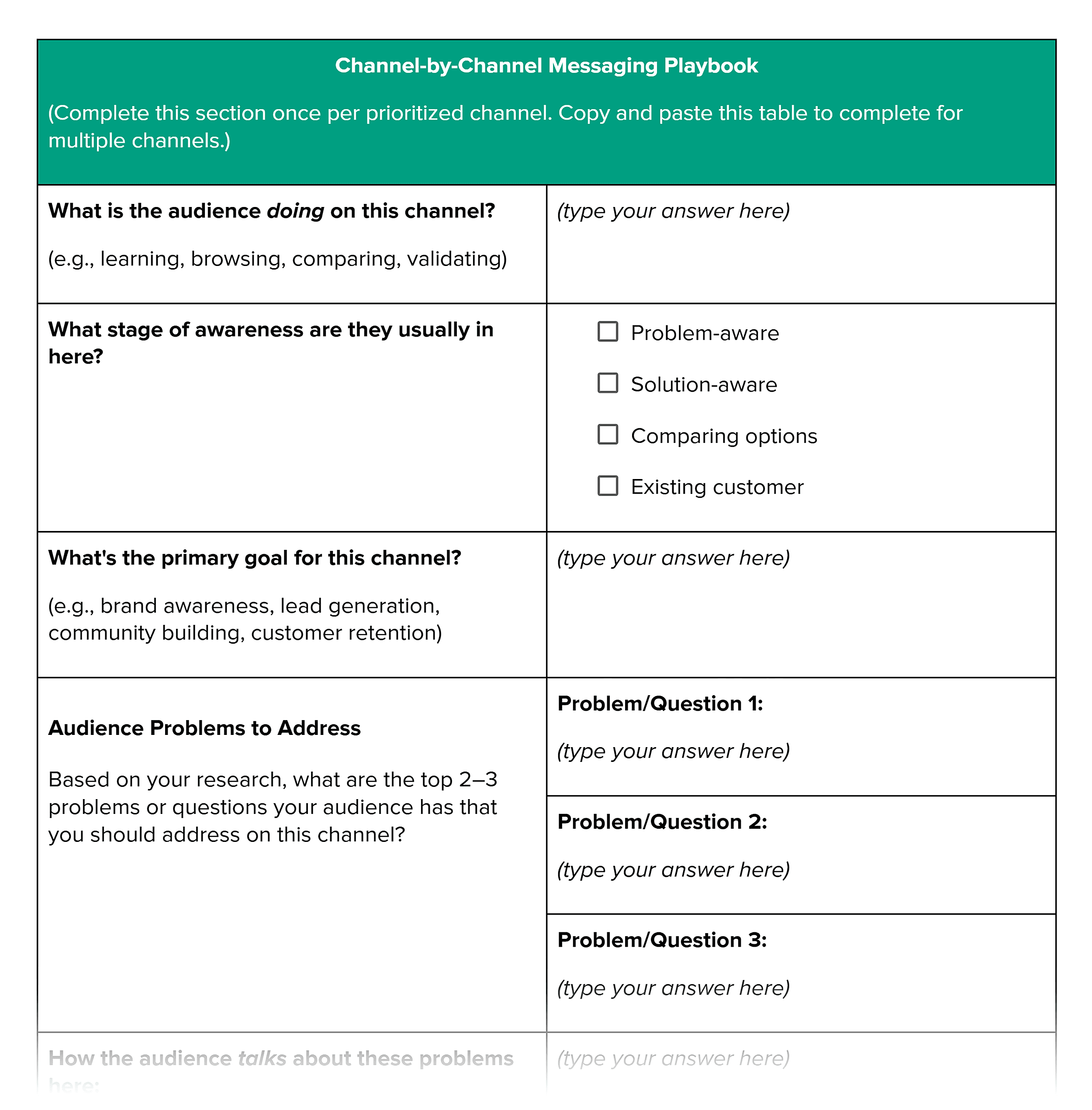
If you do this step well, you’ll end up with the right balance of consistency and adaptation.
Duolingo does this really well. Their core story is consistent: learning a language should feel fun, not intimidating.
What changes is how the brand shows up depending on the channel:
On TikTok they’re chaotic, with trend-driven, mascot-heavy humor. That entertainment-first strategy has earned them 17 million followers.

Their Instagram features similar humor, but slightly more polished and adapted to Reels culture.
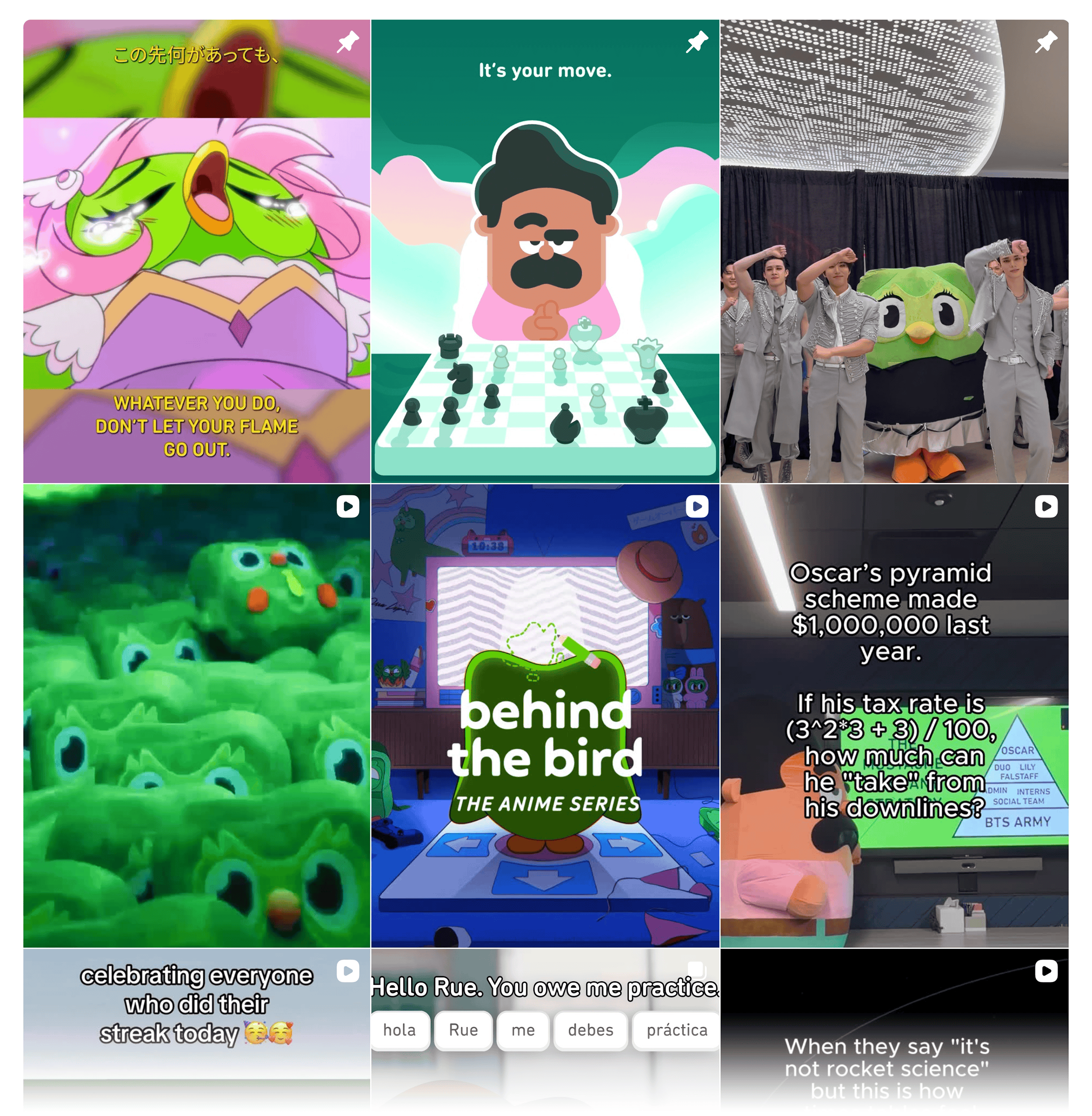
Their Facebook uses toned-down humor for an older demographic.

And on LinkedIn, the brand keeps a professional tone, but still recognizably Duolingo.
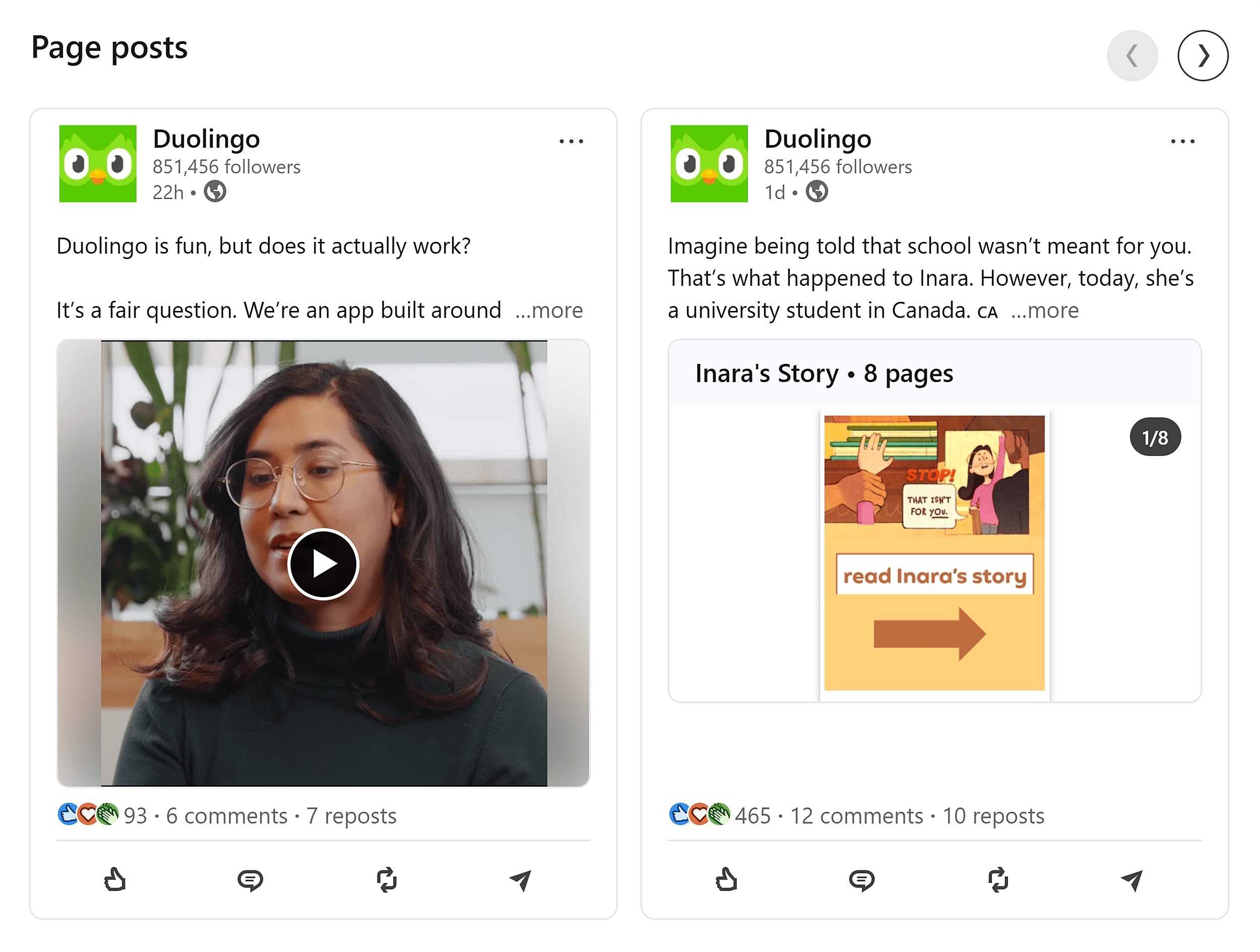
Same brand. Same core message. Different execution.
That’s what you’re aiming for.
By the end of this step, you should be able to say:
What problem each channel focuses on What format you’ll use How your tone and depth will adapt — without changing your core messageStep 6: Assign Project Owners and Resources
A marketing strategy only works if someone owns it.
For every primary channel, there should be one person responsible for results. Otherwise, it’s easy for momentum to slide.
Before assigning that owner, do a quick reality check:
How much budget is actually available? How many hours per week can realistically go toward this? What skills are missing? Will you need outside help?You can use the Marketing Strategy Workbook to keep track of team capacity and resources:
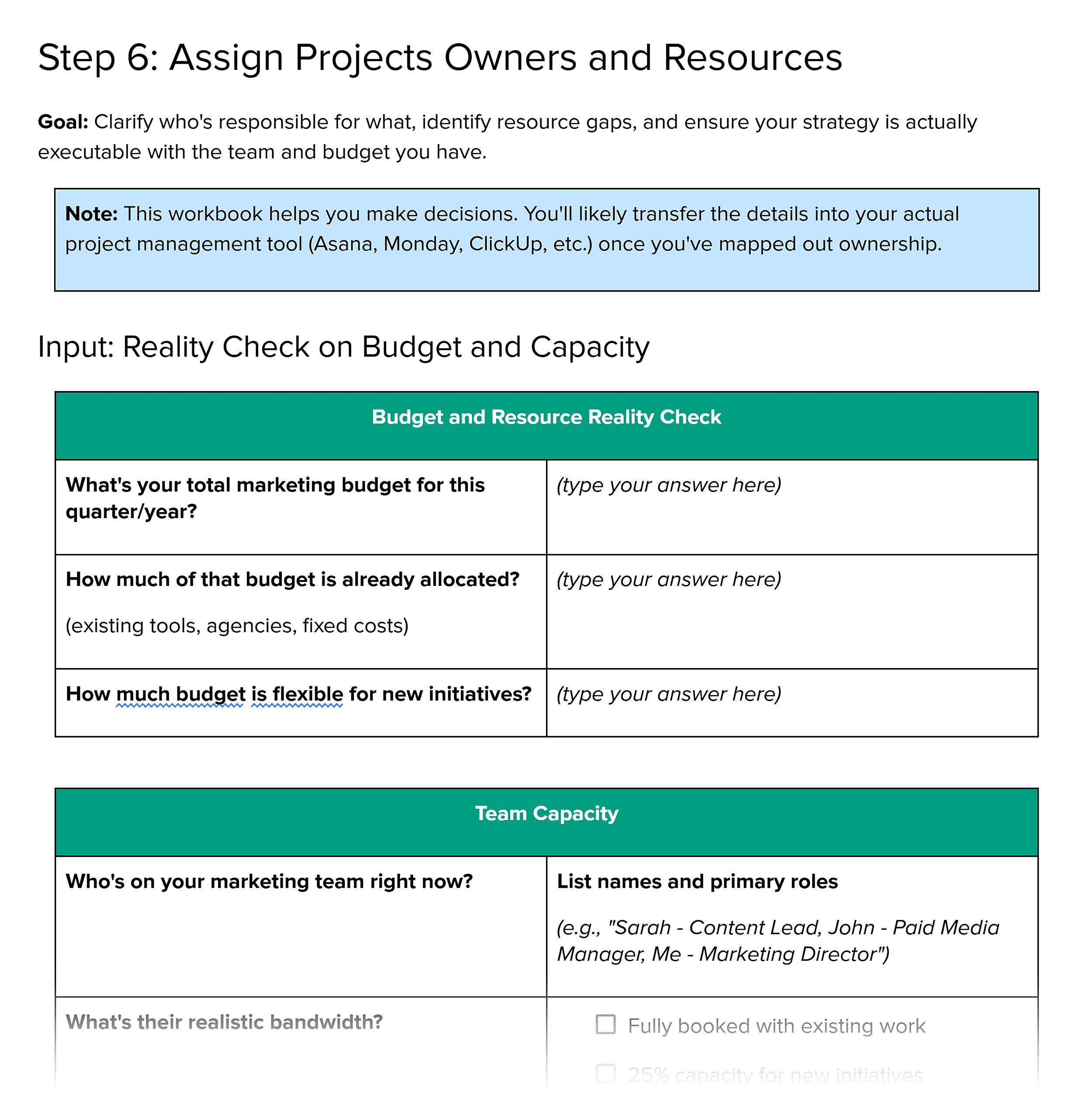
Once you understand the constraints you’re working with, clarify roles using a RACI structure:
Responsible: Who executes the work? Accountable: Who owns performance? Consulted: Who provides input? Informed: Who needs visibility?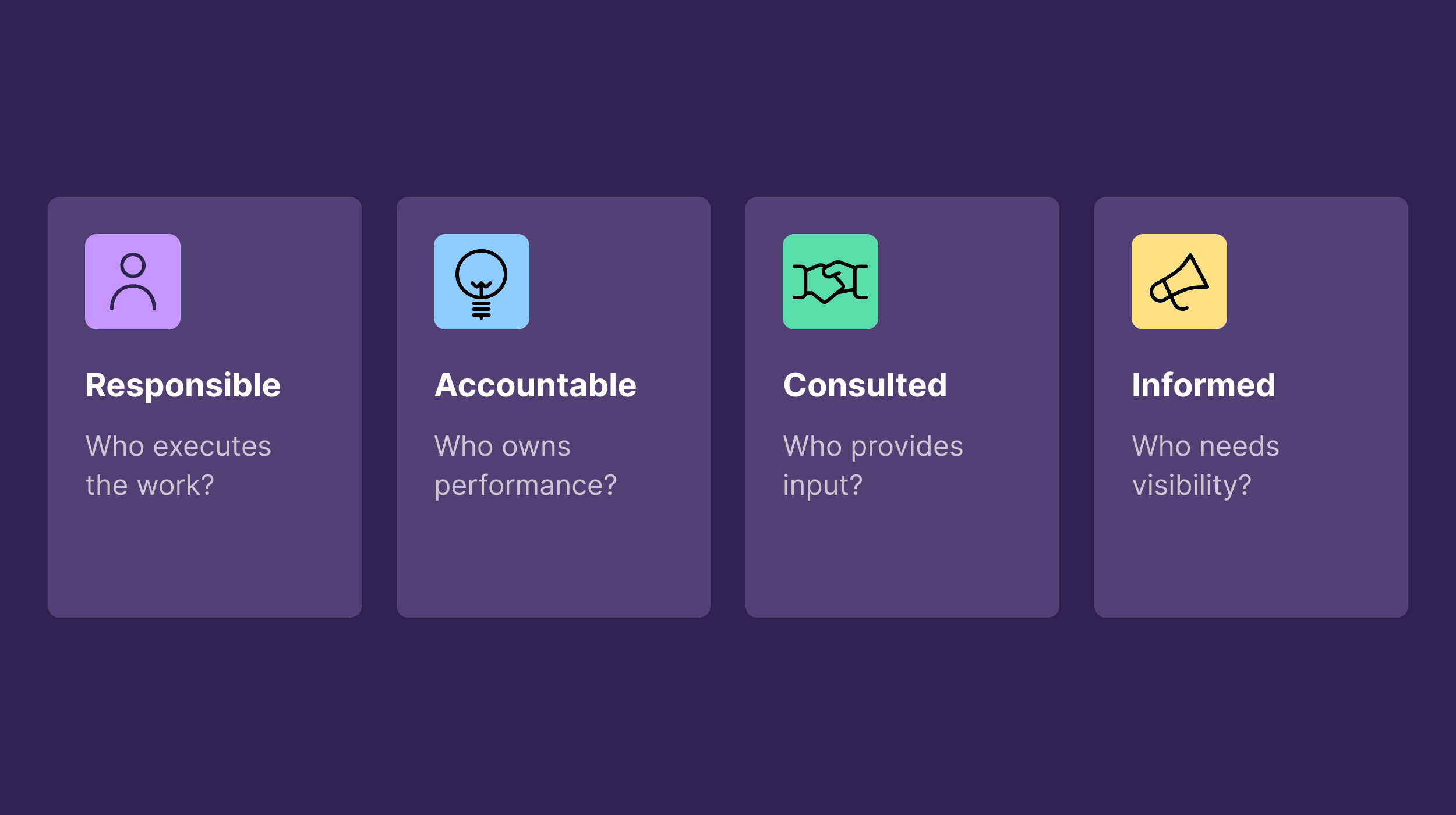
Lastly, don’t let channels operate in silos. SEO should inform paid. Sales objections should shape content. Customer success insights should influence customer marketing tactics. All of these teams would fall into the “consulted” category in our RACI framework.
Cross-team collaboration gives your digital marketing strategy the right foundation to build on.
By the end of this step, your strategy should feel operational, not theoretical.
Step 7: Establish KPIs and a Reporting Plan
KPIs let you get feedback on your marketing strategy’s performance over time. And feedback allows you to improve (without guessing).
The problem is, it’s harder than ever to measure what’s working. Marketing channels don’t always tie back directly to revenue. Some channels influence things that are harder to quantify, like brand awareness, AI visibility, or trust.
Instead of forcing attribution into a neat checklist, track metrics in three layers:
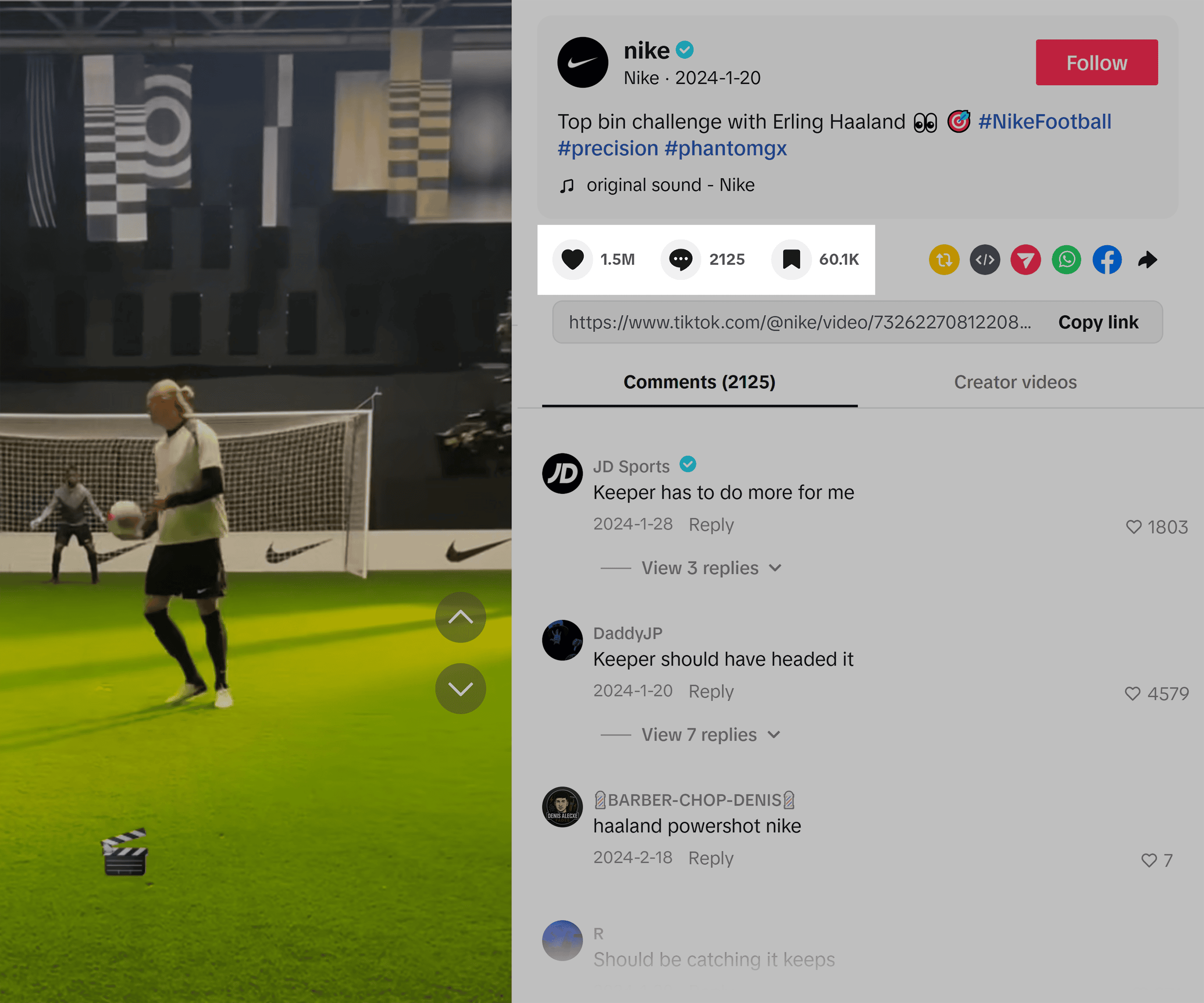
Visibility: Are we being seen? Engagement: Are people responding (positively)? Trust and intent: Are signals improving?For email, you could report on open rates (visibility), clicks (engagement), and conversions (intent).
For social media marketing, you might track metrics like reach (visibility), comments (engagement), or saves (trust).
Of course, most marketers still need to answer one uncomfortable question:
How does this tie back to revenue?
It won’t always be perfect. But you can create stronger connections with a few simple systems.
Use UTM parameters on every campaign link. That way, you can trace traffic and conversions back to specific channels, campaigns, or posts. Set up goal tracking or conversion events in Google Analytics. See which channels drive form fills, purchases, demo requests, or trials. Review user paths to understand how people move through your site before converting. Just remember: many buyers interact with multiple channels before taking action, so treat these as a guide, not as a definitive start-to-finish buying journey. For B2B teams, align with sales on pipeline influence. Even if marketing isn’t the final touchpoint, it often plays an early role in deal creation.Multi-touch attribution may not be possible from day one. But these steps will give you directional clarity.
If a channel consistently drives qualified traffic, assisted conversions, or branded search growth, it’s contributing to revenue — even if it’s not the last click.
Reporting should tell a story, not just hand out numbers. The idea is to show progress, but also know when you need to pivot.
So, take a deep breath, start small, and scale over time.
If fancy dashboards and complex reporting tools feel like too much, just pick 2-3 metrics per channel. Then, assign a clear reporting owner, and set up a review cadence (probably monthly or quarterly).
This is enough to get started.
Start with small tests to see what actually works in your industry, with your audience. Don’t get distracted by the noise of new tools and trends.
Focus on what’s actually working, and then improve and scale the ideas that work best.
| Start Small, Scale Up | Important reminder: You don’t need to track everything perfectly from day one. Here’s a plan to scale reporting over time. |
| Month 1: Establish baselines |
Set up tracking
Collect initial data
Identify what’s easiest to measure vs. what requires more setup
|
| Months 2-3: Validate what matters | Test small initiatives See what moves the needle Adjust metrics if needed |
| Months 4+: Optimize and scale | Double down on what’s working Cut or pivot what’s not Refine your reporting process |
Every quarter, revisit things like channel performance, KPI relevance, and execution quality.
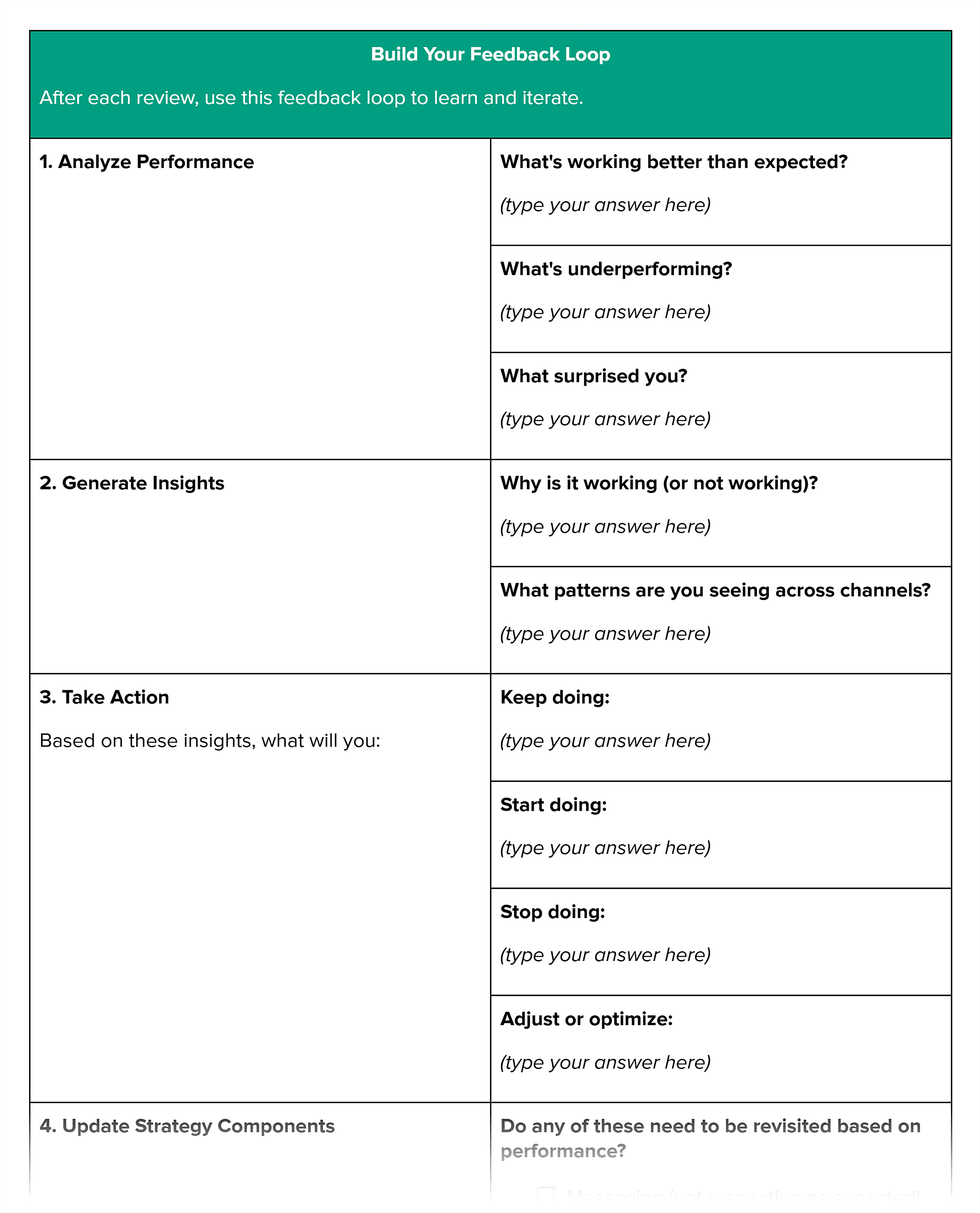
When this is in place, build a simple feedback loop:
Analyze performance Dig deeper to understand the patterns Reprioritize channels and actions Update your strategy and goalsUse the Marketing Strategy Workbook to run through this feedback loop, and document your insights and decisions. As your data improves, so will your strategy.
Evolve Your Marketing Strategy as You Grow
A marketing strategy is a living thing. That means you can revisit, refine, and strengthen the system over time.
You now have a clear structure with:
A defined goal A sharp value proposition Real audience insight Focused channel priorities Clear ownership Measurable KPIsThat clarity makes execution easier.
Your next step is simple: open the Marketing Strategy Workbook and document your decisions.
Fill in what’s missing. Then commit to your top one or two channels and start executing.
Remember: this isn’t your final version. But it’s a starting point you can revisit, refine, and build on as your business evolves.
Once your strategy is defined, the next logical step is going deeper into execution.
If you’re prioritizing organic growth, read our guide to building an SEO strategy next.
Backlinko is owned by Semrush. We’re still obsessed with bringing you world-class SEO insights, backed by hands-on experience. Unless otherwise noted, this content was written by either an employee or paid contractor of Semrush Inc.