Buddha Was Asleep in Our Home
Looking back on her life, an aging practitioner finds solace in nature’s cycles of birth and death. The post Buddha Was Asleep in Our Home appeared first on Tricycle: The Buddhist Review.
 Astrong
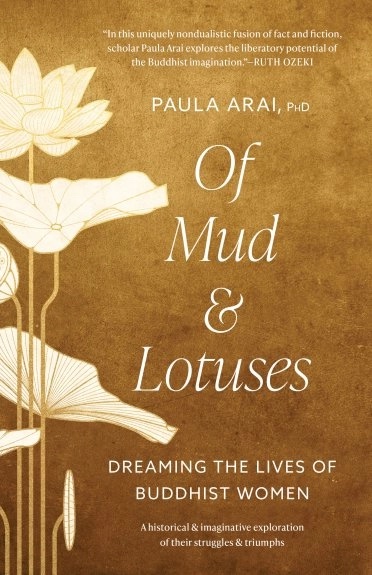
The following excerpt is from Of Mud and Lotuses: Dreaming the Lives of Buddhist Women by Paula Arai. Through personal reflection, creative histories, and interview-based nonfiction narratives, Of Mud and Lotuses illuminates the creativity and ingenuity in how Buddhist women have applied the dharma to daily life, from the earliest days of Buddhism to the present day. The following chapter tells the story of Saya, a woman that Arai interviewed in the course of her research.
***
Saya leaned forward and looked squarely into my eyes. The gravity of sacred time and space pulled us closer as she began: “I have never told anyone this before. I was in my 20s. I had an abortion.”
For over fifty years, only her partner knew. He accompanied her across state lines to receive the procedure, since it wasn’t available in the state they lived in. He cared for her afterward, too. It was a mutual decision. They weren’t ready to responsibly parent.
“We did not regret our decision,” Saya says. “Yet, there’s not a day that goes by that I don’t think about it. It’s not that I feel shame, but it is so personal. Something unresolved lingers in me. There’s a dialogue inside me. There was a longing to connect, but I didn’t know how. I decided to share this because of the times we live in now. So many women are suffering. Girls who are raped must carry a baby, and they don’t know what is going on with their bodies. Women with complications in pregnancy die because doctors fearing jail wait until they do not hear a heartbeat before they will treat a woman. Since many will read your book, I wanted to share how dharma helped me in ways that I am only now learning how to articulate. It had been so deeply embedded in daily life that I didn’t have words to understand it, but I realize now that it has undergirded my whole life.
“My family did not do explicit rituals or have Buddhist images. They came to the United States in the early 1900s. When they came from Japan, they did not know what to expect. They feared that having explicit Buddhist items might subject them to adverse treatment, so they did not bring them. They did know that they did not look like the anglicized depictions of Jesus or Mary. They did not know that coming to this land to till fields and grow vegetables would become a threat to white Americans. Rounded up into internment camps, they were forcibly detained behind barbed wire on land that was not arable.
“Our family was one of the fortunate ones, for a white man looked after our family farm and returned it to us when my family was freed. I was born not long after that. My mom was quite young, so my Obachan [grandmother] pretty much raised me. Living on a farm, we always had a lot of food and there was always a lot of sharing. Aunties, uncles, cousins, and neighboring farm families were my world.
“My Obachan was Buddhist, so I knew I grew up culturally Buddhist. It recently became clear to me that I had actually been raised in the dharma. I was living it but not knowing it. It was just the way things were done. I see now that Obachan taught me by how she carried herself, how she lived her ethics. She expected me to, as well. The qualities she embodied included honesty, hard work, reliability, integrity, generosity, standing tall, being a ‘good person’ and being kind.
“I learned gaman—a kind of patience or forbearance—from my Obachan. She came to this country with harsh conditions. Gaman got her through dark times, including the war and incarceration. Gaman doesn’t translate well into English because it’s not based on an individualistic sense of self. Awareness of our dependence on each other is implicit in gaman. Being patient or exhibiting fortitude is experienced as being an important part of a larger whole, which is integral to a relational notion of self. You are not alone. And you are not doing things just for yourself. Your actions affect others. So when you endure a difficult situation, you are enacting your respect and care for the greater whole.
“I have learned that gaman is a mature response to not getting what you want. Gaman is an antidote to self-pity. It is not about self-denial but about understanding there are limitations to conditions and resources. Gaman is a patience that stretches you. It is founded on a network of support. You do not have to have concrete knowledge of the past to draw on ancestral strength and wisdom because it is baked into current conditions. Gaman is also an expression of respect for conditions of the present and awareness that consequences of one’s actions ripple out into the future. Gaman is driven by a sense of gratitude for what you have received and moral responsibility for those who will be affected by your choices. Gaman has helped me see things from a bigger perspective, to know that I am not alone in my times of forbearance. It makes it easier to regulate my emotions as they course through me.
“I have come to appreciate how growing up in a farming family kept me close to nature and community. I learned the cycle of life and death growing up on a farm among all my cousins, aunties, and uncles. We were there for each other through births, holidays, sicknesses, and deaths. The transformation of seasons was also a teacher that gave instruction through changes in temperature, sunlight, rain, wind, and soil, through tiny sprouts and harvested vegetables. To this day, gardening keeps me in touch with the natural dynamics of reality. That’s how I approach things. It guides how I process emotions. Nature flows with birth and death, and I am part of that. It makes me want to have my hands in the soil. The growing and planting season is important to me. It’s the nurturing, the concern if the little young ones will make it. Others can handle the harvest. I want to care for the vulnerable seedlings and insects. I watch the interactions of insects moving around in the flowers. They show me how all things are interconnected.
Nature flows with birth and death, and I am part of that.
“This view of the circle of life fortified me as I cared for my aging father. He was the oldest of four sons. They all worked the farm together. After he got sick, they pressured him to retire early. Farming was his whole world, his identity. So to not work was devastating for him. Although he adored his children, he had anger issues. Since I was the eldest in my generation, my mom raised me to set a good example for my younger siblings and cousins. I had to be sure to not behave in any way that was disrespectful because the younger ones would see what I did. I would set the standard. Moreover, what I did would reflect on everyone. I had pressure to keep our family name upright, which included honoring our elders. Being raised this way, I was obligated to care for him. It felt natural.
“When my mother began to decline, I cared for her, too. For two years I slept in her bed with her, because the dementia was so pronounced. I had to be there to help, to clean up after her. It was not easy. She was the sweetest person, but once the dementia set in, at times she became obstinate and angry. I was always concerned. Was she going to go out the gate into the street? Did she poop and pee on the floor again? Once she even threw her walker at a family member trying to care for her. Then she fell down. We had to take her to the ER. She told them the person was trying to shoot her. It was like living in a hell realm for everyone.
“The dharma teachings on compassion were my armor, protecting me from erupting in frustration and shielding us all from anger. I also thought of how she cared for me so tenderly and patiently while raising me. I remember being a child falling asleep with my head on her lap as she cleaned my ears with a bamboo ear-cleaning stick. It was so calming. I felt so cared for. I wanted to give that to her, too. Being in touch with the circle of life was my liberation.
Being in touch with the circle of life was my liberation.
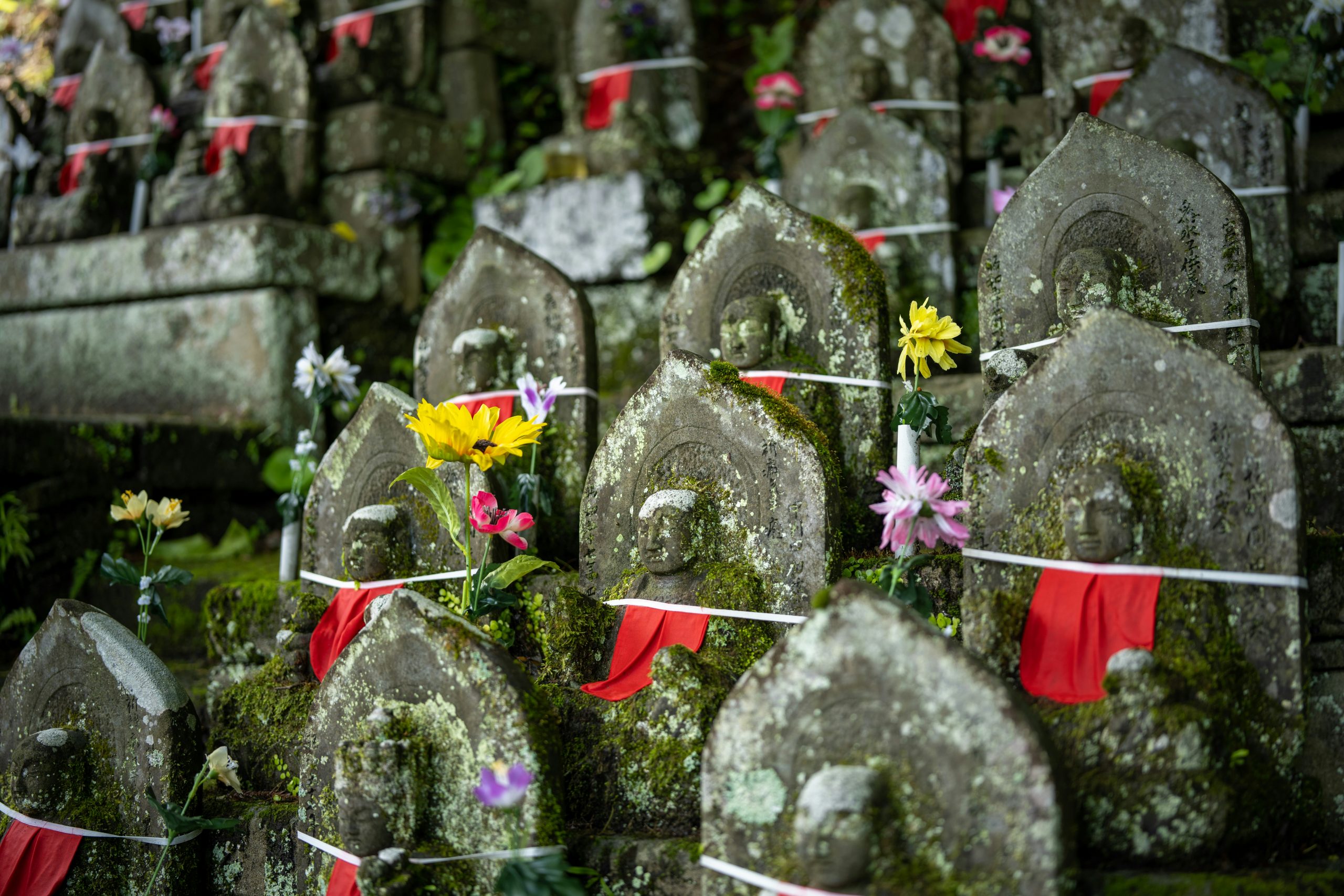
“Here I am nearing the end of my seventh decade, and I finally found a way to communicate in a consciously healing way with my mizuko, my water child. I learned about the Japanese Buddhist mizuko ritual, which helps me acknowledge the loss and engage in an ongoing relationship by doing the simple acts of lighting a candle, offering incense and flowers from the garden, and a little treat. It gives me an embodied connection with my mizuko, enabling me to express respect both to my mizuko and myself. I do it quietly by myself on the twenty-fourth of the month. It is the auspicious day for Jizo Bodhisattva. Jizo’s compassionate focus is to usher beings through different realms, holding a special place for mizuko. Mizuko are beings who returned to primordial waters without setting foot on the earth and await auspicious conditions to return.
“In a way, caring for caterpillars in my garden and watching them change is a mizuko ritual for me. Not all of them make it. It happens before your eyes. It’s watching life and death. It happens in a short period of time. It’s a beautiful thing to watch the colors change, too, from yellows and greens to black pupa. It is a sublime wonder to watch the wings expand as they drip dry before taking flight. Observing this phenomenon is a meditation on metamorphosis.
“As I age, my friends age. More of them are facing infirmity, disease, and intense diagnoses. I, too, have had brushes with diagnoses and conditions that remind me that I am part of the circle of life and death.”
After hours of conversation, Saya handed me a poem. It bubbled up in her heart after she was honored as an elder in her current sangha, which was a few weeks before we met. She says that poems sometimes come to her, usually indicating a bud of new growth.
Buddha was asleep in our home.
As a young child,
I never knew.
He didn’t need to show himself in statues and icons.
He lived in the hearts of my people.
They embodied his way and shared his teaching.
He was happy. He could rest.
I found traces he was living with us . . .
Much later,
After much time had passed.
I was unaware . . .
I just thought they were
My grandmother’s things.
I found the prayer beads.
I walked in a huge circle
To come home.
A long, winding circle
Called life.
I’m almost finished.
Today, I live with Buddha again.
I have a new home,
I found a new family that lives with Buddha.
Maybe I can live without the icons and images.
But now
It’s a different time.
I’m lucky to live
Without the fear.
And, I like
All the images of the Buddha,
Especially the ones
That look like I belong too.
I found home.
I’m so happy.
Saya’s poem reminds me of the women’s poems in the Therigatha. Saya is finally free from the suffering she and her family endured due to racism, xenophobia, and her personal life choices. Open expressions of dharma are now a source of comfort and strength, though her experience tells her that the most important expression of dharma is that which animates her heart.
♦
From Of Mud and Lotuses © 2026 by Paula Arai. Reprinted in arrangement with Shambhala Publications, Inc. Boulder, CO. www.shambhala.com.