Drawing from the Wellspring Within
At a Dervish monastery in Europe, a Zen koan comes to life. The post Drawing from the Wellspring Within appeared first on Tricycle: The Buddhist Review.
 Aliver
A week before our vacation to Eastern Europe, I get a text from my mother. Translated from Chinese, it said this:
“Dear Daughter, I have loved and been proud of you since you were a child, but now you have broken my heart, because you actually publicly announced that you abandoned the true God who loves us, and chose the idol of destruction. I hope you can remember that under my urgent prayer for you, God led you out of trouble, showed wonderful miracles, and led you to this point step by step. . . I hope the divine light shines on you and makes you turn around quickly.”
This comment came in response to her finding out about the last essay I wrote for Tricycle. She hadn’t read it; just seeing the word “Buddhist” on my Instagram post was enough.
I deeply love my mother. She’s one of the most admirable people I know. Her generosity and kindness ripple outward, and people from her church would often tell me about how she had helped them through some difficult situations. And without her support, I never would have made it through the dissolution of my marriage some twenty years ago.
When she was 9 years old, she encountered Christian missionaries in her hometown of Xian, shortly after the death of her older sister from a rare blood disease. The grieving child heard the message that “Jesus loves you” and was deeply touched by the message that even she could have a personal relationship with God. She brought her six siblings to church and eventually helped to convert the rest of her family, even her parents, to Christianity. That is to say, her religion is a central part of her identity.
I understand her devotion. Life is beautiful, bewildering, and fragile, and it’s no wonder that many of us feel called to a spiritual practice to find solid footing. My own Zen spiritual practice, which I turned to for comfort, guidance, and community during the divorce, has sustained me through many trials. It has helped me to stay open when I want to shut down, to stay present when I want to turn away.
In truth, we are more alike than she thinks.
So how do I stay true to my experience without losing my mother? How do I speak from the heart without hardening my views? How do I meet her conviction that there is only one way to the divine, without abandoning my own path?
And why is life always thrusting these kinds of tangled quandaries upon us? As if the world weren’t already heavy enough with conflict and suffering?
I bring these questions to dokusan, a one-on-one meeting with my teacher, Valerie Forstman, at Mountain Cloud Zen Center.
So, OK, it’s like what the Buddha says: Life is suffering. We face it, we don’t turn away from it. We see the cruelty, confusion, and delusion. We gradually learn to accept that absolutely nothing is permanent.
Damn, that’s a heavy load.
So I ask: How do we get up in the morning in the face of all this? How do we find joy and the strength to go on?
Forstman offers a zen koan:
In a well that has not been dug, water ripples from a spring that does not flow;
Someone with no shadow or form is drawing the water.
Deep within each of us, she says, this wellspring is alive. An inexhaustible source of renewal, transforming mud into the fertile soil from which lotus blooms arise. And notice every word: Someone is “drawing the water.” It is an intentional act. That’s what the meditation practice is about: We must learn, through sitting silently, to draw from this source within. Otherwise, we search for answers outside ourselves, “like one in water, crying out for thirst,” as Zen master Hakuin so vividly put it.
The idea is intriguing, that there is a deep, abiding, and regenerative force inside, capable of transforming pain into clarity. But how do I know this wellspring is really there? Is it real, or just a quirky little riddle?
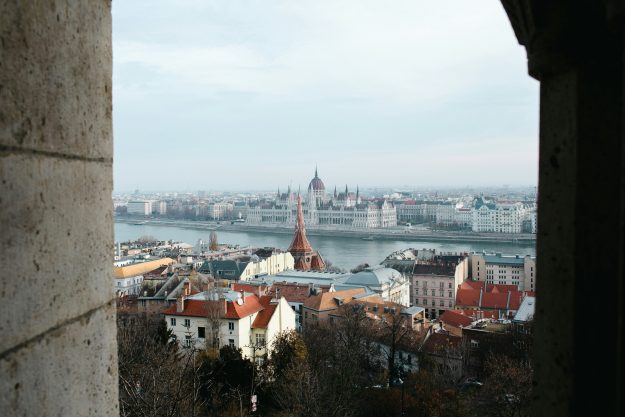 View of Budapest. | Photo by Naomi Johnston
With this koan circulating in my mind, we fly into Budapest two days before a historic election. The prime minister, Victor Orbán, has been consolidating his power for the past sixteen years, becoming a model for rising authoritarian movements. Our taxi driver speaks candidly: He is frustrated but doubtful that change is possible. As we drive into the city, every lamppost is plastered with propaganda attacking the opposition candidate. The overwhelming visual display of control feels, frankly, insurmountable.
After a brief stay, we head to Bosnia-Herzegovina. Ruled successively by the Ottoman Empire and then the Austro-Hungarian Empire, this ancient city has a split personality. Walking along the Ferhadija, the main pedestrian promenade, you come to a literal dividing line painted on the pavement marked “Sarajevo Meeting of Cultures.” Looking east from that marker, you see the Turkish bazaar, with its narrow streets winding between low-slung wood and stone buildings housing baklava stands and shops selling Turkish coffee sets, the Gazi Husrev-beg Mosque, and hidden courtyards where merchant caravans traveling between Europe and the Middle East used to stop to rest. Looking west, you see grand 19th-century European-style multistory brick and stucco buildings in pastel colors, and the Neo-Gothic Sacred Heart Cathedral. And just to the south is the Neo-Moorish Ashkenazi Synagogue, inspired by the Alhambra in Spain. For centuries, Sarajevo was a model of peaceful coexistence. Then, in the 1990s, sectarian violence tore through the city during the Bosnian War, turning it into a bloody combat zone, resulting in the longest siege in the history of modern warfare. Neighbor turned against neighbor along ethnic and religious lines. Nearly 14,000 people died.
Walking through the city, we stumble upon vivid reminders of the war, when an average of 329 mortar shells rained down on the city every day. The explosions left distinct physical marks on the pavement throughout town. A jagged crater marks the point of impact, and radiating from the center, exploding shrapnel carves out a scattering of gashes. Residents started calling them “Sarajevo Roses,” a sarcastic joke that somehow stuck. Rather than pave over these scars of war, artists filled them with a red resin, literally turning a tool of death into a blossom. A brave choice, to actively process the trauma of the past rather than erase it.
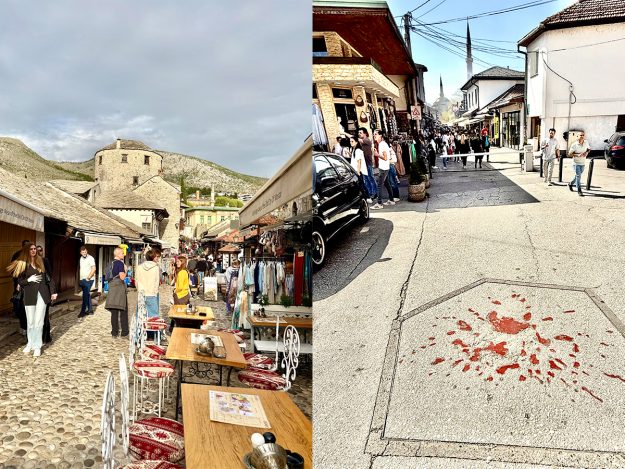 Left to right: Downtown Sarajevo, Bosnia and Herzegovina; a Sarajevo Rose. | Images courtesy Daisy Lin
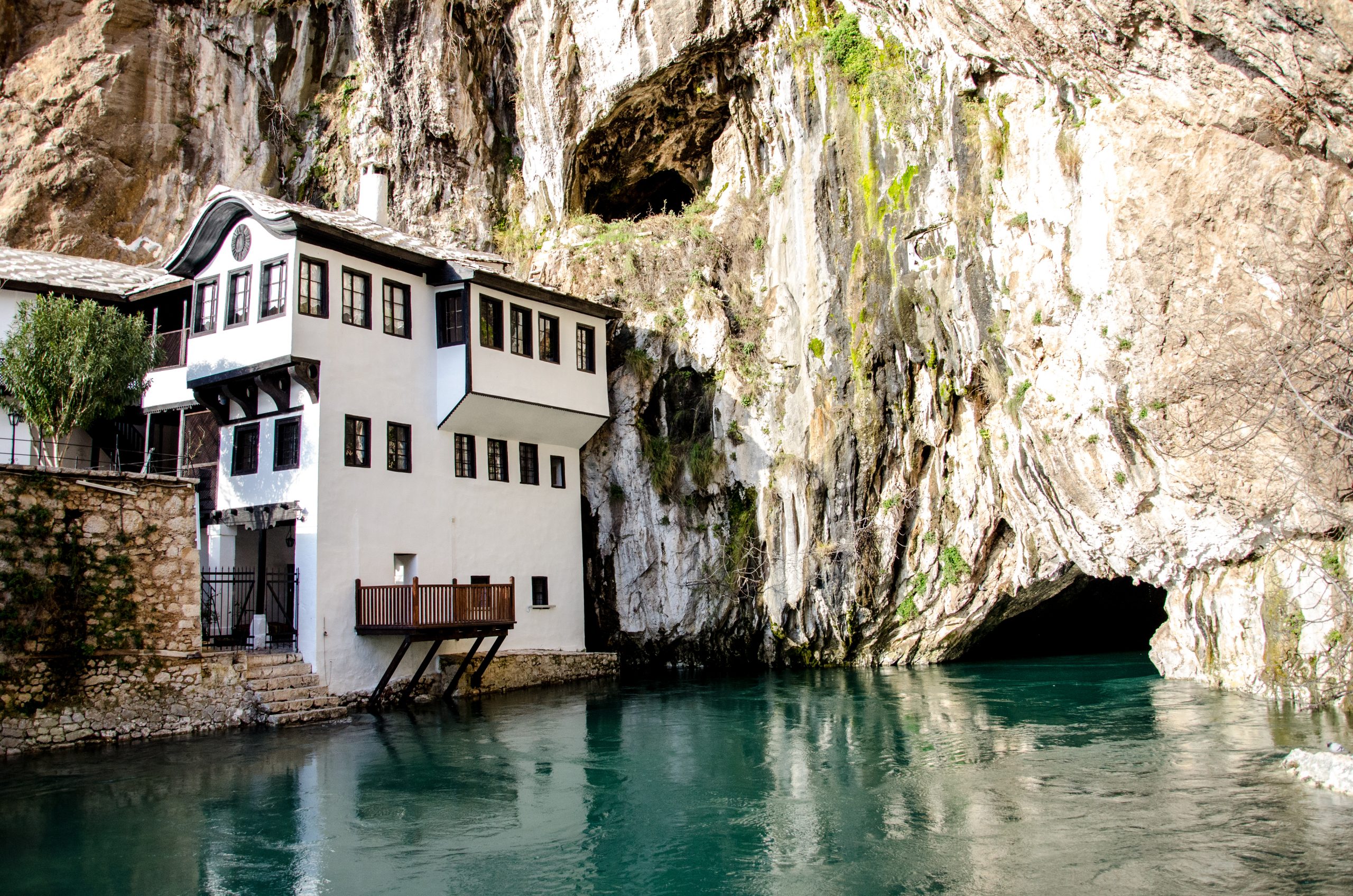
As we head down south to the city of Mostar on a bus, I research attractions in the area. By chance, I come across mentions of Blagaj Tekija, a stunning 16th-century Dervish monastery built directly into a sheer limestone cliff face, where centuries of Islamic mystics gathered to perform spiritual rituals.
And, what’s this? It hovers atop a cave where water gushes from an actual wellspring.
I feel the clarion call to visit this mysterious place, and the next day, I take a local bus to the site. The Buna river hums softly as I walk the path to the monastery, past roadside stands selling rose, pomegranate, and elderflower syrups.
Inside the monastery grounds, I wander around the main courtyard and happen upon a metal gate along the outer wall. It opens up onto a few steps hovering right above the river, and walking through the threshold, I feel the temperature drop as the water glides past.
There it is, just a few yards away. The wellspring, Vrelo Bune.
From the dark mouth of a cave at the base of the limestone cliff, clear turquoise water surges: pristine, luminous, vital.
 Left to right: The Buna Spring (Vrelo Bune) in front of the Blagaj Tekija; the well of the Buna inside a cave. | Images courtesy Daisy Lin
For centuries, snow and rainwater plunged through clefts in the weathered limestone and sank downward. Deep in the dark earth, it carved out mighty underground waterways, flowing freely until it found an opening to the surface. As the clear cold water rose, gravity trapped the heavy sediments and debris below. What gushes out, at about 30,000 liters per second, is pristine, naturally purified water. I breathe in its crystalline glow.
Stepping away from the water’s edge, I don a headscarf to enter the sacred inner chambers of the monastery. The rooms are small and covered with colorful carpets. Every window overlooks the wellspring. I enter a prayer room, sit on a stool in the back, and start to meditate. Breathing in, breathing out.
Just outside the window, the immaculate water flows from its hidden source. A family enters and starts prayers. The father stands with his palms together as a child clings to his leg. A young couple pulls up small prayer rugs. The young man kneels and starts chanting softly under his breath. He lifts both hands, palms open, and sways gently, facing the wellspring and Mecca.
We are silent together. Not Muslim, Buddhist, or Christian. Just human beings, reaching toward something sacred. We become a sangha.
At that moment, something loosens. Not an answer, exactly, but a recognition, as if the water I am looking at has always been moving within me. A quiet joy begins to rise.
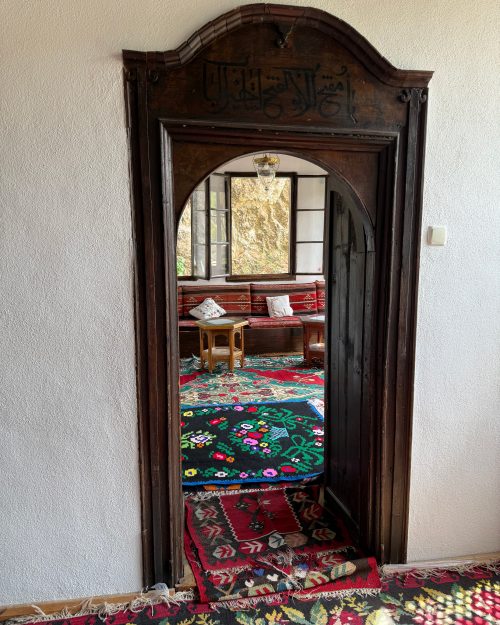 An interior room of the Blagaj Tekija. | Photo courtesy Daisy Lin
When we return home, we learn that against all odds, the election in Hungary ushered out the entrenched autocrat. Change, however unlikely, happens.
In Sarajevo, people are marking the thirtieth anniversary of the war’s end with acts of healing. My favorite is “Our Family Garden,” a project in which a women’s collective planted a thousand calendula flowers inside former war trenches, reclaiming the very ground upon which so much blood spilled with a soft medicinal blanket of yellow and orange, a living monument honoring the sacrifice of those who died, and the resilience of those who still live.
Healing emerges over time. And I think: How we treat ourselves and each other at the smallest scale is how the world begins to be shaped.
How we treat ourselves and each other at the smallest scale is how the world begins to be shaped.
I text my mother a story she once told me, the parable of the blind men and the elephant. A group of blind men encounters an elephant, visiting their town for the first time. They each touch a part of the elephant and describe it. One feeling the ear says an elephant is like a big fan, another with his arm around the leg says an elephant is wide and solid like a tree, another one at the tail says it’s thin like a rope, and so on. Just as they are arguing heatedly and getting up in arms about who is right, a wise man walking by reveals the truth: They are all partially right, they’re just not seeing the whole picture.
I follow this with: “Dear Mom, God is bigger than any of us can imagine, and each of us experiences the divine in our own way. My spiritual practice is as meaningful to me as yours is to you. It has carried me through every challenge for the past twenty years. . . Life is short, let us just love each other.”
We may never come to a resolution, and I may just have to accept that. My instinct is to withdraw, to protect myself. But my practice asks something different: to stay open.
So I sit. I sit with my love for my mother, and all beings. I sit with the quandaries that have no easy answers, the ache of not being understood, and let it sink into the deep eddy of my being. The wellspring is rippling at the core, doing its silent work, dissolving everything. Sometimes I lift my hands and sway a little, like my sangha brother at the monastery. I will keep practicing, drawing from that wellspring, knowing that one day the pure waters will come gushing out like a glacial song, the clear turquoise breaking through the surface, again and again.