France’s ‘Green Venice’ is perfect for beating the heat – and the crowds
With temperatures soaring in France this summer, Anna Richards heads to Marais Poitevin – an immense stretch of wetlands where life moves at a slower pace
 FrankLin

It’s like being on a floating Christmas pudding. Our boatman churns the muddy water with a pigouille, a punter’s oar made from ash, and the flames leap around us in response. As the whirlpool settles, they subside, and the stillness is only disturbed by dragonflies skimming the water’s surface. Swamp gas – a mix of methane, hydrogen sulphide and carbon dioxide – bubbles away in the silt. My two dogs, capable of barking at a fly as though it were an axe murderer, don’t appear remotely fazed by the fact that our boat was just on fire.
Left dried out and lethargic by the heatwave sweeping through Europe, my partner and I made for Marais Poitevin, a wetland covering more than 200,000 hectares in western France. Here, a network of more than 8,000km of muddy canals stretches all the way from the medieval city of Niort to the Atlantic Ocean, straddling the Vendée and Charente-Maritime. We’d been staying with my partner’s family in Vienne, 90 minutes away. The heat was so oppressive inland that even the fields of sunflowers seemed to be wilting. Our dogs kept climbing into my mother-in-law’s ornamental fountain to cool off, and we inspected the koi carp afterwards to see if they’d been turned into tartare by 30kg of hot, wet fluff.
Marais Poitevin may only have been a few degrees cooler, but here, a tangle of poplar trees shaded the waterways, and the dogs and I leapt gleefully into the water. The English word for marais — swamp — does Marais Poitevin a disservice. I emerge from the water of Shrek’s home turf looking and feeling reasonably clean. The mud is all at the bottom.
Read more: Underground Paris is the city at its most intriguing
However wild and natural it all looks, Marais Poitevin is artificial. Thousands of years ago, this region lay under the Atlantic Ocean. As the sea retreated, it left mud flats. In the Middle Ages, monks began to drain channels and add dykes against tidal flooding as they built their monasteries. The vestiges of many, including l’Abbaye de Maillezais and Abbaye Royale in St Michel-en-l’Herm, still stand today. As the centuries went by and farming developed, the marshes served as a vast irrigation system.
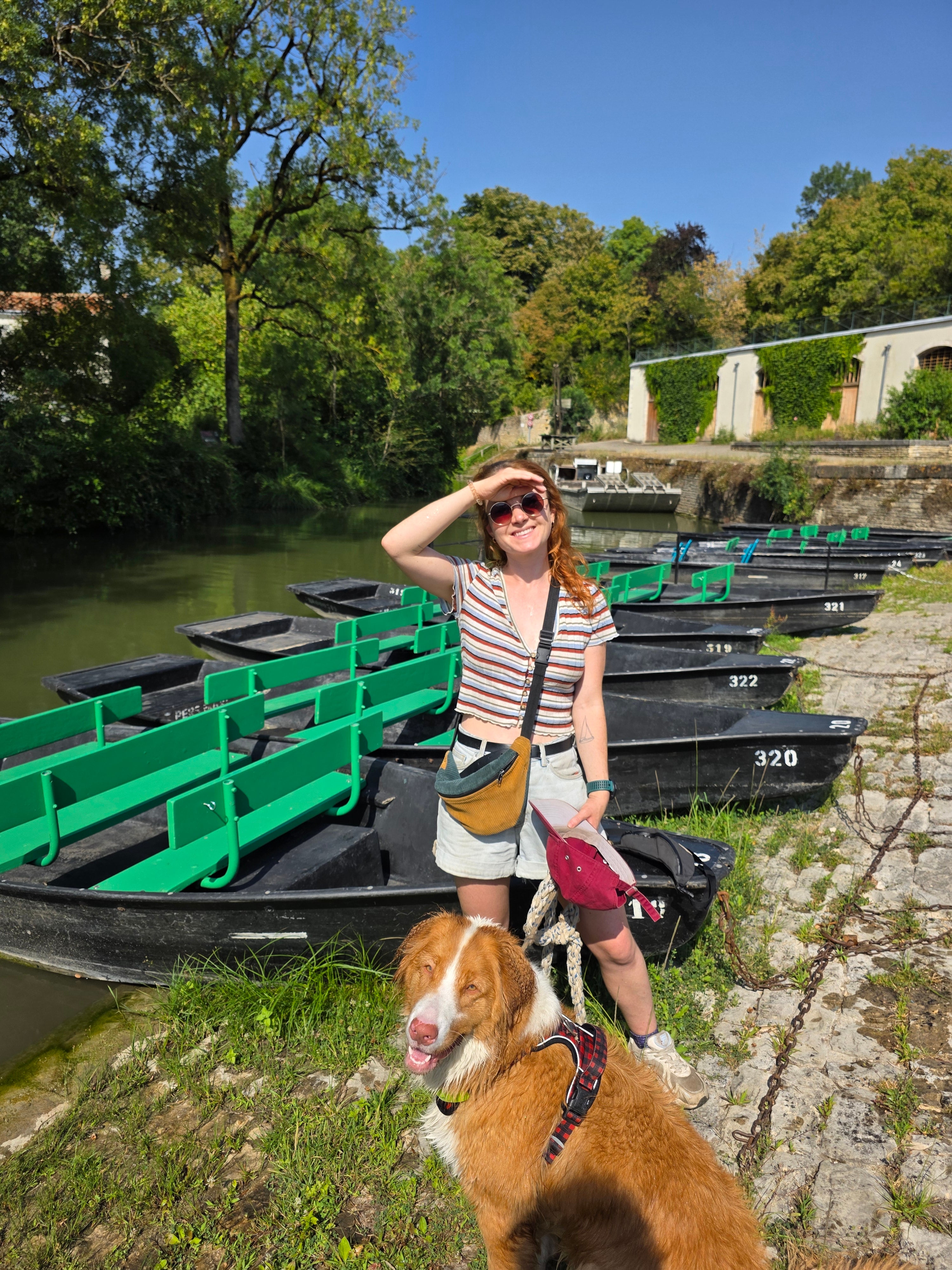
There’s very little agriculture here now, and the region largely relies on tourism. It’s a quiet kind of tourism, and life moves slowly between little boatmen’s villages enveloped in greenery. We lunch at Restaurant Au Bord de l’Eau in the hamlet of Le Mazeau, tucking into caramelised onion and goat’s cheese tart followed by tarte tatin in the shade of willow trees. We’re as close to the water as it’s possible to get without the dogs throwing themselves in during the meal. Instead, we decide to take them on a quintessentially poitevin cruise, and we hire a plate with a boatman. These flat-bottomed boats (literally named “flat”) line every waterside settlement here, and are so essential to marais life that even the postman does their delivery round on one.
-copy.jpg)
Along the banks are a chablis that has nothing to do with wine. Here, chablis means a tower of earth from an uprooted poplar tree, and they’re often taller than I am. The heatwave has come with storms, and the roots of the poplars are so vast that they create these massive columns of earth as they fall. We can even see where crayfish have nibbled on the roots.
From Le Mazeau we head to Coulon, capital of what’s known as “Green Venice” (La Venise Verte). We feel a little silly in a car: the road hugging the water is gravelly, and we don’t pass a single other vehicle, although there are plenty of cyclists. The little bridges at intervals look as though they could barely stand the weight of two people and two dogs, let alone the car along with us. Bike, canoe, SUP or even horseback are the preferred modes of transport, and every long lawn that sweeps down towards the water has a plate moored at the bottom.
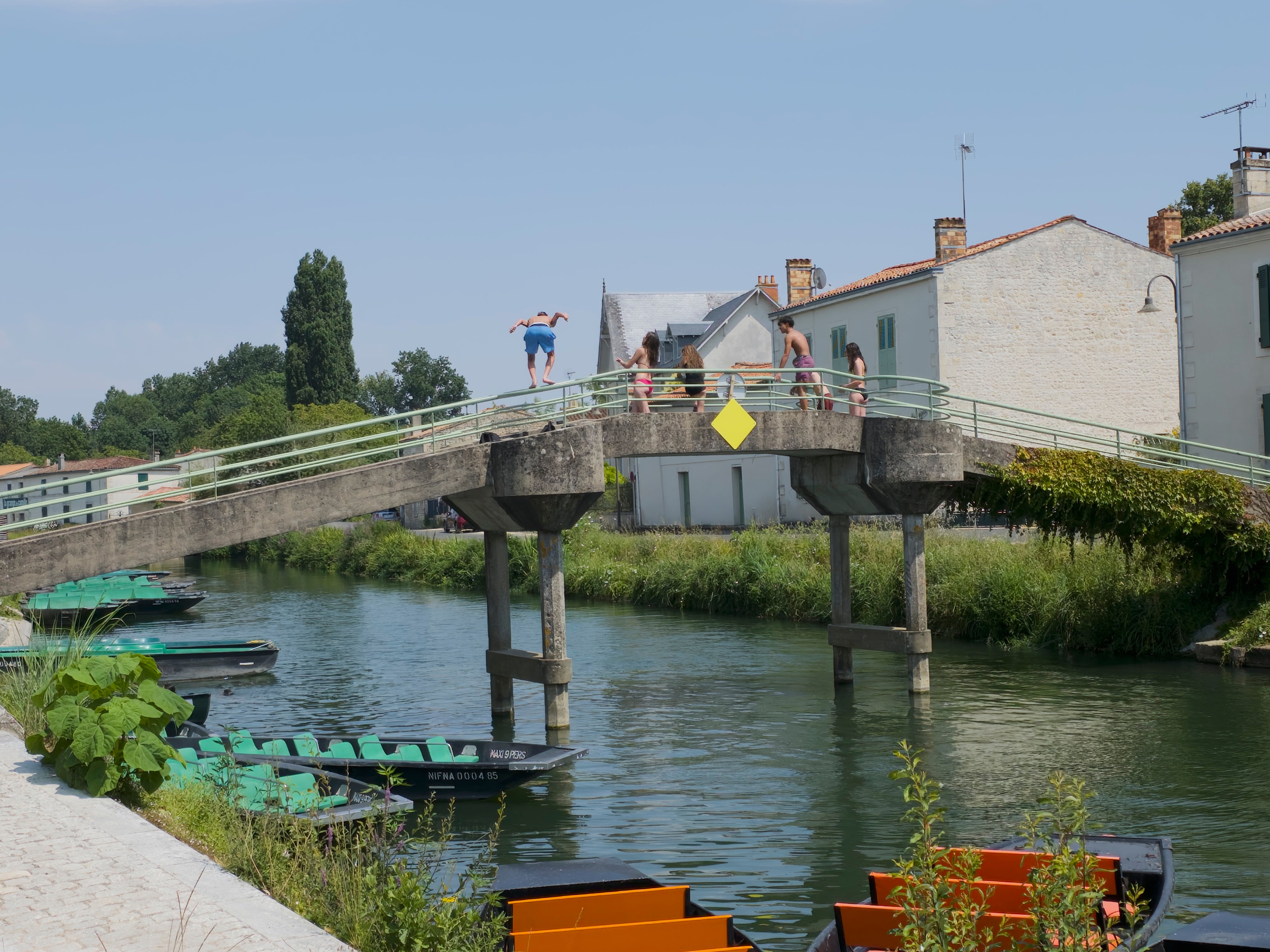
Bunting and brightly painted shutters add colour to the cream-coloured limestone buildings in Coulon. Local kids take it in turns to leap off a flower-lined bridge, so we strip off and join in, launching from the riverbank with the dogs. There are a couple of other groups wallowing in the water too, chatting away. With temperatures this high, much of the socialising has moved from café patios to the water. We dry off eating lavish quantities of ice cream in cones almost as big as my head from La Libellule, the sorbets studded with chunks of frozen fruit.
Read more: Lyon is the perfect city break destination for people who hate cities
Our last stop is Arçais, a pretty little town of artists’ workshops with a church shrouded by shrubbery. A ramshackle barn makes for an exhibition space, where a sign labelled “patriarchy” dangles from a hangman’s noose, and little vegetable gardens frame each cottage. They’re so abundant that the courgette plants poke through the chicken wire into the street, their tangerine flowers curled to avoid the sun’s rays.
We appear to be the only tourists, so we swim from the main slipway, the water just cool enough to be refreshing. I imagine the sunbed wars an hour west on the Atlantic. I think about how the tarmac in Lyon, my home city, now heats up so much that it feels like I’m cooking from every angle, and the dry fields around my mother-in-law’s home, crisp-like in colour and texture. Here, I float like a lily pad, the sunlight gentle as it dapples through a thousand leaves, every possible colour of green around me. The gentle croaking of frogs and my dogs snapping at the splashes they create in the water are the only noises.
How to get there
The closest airport to Marais Poitevin is La Rochelle, under 30 minutes away, or it’s a three-hour drive from the ferry port in St-Malo.










.jpg?trim=0,0,0,0&width=1200&height=800&crop=1200:800)
.jpeg?trim=0,0,215,0&width=1200&height=800&crop=1200:800)