Gemini Notebook’s new Collections arrive just as Google turns it into a bigger workspace
Gemini Notebook’s new Collections help users organize growing research libraries as Google expands the former NotebookLM across Gemini and Search, although the feature remains more limited than a proper folder system.
 Koichiko
Google is cleaning up notebook organization as the former NotebookLM expands across Gemini and Search
 Pranob Mehrotra / Digital Trends
Google has barely finished renaming NotebookLM, and it’s already addressing one of the headaches that comes with building a large research library.
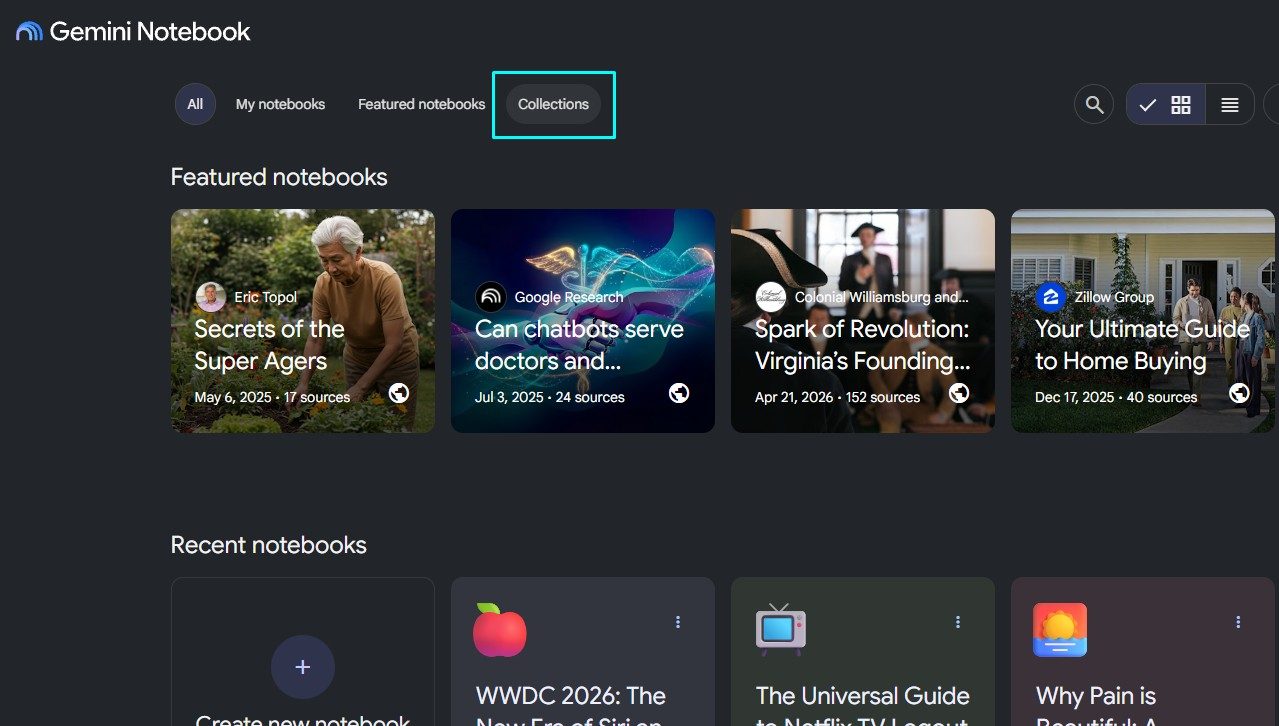
Collections are rolling out to all Gemini Notebook users, giving them a way to group related notebooks while keeping everything visible under My Notebooks. The dashboard gets some structure without asking users to rearrange the library they’ve already built.
The timing isn’t accidental. Google is connecting the former NotebookLM more closely with Gemini and Google Search, turning a standalone research tool into something users can carry across more of its AI products.
We heard you loud and clear: you want a way to organize your notebooks. So…
Meet Collections!
A brand new tab, Collections operate like photo albums or playlists: zero rigid folder structures with maximum flexibility. Add notebooks to as many collections as you want, or skip… pic.twitter.com/8wcsVSyEgm
How Collections differ from folders
A notebook can belong to several Collections at once. The same research project could sit under a work collection and a broader topic without creating a duplicate or forcing users to choose one permanent home.
Collections therefore behave more like labels or playlists than conventional folders. Anything that doesn’t need sorting can stay ungrouped under My Notebooks.
The setup is deliberately simple. It gives crowded dashboards some breathing room without introducing a complicated filing system that users then have to maintain.
Why organization is becoming more important
Notebooks can now appear inside the Gemini app, where users can work with uploaded material alongside earlier chats and custom instructions. Changes sync with the separate Gemini Notebook service, allowing the same project to continue across both products.
Google is also bringing Gemini Notebook into Search. With notebooks gaining more places to appear and more ways to accumulate information, leaving them in one increasingly crowded library would become frustrating quickly.
 Google
Collections add an organizational layer before that expansion makes the dashboard harder to navigate.
What Collections still don’t offer
Google hasn’t announced nested Collections, automatic sorting, or a full file-management system. Users can group notebooks, but they can’t build a detailed hierarchy or hand the cleanup over to Gemini.
That leaves Collections with a narrow job. They divide a growing library into useful groups without duplicating projects or removing anything from the main dashboard.
For anyone already staring at a messy wall of notebooks, that may be enough. Users expecting the control of a proper folder system will still find the new setup fairly basic.

Paulo Vargas is an English major turned reporter turned technical writer, with a career that has always circled back to…
Samsung’s humanoid robot ambitions are real, but factories come first
Samsung’s new robotics division has humanoids in its sights, although its immediate business is far more practical factory automation

Samsung wants a place in the humanoid race, but its new robotics push begins with machines built for factories rather than homes.
The CEO-led RX robotics division will initially focus on manufacturing robots. Samsung has separately identified humanoids as a priority, although it hasn’t announced a commercial model or explained where one fits into the division’s immediate plans.
WhatsApp’s Liquid Glass redesign is finally coming to Mac after months of waiting
WhatsApp's Mac app is getting Apple's Liquid Glass-inspired makeover

WhatsApp has been steadily adopting Apple's new design language across its apps, but Mac users have largely been left watching from the sidelines. That is finally beginning to change.
The messaging platform has started rolling out its Liquid Glass redesign for the WhatsApp Mac app, bringing the desktop experience much closer to what iPhone and iPad users have been seeing over the past few months. The update introduces a refreshed interface with redesigned navigation elements, updated menus, and a cleaner layout that aligns with Apple's latest software aesthetic. According to WABetaInfo, the rollout has begun through the latest Mac App Store update and is currently reaching a limited number of users.
NVIDIA’s new AI can detect deepfake videos in just 22 milliseconds
NVIDIA has a new AI tool that can tell fake videos from real ones in milliseconds

As generative AI becomes increasingly capable of producing videos that are nearly indistinguishable from real footage, the race is no longer just about creating synthetic media. It's about detecting it before it spreads.
At SIGGRAPH 2026, NVIDIA unveiled Synthetic Video Detector, a new AI-powered verification tool designed to identify AI-generated videos with remarkable speed and accuracy. Rather than replacing traditional fact-checking or forensic analysis, the company says the technology is intended to give newsrooms, broadcasters and enterprises another layer of confidence before synthetic videos enter the public domain.










/cdn.vox-cdn.com/uploads/chorus_asset/file/25825493/VST_011025_Site.jpg)