Harvard study documents the rise in divisive posts on X
The research underlines a growing body of evidence showing the platform has become more politically contentious since the change from Twitter.
 Kass
Kass
This audio is auto-generated. Please let us know if you have feedback.
While many have felt that Elon Musk’s changes at the platform formerly known as Twitter have had an impact on discourse, and led to a significant shift in discussion in the app, some have speculated that X is now less biased than it used to be, and is therefore more open to more opinions.
Now, an expanding pool of research shows that X has become a bigger source of political division in recent years, with rage bait in particular being a key driver of X discussion on political subjects.
A study conducted by researchers from Harvard University explored exactly this, using a large sample of Tweets and X posts to determine the latest in-app engagement trends and shifts in recent years.
The report, based on analysis of social media posts between 2013 and 2025, underlined the role anger now plays in X posting, and the impact it has had on political discourse in the app.
As per the report: “We document a sharp rise in anger on both the supply side (content provided by policy makers) and the demand side (emotional responses by citizens) since 2016.”
The report showed that content that triggers anger drove significantly more engagement on X, while “anger in policymakers’ discourse” aligns with shifts in political power.
In particular, the data showed that negative emotions increased support for protectionism, restrictive immigration policies, redistribution and climate policies. “In contrast, positive emotions have little effect on policy preferences but reduce populist inclinations,” the report said.
In other words, anger, and social media posts that evoke an emotional response, drove more support for politicians who campaign on divisive issues, yet positive posts didn’t have the same impact on voter outcomes.
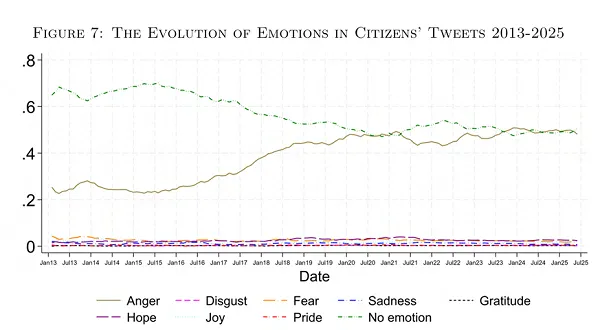
Based on analysis of two separate datasets from different time periods, comprising some 3 million Tweets and X posts, authored by 1.4 million users, the report identified “a sharp rise in emotionality in political discourse over time, with anger emerging as the dominant emotion both among citizens and policymakers.”
Among citizens, the report indicated that the proportion of posts addressing policy issues and expressing anger increased from 20% to 50%, while non-emotional tweets declined from 60% to 50% over the same period.
“The rise in anger starts sharply after the 2016 U.S. presidential election and continues steeply during first Trump administration … Anger is particularly pronounced in discussions of abortion, democracy, immigration, and tax and inequality.”
The report concluded that posts expressing anger generated substantially higher reposting rates compared to neutral or positively framed messages, while exposure to negative emotions “significantly intensified pessimistic views on issues such as trade and immigration and boosted support for protective or redistributive policies.”
“Our deeper exploration into negative emotions revealed that anger specifically - and not fear - had a pronounced influence on shaping public attitudes and policy preferences, particularly regarding climate change. Taken together, our observational and experimental results provide converging evidence that anger is the dominant emotional force shaping both contemporary citizen and political discourse, as well as public policy views and preferences.”
As noted, the findings underline the growing body of research which indicates that X has become more politically divisive since the change from Twitter, and that social media, in general, continues to fuel ragebait.
A study published by Nature earlier this year found that X’s algorithm shifts users’ political opinions in a more conservative direction, while a study conducted by the University of London, published in November 2024, found that abusing people who hold differing political opinions “is a key feature of political communication” in the app. Another report, published in October 2024 from Tulane University, found that X users were far more likely to comment on or react to posts that contradicted their beliefs, especially when they felt their core values were being challenged.
As such, the precedent of rage bait is well-established, and there are clear links between divisive commentary and political discussion in the app.
The data showed that X is a more angry, less welcoming platform than it was in the past, with clear leanings towards conservative talking points. Whether that’s a natural result of the platform’s evolving policies, or by design, is difficult to say, but the key note is that rage is the driving force of political engagement in the app.

























.jpg&h=630&w=1200&q=100&v=c0f97a310e&c=1)