How Micro-Practices Can Be the Bridge Between Your Meditation and Your Choices
There’s a ton of buzz around micro-practices these days—but are we missing the entire point of these mini-pauses? Dr. Shalini Bahl digs into how we can understand their purpose beyond a commodified “hack” and explains how micro-practices can actually...
 Astrong

There is a moment so small you almost never notice it.
The moment before you click. Before you reply. Before you reach for what’s easy.
These moments shape your life.
And they’re the ones most meditations never touch.
The Belief I Never Paused to Question
I’ve meditated for over two decades—Vipassana retreats, MBSR certification, thousands of hours on the cushion. I’m also a mindful marketing professor who teaches conscious marketing and consumer behavior, a former town councilor, and a mindfulness teacher. I care deeply about this work.
So when I say I ordered from Amazon for over ten years, I want to be clear: I was not unaware. I knew about the working conditions. I watched local bookstores close. I taught my students about values-aligned consumption. When I could, I shopped local.
Underneath all of it was a quiet belief I had never paused to examine. But the assumption I had built my consumer life around was simply not true.
But life was full—raising a family, teaching, serving on council, writing, offering free community classes. Amazon was convenient. Books, audiobooks, protein bars, gifts—it was one-click easy, and I was doing good in so many other ways.
Underneath all of it was a quiet belief I had never paused to examine: There is no real alternative to Amazon. Not an articulated belief. Just an assumption so woven into my decision-making that it felt like fact.
Then I learned that Amazon was actively funding politics that conflicted with everything I teach and stand for. That was the moment I felt compelled to confront my belief—and visible beliefs can be questioned.
I paused. I looked for alternatives and almost immediately found Thrive Market. It had been there the whole time. So had a local food cooperative. Some items were actually cheaper in the alternative stores. The assumption I had built my consumer life around was simply not true.
This is about something deeper: whether mindfulness can change how we actually think and make decisions—beyond the cushion, in our lives.
I want to be clear: this isn’t about judging anyone who shops at Amazon. It’s about pausing long enough to ask whether my choices are aligned with my values—and discovering that when I finally asked, the answer had been waiting for me all along.
Three qualities of mind that I had cultivated in meditation for twenty years seldom showed up at checkout—Curiosity, Compassion, and Inner Calm. They’re three of eight mindfulness skills that disrupt the default habits running our decisions. We’ll meet the others as we go.
The evidence that mindfulness reduces stress is well established. That’s not what this article is about. This is about something deeper: whether mindfulness can change how we actually think and make decisions—beyond the cushion, in our lives.
Reducing stress and changing decisions are not the same thing. A person can feel calmer and continue making the same unconscious choices—choices that may perpetuate the very conditions that create stress in the first place.
We don’t have one unified self making all these decisions. We have different selves that take turns being in charge depending on context. Each runs on its own defaults. And the mindfulness your morning self cultivated does not automatically transfer to the decision the consumer self is about to make.
The deeper question is whether mindfulness can reach the place where our decisions are actually formed. The emerging evidence says yes.
Researchers Maymin and Langer presented participants with 22 classic cognitive biases—the endowment effect, overconfidence, anchoring, loss aversion, confirmation bias, and seventeen others. Half received a brief induction in active noticing—instructions to look for what’s new and unfamiliar in their environment. On 19 of the 22 biases, those induced into this curious, attentive state were significantly less likely to show the bias. Not through years of meditation. Through a brief shift into the kind of active noticing that disrupts our habitual ways of categorizing and assuming—what I call Curiosity.
This is not stress reduction. This is the quality of thinking itself changing.
My own research adds another layer. We don’t have one unified self making all these decisions. We have multiple I-positions—different selves that take turns being in charge depending on context. Your morning self sets intentions on the cushion. Your consumer self shops. Your work self navigates meetings. Each runs on its own defaults. And the mindfulness your morning self cultivated does not automatically transfer to the decision the consumer self is about to make.
Longer meditation matters enormously. It builds the nervous system’s capacity to stay present with difficulty. It deepens the reservoir that micro-practices draw from.
What Meditation Builds, What Micro-Practices Reach
Let me be clear: longer meditation matters enormously. When we settle the mind over twenty, forty, or sixty minutes, patterns rise to the surface that are invisible in the rush of ordinary life—the conditioning we inherited, the beliefs we absorbed without choosing them, the default ways of thinking that shape our decisions before we’re aware a decision is being made. Formal practice is where we discover them. It builds the nervous system’s capacity to stay present with difficulty. It deepens the reservoir that micro-practices draw from.
Even though the research suggests we don’t need decades of meditation to begin shifting decisions, the ability to calm the mind enough to see deeper interconnections and patterns comes from taking time for that—whether in mindful walking, a sitting practice, or any practice dedicated to sharpening our attention and perceptions.
But calm alone is not enough. Wagner and colleagues demonstrated why in their 2025 study published in Communications Psychology. Simply repeating a choice in a given context—independent of any reward—biases us toward making that choice again. Each repetition increases our valuation of the option and decreases our uncertainty about it. We become more confident in choices we’ve merely repeated—mistaking familiarity for wisdom.
Longer meditation is like going to the gym—it builds capacity, strengthens attention, and uncovers the deeper patterns running our decisions. Micro-practices are like taking the stairs instead of the elevator—small, repeated choices woven into the day that change how we actually move through our lives.
This repetition bias operates at the checkout, in the meeting, at the dinner table—deepening every time we make the same choice without awareness intervening. A morning meditation may bring calm and clarity, but it is often not enough to offset a bias that has been compounding with repeated decisions throughout the day over time. To disrupt repetition bias, we need micro-practices that meet the moment and invite the right skills to disrupt and transform the defaults.
Longer meditation is like going to the gym—it builds capacity, strengthens attention, and uncovers the deeper patterns running our decisions. Micro-practices are like taking the stairs instead of the elevator—small, repeated choices woven into the day that change how we actually move through our lives.
And unlike a longer meditation, micro-practices don’t require separate time. They happen inside what you’re already doing—in the pause between activities, the breath before you speak, the moment before you reach for your phone. Saying we’re too busy for micro-practices is like saying we’re too busy to breathe.
What makes them powerful is that they meet the nervous system and mind in context, where change is actually possible. And the more we practice in non-critical moments—with the morning coffee, the commute, the routine checkout—the more available these skills become in critical ones. Over time, we gradually shift from our old default reactions to making mindfulness itself our new default.
We need both. The gym builds the strength. The stairs put it to use. One without the other leaves a gap—a gap our defaults will happily fill.
Eight Defaults, Eight Skills
Through my research—studying original contemplative texts alongside modern psychology and neuroscience, and testing this framework with hundreds of practitioners and students—I’ve identified eight default habits that consistently run our decisions and eight innate qualities of mind that disrupt them.
We’ve already met several. Curiosity disrupted confirmation bias. Compassion disrupted the judging mind. Inner Calm disrupted attachment. Awareness made autopilot visible.
My research published in the Journal of Consumer Affairs found that these eight skills relate differently to stress and life satisfaction—confirming that we need different skills in different situations. A one-size-fits-all approach to mindfulness misses this.
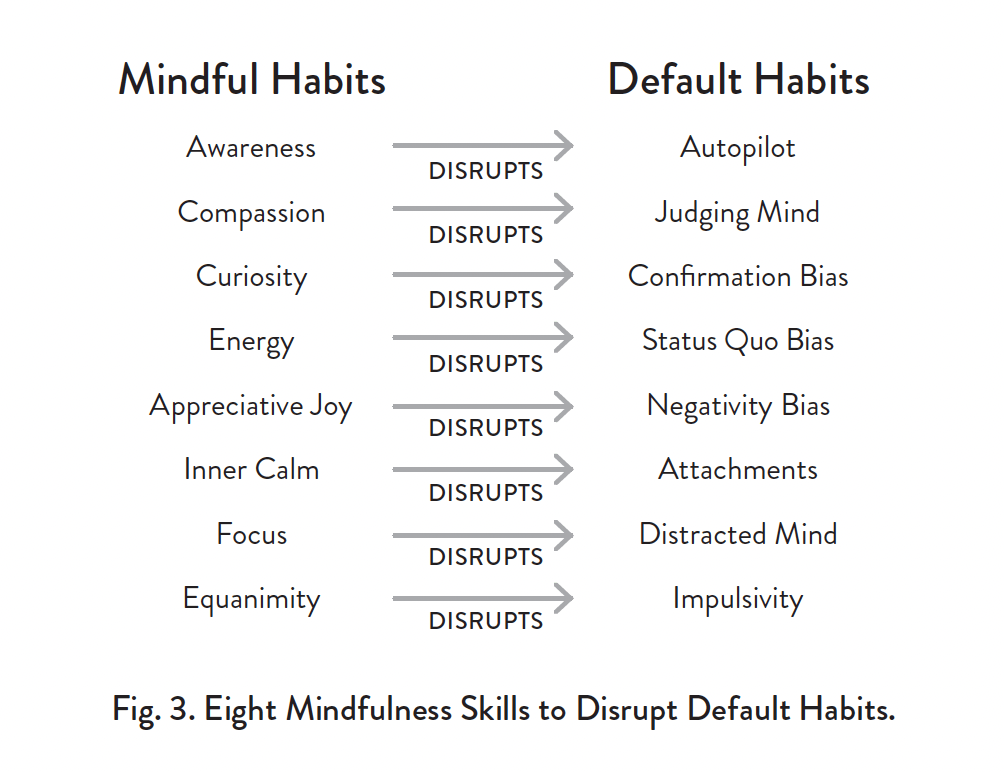 Figure: Eight Mindfulness Skills to Disrupt Default Habits, from Return to Mindfulness
The question is not, “Which skills do I need to learn?” but “How do I get them to show up in the pause before the click, the reply, the reaction?” That is the work of a micro-practice.
These skills are not new qualities we need to acquire. Every human being has experienced moments of compassion, curiosity, and calm. The problem has never been their absence. It has been their absence at the moment they are most needed.
The question is not Which skills do I need to learn? but How do I get them to show up in the pause before the click, the reply, the reaction?
That is the work of a micro-practice. And it has a specific architecture.
(To learn more about each skill, see “Cultivating Mindfulness Beyond Meditation: How 8 Skills Empower Us in Everyday Life“)
Three Steps to Meet the Moment: Return–Listen–Begin
Knowing that our defaults run faster than conscious thought still leaves a practical question: what do I actually do in the pause? Return–Listen–Begin is a three-step framework—simple enough to use in a single breath, deep enough to draw on the full architecture of the eight skills.
Step 1: Return
Return is a deliberate redirection of attention from the automatic pattern to present-moment experience. The body is the most reliable anchor—feeling the breath, the heartbeat, sensations of touch.
In my Amazon moment, Return was the pause itself—the instant before the click when something said wait. Awareness made the autopilot visible. Inner Calm softened my attachment to convenience long enough for a question to arise.
If restlessness, attachment, or resistance arises, that is not an obstacle to the practice—it is the practice. The hindrance becomes the path.
Return is not about pushing past whatever is in the way. If restlessness, attachment, or resistance arises, that is not an obstacle to the practice—it is the practice. The hindrance becomes the path. We invite the relevant skill to meet what’s blocking our presence, and in doing so, we learn what we need to return to our inner knowing.
Step 2: Listen
Listen is turning toward what lies beneath the surface of what is immediately observable—within ourselves and between ourselves and others. This is not an analytical process. It is heartfelt. We listen for the underlying causes and conditions of the situation—the needs, fears, assumptions, and patterns that aren’t visible in the immediate reaction but are driving it. We listen to our own deeper knowing and also seek to understand others’ experiences and perspectives. We open to possibilities we couldn’t see when the default was running.
In my Amazon moment, Listen was the question beneath the question—not just Is there an alternative? but What do I actually value here, and who is affected by my choice?
When Confirmation Bias is present, we invite Curiosity to question assumptions.When the Judging Mind is present, we invite Compassion—for others and for ourselves.When Negativity Bias is present, we invite Appreciative Joy to stay open to what might actually be possible.Trust that you will know what you need to know. Be patient and kind to yourself.
Step 3: Begin
Begin is taking the clarity gained from listening into skillful action. But here is an important truth: profound insights don’t automatically translate into action. Our deep-seated habits may impede our ability to act on what we’ve seen. We may need to invite the skills again:
Energy to move past Status Quo BiasFocus to gather the Distracted MindEquanimity to steady us against ImpulsivityBegin wasn’t just the act of closing Amazon that day—it was choosing, in every subsequent moment of temptation, to pause again rather than let the old groove pull me back.
Before acting, we can ask: Are my thoughts, speech, and actions aligned with my intentions? Are they promoting well-being for me and others, or are they causing harm?
And in moments when there isn’t time for a full pause—when a response is needed now—three questions can serve as a compass:
What’s present? What’s important? What’s possible?In a culture that has turned mindfulness into a billion-dollar commodity, the difference between true micro-practices and what gets marketed as “mindfulness in five minutes” is easy to miss.
What Makes Micro-Practices More Than a Hack
Ron Purser coined the term “McMindfulness” to describe what happens when mindfulness is stripped of its ethical roots and sold as a quick fix for busy people—a do-it-yourself technique for stress reduction that leaves the systems producing the stress completely unexamined. His critique is worth taking seriously, because in a culture that has turned mindfulness into a billion-dollar commodity, the difference between what I’m describing and what gets marketed as “mindfulness in five minutes” is easy to miss.
On the surface, these look like micro-practices. Both are brief. Both fit into a busy day. But the difference runs deep—and it starts with intention. The intention shapes what the practice holds and what it leaves out.
A hack privatizes the problem. It treats difficulty as an individual deficiency—you’re stressed, you’re distracted, you’re reactive—and offers a personal fix. Breathe for five minutes. Sharpen your focus. Calm your nerves before the presentation. These effects are real. But the hack never asks whether the meeting itself needs examining, whether the system that produced the stress needs changing, or who else is affected by how you move through the situation. It adjusts the person to fit the system. The system stays intact.
A micro-practice situates the person inside the larger picture. It starts not with a goal but with what is actually present—the causes and conditions for this moment to arise, not just in the last five minutes but in the patterns and systems we’ve been participating in. It asks: What default is running? What does this moment need—not just for me but for everyone involved? Are my actions promoting well-being or perpetuating harm?
A hack draws on one dimension—typically cognitive—to produce one outcome: improved individual performance. A micro-practice draws on the full range of our intelligences—physical, emotional, mental, and spiritual—not to force our way into being present but to realign with what is genuinely important: our values, our intentions, the others we are present with, and the systems our choices help sustain or disrupt.
In Thich Nhat Hahn’s concept of interbeing, we do not exist as separate selves improving in isolation. When I pause before a purchase, I am not practicing consumer discipline. I am reconnecting with the people and communities my choice affects.
The same five-minute practice can carry either orientation. A breathing exercise before a meeting can be a tool for sharper performance—or it can be a return to awareness that includes the people in the room, the conversation, the values we want our next words to reflect. We can be effective and aligned with what matters most. The technique is identical. What it holds is not.
Thich Nhat Hanh called this interbeing—the understanding that we do not exist as separate selves improving in isolation. When I pause before a purchase, I am not practicing consumer discipline. I am reconnecting with the people and communities my choice affects. Our awareness—or our autopilot—shapes not only our own experience but the experience of everyone our lives touch.
The question is not, How do I feel after five minutes of breathing? The question is, What kind of person am I becoming through the way I practice—and what kind of world am I participating in through the choices that practice shapes?
The Invitation
This week, try both.
Practice a longer meditation—whatever length and tradition is yours. Let the mind settle. Let the deeper patterns surface. This is the foundation.
Then, practice the Art of Stopping at transition points and decision points in your day—before a purchase, before hitting send, before reaching for what’s easy, between meetings, during the commute, in the pause before you speak. When you feel the pull of a habit, stop and return to the three steps.
Return. Simply stop. Without judgment, observe the momentum of your thoughts, strivings, or emotions. Take three deliberate, deep breaths and exhale slowly, releasing any tension in the body.Listen. Once you find stillness, listen within. Notice your ingrained habits of rushing and reacting. What are your actual needs and intentions? What are the causes and conditions that brought you here?Begin. Once you soften the grip of your habitual reactions, begin your response with inner calm and clarity. Let your next action arise from awareness rather than autopilot.This practice might be five or six minutes—a guided meditation before a difficult conversation or while waiting in line. It might be sixty seconds—pausing before opening your laptop to check in with your intention. Or it might be a single conscious breath—the space between the impulse to add to cart and the click that completes the purchase.
At the end of the week, notice what’s different. Not whether you feel calmer—though you might. Notice whether any decisions changed. Whether a belief you hadn’t questioned became visible. Whether a habit you thought was fixed turned out to be a choice you’d simply been making on autopilot.There is a moment so small you almost never notice it.
Now you know it’s there. The practice is learning to meet it—
both in meditation
and in the moments that shape your life.