How to Breathe in Yoga: When to Inhale and Exhale (Pranayama Basics)
Most people start yoga for the poses. Better flexibility, a stronger body, and less stress. That all makes sense. But if you ask an experienced teacher what really matters in yoga, the answer is simple. It is the breath....
 AbJimroe
Most people start yoga for the poses. Better flexibility, a stronger body, and less stress. That all makes sense. But if you ask an experienced teacher what really matters in yoga, the answer is simple. It is the breath.
Still, breathing is often the most ignored part of practice. Many beginners hold their breath in poses, feel out of sync with instructions, or are unsure when to inhale and exhale.
So how should you breathe in yoga?
You should breathe slowly and deeply through your nose. Inhale when your body opens, like lifting your arms or chest. Exhale when your body folds, twists, or contracts. The breath should feel steady, not forced.
In yoga, breathing is not just about air. It is about awareness, control, and how your body and mind work together. This is where the idea of pranayama comes in, which is the traditional practice of controlling the breath to guide your energy.
In this guide, you will learn how to breathe correctly in yoga, when to inhale and exhale, and how to build a simple breathing practice that actually improves your results on the mat.
What Is Yoga Breathing, and What Is Pranayama?
Let’s clear this up, because there is real confusion around it, especially for beginners.
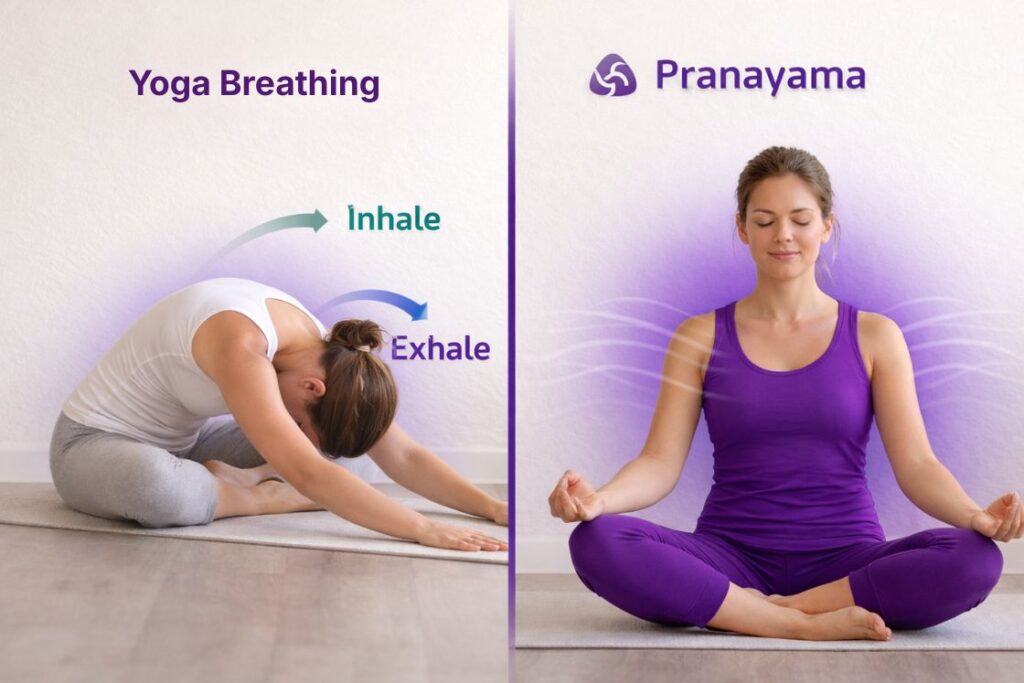
When most Western practitioners talk about yoga breathing, they mean the conscious way of breathing during a session. Inhale as you stretch or lift, exhale as you fold or move inward, and keep the breath slow to stay calm and steady. It is practical, physical, and effective.
Pranayama goes deeper.
The word comes from Sanskrit. Prana means life force or vital energy, and ayama means expansion or regulation. Pranayama is the practice of expanding and directing that energy through the breath.
In traditional yoga philosophy, breath is not just air. It is the medium through which prana moves through the body. When you breathe with awareness, you are not only taking in oxygen. You are influencing your nervous system, your mental state, and your overall level of awareness.
This is why pranayama is described in the Yoga Sutras of Patanjali as one of the eight limbs of yoga. It was a formal practice long before modern yoga poses became common. In many ways, the poses were developed to prepare the body to sit comfortably and practice breath control.
So when breathing is emphasised in a yoga class, it is not just a technique. It comes from a much deeper tradition.
For Western practitioners, this context matters.
If breathing is seen as something secondary, it is easy to forget when practice becomes challenging. But when you understand that the breath is central to yoga, not separate from it, the way you approach your practice begins to shift. The poses feel different, the mind becomes steadier, and the practice starts to come together in a more meaningful way.
Quick Difference
| Used during poses | Practiced as a separate technique |
| Focus on movement and rhythm | Focus on energy and awareness |
| Simple and beginner-friendly | More structured and traditional |
| Helps coordination and flow | Helps control mind and nervous system |
For most people, yoga breathing is the starting point. With time, it naturally leads into pranayama.
This difference matters. If you treat breathing as just a background activity, you will forget it when practice gets hard. But when you understand that the breath is the core of yoga, your entire approach changes. The poses become easier, the mind becomes calmer, and the practice feels more complete.
Join Our 5-Day Live Pranayama Workshop
Why Breathing Correctly Changes Your Entire Yoga Practice
Before we get into technique, it helps to understand what’s actually happening in your body when you breathe well, and when you don’t.
Your nervous system operates in two primary states.
The sympathetic state is what most people know as fight or flight. You feel alert, tense, and reactive. Your heart rate goes up. Your muscles are ready for action. This is useful in genuinely stressful situations, but many people stay in this state even when nothing is wrong.
The parasympathetic state is the opposite. Rest and digest. Calm, open, and present. Your heart rate slows down. Your muscles relax. Digestion works properly. This is where the body recovers and actually absorbs the benefits of your practice.
Here’s the part that matters for yoga. You can shift between these two states through your breath.
Slow, deep breathing through the nose tells your body that it is safe. Fast, shallow breathing through the chest keeps your body in a stress response.
Your brain reads your breathing pattern as a signal about what is happening around you.
You can notice this during practice. When you hold your breath or breathe shallowly:
your muscles tighten your range of motion reduces everything starts to feel effortfulThe practice feels harder than it should. But when your breath is steady and deep, something changes.
Muscles that were gripping begin to release. You move deeper into poses without forcing. Your mind becomes quieter and more focused.
That calm, open feeling in a good yoga class is not just from the poses. It largely comes from how you are breathing. This is why the breath comes first.
Get the breath right, and the rest of the practice starts to open up. Ignore it, and you miss a large part of what yoga is actually offering.
The Three-Part Breath: Where Every Yoga Student Should Start
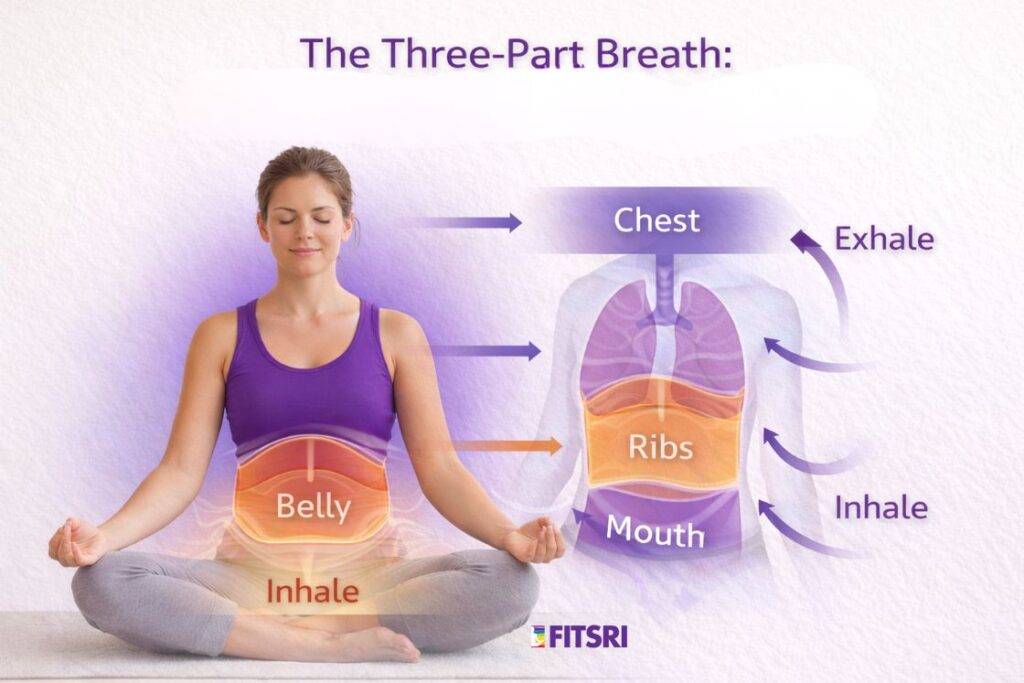
In yoga, this is known as Dirgha Pranayama, or simply the three-part breath. It’s one of the most important breathing practices to learn. If you’re new to yoga, this is where you should begin.
The idea is straightforward.
A full breath doesn’t happen in just one place. It moves through three areas of the body:
the belly the ribcage the upper chestMost people only use one or two of these. The three-part breath helps you use all of them together in one smooth, continuous inhale.
Part 1: Belly Breathing (Diaphragmatic Breath)
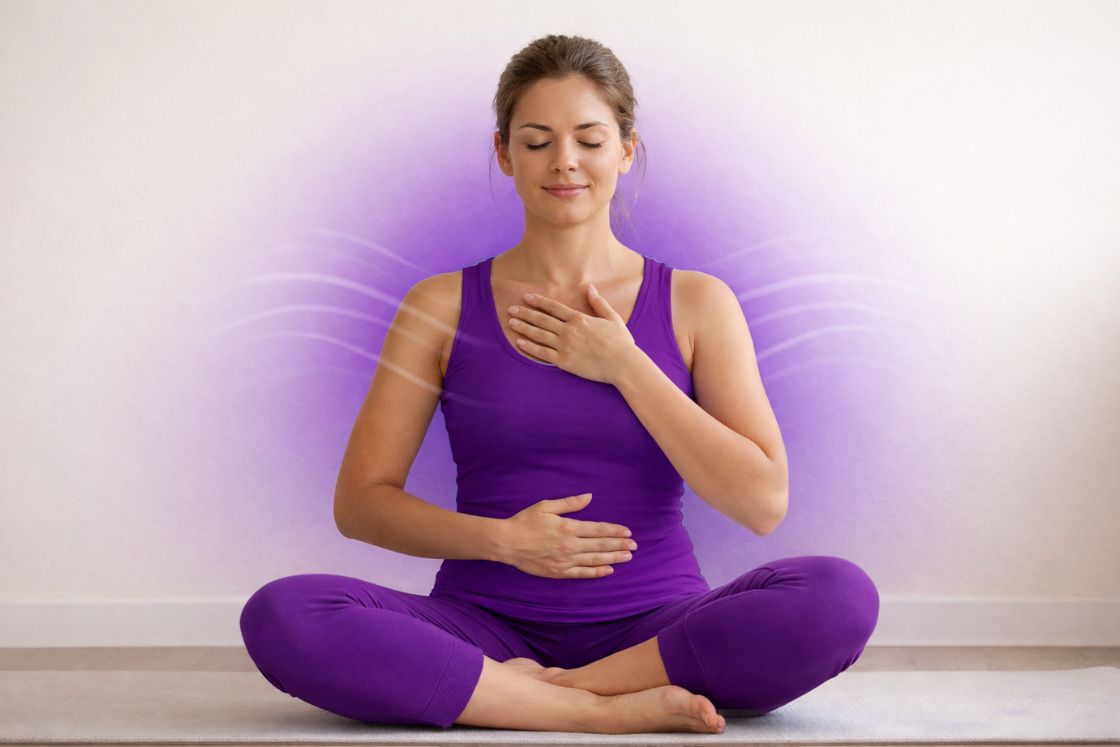
Start by sitting comfortably or lying down. Place one hand on your belly and the other on your chest.
Breathe in slowly through your nose and let your belly rise first. Your chest should stay mostly still. As you breathe out, the belly gently falls back in.
This is diaphragmatic breathing.
The movement in your belly is a sign that your diaphragm is working properly and that you are using the lower part of your lungs. You are not actually breathing into the belly, but the expansion there shows that the breath is deep and efficient.
This is how babies naturally breathe. Over time, many people shift to shallow chest breathing due to stress or habit.
Take a few days to get comfortable with this part alone. Even a few minutes before sleep can make a noticeable difference.
Part 2: Ribcage Breathing (Thoracic Breath)
Once belly breathing feels natural, bring your hands to the sides of your ribcage.
As you inhale, feel the ribs expand outward and sideways. As you exhale, they draw back in. The belly stays relatively steady here.
This part brings awareness to the middle of the lungs.
It becomes especially useful during more active or demanding poses, when your body needs more breath. Learning to feel this expansion helps you adjust instead of forcing your way through a pose.
Part 3: Upper Chest Breathing (Clavicular Breath)
This is the final and most subtle part. After filling the belly and ribcage, inhale a little more so the upper chest lifts slightly. You may feel a gentle rise around the collarbones and shoulders.
On its own, this type of breathing is often linked to stress. But as the last part of a full breath, it simply means the lungs are completely filled.
Keep it light. There is no need to exaggerate this part.
Combining It All: The Full Yogic Breath
Here’s how to put the three parts together into one complete breath:
Sit comfortably with your spine tall. Close your eyes. Spend about a minute just watching your breath as it is without changing anything.
Then begin. Inhale through your nose in a slow, continuous wave: belly first, then ribcage expands sideways, then upper chest and collarbones rise slightly. Everything fills in sequence without any jerking or stopping. Pause naturally at the top if it feels right, without straining.
Exhale in the reverse order: collarbones drop, chest releases, ribs contract inward, and finally the belly draws gently in. Pause naturally at the bottom, again without strain.
Repeat this for 5 to 10 rounds before any yoga session or meditation. It settles the nervous system, brings your attention into the body, and prepares you for everything that follows.
This, in essence, is pranayama in its most accessible form.
When to Inhale and When to Exhale in Yoga Poses
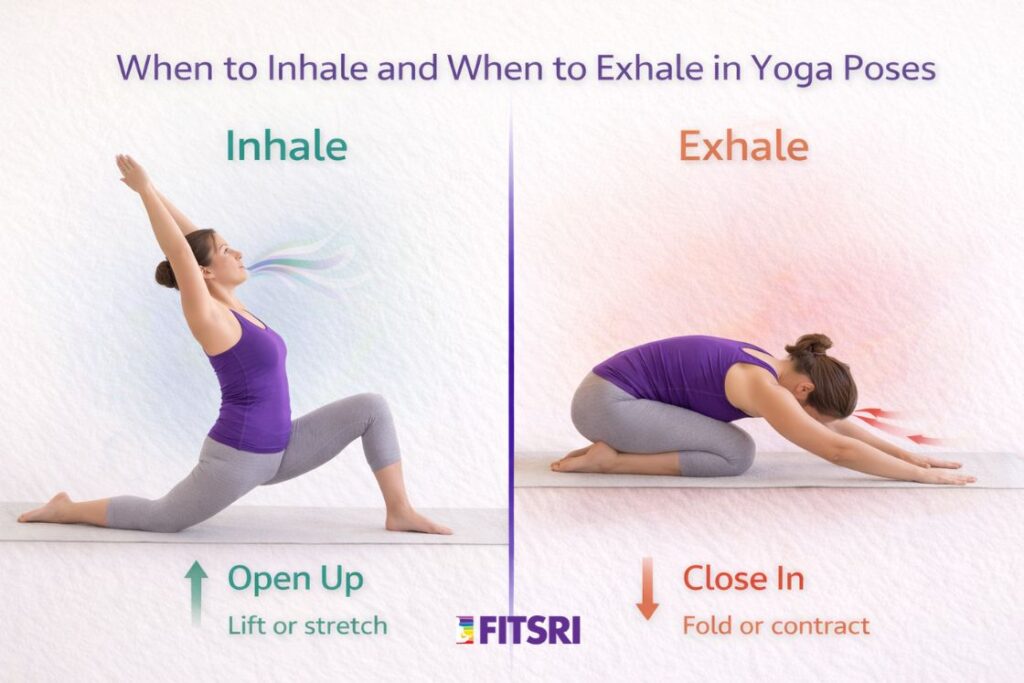
This is where most beginners get stuck. You hear the teacher give a cue… and you’re already half a breath behind. You end up guessing, trying to catch up, and the whole class feels slightly out of sync.
There is a simple rule that works in most poses:
Inhale when the body opens. Exhale when the body closes.
This is grounded in simple anatomy. When you inhale, your chest and belly expand. Movements that open the front of the body work naturally with this expansion. When you exhale, the chest and belly compress and contract. Movements that fold or rotate the torso match this contraction.
Inhale into these types of movements:
Backbends like Cobra, Camel, Upward-Facing Dog Lifting the arms overhead Opening the chest Lengthening the spineExhale into these types of movements:
Forward folds like Standing Forward Fold Child’s Pose Twists like Seated Spinal Twist Side bends Lowering the arms or moving inwardIf you’re unsure, come back to this idea. Opening equals inhale. Closing equals exhale.
You can feel this for yourself. Take a deep inhale and try to fold forward. It feels restricted. There’s no space to move. Now exhale fully and fold again. You’ll go further without trying.
The breath is not following the movement.
The breath is creating the movement.
Breath Holds in Yoga (Kumbhaka)
In traditional pranayama, the pause between breaths is called kumbhaka. It’s a more advanced part of the practice, but it helps to understand the basics.
There are two natural points where the breath may pause.
After an inhale, the body feels expanded and alert. This can be a good moment to stay still in a pose and feel its full effect. Moving from here usually feels harder because the body is already full.
After an exhale, the body feels softer and more relaxed. This is often when you can move slightly deeper into a fold or twist without force.
For beginners, there’s no need to hold the breath on purpose.
If a pause happens naturally, let it be.
If it doesn’t, that’s completely fine.
Forcing breath retention usually creates tension, which is the opposite of what you want in yoga.
Join Our Live 40-Day Kundalini Yoga Course
Nose Breathing in Yoga: Why It Matters
In most yoga traditions, you are asked to breathe in and out through the nose.
This is not just a habit or a rule. There is a reason for it.
Your nose does more than just let air in.
It filters dust and particles, warms the air, and adds moisture before it reaches your lungs. This protects the lungs and makes breathing more efficient. It also produces nitric oxide, which helps your body use oxygen better by improving blood flow.
Nasal breathing naturally slows the breath down.
When you breathe through the nose, the breath tends to be deeper and more controlled. When you switch to mouth breathing, it usually becomes faster and shallower, staying in the upper chest. That kind of breathing keeps the body slightly tense and reactive.
You can feel the difference during practice. Nose breathing keeps you steady and focused.
Mouth breathing often shows up when the body is struggling or pushing too hard.
From a traditional yoga point of view, the nose is also seen as the proper pathway for prana, or life energy. The idea is that breath through the nose supports both the body and the mind in a more balanced way.
You don’t have to think of it in philosophical terms to notice the effect. In practice, nasal breathing simply helps you stay more present.
There are a few exceptions.
Some practices like Sitali use the mouth to inhale for a cooling effect. In restorative yoga, a gentle sigh through the mouth may be used to release tension. Sometimes beginners briefly open the mouth while learning certain breathing techniques.
But in most cases, the nose remains the default. If your nose is blocked due to a cold or allergies, don’t force it.
Breathe in whatever way feels comfortable. The goal is not perfection. It is awareness and ease.
The Pranayama Techniques You’ll Encounter in Yoga
Once the three-part breath starts to feel natural, you’ll come across specific breathing techniques in classes or while reading about yoga. These are called pranayama practices.
Each one has a different effect on the body and mind. Some are calming, some are energising, and some help you find balance.
Here are the most common ones you’re likely to encounter.
Ujjayi Breath (Ocean Breath)
Ujjayi is the breath most often used in vinyasa and Ashtanga yoga.
You breathe in and out through the nose while slightly narrowing the back of the throat. This creates a soft, steady sound, often compared to ocean waves or the sound of fogging up a mirror.
If it feels confusing at first, try this. Exhale gently with your mouth open and make a soft “haa” sound. Then close your mouth and keep the same feeling in the throat as you breathe through the nose.
Ujjayi helps regulate your breathing and gives your mind something to focus on during practice. It also builds a gentle internal heat.
A simple way to check yourself is this. If the sound becomes strained or disappears completely, you’re likely pushing too hard in the pose.
Nadi Shodhana (Alternate Nostril Breathing)
This is one of the most calming breathing practices in yoga.
You use your fingers to gently close one nostril at a time, alternating the breath between the left and right side.
In traditional yoga, each nostril is linked to a different energy. The left side is associated with calm and cooling qualities, while the right side is linked to energy and activity. This practice is said to balance both.
You don’t need to focus too much on the theory to feel the effect. After a few rounds, the mind naturally becomes quieter and more steady.
It’s especially useful before meditation or before sleep.
Kapalabhati (Skull-Shining Breath)
Kapalabhati is more active and energising. It involves short, forceful exhales through the nose while the inhale happens naturally in between. The belly pumps inward with each exhale.
This practice is often described as cleansing and stimulating. It can help clear the mind and increase alertness.
However, this is not something to jump into without guidance. It requires proper technique and awareness.
It’s generally not recommended for people with high blood pressure, heart conditions, anxiety issues, or during pregnancy. If you’re unsure, it’s best to learn this with a teacher.
Bhramari (Humming Bee Breath)
Bhramari is simple but very effective. You inhale through the nose and exhale with a gentle humming sound, like a bee.
The vibration created by the sound has a calming effect on the nervous system. Many people notice an immediate sense of quiet and ease after just a few rounds.
It’s a helpful practice when you feel anxious, frustrated, or mentally overwhelmed.
Sitali Pranayama (Cooling Breath)
Sitali is used to cool the body and calm the system. You inhale through the mouth, either by rolling the tongue into a tube or by gently parting the lips if that’s not possible. Then you exhale slowly through the nose.
This creates a noticeable cooling sensation.
It’s especially helpful in hot weather, after intense physical practice, or when you feel overheated, both physically and emotionally.
Five Practical Rules for Breathing During Yoga
You don’t need to remember everything at once. These five principles will support you across different styles of yoga and levels of practice.
1. The breath leads, the body follows.
Start your inhale or exhale just before the movement begins. The breath initiates, and the body responds. Even this small shift can change how transitions feel.
2. If you’re holding your breath, notice it.
This is the most common habit on the mat, especially when a pose becomes challenging. The moment you notice it, take a conscious breath. If you genuinely cannot breathe in a pose, come out of it. The pose is not more important than the breath.
3. Match the length of your inhale and exhale.
A count of four in and four out is a good place to begin. This pattern, known as sama vritti, creates a steady rhythm in the breath and helps settle the nervous system.
4. The breath is your feedback system.
A smooth, even breath usually means you are working at the right level. When the breath becomes strained or uneven, you have likely gone too far. This is often a more reliable signal than discomfort.
5. You will lose the breath. Come back.
This happens to everyone. Your attention shifts, a pose demands more effort, and the breath disappears. The practice is simply to notice and return, without overthinking it. Take a breath and begin again.
Breathing and the Nervous System: The Science Behind the Tradition
Yogic teachers understood the effect of breath on the mind long before modern science could explain it. Today, research gives us the language for what the tradition has always pointed to.
The vagus nerve is a key part of the parasympathetic nervous system. It runs from the brainstem through the chest and abdomen, linking the brain to major organs. Slow, steady breathing stimulates this nerve and triggers a calming response in the body. Heart rate slows, blood pressure drops, cortisol levels reduce, and the brain shifts toward a more relaxed state.
In contrast, fast and shallow breathing activates the sympathetic nervous system. This keeps the body in a state of alertness. Over time, this pattern can turn into ongoing stress, even when there is no real threat.
The balance between inhale and exhale also plays a role.
A longer exhale tends to increase parasympathetic activity more than an equal breath. This is why exhale-focused breathing feels calming and why many restorative practices place more attention on the exhale.
In traditional pranayama language, the inhale is linked with energy and activation, often described as solar or pingala. The exhale is associated with release and calm, described as lunar or ida.
Both are necessary. Balance supports stability in the system.
But when the body is under stress, placing more attention on the exhale can help bring it back to a calmer state.
Common Yoga Breathing Mistakes (And How to Fix Them)
Knowing what to avoid is just as useful as knowing what to do.
Breathing through the mouth by default: Many people, especially those used to high-intensity workouts, switch to mouth breathing as effort increases. In yoga, the approach is different. Instead of opening the mouth, deepen the breath through the nose. If you can’t maintain nasal breathing in a pose, ease out of it slightly. Holding the breath during transitions: This happens often when moving between poses. The body shifts, but the breath pauses. Set a simple intention to keep breathing through every transition, even if it’s just one steady breath. Breathing too fast: A quick, shallow breath is usually a sign of tension or nervous energy. Rather than trying to control everything at once, slow down the exhale. A longer exhale naturally steadies the rhythm of the breath. Forcing the breath to match an ideal: It’s common to try to copy how a teacher sounds or breathes. This often creates more tension than ease. Let your breath be natural. It will become smoother over time without forcing it. Ignoring the breath when things get difficult: This is the most important one. When a pose becomes challenging, the breath is usually the first thing to go. That moment is not a problem, it’s the point of the practice. Come back to the breath there.Conclusion
In traditional yoga, there is a saying that prana follows the mind, and the mind follows prana. Where your energy goes, your attention follows. Where your attention goes, your breath goes. They are closely linked.
In simple terms, when you learn to guide your breath, you begin to guide your mind. And when the mind becomes steadier, everything else becomes easier to manage.
In the West, yoga is often seen as a physical practice with some relaxation benefits. That’s partly true, but it leaves out something essential. The poses were never the final goal. They were a way to prepare the body for stillness, awareness, and a clearer state of mind. The breath has always been central to that process.
You don’t need to follow any belief system to experience this. The body responds to how you breathe, regardless of philosophy. But when you approach it with attention, you begin to see why these practices have been passed down for so long.
Start simple. Work with the three-part breath. Add ujjayi when it feels natural. Explore practices like alternate nostril breathing over time.
There’s no need to rush.
Stay with the breath, and let the practice build from there.
FAQs
1. Do you inhale or exhale when bending forward in yoga?
You exhale when bending forward. Forward folds compress the front of the body, and exhaling helps the body soften into the movement. If you try to fold on an inhale, it usually feels restricted because the lungs are expanded.
2. Should you breathe through your nose or mouth during yoga?
In most cases, you should breathe through your nose. Nasal breathing helps slow the breath, improves oxygen use, and keeps the nervous system calm. Mouth breathing is usually a sign that the intensity is too high or the breath is not controlled.
3. Why do I feel out of breath during yoga?
This usually happens when the breath is shallow or not coordinated with movement. It can also happen if you are pushing too hard in a pose. Slowing down the breath, especially the exhale, and easing out of the pose slightly can help you regain control.
4. What happens if you hold your breath during yoga?
Holding your breath creates tension in the body and keeps the nervous system in a stressed state. It reduces stability and makes poses feel harder. If you notice you’re holding your breath, it’s a sign to pause, reset, and breathe again.
5. How should beginners start learning pranayama?
Start with simple breathing awareness. Focus on slow, steady breathing through the nose and practice the three-part breath. Once that feels natural, you can gradually explore basic techniques like ujjayi or alternate nostril breathing.
6. How long should you practice breathing before yoga?
Even 3 to 5 minutes of conscious breathing before a session can make a noticeable difference. It helps settle the mind, regulate the nervous system, and prepares the body for movement.