Inside Decathlon Marketing Campaigns: Winning the Sporting Goods Game
Decathlon marketing campaigns solve an inspiring challenge: bringing the joy of play to complete beginners and seasoned athletes across 80+ countries, making a massive range of sports personally meaningful to everyone. Decathlon is no small specialist retailer looking for...
 Lynk
Lynk
Decathlon marketing campaigns solve an inspiring challenge: bringing the joy of play to complete beginners and seasoned athletes across 80+ countries, making a massive range of sports personally meaningful to everyone.
Decathlon is no small specialist retailer looking for one neat audience. In 2025, the company reported €16.8 billion in net sales, 1,902 stores across 82 countries and regions, and 1.23 billion products sold. Digital channels accounted for 20.2% of sales.
Scale like that creates an awkward marketing question. How do you build one recognizable sports brand without flattening running, football, hiking, cycling, surfing, fitness, racquet sports, and everything else into the same generic message?
Decathlon’s answer appears in the campaigns themselves; some sell participation, some turn a technical product feature into the creative hook and others make affordability meaningful, build campaigns around circular services, or adapt a global sporting idea to one local community.
The result is a useful body of work for marketers, brands, and agencies because Decathlon advertising rarely depends on one creative formula. The stronger examples connect what the company sells with a clear reason for people to move.
So, what can we learn from them? Let’s find out.
Click & Learn about Decathlon Marketing Campaigns
How Decathlon Approaches Marketing and Advertising Best Decathlon Marketing Campaigns Decathlon’s Brand-Building Campaigns Ready to Play? (2024) Prices That Offer So Much More (2025) Firsts (2026) Product-Led Decathlon Campaigns Defying Logic (2024) From Tree to Sea (2024) Sports Participation and Community Campaigns The Breakaway (2021) The First Meter (2017) Sustainability and Circular Economy Campaigns Dreamin’ (2024) Rentals for Rubbish (2024) Local and International Decathlon Campaigns Choose Your Way (2025) PEThletes (2024) What Makes Decathlon Advertising Campaigns Stand Out? Decathlon’s Advertising Strategy How Decathlon Uses Sports Marketing Decathlon’s Digital and Social Media Campaign Strategy How Decathlon Adapts Marketing Campaigns Across Countries Who Is Decathlon’s Target Market? Decathlon Advertising Campaigns vs. Wider Marketing Strategy What Marketers Can Learn From Decathlon Campaigns Frequently Asked Questions About Decathlon Marketing CampaignsHow Decathlon Approaches Marketing and Advertising
Calling the Decathlon marketing model standard sports marketing campaigns misses a large part of what makes it work.
One Decathlon study analyses the company through the 4P framework. It highlights broad product coverage, product innovation, accessible pricing, direct distribution, online-offline integration, experiential marketing, and word of mouth as key parts of its model. It also identifies localization as a challenge, particularly in its analysis of China.
That context matters because modern Decathlon advertising campaigns sit on top of a much larger commercial system.
Making Sports Accessible to More People
Accessibility is one of the most persistent ideas running through Decathlon’s history and its current positioning. The company describes its purpose as moving people through sport and says its offer spans from beginners through top athletes.
Accessible to all people, at all levels. From beginners right up to expert elites. Today we have the technicity that enables us to produce world-class competitive products.
That gives its campaigns an unusually broad emotional territory. The protagonist does not always need to be an elite athlete breaking a record. Someone starting a run, learning a sport, getting back on a bike, or simply finding the motivation to move can carry the story.
Product, Price, and Innovation as Marketing Assets
Decathlon also designs and develops much of what it sells. That changes the role of Decathlon advertising.
Product utility can become media material. Price can become a brand statement. An innovation can supply the campaign premise instead of appearing as a specification dumped into the final five seconds.
The 4P research we mentioned above specifically identifies innovation, category breadth, accessible pricing, and integrated online-offline selling as important features of the company’s model.
Building One Sports Brand Across Multiple Categories
Decathlon’s brand architecture has also been simplified. From 2024, Decathlon became the principal brand visible across products, supported by nine specialist sports labels including:
Quechua, Tribord, Rockrider, Domyos, Kipsta, Inesis, Van Rysel, Kiprun, Simond, Solognac.That is an important piece of the Decathlon brand strategy. A running campaign still needs running credibility. A surfing campaign needs to understand surfers. Yet both should add equity to the larger Decathlon name. And that brings us to the campaigns.
Best Decathlon Marketing Campaigns
Before calling anything one of the “best,” we need criteria. A campaign archive can become a collection of ads somebody on the creative team happened to like.
For this analysis, campaigns were selected using four practical filters: they must be publicly verifiable; represent a meaningful strategic objective beyond a routine product promotion; show variety across markets, sports, media, and audiences; and reveal something useful about the wider Decathlon marketing strategy.
Each example below follows the same framework: campaign, objective, target audience, creative idea, channels, execution, what makes it notable, and the lesson marketers can take from it.
Decathlon’s Brand-Building Campaigns
Ready to Play? (2024)
Ready to Play? is the global launch campaign for Decathlon’s major 2024 brand transformation. It introduces the company’s updated positioning, visual identity, Orbit symbol, and a more emotionally expressive view of sport. The creative centres on play as something shared by people across ages, abilities, and sports.
The campaign speaks unusually broadly: beginners, experienced participants, families, younger audiences, older consumers, and people who may feel that organised or performance-focused sport is not “for them.”
Instead of presenting sport as perfection, the campaign presents it as play. Real people, found footage, spontaneous movement, different ages, and different sporting situations create a deliberately inclusive picture.
The campaign launches with a 60-second hero film, supported by 30-, 15-, and 6-second versions across TV, digital, and social, plus OOH. The launch is designed to reach 70 markets.
Why it worked: The campaign gave the rebrand an actual behaviour and emotion. It connected an enormous product portfolio through one idea (play) without forcing every sport into the same aesthetic. It also made accessibility emotional. Decathlon showed a world in which everybody had permission to participate.
Prices That Offer So Much More (2025)
Prices That Offer So Much More turns affordability into an emotional brand idea.
Products become gateways to experiences: a table-tennis racket can help a child connect with others, hiking shoes can unlock a renewed sense of energy, and a mountain bike can represent independence.
The objective of that campaign? Reinforce Decathlon’s value positioning while preventing “affordable” from sounding cheap, transactional, or low aspiration.
With that campaign, the brand targets mainstream French sports consumers, including families and recreational participants who care about value but still want products associated with meaningful experiences. What’s more, BETC Paris develops three films and five visual executions, with television, online video, and outdoor media supporting the campaign in France.
Why it worked: It translated Decathlon’s accessible pricing model into brand meaning. Low price had often been treated as a retail proof point. Here, it became an enabler of confidence, freedom, connection, and rediscovery. That gave a functional commercial advantage a human consequence.
Firsts (2026)
Here is a bold example of how Decathlon makes sports accessible to everyone.
Firsts celebrates first sporting experiences: trying an activity, taking a risk, completing something new, or rediscovering the beginner mentality. A nine-year-old voice performer, Frida, helps shape the narration, giving the film the curiosity and looseness of somebody for whom trying new things is normal.
It extends the participation-led brand platform by making sporting progress feel emotionally rewarding at every ability level, and targets new participants are obvious, but the campaign also speaks to experienced athletes because everyone can still encounter a first.
The campaign runs in the UK and across Europe using digital, social, TV, cinema, and OOH, with multiple film lengths.
Why it worked: The campaign found a universal sporting experience that did not depend on a single category or demographic. It permitted Decathlon to show ballet, cycling, family activities, and other sports in the same campaign because the unifying idea was psychological (not product-based!).
Product-Led Decathlon Campaigns
Product advertising gets interesting when the product itself creates the story. So what made Decathlon’s products interesting enough to become campaign ideas?
Defying Logic (2024)
Defying Logic launches Decathlon’s official UEFA Europa League and UEFA Conference League match balls. The campaign frames professional-level product performance and mainstream accessibility as a contradiction: the ball used at elite competition level is also made available to everyday players.
It targets football fans and players, with particular attention to younger audiences, from casual players through technically demanding enthusiasts. What’s more, the campaign takes the product proposition and turns it into the line. Professional specification plus accessible availability “defies logic.” Other Decathlon innovations are used to build that wider brand behaviour around solving problems that previously looked improbable.
What about channels and execution? The campaign uses hero film, shorter video, print, social, web, in-store media, and localized plans across European and international markets. Decathlon says prototypes were tested with more than 10 professional football teams.
Why it worked: Technical credibility and accessibility supported each other instead of fighting for attention. The campaign made the engineering story easy to understand without reducing the product to a spreadsheet of performance claims.
From Tree to Sea (2024)
The next one is the campaign that introduces a technical materials innovation while giving its environmental story credibility among actual watersports users.
From Tree to See targets surfers and other watersports participants, beginning with users of junior surf shorties and snorkelling tops. People appear in surf-camera feeds holding handmade messages built from beach-associated materials. The separate feeds combine into the Yulex100 launch story.
The work uses surf cams, a 60-second film, shorter online films, in-store media, experiential activity, press, and OOH across 17 markets. Product development involved more than two years of research, over 50 laboratory tests, and 50 material formulas.
Why it worked: The media behaviour matched the audience behaviour. The campaign entered a utility surfers already use. The product innovation, audience insight, and media idea all pointed in the same direction.
Decathlon’s purpose becomes most interesting when advertising does more than represent participation and actually creates an opportunity to participate.
The Breakaway (2021)
The Breakaway creates what the campaign describes as the first eCycling team for prisoners at a maximum-security prison in Oudenaarde, Belgium. Participants race cyclists outside the prison through Zwift. The initiative is developed with De Rode Antraciet, Cellmade, and the Belgian Department of Justice.
This is an integrated initiative with real participation at its centre, supported by film and communications around the programme.
That bold campaign demonstrates Decathlon’s accessibility mission through a community that has limited access to organized sports experiences.
The immediate participants are prisoners, but the public-facing audience is wider: cyclists, sports communities, and consumers interested in sport as a means of social connection.
Why it worked: The idea made “sport for everyone” testable. The campaign was built around access itself, not footage claiming that Decathlon cared about access. The technology also had a clear role: Zwift removed a physical constraint and enabled a genuine shared sporting experience.
The First Meter (2017)
That Decathlon ad starts with one of running’s least glamorous truths: the hardest distance can be the gap between you and your shoes. The Kalenji campaign positions getting started as the real achievement and presents the Ekiden Run Activ shoe as equipment that helps remove friction from that first decision.
It motivates hesitant recreational runners and make running feel obtainable while targeting beginners, interrupted runners, and people who recognise the ritual of inventing excuses not to go outside.
The campaign uses film, with the creative built around the psychological moment before a run begins.
Why it worked: It understood the customer’s problem before talking about the product. Instead of dramatizing pace, medals, or athletic transformation, it focused on initiation. That matched Decathlon’s accessibility position long before its current global brand platform made participation even more explicit.
Sustainability and Circular Economy Campaigns
A Decathlon sustainability campaign needs extra scrutiny. Environmental messaging is easy to make vague and reassuring. The better examples tie the creative idea to a specific service, product innovation, or measurable behaviour.
That matters even more now that circular services are becoming economically meaningful for the company. Decathlon reported 1.58 million second-hand products sold in 2025, second-hand availability in 43 markets, and 1,746 repair workshops. Products benefiting from its ecodesign approach represented 53.9% of sales.
Dreamin’ (2024)
That campaign promotes Decathlon’s BuyBack service by imagining forgotten sporting equipment dreaming about being used again. Bags, bikes, skis, and paddleboards are given expressive human-like faces, turning unused kit into the emotional protagonist.
The main objective is drivşng awareness and use of BuyBack while making circular consumption feel simple and desirable. It targets existing sports-equipment owners, including people with gear sitting unused at home.
The film runs in 80-, 15-, and 6-second formats across digital channels in France, Italy, and the UK, with wider European expansion. The service allows eligible customers to receive value back on equipment; the campaign source states vouchers can reach up to 40% of an item’s value and references an inventory of more than 5,000 spare parts supporting repair.
Why it worked: Circularity became a story about use. The creative made an operational service memorable while keeping the sporting activity at the centre.
Rentals for Rubbish (2024)
That sustainability campaign lets UK participants earn discounts on sports-equipment rentals by collecting litter and logging what they find through Planet Patrol. Bikes, paddleboards, and camping equipment are among the rental categories involved.
It links Decathlon’s rental model with environmental participation and community action around World Cleanup Day and targets outdoor sports participants, environmentally engaged communities, and people curious about renting equipment instead of buying it.
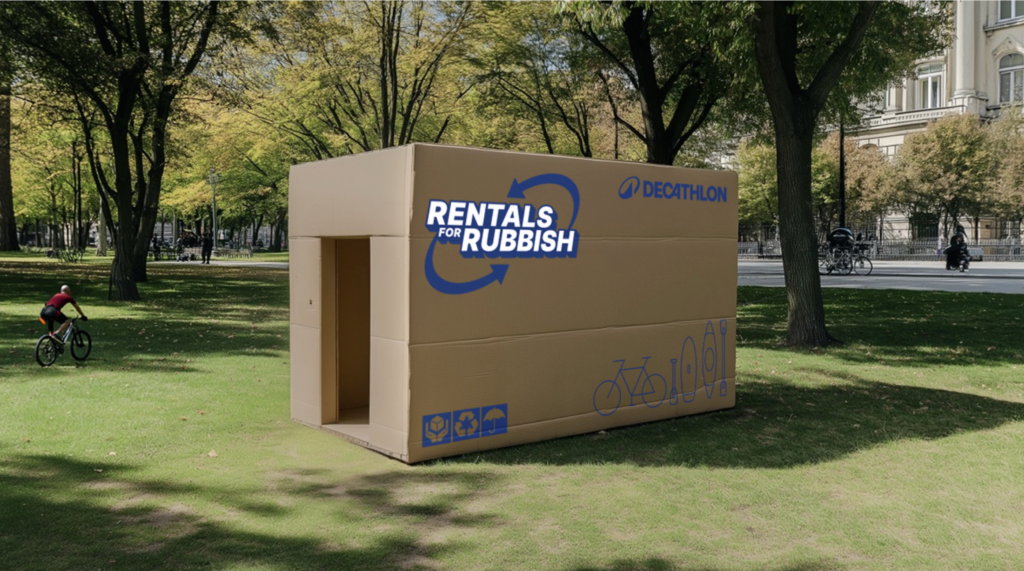
So, litter becomes a form of currency for access to sporting gear.
Why it worked: It joined two actions, cleaning outdoor spaces and accessing rental equipment, that made intuitive sense together. The promotion also gave people something to do, turning sustainability from a communication theme into a value exchange.
Local and International Decathlon Campaigns
A global identity does not mean every market has to produce the same ad with different subtitles. Some of the most revealing Decathlon advertising campaigns come from individual markets.
Choose Your Way (2025)
Created in Chile, Choose Your Way transforms details from sporting products into visual routes. Lines, textures, stitching, and sporting surfaces become paths that lead toward participation.
While reinforcing Decathlon as the starting point for many different sporting journeys, the ad targets broad (mostly Chilean) sports consumers across several categories.
The graphic campaign uses five visual assets and applies one flexible visual system across different sports.
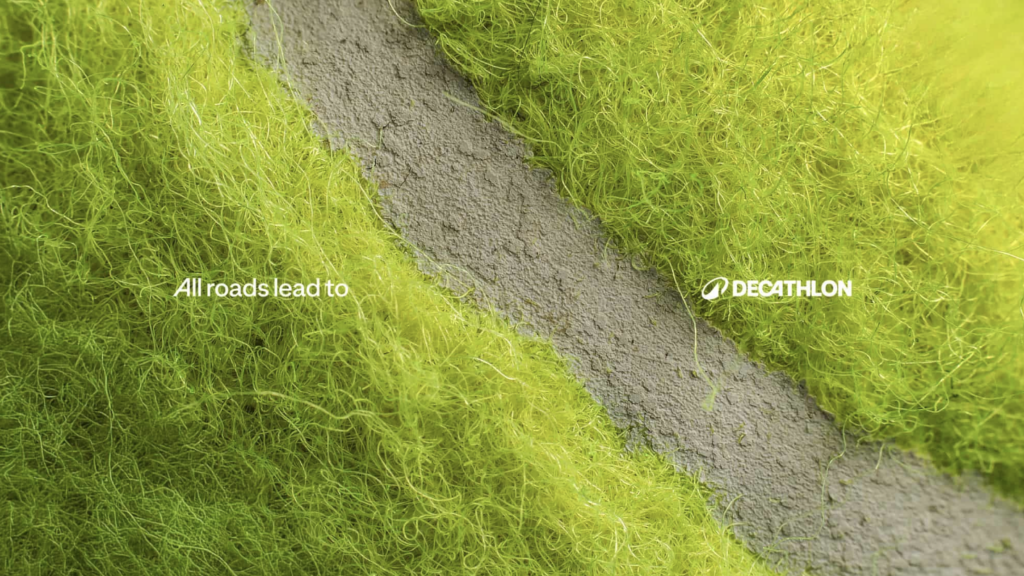
Why it worked: The execution felt local and creatively distinctive without departing from the global participation idea. It also demonstrated how a retailer with huge category breadth can build coherence through an art-direction system.
PEThletes (2024)
Decathlon Brazil and Publicis Brasil create “PEThletes,” an initiative that uses PET bottles collected in parks to produce 3D-printed mobility prostheses for dogs with disabilities. The activation links pet mobility with the owners’ ability to return to active routines with them. In other words, collected bottles become material for prostheses that help dogs move again, creating a literal transformation from waste into movement.
That campaign extends the brand’s accessibility idea into a locally engaging community initiative built around mobility, pets, owners, and exercise.
Why it worked: The Brazilian campaign stretched the brand purpose in an unexpected direction without losing the central idea of movement. The physical object, a prosthesis created from collected material, made the initiative visible, functional, and easy to explain.
What Makes Decathlon Advertising Campaigns Stand Out?
Once you look across these Decathlon marketing campaigns, a few patterns become difficult to miss.
1. Making Sports Feel Accessible
Decathlon regularly makes the emotional barrier part of the story. “The First Meter” tackles motivation. “Firsts” embraces beginner uncertainty. “Ready to Play?” resists the idea that sport needs to look perfect.
Accessibility, in other words, is not confined to price.
The cheaper product does not automatically create an accessible category. People can still feel intimidated, inexperienced, unfit, excluded, or unsure where to begin. The strongest Decathlon work addresses those barriers too.
2. Product Utility as Part of the Creative
“Defying Logic” turns technical standards into the campaign proposition. “From Tree to Sea” connects material innovation with the media habits of surfers. “Dreamin’” takes an operational circular service and gives it a character.
The product is not waiting backstage for the pack shot.
That makes Decathlon ads particularly useful case studies for marketers working with functional categories. Utility does not have to kill creativity. Utility can give creativity something solid to work with.
3. Simple and Inclusive Campaign Messaging
Many of the ideas survive a one-sentence explanation.
Start running. Try something for the first time. Give old gear another life. Pick up rubbish and earn a rental. Pro-level football technology can be accessible.
Simple does not mean simplistic. It means the audience does not need a strategy workshop to decode the ad.
4. Connecting Advertising With Real Sports Participation
Decathlon is at its most distinctive when the communication creates movement outside the communication itself.
“The Breakaway” creates a cycling team. “Rentals for Rubbish” links action to equipment access. “The First Meter” focuses on getting out the door.
This is where Decathlon sports marketing separates itself from generic retail promotion: sport is not simply the theme decorating the sale.
Decathlon’s Advertising Strategy
Decathlon has an advertising problem most specialist sports brands do not have: it needs to be relevant to people buying a €10 beginner product and to serious athletes looking for technical performance gear, often under the same master brand.
That helps explain why Decathlon advertising strategy operates on several levels at once:
Corporate campaigns create a shared meaning around sport and participation. Product campaigns prove technical credibility. Category advertising speaks to the culture of individual sports. Local teams adapt ideas around market-specific behaviours. Stores and digital commerce then turn that attention into product discovery and purchase.In other words, Decathlon advertising is becoming less like a collection of retail promotions and more like a connected brand-and-commerce system.
That shift became particularly visible with Decathlon’s 2024 brand transformation. The company repositioned itself as a global “multi-specialist sports brand” and said its new communication approach would connect products with larger emotions and activities through more expressive imagery, storytelling, motion, and content.
1. Product-Led Advertising
Some Decathlon commercials start with a product truth. Technical footballs, wetsuits, footwear, and specialist equipment supply material for storytelling.
This makes sense for a company whose R&D, design, manufacturing relationships, and retail distribution are closely connected. The marketing team has access to genuine product stories.
2. Brand and Purpose-Led Advertising
Campaigns such as “Ready to Play?” and “Firsts” sit higher in the funnel. They are less concerned with explaining one SKU and more interested in defining Decathlon’s role in people’s sporting lives.
That role is participation.
3. Digital and Social Advertising
Digital is now too large to treat as a supporting channel. In 2025, digital activity, including e-commerce, connected orders in stores, and external marketplace sales, represented 20.2% of Decathlon’s sales.
Campaign planning therefore has to connect content, product discovery, inventory, e-commerce, and store fulfilment.
4. Local and Geo-Targeted Campaigns
The Canadian, Brazilian, Belgian, Chilean, French, and UK examples show how local teams can connect the global accessibility proposition to local conditions.
That flexibility becomes especially important when sport itself is local. Climate, facilities, cultural relevance, sporting popularity, and seasonality all change the context.
5. Seasonal and Sports-Specific Advertising
Running peaks are not identical to ski peaks. Camping behavior is not football behavior. Equipment replacement cycles vary enormously. A multi-specialist retailer cannot run one universal promotional calendar. Effective Decathlon promotional strategy needs to operate simultaneously at brand, category, sport, season, and market levels.
How Decathlon Uses Sports Marketing
What separates sports marketing from putting athletes in an ad? The answer is participation. Decathlon uses events, communities, partnerships, specialist products, and sporting experiences to create ways into the brand. What’s more?
Connecting Campaigns With Sports Participation
“The Breakaway” is the clearest example. The sporting activity is not a backdrop, but, it is the programme.
The Decathlon Foundation offers a much larger organisational example. From 2005 through 2024, the Foundation says it supported more than 1,000 projects across 53 countries using sport as a tool for social integration. That provides strategic context for campaigns centred on access and community. It also says:
Looking ahead, DECATHLON aims to broaden access to physical activity and strengthen its positive impact on society. The companyʼs ambition is to positively impact one billion people by 2030, reinforcing the role of physical activity and movement as a key contributor to wellbeing and adapting to evolving lifestyles and practices around the world.
Behind this ambition, a team of over 102,900 teammates contributes every day to bringing sport and physical activity closer to people around the world. Their engagement remains a key strength of the company: more than 90% say they are proud to work at DECATHLON, reflecting a strong culture of responsibility, collaboration and shared purpose.
Events, Communities, and Local Sports
Local sporting communities give Decathlon something mass media cannot: context.
A surf camera is meaningful to surfers. A park activation reaches people where movement already happens. An eCycling platform can connect communities separated by physical restrictions. Good Decathlon social media marketing can then amplify those experiences instead of inventing a social-first idea in isolation.
Athlete and Creator Partnerships
“The CLR Academy” shows one productive model: Antoine Griezmann functions as a teacher and football authority inside the creative concept.
Decathlon has also expanded high-level sports partnerships. Its 2025 reporting notes stronger relationships with internationally known athletes and further investment in professional cycling.
DECATHLON strengthened its ecosystem through partnerships with internationally renowned athletes, reinforcing its connection with sports communities worldwide. The Group also accelerated its ambitions in key categories such as cycling, becoming the owner of the DECATHLON CMA CGM cycling team. Through DECATHLON PULSE, the Group reinforced its footprint in the circular economy and sustainable mobility sectors through its partnership with Munich-based e-bike refurbishment specialist Rebike Mobility, and its acquisition of a 65% share in Bikeleasing Group, one of the leading providers of sustainable bicycle mobility in German speaking countries.
The brand opportunity is clear. Elite credibility can support technical products while the wider communication still tells everyday participants that those products and experiences are for them too.
A study on Decathlon emphasises the increasing importance of technology, personalized experiences, social influence, and online-offline integration in sporting goods retail. Its discussion highlights websites, mobile apps, social touchpoints, store integration, product information, inventory visibility, and click-and-collect as components of a connected customer journey.
That gives us a useful way to understand the Decathlon digital marketing strategy. Here is a quick table:
|
Social First Sports Content & Moments |
Capitalize on raw sports elements—movement, tension, humor, mistakes, and community. | Short product demonstrations, athlete stories, challenges, and event moments over polished ads. | Engages audiences naturally across social platforms without heavy cinematic production costs. |
|
Education Product Demos & Guides |
Demystify technical gear by explaining fit, performance, and level suitability. | How-to guides and technical breakdowns for hiking boots, paddleboards, running shoes, and fitness gear. | Reduces purchase uncertainty; drives discoverability and conversion across Search, CRM, and E-commerce. |
|
Partnerships Influencer & Athlete Strategy |
Match creator authority directly to specific audience experience levels and needs. | Elite athletes (technique), local running creators (beginner friendly), hiking experts (conditions). | Builds multi-tier credibility across beginner, intermediate, and advanced sports segments. |
|
Community User-Generated Content |
Leverage real customer participation and visible sporting activities as brand creative. | Highlighting customer “Firsts” (first 5K, first camping weekend, first climb, first bike ride with kids). | Turns everyday customer milestones into an authentic, self-sustaining content engine. |
|
Omnichannel E-Commerce Integration |
Unify creative campaigns with digital platform discovery and retail fulfillment. | Connected chain: Campaign → Content → Discovery → Web/App → Purchase/Rental → Store/Delivery. | Eliminates campaign drop-off, enhances digital UX, and directly drives retail and app conversions. |
How Decathlon Adapts Marketing Campaigns Across Countries
Managing a Decathlon international marketing strategy means solving two competing problems: recognition and relevance.
The brand has to look like Decathlon in France, Canada, Brazil, Chile, the UK, and every other market. But sport does not look identical in those places.
1. Global Brand Consistency vs. Local Relevance
Decathlon’s unified identity provides a common visual and strategic system. Local campaigns then adapt the expression.
“Choose Your Way” in Chile feels visually different from “PEThletes” in Brazil or “Stolen Discount” in Canada, yet each can still connect to access, movement, and participation.
2. Adapting Campaigns to Popular Sports in Each Market
Decathlon itself notes that some sports expertise is located according to local participation patterns; its badminton activities in China are cited as one example of adapting to where a sport is heavily practised.
That same logic should influence campaign investment. A Decathlon localization strategy has to ask which sporting behaviour matters locally, not simply which global asset needs translating.
3. Local Events, Communities, and Partnerships
Community-based campaigns provide a useful bridge between global identity and local relevance. The Brazilian PEThletes project uses local NGOs and a São Paulo park. The Belgian Breakaway programme relies on local institutional partners. The UK Rentals for Rubbish activation works with Planet Patrol. Those relationships make the campaign harder to copy-paste, which is often a good sign.
Who Is Decathlon’s Target Market?
There is no single useful answer to the Decathlon target market question, actually. “People who like sport” is technically broad enough and strategically close to useless. Decathlon’s own current description is more helpful: it calls itself a multi-specialist sports brand serving everybody from beginners to top athletes.
A global multi-specialist sports brand catering for everyone from beginners to top athletes, DECATHLON is an innovative manufacturer of sporting goods for all skill levels. With over 102,900 teammates and 1,902 stores worldwide, DECATHLON and its teams have been working ever since 1976 to make the joys and benefits of sport truly accessible to all.
The Decathlon target audience therefore changes by sport, need, participation level, product complexity, price point, and moment in the customer journey. Let’s classify them together.
Psychology & Needs
Requires low friction, intuitive products, reassurance, and education. Needs to feel that sports are open and non-intimidating.
Value Strategy
Serves as an approachable entry point that removes intimidation and builds long-term athletic confidence.
Campaign & Product Focus
Targeted campaigns like “The First Meter” and “Firsts” alongside easy-to-use starter equipment.
Psychology & Needs
Prioritizes affordability, product durability, and seamless one-stop convenience across multiple sports for different ages.
Value Strategy
Leverages Decathlon’s multi-category retail model to maintain customer relationships as household sports needs evolve.
Campaign & Product Focus
Multi-sport shopping, durable kids’ activewear, all-in-one family camping equipment, and seasonal sports gear.
Psychology & Needs
Demands high-level technical performance, specialized equipment, exact specifications, and domain credibility.
Value Strategy
Demonstrates product R&D and technical expertise to win over athletes who know exactly what specifications they require.
Campaign & Product Focus
Pro football gear, advanced running shoes, specialist road cycling equipment, and technical mountain gear.
Decathlon Advertising Campaigns vs. Wider Marketing Strategy
| Primary Job | Create attention, participation, product interest, and brand meaning | Build demand and deliver value across products, prices, channels, services, and customer experience |
| Time Horizon | Campaign bursts and ongoing content platforms | Multi-year brand, commercial, retail, digital, and product development |
| Product Role | Product can become the creative idea | Product architecture, innovation, R&D, assortment, and lifecycle management |
| Price Role | Communicates affordability and value | Supports market positioning and access |
| Channels | TV, digital, social, OOH, cinema, experiential, creators, retail media | Stores, e-commerce, apps, marketplaces, CRM, service networks, community touchpoints |
| Participation | Creates motivation and community engagement | Supports the wider objective of making sport accessible |
| Sustainability | Promotes specific innovations and circular behaviours | Includes ecodesign, repair, rental, second-hand services, materials, production, and decarbonisation |
| Localization | Adapts creative ideas to markets and communities | Adapts assortment, sports priorities, channels, pricing, services, and operations |
The distinction is useful because a great Decathlon advertising campaign cannot compensate for a weak sporting offer. Equally, an innovative product does not automatically create awareness or emotional relevance.
The advantage comes when both sides work together.
What Marketers Can Learn From Decathlon Campaigns
You do not need Decathlon’s store footprint, product range, or R&D organisation to steal the useful thinking.
⚽ Build campaigns around what the audience can actively do rather than what they should think. ⚽ Design participation around trying products, attending events, completing challenges, or returning old gear. ⚽ Give the customer an active, essential role in the campaign concept. ⚽ Ask what specific problems users solve differently because the product exists. ⚽ Search for your next campaign idea directly inside existing prototypes. ⚽ Adapt your tone of voice to suit distinct sub-cultures like runners, surfers, and parents. ⚽ Centralize core brand meaning while decentralizing its local and category expression. ⚽ Offer concrete touchpoints like trade-in programs, community cleanups, and repair workshops. ⚽ Ensure purpose is directly useful, touchable, and beneficial to the end user. ⚽ Eliminate the artificial divide between brand campaigns and shopper marketing. ⚽ Connect every channel, from video film and social content to retail stores and CRM, into one seamless system. ⚽ Base creative work on operational truths like engineering, pricing, access, and repair. ⚽ Turn core business realities into participation mechanics that people genuinely care about.Frequently Asked Questions About Decathlon Marketing Campaigns
What are the best Decathlon marketing campaigns?
Notable examples include “Ready to Play?”, “Firsts,” “Prices That Offer So Much More,” “Defying Logic,” “From Tree to Sea,” “The Breakaway,” “Dreamin’,” and “Rentals for Rubbish.” They stand out for different reasons, including global brand building, product innovation, participation, accessibility, and circular services.
What is Decathlon’s marketing strategy?
Decathlon’s strategy combines accessible pricing, broad sports coverage, product development, physical retail, digital commerce, customer experience, sporting participation, and an increasingly unified global brand. Its current corporate strategy also gives major roles to customer experience, sustainability, and business modernisation. The supplied academic research also analyses Decathlon through 4P and 4C frameworks, with particular attention to product, price, channel integration, consumer needs, digital communication, and participation.
How does Decathlon advertise its products?
Decathlon advertising uses a mix of product films, global brand campaigns, social content, OOH, cinema, digital video, retail communication, experiential activity, athlete partnerships, and local-market executions. Product demonstrations often connect technical features to a larger creative idea, as seen in “Defying Logic” and “From Tree to Sea.”
What makes Decathlon advertising campaigns successful?
The strongest examples have clear product or participation truths, simple ideas, accessible storytelling, and a strong link between the campaign promise and something Decathlon can actually provide. They also give different sports enough cultural space to feel specific.
Who is Decathlon’s target market?
The Decathlon target market includes beginners, recreational participants, families, experienced sportspeople, and high-level athletes. A more useful way to segment the audience is by sport, participation level, need, and context, alongside traditional demographic and behavioural information. Decathlon describes its current brand as serving people from beginners through top athletes.
How does Decathlon use sports marketing?
Decathlon combines product campaigns with athlete partnerships, sporting communities, events, participation initiatives, professional sports relationships, local programmes, and social-impact projects. Campaigns such as “The Breakaway” demonstrate how sporting participation itself can become the marketing experience.
How does Decathlon adapt its campaigns for different countries?
The Decathlon localization strategy keeps a recognisable global brand platform while allowing local teams to adapt sports, creative execution, partnerships, channels, events, and community relevance. Work from Canada, Belgium, Brazil, Chile, France, and the UK demonstrates how different ideas can still reinforce the same broader participation positioning.
How does sustainability feature in Decathlon marketing campaigns?
The strongest examples attach sustainability communication to specific products or services. “From Tree to Sea” introduces a natural-rubber wetsuit innovation. “Dreamin’” promotes BuyBack. “Rentals for Rubbish” connects rental access with environmental action. That communication sits alongside a broader circular model. In 2025, Decathlon reported 1.58 million second-hand products sold, 1,746 repair workshops, and 53.9% of sales generated by products benefiting from its ecodesign approach.
So the next time your campaign brief says, “We need something inspiring about our brand purpose,” Decathlon offers a useful challenge: what could customers actually do with that purpose tomorrow?