Pregnancy Yoga: Safe Poses for Every Trimester | Guide
✨ QUICK ANSWER Pregnancy yoga is a gentle, modified practice designed specifically for pregnant women to maintain strength, flexibility, and […]
 BigThink
✨ QUICK ANSWER
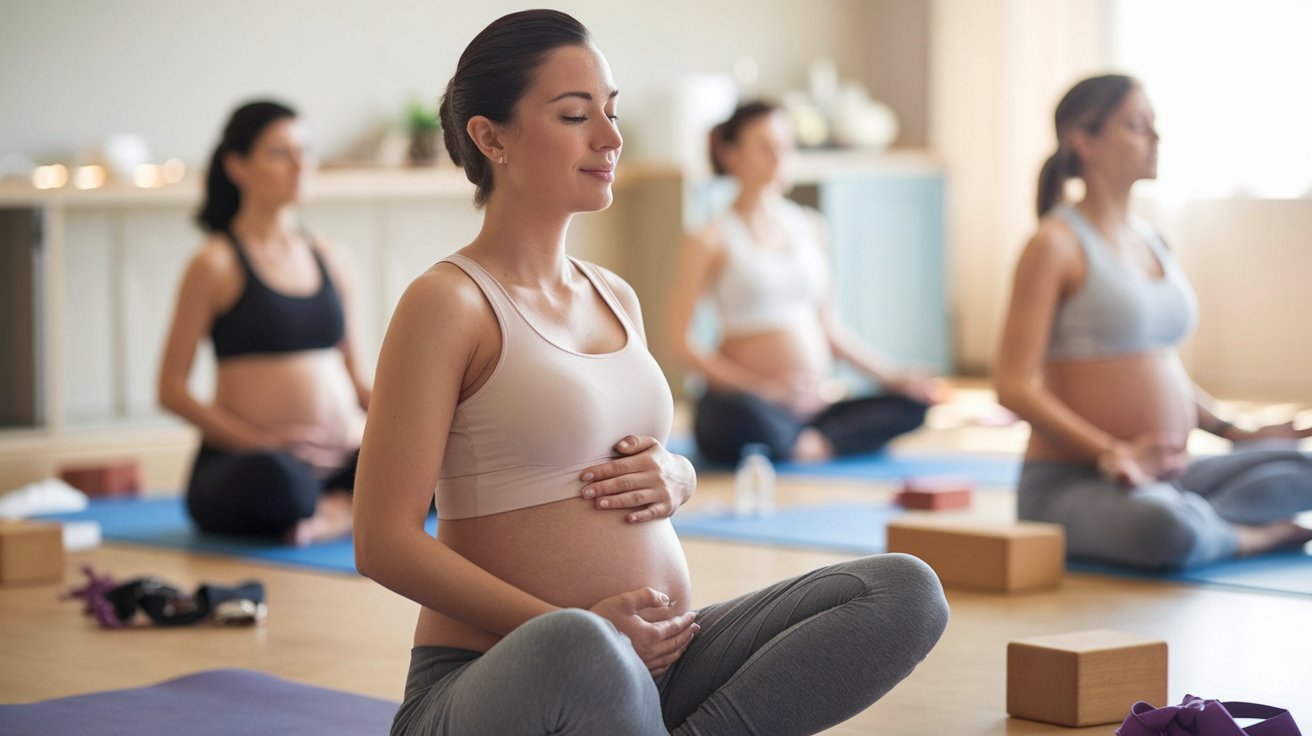
Pregnancy yoga is a gentle, modified practice designed specifically for pregnant women to maintain strength, flexibility, and mental calm throughout all three trimesters. Safe pregnancy yoga includes modified forward folds, hip openers, pelvic floor strengthening, and restorative poses — while avoiding deep twists, intense backbends, and poses that compress the belly. With medical clearance, pregnancy yoga reduces back pain, sciatica, anxiety, and prepares the body for labor. Practice should be customized to each trimester’s changing physical needs.
Pregnancy transforms your body completely — in nine months, your center of gravity shifts, your ligaments soften, your heart pumps 30% more blood, and your posture changes in ways that create new vulnerabilities in your lower back, hips, and pelvic floor.
Most pregnant women feel this acutely: the stabbing sciatica that makes sitting painful, the lower back ache that wakes you at night, the anxiety about labor that won’t quiet, the swelling in the legs and feet that makes simple walking exhausting.
Exercise during pregnancy is not optional — research from ACOG (American College of Obstetricians and Gynecologists) shows that 150 minutes of moderate movement per week during pregnancy reduces gestational diabetes risk by 27%, reduces C-section rates by 20%, and significantly reduces postpartum depression. But what kind of movement?
This is where pregnancy yoga becomes invaluable.
Unlike running, which jars the joints and challenges balance on a shifting center of gravity, or most traditional fitness classes, which aren’t designed for the unique vulnerabilities of pregnancy, pregnancy yoga works with your changing body — strengthening what needs strengthening, stretching what needs stretching, and calming the nervous system in preparation for labor and motherhood.
This complete guide walks through safe pregnancy yoga for all three trimesters — which poses are safe, which to avoid, why each trimester requires different modifications, how to manage common pregnancy discomforts (back pain, sciatica, swelling, morning sickness), and how to prepare your body and mind for labor.
Whether this is your first pregnancy or your fifth, whether you’ve practiced yoga before or are new to it, pregnancy yoga is accessible, safe, and transformative.
Let’s practice in a way that honors both you and the life growing within you.
IS PREGNANCY YOGA SAFE? THE EVIDENCE
The short answer: Yes. Pregnancy yoga is safe — and highly beneficial — when practiced with proper modifications and medical clearance.(1)
Research published in the American Journal of Obstetrics and Gynecology shows that pregnant women who practice yoga consistently experience:
40% reduction in anxiety and depression compared to non-practicing controls 50% reduction in lower back pain Significant reduction in sciatica (sciatic nerve pain affecting 50% of pregnant women) Easier labor and childbirth — shorter labor duration, fewer complications Reduced pregnancy complications including gestational diabetes (27% reduction) and preeclampsia Better sleep quality — crucial for both mother and fetal development Faster postpartum recovery — stronger pelvic floor and core stabilityMedical Clearance is Essential
While pregnancy yoga is safe, it is not universally recommended without modification. If you have any of the following, consult your OB/GYN before beginning:
Preeclampsia or gestational hypertension — high blood pressure in pregnancy Placental problems (previa, abruption) — certain poses are contraindicated Incompetent cervix — requires modified practice or limitation to first trimester Risk of miscarriage or threatened miscarriage — especially first trimester Multiple pregnancy (twins, triplets) — requires specialized modifications Severe sciatica or other pain — may require physical therapy firstGet written clearance from your OB/GYN before beginning any exercise program during pregnancy.
Key Safety Principles
Regardless of trimester, certain principles govern all safe pregnancy yoga:
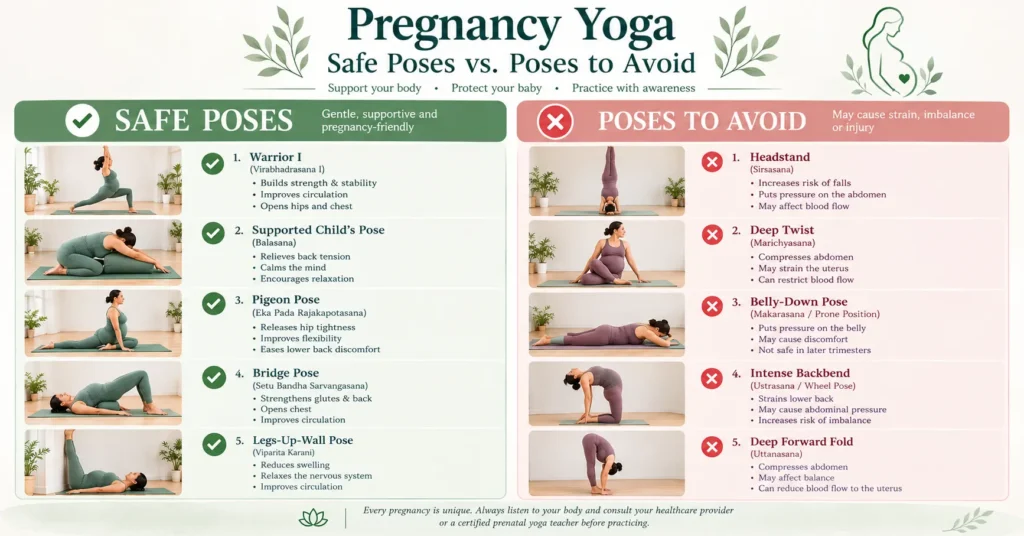
1. Avoid Deep Twists — Twists that wring the abdomen compress the uterus. Gentle, open twists (where the twist comes from rotation of the spine, not abdominal compression) are safe; deep, binding twists are not.
2. Avoid Intense Forward Folds — In early pregnancy, intense forward bends can increase downward pressure on the growing uterus. Later pregnancy, the belly simply prevents deep folding. Gentle forward folds with knees bent are safe.
3. Avoid Deep Backbends — Intense backbends during pregnancy increase lumbar curve (which is already exaggerated by the weight of the baby), worsening back pain. Gentle, supported backbends are appropriate.
4. Avoid Belly-Down Poses — After the first trimester, poses that require lying on the belly (prone backbends, certain arm balances) are physically impossible and uncomfortable.
5. Avoid Inversions (with caution) — Headstand and shoulder stand are traditionally contraindicated in pregnancy, though some experienced practitioners with medical clearance continue them with modifications. For most pregnant women, gentler inversions (legs-up-the-wall, downward dog) are safer.
6. Engage the Pelvic Floor — Pregnancy yoga should include specific pelvic floor strengthening (Kegel exercises, pelvic floor engagement in poses) to prevent incontinence and prepare for labor.
7. Modify with Progressive Belly Growth — A pose that was perfect in month 2 may need modification by month 7. Adjust continuously as your belly grows.
TRIMESTER-BY-TRIMESTER PREGNANCY YOGA GUIDE
Pregnancy yoga changes dramatically across the three trimesters — not just in what poses are safe, but in why they’re being practiced and what physical needs they address. Understanding your trimester is essential to practicing safely and beneficially.
FIRST TRIMESTER (Weeks 0-12): Foundation Building & Stabilization
The first trimester is a paradox: your body is undergoing seismic changes, yet from the outside, you often look the same. Invisible to others, you may be exhausted, nauseous, emotionally raw, and anxious about the pregnancy itself.
Physical Changes in First Trimester
Rapid hormonal shifts (progesterone, relaxin — the softening hormone) Ligament laxity begins (joints become more flexible, less stable) Cardiovascular changes (heart rate increases, blood pressure may drop) Fatigue (extreme energy demands as placenta forms) Nausea and food aversions (affecting nutrition and energy)First Trimester Yoga Modifications
Focus: Foundation, stability, gentle strengthening (before the belly grows too large), breath awareness, stress relief
Safe First Trimester Poses:
Standing poses (tadasana, warrior I, warrior II, extended side angle) — build lower body strength and stability Gentle hip openers (low lunges, pigeon pose, cow-face pose variations) — prepare hips for birth and offset pregnancy postural changes Pelvic floor engagement — practiced in standing poses and lunges to prevent future incontinence Pranayama (breath work) — especially calming breathing to reduce nausea and anxiety Supported child’s pose — calming, restorative Cat-cow (marjaryasana-bitilasana) — gentle spinal mobility without intense flexion or extension Legs-up-the-wall — reduces swelling, calms nervous system Gentle forward folds with bent knees — soft hamstring stretches without abdominal compressionPoses to Avoid in First Trimester:
Deep twists (especially binding twists) Intense inversions (headstand, shoulder stand) — wait for medical clearance Poses that require lying on the belly Intense backbends (they aggravate lower back discomfort) High-impact movement or vigorous vinyasas (save energy, avoid injury)First Trimester Sequence (20-30 minutes):
Grounding (seated breathing) – 3 minutes Gentle warm-up (cat-cow, gentle shoulder circles) – 3 minutes Standing poses (warriors, extended side angle) – 10 minutes Hip openers (lunges, pigeon variations) – 5 minutes Pelvic floor work (engaged warrior poses) – 3 minutes Restorative (child’s pose, legs-up-wall) – 5 minutes Final rest (savasana with pillow support) – 3 minutesFirst Trimester Nausea Management: Many pregnant women experience severe first-trimester nausea. Yoga can help:
Practice gentle inversions and forward folds (helps digestion) Use pranayama (breath work reduces nausea) Avoid intense backbends (compress stomach) Practice early in day when nausea is often worse Practice on empty stomach (but stay hydrated)SECOND TRIMESTER (Weeks 13-27): Strength Building & Hip Preparation
The second trimester is often called the “honeymoon period” of pregnancy — nausea has usually subsided, energy returns, and you look visibly pregnant but can still move relatively easily. This is the ideal time for building strength.
Physical Changes in Second Trimester
Belly noticeably expands Center of gravity shifts forward (back strain increases) Ligament softening accelerates (due to relaxin hormone) Skin stretches (stretch marks may appear) Energy typically returns after first-trimester fatigue Waddle posture may develop as hips adjustSecond Trimester Yoga Modifications
Focus: Strength (especially hip and pelvic floor), hip opening for labor, back pain prevention, continued stress relief, building stamina
Safe Second Trimester Poses:
All first-trimester poses, plus: Deeper hip openers (crescent lunges, lizard pose, wide-legged forward fold with bent knees) — prepare birth canal Standing poses with emphasis on core engagement (warrior III modifications) — strengthen stabilizer muscles Supported bridge pose — glute and lower back strengthening Table-top variations — pelvic floor engagement, core stability Quadruped hip circles — hip mobility and pelvic floor Side-lying leg lifts — hip and pelvic floor strengthening Wide-legged child’s pose — hip opening, belly space Supported forward folds (hands on blocks) — hamstring and back flexibility without abdominal pressure Dolphin pose (preparation for down dog with more support) — arm and shoulder strength Wall-assisted poses — all poses can be modified with wall support for balance as center of gravity shiftsPoses to Avoid in Second Trimester:
Anything that compresses the belly Traditional headstand and shoulder stand Deep twists Intense backbends Vigorous flowing sequences (save energy for third trimester)Second Trimester Sequence (30-40 minutes):
Centering (seated breathing, set intention) – 5 minutes Warm-up (gentle cat-cow, shoulder rolls) – 3 minutes Standing poses (warriors, extended side angle with emphasis on core) – 12 minutes Deep hip openers (crescent lunges, lizard, pigeon) – 10 minutes Pelvic floor work (bridge, quadruped circles, side-lying lifts) – 8 minutes Back pain prevention (supported forward folds, gentle twists) – 5 minutes Restorative (wide-legged child’s pose, supported reclining poses) – 5 minutes Final rest (savasana with pillow/bolster support) – 5 minutesSecond Trimester Back Pain Management: By month 5-6, 60% of pregnant women experience back pain as the belly grows and pelvis tilts forward.
Yoga strategies:
Strengthen the hip abductors (side-lying leg lifts, warrior II) — these muscles stabilize the pelvis and reduce back strain Open the hip flexors (lunges, lizard pose) — tight hip flexors increase lumbar curve and back pain Engage the pelvic floor (bridge, quadruped work) — a strong pelvic floor supports the lower back Neutral spine alignment — avoid deep backbends that increase lumbar curve Gentle spinal mobility — cat-cow, gentle twists open the spine without compressionTHIRD TRIMESTER (Weeks 28-40): Labor Preparation & Symptom Relief
The third trimester is about preparing for birth and managing increasingly difficult physical symptoms — heaviness, swelling, difficulty sleeping, increased back/pelvic pain, Braxton-Hicks contractions.
Physical Changes in Third Trimester
Belly reaches maximum size (significantly restricts forward movement) Center of gravity maximally shifted (balance becomes difficult) Swelling in feet, ankles, legs (edema common) Sleep difficulty (due to size, discomfort, psychological anticipation) Possible sciatica or pubic symphysis pain Braxton-Hicks contractions begin (practice contractions) Mucus plug may dislodge (labor approaching)Third Trimester Yoga Modifications
Focus: Labor preparation, pelvic floor strengthening, symptom relief (swelling, sciatica, sleep), mental/emotional preparation for birth, relaxation
Safe Third Trimester Poses:
All previous poses, modified further for belly size Wide-legged poses (wide-legged child’s pose, goddess pose hold) — optimal pelvic positioning for labor Supported squat (wall-assisted or chair-assisted) — natural labor position, pelvic opening Kneeling positions (on all fours, kneeling hip circles) — natural labor positions, pelvic floor engagement Supported forward folds — hamstring and lower back release Reclining bound angle (supported with pillow under belly and back) — hip opening while supporting growing belly Legs-up-the-wall (essential third trimester) — reduces swelling, calms nervous system, prepares for labor Pelvic floor engagement in all positions — prepare for birth Extended exhale breathing (4:8 ratio) — activates parasympathetic nervous system, prepares for labor breathing Meditation and visualization — mental/emotional preparation for birthPoses to Avoid in Third Trimester:
Anything that requires balance on one leg (fall risk too high) Intense hip openers (too much pelvic floor engagement can trigger premature labor) Deep twists Vigorous sequences (save energy for labor) Backbends (belly too large, back too strained)Third Trimester Sequence (30-45 minutes):
Centering and breathing (5 minutes) Gentle warm-up (pelvic circles, gentle cat-cow) – 3 minutes Wide-legged work (goddess pose, wide-legged child’s pose) – 8 minutes Supported squats (wall-assisted, practicing labor positions) – 5 minutes Kneeling work (kneeling hip circles, quadruped positions) – 5 minutes Pelvic floor engagement (all positions include pelvic floor focus) – 5 minutes Swelling relief (legs-up-the-wall, supported reclining) – 10 minutes Breathing and meditation (labor breathing practice) – 5 minutes Final rest (supported savasana) – 3 minutesThird Trimester Symptom Relief:
Sciatica (50% of pregnant women):
Pigeon pose (gentler version for third trimester) Figure-4 stretch (lying down, right ankle crosses over left knee, pull left knee toward chest) Supported child’s pose Avoid deep twists that aggravate sciatic nerveSwelling (feet, ankles, legs):
Legs-up-the-wall (gravity assists fluid return to heart) Gentle ankle circles Wide-legged poses (don’t compress legs/abdomen) Reduce salt intake (talk to doctor) Stay hydratedSleep Difficulty:
Restorative yoga before bed (supported child’s pose, legs-up-wall, reclining bound angle) Extended exhale breathing (4:8) before sleep Pregnancy pillow positioning (yoga bolster positioned to support belly and back) Avoid vigorous practice in evening (do earlier in day)Pubic Symphysis Pain (rare but intense):
Some pregnant women experience pain where the two pubic bones meet Avoid deep hip openers Avoid wide-legged poses Modify all poses to keep knees more hip-width apart May require physical therapySTEP-BY-STEP GUIDE: HOW TO PRACTICE PREGNANCY YOGA (Safe Entry & Modifications)
Setup & Preparation
Step 1: Gather Your Props Pregnancy yoga is not minimalist. You will need:
Thick yoga mat (or two mats stacked — extra cushioning for joints) Two yoga bolsters (or rolled blankets) 2-3 yoga blocks Strap (or belt) Blankets or towels (for support and warmth) Wall space (for wall-assisted poses) Chair (for balance and modifications)Step 2: Get Medical Clearance Before beginning any yoga practice in pregnancy, schedule an appointment with your OB/GYN or midwife. Tell them you plan to practice yoga, and ask for explicit clearance. Mention any complications (previous miscarriage, placental issues, gestational diabetes risk, etc.). Get written clearance if possible.
Step 3: Dress Comfortably
Wear soft, stretchy clothing that doesn’t compress the belly Avoid tight waistbands Wear supportive but flexible shoes for standing poses Some women practice barefoot for better ground connectionStep 4: Choose Your Practice Time
Early morning (after bathroom and breakfast) is ideal Avoid practicing on a full stomach (wait 2-3 hours after meals) Stay hydrated (pregnancy increases fluid needs) Practice 3-5 times per week (consistency matters more than duration) Best duration: 20-40 minutes (not longer in pregnancy — conserve energy)Entry: Grounding & Breath Awareness
Step 5: Sit Comfortably Sit on your mat or a bolster in a comfortable cross-legged position or kneeling position. Spine should be upright without being rigid. Belly should have space (no compression).
Step 6: Begin with Awareness Close your eyes or soften your gaze. Place one hand on your heart, one on your belly. Take three full breaths, simply noticing the state of your body and mind right now. No judgment — just awareness. This centers your practice and attunes you to your baby’s energy.
Step 7: Set Intention Silently or aloud, set an intention for your practice. Common pregnancy yoga intentions:
“I practice for my health and my baby’s health” “I welcome this pregnancy with compassion and strength” “I breathe deeply and release fear” “I prepare my body and mind for birth”Step 8: Practice Prenatal Breathing (Ujjayi Breathing) Breathe in slowly through the nose for a count of 4, feeling the belly expand. Exhale slowly through the nose for a count of 6, feeling the belly soften. Repeat 10-15 times. This breathing:
Calms the nervous system (longer exhale activates parasympathetic response) Oxygenates your body and baby Becomes your labor breathing tool Quiets racing thoughtsMain Practice: Safe Pose Sequencing
Step 9: Warm-Up (Always) Never jump into deep stretches or strength poses. Always warm up first:
Seated cat-cow (on hands and knees) — 10 rounds Pelvic circles (seated or on hands and knees) — 10 slow circles each direction Gentle shoulder rolls (standing) — 10 forward, 10 backward Ankle circles (standing with hand on wall for balance) — 5 each direction, each ankleStep 10: Choose Poses Based on Trimester Select 4-6 poses from the appropriate trimester section above. Examples:
First trimester: Warrior I, low lunge, supported child’s pose Second trimester: Crescent lunge, pigeon pose, bridge pose Third trimester: Wide-legged child’s pose, supported squat, legs-up-the-wallStep 11: Enter Each Pose Mindfully For each pose:
Breathe first — take 3 full breaths before entering Move slowly — no bouncing or sudden movements Feel for tightness — move only to 70% of your flexibility range (pregnancy hormones loosen ligaments more than normal) Engage pelvic floor — consciously tighten pelvic floor muscles (as if stopping urine flow) and hold for 2-3 seconds while in the pose, then release. Repeat 5-10 times per pose Breathe continuously — never hold your breath in pregnancy Hold 4-8 breaths — shorter holds than non-pregnant yoga (5-30 seconds typically) Exit slowly — reverse how you entered; never jump out of a poseStep 12: Modify Every Pose Use props liberally:
Hands on blocks to reduce the depth of forward folds Bolster under the belly in reclining poses Wall for balance in standing poses Chair for support in lunges and squats Blankets under knees for comfortExample: First Trimester Low Lunge (Modified)
Stand at top of mat, feet hip-width apart Step right foot back into a lunge, left knee bent 90 degrees Place hands on blocks on either side of left foot (reduces strain on front knee) Press right hip forward gently Engage pelvic floor (tighten, hold 2 seconds, release × 10) Breathe 5-8 full breaths Notice any sensations in belly, hips, or lower back Exit slowly by stepping back to center Repeat other sideCooldown & Integration
Step 13: Transition to Restorative Poses After your main practice, move into calming, restorative poses:
Supported child’s pose (5-10 minutes) Legs-up-the-wall (5-10 minutes) Supported reclining bound angle (if comfortable)These poses:
Calm your nervous system (crucial in pregnancy) Reduce swelling (especially legs-up-wall) Prepare your body for rest and sleep Deepen the parasympathetic activation begun in pranayamaStep 14: Final Rest (Savasana) Lie down in a comfortable resting position — usually on your left side with a pillow between the knees and a pillow under your head (lying on left side supports circulation to the baby). Some women prefer supported reclining bound angle.
Close your eyes. Mentally scan your body from head to toe, releasing tension. If your mind wanders to worry or planning, gently return it to sensation and breath. Rest here for 5-10 minutes.
Step 15: Closing Press yourself up slowly (don’t rush from lying to standing in pregnancy — your blood pressure has lowered). Sit for 10-20 seconds before standing. Place your hands together at your heart and silently acknowledge the practice and the life within you.
SEVEN MODIFICATIONS FOR DIFFERENT PREGNANCY SITUATIONS
Modification 1: Tight Hips (Very Common)
Many pregnant women have tight hips before pregnancy — pregnancy doesn’t fix this, it intensifies the need for hip opening.
Modification:
Use all hip-opening poses from your trimester sequence Add extra props (bolster under hip in pigeon to reduce intensity) Hold longer in hip openers (8-10 breaths instead of 5) Don’t force depth — you’re more flexible in pregnancy due to relaxin, but that flexibility is deceptive (ligaments are softer, not stronger)Modification 2: Severe Lower Back Pain (Common, Especially Trimesters 2-3)
Back pain affects 60%+ of pregnant women by third trimester.
Modification:
Avoid intense backbends entirely Add extra hip openers (tight hips = strained back) Strengthen glutes and hip abductors (side-lying leg lifts, warrior II holds) Practice neutral spine alignment (not exaggerated curve) Use pregnancy belly band (provides support, reduces pain) Ice or heat (ask doctor) after practiceModification 3: Sciatica (Sciatic Nerve Pain)
Compression of the sciatic nerve is common in pregnancy, especially third trimester.
Modification:
Gentle pigeon pose (very gentle — don’t force) Figure-4 stretch (lying down) Avoid deep hip openers (they can aggravate sciatica) Avoid intense twists Foam rolling is generally not recommended (too intense) Physical therapy may be neededModification 4: Gestational Diabetes or Pre-Diabetes
If you have gestational diabetes, slightly more vigorous practice helps manage blood sugar.
Modification:
Can practice 4-5 days per week (instead of 3-4) Can hold poses slightly longer Can include gentle flowing sequences (not vinyasas, but moving between poses) Avoid very intense backbends (still avoid) but can be slightly more active Speak with your doctor about appropriate intensityModification 5: Pre-Eclampsia or Gestational Hypertension
High blood pressure in pregnancy requires careful practice modifications.
Modification:
Avoid inversions (can increase blood pressure) Keep practice gentle and restorative Focus on calming breathing and meditation Avoid intense backbends Shorter practice sessions (20-30 minutes max) More frequent restorative practice Medical supervision is essentialModification 6: Multiple Pregnancy (Twins, Triplets)
Expecting multiples changes what’s safe due to increased belly weight and earlier delivery timing.
Modification:
Avoid deep hip openers (increased risk of premature labor) Keep practice very gentle Shorter practice sessions (15-25 minutes) More frequent restorative focus Avoid inversions Medical clearance and supervision is essentialModification 7: Placental Issues (Previa, Abruption) or Incompetent Cervix
Certain placental problems require modified or restricted practice.
Modification:
Work directly with your OB/GYN to determine what’s safe Avoid inversions entirely (can worsen placental issues) Avoid intense hip openers (incompetent cervix risk) Practice only restorative, very gentle poses May need to limit practice entirely Medical supervision is essentialFIVE COMMON PREGNANCY YOGA MISTAKES & HOW TO FIX THEM
Mistake 1: Practicing Without Medical Clearance
The Problem: Even if you practiced yoga before pregnancy, your body has changed — what was safe is now risky without explicit doctor approval. Some pregnancy complications (placental issues, incompetent cervix) require modified or restricted practice.
The Fix: Schedule an appointment with your OB/GYN or midwife. Tell them you want to practice yoga. Get written clearance that includes any specific modifications needed for your situation. This is not optional.
Mistake 2: Forcing Flexibility Beyond Safe Ranges
The Problem: The pregnancy hormone relaxin makes ligaments dramatically more flexible. Many women interpret this as permission to deepen stretches beyond what’s safe. Ligaments don’t get stronger with relaxin — they get softer. Overstretching can cause ligament damage that persists after pregnancy.
The Fix: Practice at 70% of your flexibility range, even if you could go deeper. Use props. Never bounce into stretches. If a pose creates sharp pain (rather than gentle stretch sensation), back out. Remember: pregnancy yoga is about functional mobility, not maximum flexibility.
Mistake 3: Practicing Seated Twists Too Deeply
The Problem: Twists that wring the abdomen compress the uterus and can increase intra-abdominal pressure. Some prenatal yoga teachers still teach deep binding twists as “safe.”
The Fix: Practice only open twists (where the twist comes from spinal rotation, not abdominal binding). Examples: seated twist where both hands are on the opposite thigh (torso twists right), or standing twist where both arms are crossed loosely. Avoid: deep twists with one hand pressing the opposite knee, binding twists with hands clasped behind the head, intense revolved poses.
Mistake 4: Holding Poses Too Long
The Problem: A non-pregnant yogini might hold warrior II for 10 full breaths. In pregnancy, this duration is too long — it fatigues the body, creates strain on unstable joints, and depletes energy needed for pregnancy and growing a human.
The Fix: Hold each pose for 4-8 breaths only (20-40 seconds). This is long enough to get benefit without over-taxing your system. It’s quality, not duration.
Mistake 5: Skipping the Pelvic Floor Work
The Problem: Many pregnant women do yoga for strength and flexibility but miss the most important pregnancy yoga benefit: pelvic floor strengthening. This is the #1 way to prevent postpartum incontinence and support labor.
The Fix: In every pose, engage your pelvic floor:
Tighten the pelvic floor muscles (as if stopping the flow of urine) Hold for 2-3 seconds Release completely Repeat 5-10 times per poseThis 30-second practice per pose is simple but transformative for labor preparation and postpartum recovery.
WHEN & HOW TO PRACTICE PREGNANCY YOGA: TIMING & SEQUENCING
Best Times During Pregnancy
Early Morning (6-7 AM): Ideal
Energy levels typically higher Fewer distractions Sets calm tone for the day Helps manage morning nausea if practiced before breakfastMid-Morning (9-10 AM): Good
Sufficient time to digest breakfast Energy still available Baby is often active (positive connection through movement)Afternoon (3-5 PM): Acceptable but harder
Risk of fatigue (especially second/third trimester) Easier to skip when busy Practice quality often lowerEvening (6-8 PM): Risky
Practice right before bed can cause insomnia (activation) If practicing in evening, do restorative yoga only (legs-up-wall, gentle stretches) Never vigorous vinyasa at nightAvoid: Late night (within 2 hours of bed)
Weekly Practice Rhythm
Ideal: 3-5 times per week
| 2x/week | Maintenance | Insufficient for full benefits |
| 3x/week | ✓ Builds pelvic floor strength ✓ Manages pain ✓ Reduces anxiety | Good balance of benefit/effort |
| 4x/week | ✓ Maximum benefits ✓ Labor preparation | May increase injury risk if form is imperfect |
| 5x/week | High benefits, high risk | Risk of repetitive strain injury |
| Daily | Overuse injury risk | Depletion of energy needed for pregnancy |
Recommended: 3-4 times per week, with 1-2 rest days
How to Sequence a Week
Sample Weekly Schedule:
Monday: Full 35-minute practice (strength + stretching) Tuesday: Rest or restorative (15 minutes legs-up-wall) Wednesday: Full 35-minute practice Thursday: Rest or restorative Friday: Full 35-minute practice Saturday: Rest Sunday: Restorative focus (30 minutes) or restSeasonal Variations
Winter (December-February): More restorative, shorter sessions
Cold can tighten muscles Seasonal Affective Disorder affects mood (pregnancy exacerbates) Practice indoors; keep warm with blanketsSummer (June-August): Adjust for heat
Dehydration risk is higher Practice early morning (avoid heat of day) Shorter sessions (heat depletes energy faster) Stay hydratedSpring/Fall: Standard practice is ideal
Moderate temperature Natural energy levels support practice Full benefits of full-length sessionsTEN CONTRAINDICATIONS: WHEN TO MODIFY OR AVOID PREGNANCY YOGA
1. Preeclampsia or Gestational Hypertension (Modify Significantly)
High blood pressure in pregnancy is serious.
What’s risky: Inversions increase blood pressure, intense backbends strain the system, vigorous practice elevates heart rate too much.
Safe modifications: Gentle, restorative practice only. Breathing and meditation. Walking. Medical supervision is essential.
2. Placenta Previa (Modify or Avoid)
Placenta partially covers cervix.
What’s risky: Inversions can worsen positioning. Deep hip openers. Intense practice.
Safe modifications: Restorative, gentle practice. Lying on left side. Walking. Avoid inversions entirely. Ask doctor about what’s safe.
3. Placental Abruption Risk (Avoid Intense Practice)
Placenta is partially detaching.
What’s risky: Any vigorous practice. Intense hip openers. Inversions. Falls.
Safe modifications: Very gentle restorative practice only or may need to pause yoga entirely. Medical guidance is essential.
4. Incompetent Cervix (Avoid Deep Hip Openers)
Cervix is weak and at risk of opening prematurely.
What’s risky: Deep hip openers (can relax the cervix too much). Intense practice. Inversions.
Safe modifications: Gentle practice. Avoid deep hip opening. May need to limit practice or focus on meditation/breathing. First trimester especially risky — many doctors recommend modifying or pausing.
5. History of Miscarriage or Threatened Miscarriage (First Trimester Caution)
Pregnancy is high-risk.
What’s risky: Intense practice. Inversions. Deep hip openers. Anything that increases pelvic pressure.
Safe modifications: Very gentle practice (light stretching, breathing, restorative). First trimester especially important. Consider focusing on prenatal meditation and breathing rather than physical poses. Medical clearance is essential.
6. Multiple Pregnancy (Twins, Triplets) (Significant Modifications)
Extra belly weight and earlier delivery timing change what’s safe.
What’s risky: Deep hip openers (cervical insufficiency risk higher). Intense practice. Inversions. Vigorous sequences.
Safe modifications: Very gentle practice. Short sessions (15-25 minutes). Frequent restorative. Medical supervision is essential.
7. Severe Gestational Diabetes or Pre-Eclampsia (Careful Modifications)
Metabolic complications of pregnancy.
What’s risky: Depends on severity — work with your doctor.
Safe modifications: For gestational diabetes: slightly more active practice may help. For pre-eclampsia: very gentle, restorative. Medical guidance essential.
8. Severe Sciatica or Pubic Symphysis Pain (Modify, Maybe Pause)
Nerve compression or joint pain can be excruciating.
What’s risky: Certain poses that aggravate the condition.
Safe modifications: Avoid deep hip openers or wide-legged poses (for pubic symphysis pain). Gentle pigeon or figure-4 stretch (for sciatica). Physical therapy recommended.
9. History of Diastasis Recti or Abdominal Separation (Modify Carefully)
The abdominal wall muscles separated in a previous pregnancy.
What’s risky: Deep forward folds. Intense core work. Deep twists. Anything that puts pressure on the linea alba (midline of abdominal wall).
Safe modifications: Avoid intense core work. Avoid deep forward folds. Gentle practice focused on pelvic floor and hip opening. Work with a pelvic floor physical therapist.
10. Extreme Fatigue or Dizziness (Rest, Don’t Practice)
Your body is telling you something.
What’s risky: Pushing through exhaustion or dizziness increases fall risk and depletion.
Safe modifications: Rest. Walk gently. Meditate. Breathe. Practice only restorative yoga (legs-up-wall, child’s pose) or not at all. Listen to your body — it knows what it needs.
KEY TAKEAWAYS
Pregnancy yoga is safe and highly beneficial — research shows 40% anxiety reduction, 50% back pain relief, and improved labor outcomes. Medical clearance is essential — get explicit approval from your OB/GYN before beginning any yoga practice in pregnancy. Pregnancy yoga is not regular yoga — the hormone relaxin makes ligaments softer but not stronger; all poses must be significantly modified. Practice should be trimester-specific — first trimester focuses on foundation, second on strength, third on labor preparation. Hold poses for 4-8 breaths only (20-40 seconds) — longer holds deplete energy and create strain on unstable joints. Pelvic floor engagement is crucial — tighten-hold-release 5-10 times in every pose to prevent postpartum incontinence and prepare for birth. Use props liberally — blocks, bolsters, blankets, and wall support are not “cheating”; they’re essential for safe practice. First trimester practice builds foundation through gentle poses, breathing, and stress relief before the belly grows large. Second trimester is strength-building season — focus on hip openers, glute/hip abductors, and pelvic floor to prepare for birth. Third trimester practice emphasizes labor preparation — wide-legged poses, supported squats, and kneeling positions optimize pelvic positioning for birth. Avoid deep twists, inversions, and intense backbends throughout pregnancy — they strain the body and don’t align with pregnancy’s physical changes. Never practice on full stomach (wait 2-3 hours after eating) and avoid practicing immediately before bed. Practice 3-5 times per week (not daily) to build benefits without depleting energy needed for pregnancy. Pregnancy yoga manages common discomforts — back pain, sciatica, swelling, sleep difficulty, nausea — through targeted poses. Extended exhale breathing (4:8 ratio) activates the parasympathetic nervous system and becomes your labor-breathing tool. Restorative poses at the end (child’s pose, legs-up-wall) are essential for nervous system calming and recovery. Certain complications require modified or restricted practice — preeclampsia, placental issues, incompetent cervix, multiple pregnancy all have specific safety guidelines. Listen to your body always — pregnancy changes what’s safe day-to-day; honor fatigue, dizziness, and pain signals.FAQ SECTION
Q1: Is pregnancy yoga safe in early pregnancy (first trimester)?
Yes, with medical clearance. First trimester is ideal to establish practice. Avoid deep twists, inversions, and intense backbends. Gentle poses, breathing, and meditation are safe and beneficial. Hormonal changes and energy demands make gentle movement valuable, though nausea may limit intensity. Ask your doctor first.
Q2: Can I continue practicing if I did yoga before pregnancy?
Yes, but modify significantly. Pregnancy hormones (relaxin) make ligaments softer — you’re more flexible but vulnerable to injury. Reduce depth of all stretches, shorten pose holds, avoid inversions without doctor clearance, and skip practices that compress the belly. Pre-pregnancy fitness doesn’t mean pre-pregnancy practice intensity.
Q3: What’s the difference between prenatal yoga and regular yoga?
Prenatal yoga modifies all poses for pregnancy’s physical changes: growing belly, loosened ligaments, shifted center of gravity, and pelvic floor demands. Regular yoga typically assumes non-pregnant bodies. Prenatal yoga emphasizes hip opening for labor, pelvic floor strengthening, and restorative practices for emotional support.
Q4: How does pregnancy yoga prepare for labor?
Pregnancy yoga strengthens the pelvic floor (essential for pushing), opens the pelvis (natural labor position), teaches breathing techniques (used during contractions), and cultivates mental calm (helps manage pain). Wide-legged poses, supported squats, and breathing practice directly prepare the body and mind for birth.
Q5: Is it safe to practice if I have gestational diabetes?
Yes, consult your doctor. Slightly more active pregnancy yoga (4-5x/week) may help manage blood sugar. Gentle flowing sequences and longer holds are acceptable. Avoid inversions. Movement supports healthy glucose levels. Personalized medical guidance is essential for your specific situation and health.
CONCLUSION
Your body is doing something extraordinary.
In nine months, you’re building an entire human being — organs, bones, skin, nervous system, blood. Your heart is working 30% harder. Your blood volume is expanding. Your ligaments are softening. Your entire physiology is reorganizing in service of this miracle.
And yes, it hurts sometimes.
The lower back aches. The sciatica shoots down the leg. The feet swell. The anxiety about labor — about whether your body can do this — rises at night. Sleep becomes difficult. The exhaustion is real.
Pregnancy yoga exists because your body needs specific support for this incredible work.
Not generic fitness. Not pre-pregnancy yoga, modified only superficially. Yoga designed specifically for the transformation happening in your body — poses that strengthen what needs strengthening, stretch what needs stretching, calm the nervous system in preparation for birth, and prepare your pelvic floor for the work ahead.
The practices in this guide are not about achieving any particular pose. They’re not about flexibility or strength compared to others or to your pre-pregnancy self. They’re about honoring what your body is doing and giving it the specific support it needs — right now, in this trimester, at this stage of your pregnancy.
When you practice pregnancy yoga, you’re not just exercising. You’re breathing with your baby. You’re strengthening your pelvic floor. You’re opening your pelvis for birth. You’re calming your nervous system. You’re preparing both your body and your mind for one of the most powerful events a human being can experience.
This is why pregnancy yoga matters.
You don’t need to be flexible before you begin. You don’t need to have practiced yoga before. You just need your body, your willingness to listen to it, medical clearance from your doctor, and the commitment to practice 3-4 times per week.
Your body knows how to do this.
Pregnancy yoga simply clears the path, quiets the fear, and helps you trust the extraordinary work already underway.
Begin today. Your baby is already part of your practice.






















.jpg&h=630&w=1200&q=100&v=c0f97a310e&c=1)