Waking Up to Life
On surrender, recovery, and appropriate attention The post Waking Up to Life appeared first on Tricycle: The Buddhist Review.
 MikeTyes

In honor of National Recovery Month, we are offering this article freely. To read more teachings on Buddhism and recovery, check out these articles from Tricycle’s archive.
I started getting high at 10, and trouble quickly followed. By my early teens, I had been arrested and busted for drugs at two schools. After being expelled from the second, I entered my first long-term rehabilitation program in 1968. I was 14.
There weren’t many treatment centers in those days. This one was called Synanon, and at first, it was exciting. I was out of school, away from my parents, living in a community of addicts, alcoholics, and criminals. I regarded them as wise elders. I didn’t want to stop using; it was like a trade school in advanced addiction.
I met fascinating characters and learned confidence games, crimes, and hustles. I was also exposed to great jazz and musicians like Art Pepper. People encouraged me to read widely—writers such as Ralph Waldo Emerson and Henry David Thoreau—and introduced me to the work of R. Buckminster Fuller, a visionary inventor and philosopher.
After fifteen months at Synanon, I returned to public school and met Bucky’s grandson, Jamie. He introduced me to Bucky, and I sought out opportunities to spend time with him whenever he came to town. He drank tea all day—something I now do as well—and I kept his teapot full, ran errands, and listened deeply. He saw himself as a generalist rather than a specialist, describing his work as “comprehensive anticipatory design science.” He helped me learn to see patterns.
Bucky told me he had once been an alcoholic and, with a wife and young child, had fallen into suicidal depression. As he contemplated taking his life, he wondered whether there was any meaning or purpose to it all. Instead of acting, he decided to take a year to reflect and made a vow of silence during that time.
In a moment of clarity, he concluded that since we all have problems, our purpose must be problem-solving.
He intuitively arrived at two aspects of the noble eightfold path: right view and right mindfulness. “Right” is sometimes translated as “wise,” pointing toward well-being and freedom from suffering rather than moral judgment. Right mindfulness is asking a simple question: What are we paying attention to, and where is it leading us? Right view is recognizing that problems can reveal solutions. Problems and solutions define each other. The pairs of opposites we experience in life arise together and depend on one another.
One day, when I was hanging out with Bucky, I tried to impress him with a scathing commentary I’d borrowed from my older brother. I was fishing for praise, but he said, “Peter, it’s easy to be brilliantly negative. The challenge is to be brilliantly positive and find solutions to our problems.”
The wisdom of that guidance still resonates with me, both in the dharma and in recovery. The Buddha taught a simple arc, referred to as the four noble truths: We suffer; suffering has causes; freedom is possible; and there is a path. Though the Buddha taught about suffering, his teaching points toward the cessation of suffering—brilliantly positive in its aim. When I heard the Twelve-Step program described as “solution-oriented” many years after this conversation with Bucky and my first encounters with mindfulness, I felt a quiet sense of recognition and alignment. Thanks to Bucky, I trusted that these ways of being free were possible.
As Bucky concluded, problems are an opportunity for problem-solving. Suffering—the first of the four noble truths—is not a wall but a dharma door. It is an invitation, not a destination. With right view and right mindfulness, pain and suffering can become a friendly warning system. They point us to the causes of suffering and reveal the possibility of freedom.
We all want to be happy. The pursuit of happiness is even named as an unalienable right in the United States’ Declaration of Independence. Drugs were my idea of happiness. But what happens when our idea of happiness becomes the very cause of our suffering?
Samsara: The Cycle of Suffering
I thought of drugs as emotional alchemy. They magically changed my mood and how I felt about you, me, and my life. Sure, they caused problems, but I chalked those up to bad luck and circumstance.
Drugs were my medicine, friend, and lover. They got me out of bed in the morning and helped me sleep at night. Incarceration, sickness, and eventual homelessness were simply the price to pay. A fair trade, I thought—until it became too much to bear.
Everything that disturbed me seemed a curse, proof of my unworthiness and the unfairness of life. I needed to stop, but abstinence felt like a loss. I couldn’t let go of the idea that drugs had something to offer me.
I took a bus to Santa Monica, where I had left my car. The ocean air felt good and smelled fresh. I had nowhere to go, but I tried to put a spring in my step. Everything would be different this time. I would get a girlfriend and a job and stay away from narcotics.
As I walked up to the friend’s house where my car waited, I was a man with a plan. I could hear the TV inside and stopped to take a breath. I was clear about my plan: I was not going to use heroin. This was a new beginning.
I was shocked when I opened the screen door. Trash was piled in the corner. I could smell the mountain of garbage in the kitchen, and the living room looked like a tornado had hit it. My cell was cleaner than this. My friend Freddie was slouched in an old armchair in front of a small black-and-white TV sitting on a milk crate with a coat-hanger antenna.
Freddie was obviously loaded—his eyes drooped, and his chin rested on his chest. A lit cigarette dangled from his hand, the ash two inches long. As I stood in the doorway, I was surprised by my first thought: I wondered if he had more. Absurd as it sounds, his inebriated state looked good to me. It was an out-of-body experience watching myself ask for drugs. My gut was telling me no, but the pull of desire overpowered it. Fuck it. I’d been locked up. I had a high coming. The thought of getting high became an obsession. Where was mine?
I was defenseless. My plans went out the window. I was off and running again.
They say insanity is doing the same thing over and over and expecting different results. Buddhists call this cycle of repeated suffering the wheel of samsara: the endless loop of wanting, getting, regretting, repeating. Did I expect things to be different this time? In the grip of obsession, the question never arose. The logical, mindful part of my brain had gone offline. I was consumed by a want that felt like need, and nothing else mattered.
I got high for the last time just a month later. What changed? What made me teachable?
Step Zero
Hitting bottom is a moment of reckoning, sometimes called a moment of clarity. It is when our denial dissolves in the backwash of our actions. On January 5, 1986, the consequences of my addiction became impossible to ignore. It wasn’t the first time I’d seen that drugs were causing me problems. I had sold my treasured instruments, trading music for drugs. I was living in my car with everything I owned: a bag of dirty clothes, a dull syringe, and a pistol. Any of these might have been a bottom for someone else, but that morning I was still clinging to the illusion of power and control.
[Someone in the throes of addiction] chases immediate relief and pushes away thoughts of the consequences, convinced the benefit outweighs the cost—until the pain becomes too great to bear. My brother Richard was also an addict. When he gave me my first taste of opiates, he offered a bit of advice: “Pete, you’ll probably throw up, but don’t worry, it’s just part of the high.” I took it as a life lesson.
A bottom is a moment of surrender, when the pain we are in exceeds the pain we are trying to avoid. For some, waking up sick is enough. For others, it takes the loss of a job or relationship, incarceration, hospitalization, or homelessness. Tragically, for Richard and others, the bottom is death. I was incarcerated when his pain became too much to bear, and suicide seemed to be the only surrender he could find. My family had cut off contact a year earlier, and I didn’t hear about his death until I got out.
On the morning of January 5, 1986, I sat in my car, feeling sick and defeated. Too weak to continue, I looked at my gun and thought about where I could get the money to “get well” again. There had been times when I had romanticized the addict life, even taking pride in the crimes I’d committed. Those days were gone. My last robbery had been sticking up a man selling bags of oranges on a freeway off-ramp. I sped away like I’d robbed a bank, trying to outrun my shame. Now, even shoplifting seemed scary.
I sat in a quagmire of dope sickness and despair, the gun heavy in my hand. I didn’t know how to stop using, and I couldn’t imagine a life without drugs. I thought of Richard. Just a month earlier, he had sat in his car before ending his life with a bullet.
Looking down the barrel, I saw only loneliness and despair.
Something shifted. A will to live broke through the cloud of self-centered fear. I didn’t want to die. I didn’t even want the temporary relief of the next fix. All I wanted was a place to lie down and kick my habit in peace. In that moment, I saw it clearly: Drugs were the reason I was in that car, in that state. The fleeting comfort they offered was inevitably followed by deeper suffering. That small hope of peace became a turning point.
I worried about forgetting this truth. Addiction is called a disease of forgetfulness, where euphoric recall eclipses the pain. I was afraid this sudden clarity would fade. It had before. I would not survive another cycle.
How could I keep this realization alive?
For the first time, fear, loneliness, and despair were not problems to escape but experiences of value. I wanted to imprint this moment in my body—to let it become a resource and a lasting catalyst. Without realizing it, I was nurturing mindfulness, fully present with my suffering and guided by good intention.
I took care to remember the taste of that loneliness: my aching bones and squirming intestines, the cold fear in every pore. The visceral memory became a treasured counterpoint to the fantasies of getting high that inevitably return. My mind had long been a refuge, freeing me from the confines of my body and helping me bypass the emotions that overwhelmed me. But in the car that morning, something different happened. I turned toward the feelings rather than away from them. I sank deeper into my body, fully present for the raw sensations of the moment, burrowing beneath my stories and thoughts of escape. My mind and body no longer felt divided. For a moment, I experienced an embodied mind and a mindful body.
I later learned that the Buddha called this “mindfulness of body.” His phrase, “mindfulness of the body in the body,” points less to thinking about the body and more to inhabiting it. Insight isn’t a concept. It’s the embodied experience when “oh shit” becomes “aha.”
I had allowed thoughts of getting high to drive my actions. First I entertained them; then they became an obsession. The clarity of that moment in the Pinto gave me a new tool. When the thought of getting high arose, I listened to my body and remembered how it felt in that car. The physical memory became an antidote to euphoric recall.
Instead of fixating on an imagined rush or release, analyzing the craving, or negotiating with it, I learned to associate the thought of getting high with its inevitable result: the full-body despair and fear I had felt so deeply that morning. Turning from mind to body grounded me and proved liberating. I was no longer a victim of the obsession.
Every time I relapsed, my body had tried to warn me: a tightening in the gut, a hollow feeling, a closing throat, a weight in the chest. I drowned those sensations in a stream of thoughts to bypass them. The mind is skilled at denial and rationalization. The gut check has become invaluable for me.
When I stopped resisting and embraced painful moments, fear, shame, and pain became noble, revealing both the cause of suffering and the possibility of its end. Over time, the imagined relief of using became linked to the embodied memory of that January morning, what I now think of as my “Pinto moment.” This capacity to rewire our thoughts, responses, and behavior is now understood as neuroplasticity.
How strange. The intoxicants I had mistaken for happiness were revealed as the source of my suffering, while abstinence, once feared as suffering, became the source of true happiness.
My insight didn’t come from a book—no one could teach me how to surrender. It arose from a moment of presence, stripped of excuses and delusion. When I was beaten down enough to surrender my belief in drugs as a solution, a medicine, or a superpower, it became unmistakably clear that they were a cause of suffering.
I think of this as “step zero,” the threshold many of us cross before recovery can truly begin. It is the clarity born of surrender that informs a commitment to abstinence.
Not using became freedom from the suffering I was living in. No matter how difficult things might become, I knew drugs would only make them worse. Abstinence was no longer a loss or a sacrifice. It became a source of joy.
How strange. The intoxicants I had mistaken for happiness were revealed as the source of my suffering, while abstinence, once feared as suffering, became the source of true happiness.
Appropriate Attention
Profound moments of insight often fade as we are swept along in the stream of life. How do we keep them alive? For this question, the program had a clear answer.
Surrender is a funny word, usually associated with defeat. But in Zen and recovery, it is letting go, not giving up. It is a beautiful form of empowerment: acting from choice rather than reactive conditioning. With awareness, we learn to let go of resistance rather than feeding or fighting it. We loosen the grip of rigid views, of our ideas about how things are supposed to be when we are at odds with the way they are. Surrender is a shift in perception, a softening that allows a new perspective to appear.
Hitting bottom gave me the willingness to do whatever it took to stay clean. I never wanted to feel that way again. If there was an answer in the rooms of recovery, I wanted to be there. I had nowhere else to turn. The desperation that once drove my addiction became “the gift of desperation,” nourishing my commitment to stay clean “no matter what.” I understood clearly that no matter how bad things got, drugs would ultimately make things worse.
With the surrender, I became teachable. I returned to meetings, hungry for guidance rather than intoxicants. I was ready to learn, and it no longer mattered how you dressed, where you had been, what drugs you used, or if you had tattoos. If you knew something that could help me stay clean, I wanted to hear it. Anyone and everyone was my teacher.
Staying clean became my number one priority. I was encouraged to use the program the way I’d used drugs, and I knew what that meant. I was told to go to ninety meetings in ninety days, get a sponsor, and read the literature daily. I wondered if I was trading one crutch for another. It felt cultish to live my life around the program rather than fitting the program into my life. But I was actually being trained in what the Buddha called appropriate attention. Keeping the program first was like following the breath in meditation. I learned to notice what is deepening and encouraging recovery and what pulls me away. I was replacing chemical dependency with a path of freedom.
In the Buddha’s time, buildings were held together with wooden pegs. Over years of rain and weather, these pegs would rot. If you pulled out a rotten peg without replacing it, the whole structure could collapse. But if you tapped in a new peg, it naturally pushed the old one out. Addiction and recovery were like that for me. Removing drugs left a vacuum that pulled me back into the vortex of old habit energy. Recovery gave me a new peg. I replaced old ways of thinking and living with new ones and committed myself as if my life depended on it—because it did.
Surrender is a shift in perception, a softening that allows a new perspective to appear.
Happiness comes and goes. With mind training, otherwise known as appropriate attention, we can learn to refresh and renew it. Conditions for happiness are always available if we look deeply. My experience with Zen has shown that it is always possible to generate a feeling of happiness. That’s a tall order when someone dies or when depression takes hold. Yet I heard the same wisdom in early recovery: Any day clean is a good day. Happiness is relative. Things could always be worse.
Most of the time, happiness feels conditional: “I’ll be happy when . . .” or “I’m happy because . . .” Yet even with grief, illness, or injustice, we have the capacity to recognize and water seeds of joy. Happiness isn’t entirely dependent on outer circumstances. As my teacher Thay said, “Sometimes your smile is the result of your happiness. Sometimes your happiness is the result of your smile.” Sometimes feelings of well-being are as simple as experiencing abstinence or breathing freely.
Reactions arise in a heartbeat but easily spiral into a self-perpetuating loop. A single moment becomes the whole story. We turn a snapshot into a movie and replay it endlessly. Each time, amplifying our distress until it becomes a spiral of suffering that feels inescapable. With mindfulness and appropriate attention, we recover the capacity to respond. Our grip loosens. Spaciousness returns. Surrender, reframing, and reorienting—choice—become possible again.
The Twelve Steps, like mindfulness meditation, train awareness and discernment. They help soften our negativity bias and transform afflicted states into something beneficial. Simply noticing reactivity opens the space for a response. We train responsiveness rather than reflex. Freedom is not found in controlling triggers. It is in recognizing and showing up for our afflicted states. That’s where healing and growth happen.
♦
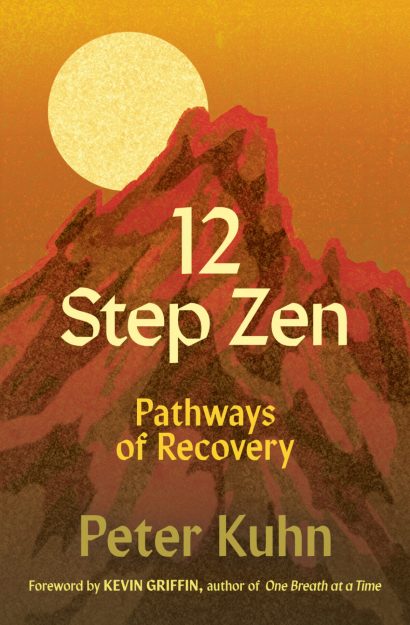
From 12-Step Zen: Pathways to Recovery (2026), courtesy of Parallax Press, parallax.org.