Rituals and Meditations
A conversation with the practicing Buddhist and avant-garde composer David Shea The post Rituals and Meditations appeared first on Tricycle: The Buddhist Review.
 JimMin

An experimental composer by trade, David Shea’s recent works have found a new audience within electronic and ambient music listening communities. In the early 1990s, he started out as a turntablist and sample manipulator on John Zorn’s ensembles, cutting his teeth on New York City’s Downtown music circuit. In his own pieces, he would compile elements of classical, avant-garde, jazz, pop, and folk music, bridging the gap between what was perceived as high-brow and low-brow culture. Inspired by the rich tradition of electroacoustic music (particularly Cage, Xenakis, Feldman, and Ligeti), he created postclassical sampling collages, shaped by references to East Asian culture including Hong Kong films and Chinese literature. Shea’s been immersing himself in the study of East Asian arts—including martial arts—since his youth in the 1970s, and he’s still constantly working with local folk musicians; around the time of the interview, he’s in between busy recording sessions with a group of traditional Vietnamese players.
Shea has been a practicing Buddhist for most of his life, and some of his musical works are deeply influenced by his own spiritual journey—including what is often regarded as his modern classic Towers of Mirrors (1995) and more recent works like Rituals (2015) and Meditations (2025). “The past four or five years, there seems to be more of an openness to looking at the arts as a central part of practice,” Shea explains, “which I think is a very positive thing.” Shea has been living in Melbourne for over a decade, and while he released his music on avant-garde outlets like Sub Rosa and John Zorn’s Tzadik in the 1990s, he’s found a new label home in the acclaimed ambient label Room40, run by the Australian musician and field recordist Lawrence English. When regular Tricycle contributor Stephan Kunze requests a call with Shea, he gets an early glimpse of the composer’s trademark dry humour: “We are ten hours ahead of European time,” Shea writes back. “Not that I believe in time or anything—just being practical.”
Hello, David, it’s great to be able to talk to you. First of all, thank you for agreeing to do this interview. Do you belong to any specific Buddhist sect, or do you practice in a certain tradition? Certainly my education growing up was on the Mahayana side of town. The temples I go to in Melbourne still tend to be more Mahayana. But I love learning about all the different groups, and they fight like cats and dogs. It’s all the same stupid thing that every religion does. We have to accept that the Nikayas are translations of translations of translations. For me, this means that we can translate those into music, into theater, into film, into workshops, into all sorts of things.
You just mentioned going to Buddhist temples in Australia, where you’ve been living for years. What else does your daily practice entail for you right now? I’m not sure there’s anything that the practice doesn’t entail. Writing music, doing meditations, teaching at universities, going to the pub, having a conversation with you—all of that is part of practice. I’m always looking for opportunities to practice. If a person makes me incredibly angry, that’s a good opportunity to practice. I studied martial arts as a teenager, and I thought that meditation was something that happens on the top of the Himalayas, when everything is beautiful around you. But you really need to find some kind of balance and equanimity in chaos, in the middle of violence, in the middle of engaged life. I completely respect the retreats and monasteries and all that, of course, but I always felt that my path was to do this in a very engaged way, to be in the center of art scenes and different communities around the world. I’ve moved around a lot. In the first sanghas, it was about going into the village, and you take your bowl with you, and if they like what you have to say, you eat. So you make it useful and practical, make it something that really does create more compassion and really is effective in the context that you’re in. For me, that context was growing up in media culture and technology. Interestingly, when I work with traditional folk musicians from China or Indonesia or Italy, they never seem to have a problem with that. I come in with samplers and strange electronics, and they just treat it as if that’s my folk instrument, while jazz and classical musicians often do not see [those electronics] as instruments. Traditional musicians feel so identified with what they do. I don’t try to change what they do. I don’t try to modern it up in any way. I set up a context and see what happens. This new record Meditations is very much like that as well.
How did Buddhist practice inform your recent works like Meditations (2025) and Rituals (2015)? The newest [album] was about the reality of meditational practice. You know how sometimes you’re deeply concentrated and suddenly you think, “Oh God, I left the stove on.” These thoughts arise, and you let them pass. New Age music or meditation music often feels idealized; it’s [often] a very comforting and beautiful music. But anytime I sit in the park, all sorts of frustrations and angers come and go. The sun’s there, but the clouds come over it, and then it rains for a while, and then [the sun] comes out again. I wanted to make a record that really reflected that dissonance. Nonharmony is a part of harmony, and we live with that every day. I’ve worked with traditional Chinese players and other musicians who [have] grown up with meditation as well, and they seem to relate to that pretty easily. Meditation is not some cosmic, idealized process. It’s getting up in the morning, having the ritual of having your tea or coffee, and having the ritual of “My god, I forgot to answer ten emails,” and then having the ritual of something that’s quite sacred and peaceful. Both Rituals and Meditations are about being in the experience, not trying to describe the experience.
Maybe the typical New Age or ambient music way isn’t so much about reflecting the actual practice but just providing a sonic backdrop that allows us to get into a more peaceful, harmonic mind-state. So it’s more of a functional approach, while yours is clearly more of a compositional, artistic approach. Yeah, I can see it with my students. I run these courses at Melbourne University, and meditation always makes it into some of the classes. I often talk about meditation as “chilling out” and “focusing on the breath,” because immediately they go into the mudras and they’re like, “OK, I got it. I have to have a clear mind.” Then the thoughts arise and they go, “Oh, I’m terrible at this.” In early stages it’s about demystifying that and saying, “Look, this is focus, this is attention. The mantra is not a magic formula but a way of focusing the mind.” And when you do that, other things happen that thought doesn’t allow to happen. If you were really one with everybody, you’d be bumping into everybody all the time. “Oh, sorry, I thought that was me!” [laughs]
Nonharmony is a part of harmony, and we live with that every day.
So we all make distinctions at some point in a physical world, and when you talk about activities that make fewer distinctions, then to mystify that is sometimes a disservice. It is the state of being all the time, and when we can be aware of that in fairly relaxed ways, at least in the early stages, students open up to that almost immediately. Even if they’ve done a yoga class or anything like that, they tend to say, “Oh, I’ve had moments like that.” And when I’m relating to the music, I don’t want to mystify that either. This is not “an East-West record,” or “World Music,” or any of that kind of rhetoric. The connections are already there. I try to set up a compositional context where they can come about, and I curate that with them. So I put my name on it. Why not? Saves time. But it really is a collaboration between the people that are there and their backgrounds, their language, what they’re bringing to that composition.
You grew up under John Zorn in New York’s avant-garde music scene. How did you originally become part of that? I left home when I was fairly young. At 16, I had a short time at the Oberlin Conservatory of Music. I didn’t last very long, and I started being a part of the Downtown music scene when I was 17 or 18. John Zorn was the center of that scene at the time, and I started working in his ensembles in the late ’80s. Besides being a taskmaster, he was an older brother who was very kind and supportive. For him, it really was about community, even though the world doesn’t like that. They want the hero. But he [wasn’t like that]. In fact, when he got a lot of attention, he would always talk about the people he worked with. I was a lot younger than that generation, but growing up in that was probably the best education I could have had. Until the early ’90s, I was working in his ensembles, and then in the mid-90s, I started doing the same thing with my own ensembles, and I spent the next twenty years on tour.
Did you actually have any type of musical training? I was always interested in it. I just didn’t find that institutions and schools [were] the way that I learned best. I played in many bands, and I studied as much theory as I could. I went to a performing arts high school, and went to every concert I could go to. Instead of running away from home and joining a cult, I went to the library constantly. I was just very curious to discover things. I was very influenced by John Cage, and I was reading about Daoism and Buddhism and going to temples and studying martial arts and watching too many Bruce Lee films. It was just coming from every angle, but I always did care very much about learning. I loved Stockhausen’s music, and I loved Xenakis and Ligeti and all the contemporary classical people. I just didn’t like these dark, cynical institutions that were very separated from the engagement with the rest of the world.
It’s fascinating that you got into weird art music in your teens, when most kids would listen to pop or rock. Well, by the time I was about 9 or 10, I was playing clarinet and knew that this [was] the direction, this [was] generally what I [wanted] to do. I had a pretty good idea really early on, that somehow that path was going to be my path. I played in Gospel bands and punk bands and hip-hop bands and all that stuff, and I enjoyed that. But there were also people around me that said, “Have you ever heard this computer music from the Princeton Harvard Lab?” And I’m like, “What is that?” It sounded horrible. [laughs] But I just didn’t make many distinctions. I notice that [same quality] in my students all the time. If it’s a Bach chorale, and they’ve never heard it before, they’re like, “What is this cool thing?” They don’t really care if it’s old music. It’s just interesting stuff that they found. So I knew the distinctions, but they just weren’t very important. I was discovering stuff and loved it.
But how did you stumble across these things? This was long before the internet became accessible to the general public. I was a kid in the ’70s, you know? These different religions and ways of looking at the world were just in the air. My family are Irish and Sicilian working people and we’re certainly not in the hippie area at all, but that was just around. I’m an only child, and I was fairly independent. I went to all the weird talks I could go to. I would be learning about TM [transcendental meditation]. I was informed by a lot of Hong Kong films and other media stuff that I was seeing. Then I started to meet people, and they’d be like, “Hey, have you heard of this guy Stockhausen? He wrote a piece called ‘Mantra.’ You’re interested in mantras, right?” I would listen to it, and it’s a piece I still deeply love. I started reading John Cage. I realized that so many of the 20th-century people that I admired had been influenced by Zen. It was really a shift in consciousness, and that’s when I started to look beyond the surface styles, because they seem connected, but I didn’t know how, and I needed to figure it out. Cage was a huge influence in that way. I was lucky enough to meet him in New York and watch him play some games of chess. He was one of the kindest people I’d ever met. When he found out I was a composer, he was like, “Oh, what are you working on?” [laughs] Zorn was like that too. I started feeling responsible for part of this tradition, not to carry it on but to respect it and to combine those traditions with other traditions.
As a teenager interested in Daoism and Mahayana Buddhism, what were you searching for at the time? I don’t think I was searching for anything in particular. I was just really fascinated to explore. In the US, the karate craze was massive at one point, and I didn’t do that but went more the Chinese route in martial arts and qigong. That stuff was around, but I felt a lot of it was very superficial, and I got curious about the original texts, the scriptures, the actual music. . . . Luckily, you had libraries and you had Smithsonian Folkways that recorded everything on earth, even Vietnamese folk music going back to the 1850s. So I didn’t feel like I was searching for any particular truth. I just felt that I had to deeply explore these different pathways to figure out how I could contribute to the conversation or understand where all this came from.
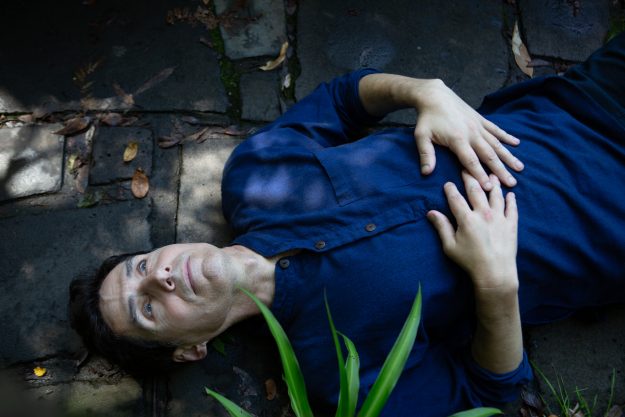 Photo by Lottie Davitt
In the 1990s, you started working with turntables as your main instrument. How did that come about? Well, it was completely practical. When I left the conservatory, I was completely broke and had no instruments. I was a squatter in the East Village in New York. I thought, if I’m such a hot shot composer, I should be able to do this with three trash cans. It’s not a matter of what you have, it’s how you put together the materials that you have. But I didn’t even have trash cans at the time, so I started using my voice and doing solo vocal performances. I had learned some of the multiphonic and overtone techniques, and then I found a police megaphone that was thrown away, so I started working with that. When I got cassette tapes, I started making tape collages. The purpose was to try to compose, but I didn’t have the resources to do it, so I tried to find things that I could do it with. If I couldn’t find a Koto player, I could find one on cassette, take a little razor blade and take that bit of tape, loop it, and play something live with that.
It’s not a matter of what you have, it’s how you put together the materials that you have.
Eventually, I was able to get turntables. Zorn was very supportive of my doing things with it. I would have three turntables, and I would play a Swedish death metal record on one, a tango record on another, and Schubert on the third. I would just let them play together, and sometimes they’d crescendo together, or they would be in the same harmony, or in a perfect polyrhythm. If you positioned them in the right place, those connections were already there. It was recorded material, and I was using it for something it wasn’t intended for necessarily. But I felt that these traditions must be highly connected. I wasn’t as interested in vinyl as some kind of conceptual object. I was interested in connecting traditions, harmonies, disharmonies, using technology that I had or that I could find, taking things that had already existed, finding the connections between them, and then combining that with live players, acoustics, and electronics and making this hybrid connective tissue music.
Were you aware of John Oswald and his idea of plunderphonics, which laid the groundwork for the techniques of sampling in modern music? I knew John because he was part of that same New York scene. Christian Marclay as well, who was the turntable player in John Zorn’s ensembles before me. His techniques were incredible, cutting records into pieces and then gluing them back together. He was a visual artist, and if you asked him what a dominant seventh chord was, he wouldn’t have the first idea at that time. But he would use his visual capacity and make music with it in a way no musician ever had. Some filmmakers [have] the most musical influence on certain composers. At that time, in early ’80s New York—I was too young to be a part of that—people were playing in galleries, cinemas, and bookstores, improvising together, but not talking about what they did before they got on stage. Somebody makes a noise or a sound, and you decide how you’re going to have a relationship with that or not. They called it free improvisation, and that was very liberating in a way, because I could really explore these kinds of connections without any real preconception other than the subconscious. It was composition in real time. I also had great respect for Pauline Oliveros and that older minimalist scene that is really about listening. I think many musicians don’t do enough of just practicing listening.
You mentioned coming up in New York’s ’80s improv scene, which was a continuation of the free jazz and loft jazz scenes in the ’60s and ’70s, mixed with European free improvisation. What was your relation to that part of the musical world? Well, my second “older brother” at that time came through [British avant-garde guitarist] Derek Bailey. Derek’s [free improvisation group] Company was seven days where you improvised together every night in various duos, trios, and combinations. I did Company in 1992. Jin Hi Kim was there, a Korean komungo player, and Reggie Workman from the John Coltrane quartets, and Tony Oxley, the great drummer for Cecil Taylor—people that had nothing in common at all. Derek was playing that night, and I would play turntables with him. Suddenly, I was soloing and didn’t know I was. This is something that people don’t really get about great improvisers. They’re so aware of the context that they’re always asking how they can contribute to the dialogue, even if they’re doing nothing. Suddenly, I sounded brilliant, and I thought: “This can’t be me.” And it wasn’t, of course. It was Derek teaching me that this is the way you listen, and that the secret to being a good musician is being a great listener—not in a cosmic sense but in really practicing your listening and being able to have the awareness of what someone else is doing, or being aware that you need to ignore them, and being situational with that. I soaked it all up, and again, I asked myself: How are all these traditions separated? Why are there jazz festivals, classical festivals, World Music festivals, whatever that means, and why are these completely isolated from each other? I know there are economic and other reasons, but it didn’t make sense to me. I was interested in layering them much more than I was putting them one after another. What you hear in my work is a process of layering and listening for connections, and trying to create them.
I struggle with the idea of academic “experimental” music, because in these electroacoustic contexts, we’re usually still relating to ideas that Cage or Stockhausen or Pierre Henry had sixty or seventy years ago. I find more of an experimental, explorative spirit in much of today’s popular music. Of course these terms at some point become utterly meaningless. I’ve never had much concern with that. I don’t align myself with the continuation of the avant-garde or any of that. I think those were historical battlegrounds that probably needed to be fought at one time. I respect them very much, but I’ve never felt very close to one. On Bandcamp, my record landed on the ambient charts. So I’m like, “Wait a minute. What happened? How did I become an ambient artist?” I don’t fight it. As long as we can see them as meaningless, I don’t mind the categories. It’s just marketing. And it saves time. You don’t throw all the records in the record store on the floor, and have people pick something. We created those divisions for a reason, and we can uncreate them as listeners or as collectors or as concert-goers.
I don’t even think it’s super far-fetched to call Meditations an ambient record. Still, I haven’t often found music supporting my meditation practice more than it would get in the way of the actual experience. What are your thoughts on that? I agree. I don’t think music is necessary for it, but there isn’t really a place that we can be where there’s silence. There’s always the sound of the wind and the birds and things that are in that space, so sound is already present. If you have someone doing something more conventionally musical, that could enhance or detract from the sound that is around you. I do a lot of field recordings in natural spaces here in Australia, which you can hear on my records. I have wonderful microphones that fit into my ears and that record what my head is listening to. So I’ll go up into the trees and just move around. I would just turn on the camera and then improvise with the sounds that were around me at the time, or even use other field recordings to mix with the natural sounds that were in that space. I called it the bush concerts, and I started a YouTube channel for that. If Cage was right on any level, then how can there be anything such as silence, and whether we identify that as music or not, that’s just somebody’s belief system. You’re concentrating on a mantra, or the sound of the breathing, or the physical action of the breathing in combination with the sound, so music is always present. Which choices do we make that are going to enhance the practice, and which ones might distract from it? Often music can distract because we focus on it, but so can a candle flame—it can enhance your practice, or you just get so caught up in the candle flame you forget to practice. Same thing with mantras, right? If people get attached to mantras as being the meditational practice, and they love their voice and they love the sound of the mantra, they probably lose touch with why they were in that meditation in the first place.
Currently, digital music platforms are rapidly filling up with automated slop. The last actual number I read was 50,000 tracks per day, but it’s probably more by now. How does that feel for someone who’s dedicated his life to creating compositions and working with human musicians? It’s fantastic. I say 50,000 is not enough. Keep it coming. [laughs] You know, when synthesizers were introduced, that was considered the end of all orchestras. No one will ever need to be a musician again! Cheap synthesizer music will flood the market! With one finger in your living room, you can reproduce all the Beethoven symphonies! And don’t get me wrong, we have fantastic synthesizer music. But the orchestras didn’t disappear. The folk musicians didn’t disappear, the traditional ensembles didn’t disappear. I’m simplifying it, but I think good artists will work with technology and machines in interesting ways. AI can do interesting things, as synthesizers can do interesting things. The people that produce really mediocre, pointless work, they didn’t need machines to do that. So if they can find a new way to produce work that we shrug our shoulders at, they will.
I don’t think it’s all that significant an issue. I encourage my students to use everything they want to use. But ask yourself, why are you using it? A sequencer sounds like a sequencer because it plays perfectly like a machine, and that’s beautiful. But what if you don’t want something to play like a machine? Work with a musician who makes human errors and has tempo fluctuations. There’s a program that I’ve been working with where I improvise into the AI, and it tries to improvise an accompaniment with me, and then I try to accompany it, and we can co-compose the improvisation together. Most of the time it’s terrible, but some of the time it unleashes some kind of sound that I just would not have come up with if I was in my own bubble. I’m sure this will be unpopular to say. Technology in the arts is really positive, but it’s still a human issue. Computers, to me, are physical musical instruments, or can be. So were samplers, so were turntables. Just because somebody happens to be playing a tuba doesn’t make it interesting tuba music. Same thing with spatialization—that’s very 20th century to me, where you’d have an eight-channel spatialization, but the experience was terrible. I think we still have the same fundamental issues. Every tool we use changes us and the audiences, and we have to be aware that that can be really positive or destructive. It’s worth approaching the newest technology with that same sense. In the hands of good artists who understand it, we’re going to get something interesting with that. I’m curious about it. I think the best thing to do is just see what artists do with it instead of theorizing that it’s gonna create gray goo and destroy the universe. Have you ever heard this song, where they took all the lyrics and songs from sixty years of the Eurovision Song competition and AI composed a winning Eurovision song out of it? There are just no words to describe it. But I’m glad somebody did it, because it shows that the technology by itself really isn’t much of anything, and neither is any other technology. For me, the piano is a phenomenal piece of technology. A crystal singing bowl is a phenomenal piece of technology. When I sit with a computer and it crashes nine times, I think this is a primitive stone tool. So we have a long way to go. But the response to that is going to generate a lot of great work.

















.jpg&h=630&w=1200&q=100&v=c0f97a310e&c=1)