The Birder’s Mind
On woodcocks, Zen Buddhism, and how ornithology can teach us to remember who we’ve always been The post The Birder’s Mind appeared first on Tricycle: The Buddhist Review.
 BigThink
Midtown Manhattan, New York City. It’s cold, but the air is thick with urban sounds: horns, traffic, the occasional shout. On Broadway, a blur of suits and tourists jostle shoulders, back and forth.
Nearby, in Bryant Park, an American woodcock stands apart. Her little body, dappled brown and patterned like a snake, is the size of my fist. Her beak is flamboyantly long, jutting out beyond a rounded chest. She sways in a slow, rhythmic dance, eyes dark and bright as a sky, studded with stars. People watch quietly, attentive and in awe.
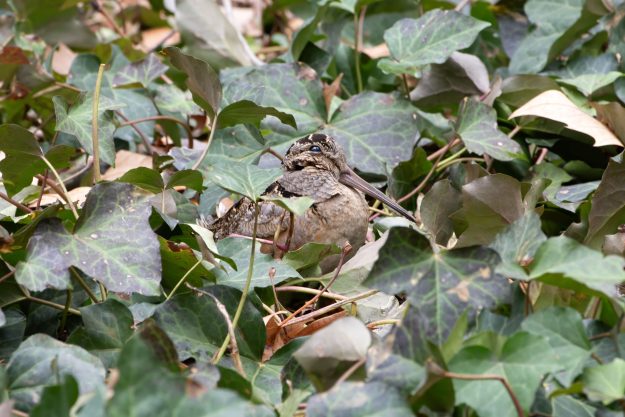 The American woodcock. Photo by Carol Ourivio.
Birds can have that effect: They can ease the constant chatter within us, offering gateways to a quieter, calmer state of awareness.
This is something that many birders understand. Birding can be a practice of paying attention, stilling your mind, and being receptive to the present moment. Sometimes this is called “mindful birding.” (It contrasts to more competitive, gamified forms of birding, where birders, or “twitchers,” focus on identifying species and growing their life list—the list of species they’ve observed. For mindful birders, meanwhile—to quote naturalist Tom Brown Jr.—the idea is to “know the soul before you know the name.”)
Last month, I visited New York’s Zen Mountain Monastery, to understand what a birder’s mind might share with a Buddhist’s. Tucked among trees on a mountainside, the monastery is deeply entwined with this land in the Catskills. Birds are woven into monastery life: Herons visit the pond, and barred owls roost in the forest.
“Just last week,” says Danica Shoan Ankele, a sensei here, “we heard the first birds in our dawn meditation period. Birds who winter here, like chickadees, are companions through the cold, dark months. Then spring comes with a cacophony of birdsong.” Like chanting or meditation, birds can mark the natural rhythms that define our days. My own mornings are consecrated by the scuffle of northern cardinals, breakfasting at my feeder.
 Northern cardinal. Photo by Carol Ourivio.
“When people come here, they’re often seeking quiet,” Shoan says, our tea steaming in the frosty air, not quite surrendered to spring. “That opens up different possibilities for connection and communication.” It’s the same in birding. Quietness clears a space, in which birds offer themselves.
“We can get so myopic in our human-made, constructed world,” Shoan smiles. “The presence of these beings, with their full, rich lives, breaks through that self-concern.”
Nature doesn’t reflect our narratives: It asks us to drop them, to be open. Birding, in turn—like Buddhist practice—can collapse the gap between self and other. And when we start to recognize and empathize with other beings, we start to dissolve the perceived boundaries between us.
Nature doesn’t reflect our narratives: It asks us to drop them, to be open.
Another Zen Mountain monastic, Simon Daio Harrison, articulates this with a clear-eyed, northern English matter-of-factness. “Zen practice, for me, is about relationships. If I’ve solidified me, and I’ve solidified that little warbler outside, there’s a gap between us. If I’m not careful, I’ll dismiss that ‘other,’ or even be OK destroying them.”
Birding is an exercise in unsolidifying—decentering ourselves, or dissolving the “self” completely. Throughout the Zen canon, teachers and poets have used the natural world to illustrate that we’re all of one essence. Dogen Zenji’s poems, for example, are replete with natural imagery. “They’re metaphorical,” Shoan says, “or they’re offered up as examples of fully embodied buddhahood: The mountains and rivers themselves are the sutras; the sound of streams is the song of universal praise.” Here, birds can shine especially bright. With a stretch of the wing or a flurry of song, a bird can embody that wholeness.
Dogen’s poem “Zazenshin” (Acupuncture Needle of Zazen), found in the Shobogenzo, comes to mind:
Realization, neither general nor particular,
is effort without desire.
Clear water all the way to the bottom;
A fish swims like a fish.
Vast sky transparent throughout;
A bird flies like a bird.
Animals aren’t just metaphors, here, but fully realized paradigms. “We can learn so much from the ease with which birds are in their own embodiment—so uncomplicated, so wholehearted,” Shoan says. Humans, meanwhile, “twist ourselves in knots, trying to become who we already are.”
This revelation, when it comes, can offer great relief. Holly Merker, founder of the Mindful Birding Network, understands this well. Once a twitcher, she came to mindful birding through a series of calamities: two spinal fractures, followed by a cancer diagnosis. During treatment, she was forced to bird more slowly, conversing mostly with those outside her window. These birds didn’t parrot her narrative. “Friends and family treated me differently because I lost my hair, and my body changed,” Holly told me. “The birds weren’t judging me for who I was, or how I looked. That was an incredible gift.”
Events and programs by the Mindful Birding Network, founded in 2021, more explicitly bring foundational mindfulness techniques into birding. “I usually have a local land partner, like a nonprofit,” Holly says. “We’re in spaces where we can walk slowly or sit comfortably. I invite people to gently close their eyes or set them at a soft gaze, and I walk them through tuning into the layers of sound, how the ground feels, their breath. Then noticing birds as they appear. . . . Often in mindfulness practices, the breath is the anchor. Here, the birds are the anchor.”
As Daio notes at Zen Mountain, this recalls the notion of a “sit spot”: a place to sit quietly in nature, ideally close to your home, where you can return on a daily basis, and be open to whatever wildlife comes your way (dawn and dusk is best). The practice was conceived by Jon Young, teacher and author of What the Robin Knows: How Birds Reveal the Secrets of the Natural World; in a past life, Daio worked on Young’s environmental education programs.
 Mountain chickadee. Photo by Carol Ourivio.
The common ground of mindfulness and birding is, perhaps, intuitive—but increasingly, scientific research affirms it. Where Western psychology and neuroscience now study mindfulness, an interest in nature-based practices, like birding, has followed—and similar restorative benefits have been observed. Birding, like mindfulness, seems to improve birders’ memory and neuroplasticity. And birdsong—again, like mindfulness—can improve attention and cognitive performance. There’s no need to be a dedicated birder, either: A litany of studies shows that simply being exposed to birds can be restorative. A 2006 study concluded that to humans, the three most soothing sounds are wind, water, and birdsong. Others tied birdsong to reduced stress, depression, and anxiety.
The more attention and care that you offer the more than human world, the more it will give back. For Holly, this reciprocity is at the heart of mindful birding. “They give us the gifts of joy and mindfulness,” she says. “In turn, we can support conservation and stewardship. We can plant native plants, offer food and water, and contribute to citizen science.”
The more attention and care that you offer the more than human world, the more it will give back.
After visiting Zen Mountain, a friend and I went hiking nearby. “Look up,” my friend said, halfway through the climb: A boreal owl gazed down at us, silvery, wide-eyed, crystal-clear. All day, I’d been speaking for birds. In that moment, they seemed to speak back.
By cultivating inner peace, we’re better positioned to protect the natural world. Just as Buddhist practice invites compassion, birding can extend that compassion to nature.
Since Covid, the global rise of birding has been stunning. For good reason: Among outdoor activities, birding is uniquely accessible; birds live in all environments, including, crucially, cities. Over half the world’s population lives in cities; by 2050, it’s likely to be over 68 percent. All these people live among birds. In turn, over 20 percent of all bird species might live in cities. Even in urban areas without many trees, hawks, starlings, pigeons, and many blackbirds thrive.
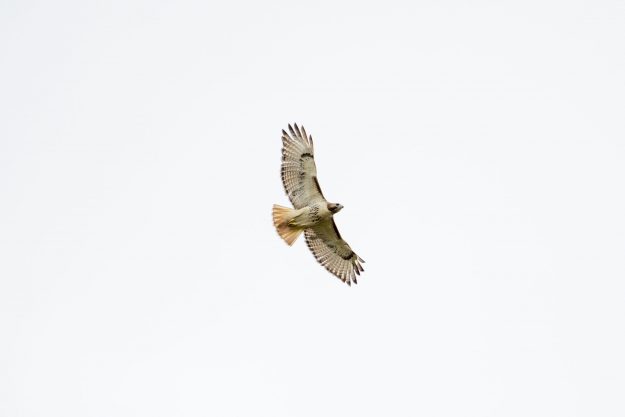 The red-tailed hawk. Photo by Carol Ourivio.
Birding is inclusive in other ways too. It doesn’t require much physical fitness. Those with visual impairments can bird by ear. Projects like Project FeederWatch and Garden BirdWatch encourage birding from home. As a low-cost activity with a wealth of free knowledge online, and birding groups actively expanding efforts at inclusion, birding is breaking down barriers that, traditionally, exclude marginalized groups from nature-based activities. As with mindfulness: To practice, all you need is a receptive mind.
From the waterbirds of ancient Zen poetry, to woodcocks in New York, avian teachings are rarely out of reach. To observe a bird is to calm the wild storms of consciousness: to collect the mind, and distill it in avian form.
Another Dogen poem comes to mind:
To what shall we compare this world?
To moonlit dew
Flicked from a crane’s bill.
He is, I think, speaking to the same essential truth.
I have set up camp in the Oregon forest, to find two northern spotted owls, steps away in their resident tree—staring at me, a universe melted in their dark, wide eyes. I’ve watched a bald eagle circle the treetops in Brooklyn’s Prospect Park, feathers taut against a winter sky. Reality has never felt so close as in those moments; my mind has never felt so still.
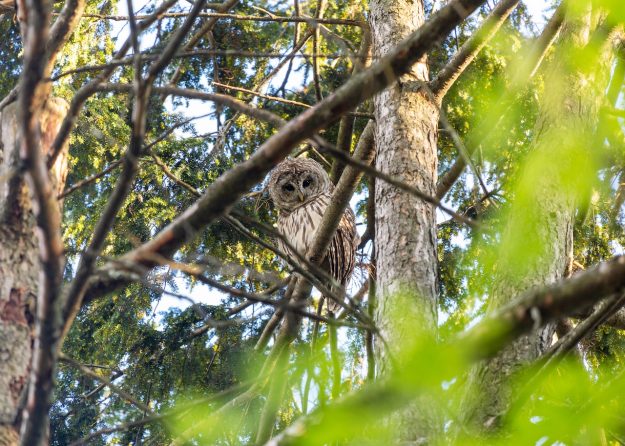 Barry the barred owl. Photo by Carol Ourivio.
“I don’t know anything about consciousness,” Zen Master Shunryu Suzuki once said. “I just try to teach my students how to hear the birds sing.” I’d invite you to hear them too.