Weaving a Mindful Community of Elders
Inspired by Aging with Wisdom, a group of Cambridge, Massachusetts-based seniors reorient their relationship to old age. The post Weaving a Mindful Community of Elders appeared first on Tricycle: The Buddhist Review.
 Kass
Kass
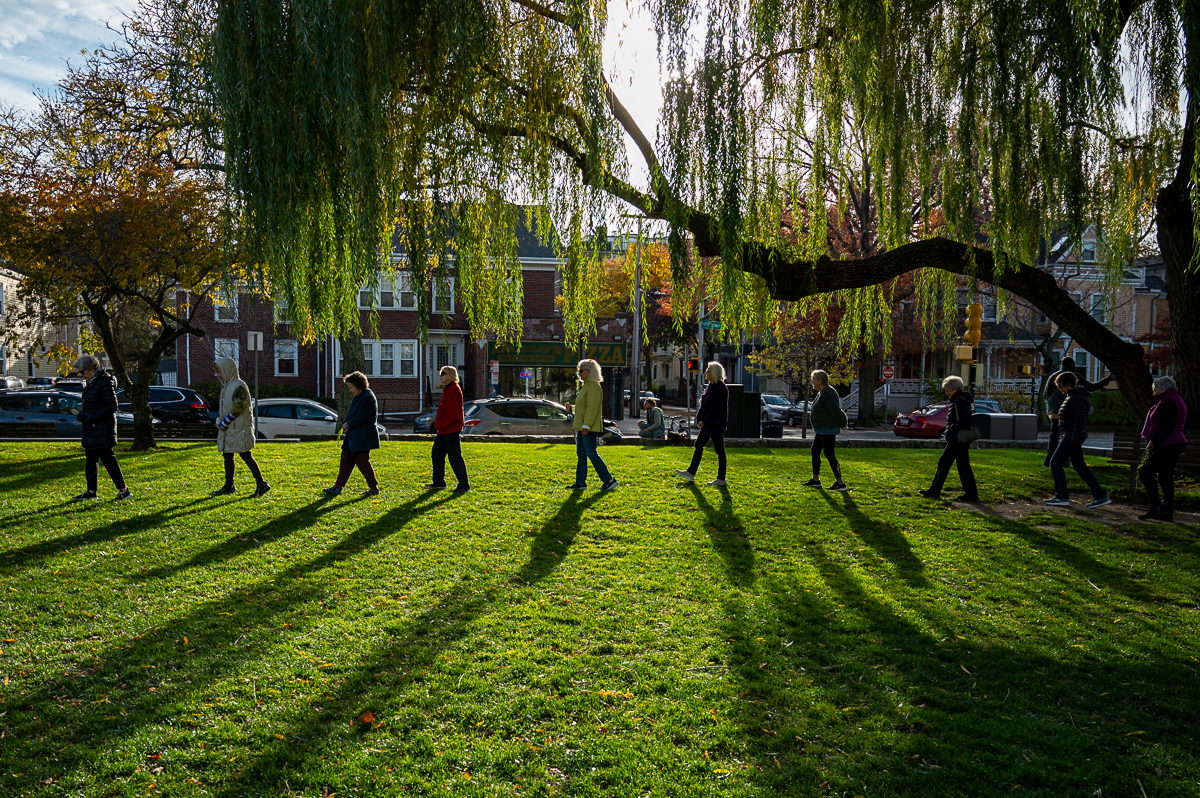
Every Monday morning, dozens of elders gather on Zoom through the Cambridge Public Library. Some sit upright, hands folded; others lie back, eyes closed, listening. Many arrive with pain—arthritic joints, shaky balance, chronic illness, grief. And that is where we begin: the body, as it has arrived.
We open with meditation, often breath-based or on sensory awareness. In a culture that resists and even disdains aging, we commit to a quiet, radical reorientation: We regard the aging body with tenderness. Instead of holding resentment toward growing older, we accompany the body across practices—interoception, loving-kindness, and resting attention. Our mindfulness honors Buddhist teachings on surrendering to the reality of the present moment and embracing the fragility of life.
What began eighteen months ago as an experiment has become a remarkable public-library-centered sangha and a collective inquiry into how mindfulness meets the conditions of later life. After meditation, I offer a brief reflection drawn from a range of sources such as the Buddhist five recollections, poems, or teachings by elder practitioners—and then we turn toward one another.
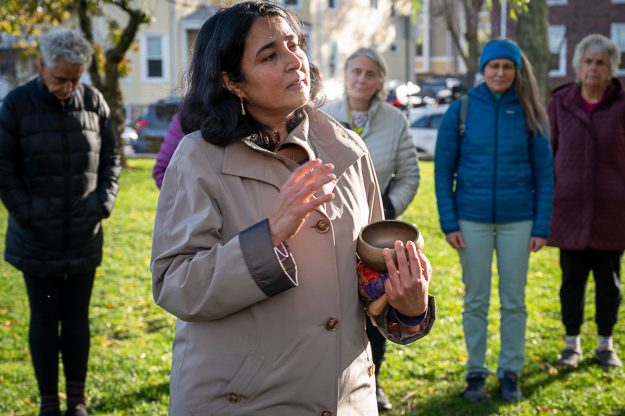 Photo by Randi Freundlich
In small groups, elders are invited to speak and listen with clear guidelines: no fixing, no advice-giving, only deep attention. In a society that often isolates elders or pathologizes aging, shared presence becomes its own form of medicine. As one participant told me, “Feeling connected to and resonating with a community of elders supports my acceptance of aging. I feel increasingly safe in the group discussions.” In the first iteration of the class, we worked with concepts from the book Aging with Wisdom by Olivia Ames Hoblitzelle, a psychologist and meditation teacher. Hoblitzelle describes elders as “wayshowers”—those who have gone before us and can illuminate the terrain of aging, sickness, and death. That spirit now animates our weekly gatherings: a willingness to turn toward what Hoblitzelle calls “the grace of diminishment.” We also draw inspiration from Katsi Cook, a Mohawk wise woman who refers to elderhood as a “generational transfer of wealth.”
Below, I share the testimonies of four regular attendees.
Cameron Lane
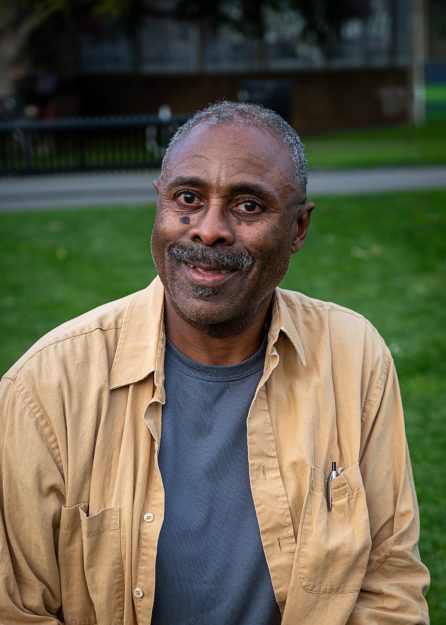 Photo by Randi Freundlich
Cameron Lane, 67, was born in Barbados and grew up in Cambridge. He describes his journey as a long process of “returning to the nest.” His life has been shaped by devotion—to his decades of work at an electric company, his Christian faith, and to his wife, Anne, whom he has cared for through more than thirty years of mental illness.
In class, he often speaks in the language of electricity—how humans, like batteries, need grounding and discharge, how energy moves and settles. Amid ongoing crises, including his wife’s recent hospitalization, mindfulness has given him a way to tend to his own mind and body while continuing to show up for others.
Amid ongoing crises, mindfulness has given him a way to tend to his own mind and body while continuing to show up for others.
One teaching from his mother stays close: “We are born in pain, and hopefully we don’t live in pain, and we pray we don’t die in pain.” As Lane moves into what he calls the final third of life, mindfulness supports him in meeting uncertainty with faith and a deep, practiced love.
Elka Kuhlman
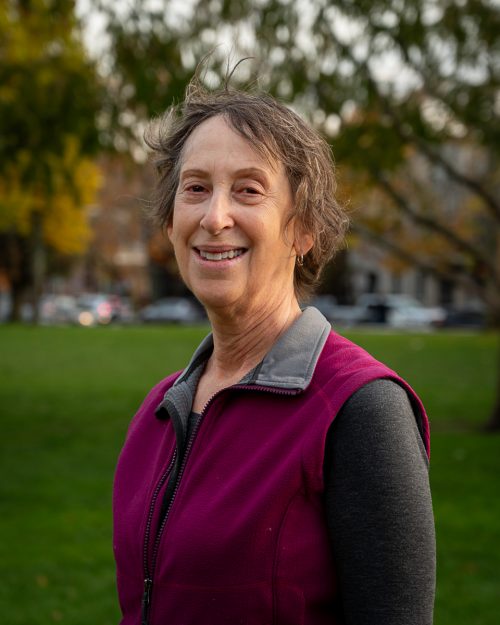 Photo by Randi Freundlich
Elka Kuhlman, 72, grew up surrounded by the unspoken grief of a family scarred by the Holocaust. While working her way through college, she discovered Transcendental Meditation® (TM) almost by accident. Twenty minutes, twice a day, became a refuge through years of parenting and a career in education.
Her daughter introduced her to the Cambridge Insight Meditation Center (CIMC), where Kuhlman felt an immediate resonance. The practice did not ask her to abandon her roots; instead, it offered tools for seeing her inner life with greater clarity.
Kuhlman has watched elders in her family meet old age with fear and rigidity. In the class, she values the freedom to speak honestly about pain, anxiety, and shifting identity. “Fixing interrupts real listening,” she says. What she seeks is space to articulate her own experience and discover meaning without receiving advice.
Philippa Bovet
Philippa Bovet, 88, was born in England and raised in Paris, and came to the United States more than fifty years ago.
She found the Presbyterianism of her upbringing ultimately insufficient, and in midlife, friends introduced her to CIMC. She felt her inner life deepen through weekly sits and teachings from many traditions. Nature has also been an important teacher. During the pandemic, she and a close friend walked weekly to a nearby waterfall, watching the subtle shifts of water, plants, and light. This practice became its own meditation, offering lessons in interconnection and wonder.
Living in a senior community, she notices how often conversations about aging and death are avoided. Mindfulness has changed Bovet’s relationship to aging by teaching her to pause and soften rather than rush or resist. If aging asks anything of her now, Bovet believes it is to listen—deeply and with love.
Ruth Farris
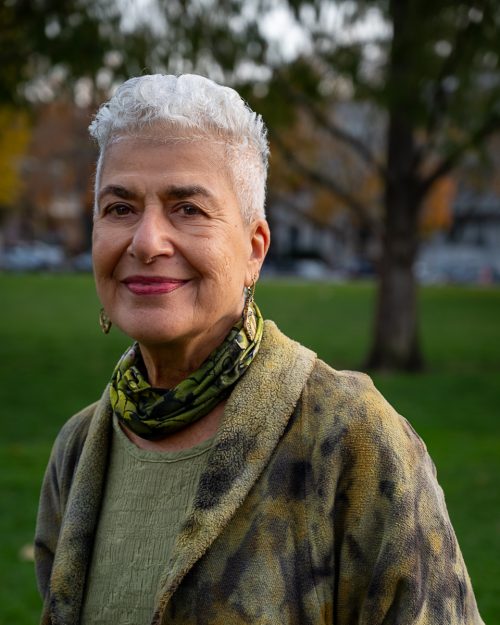 Photo by Randi Freundlich
Ruth Farris, 75, grew up Catholic. In her 20s, a twelve-step program for food addiction reshaped her understanding of faith with its emphasis on honesty and daily reflection. Later, Buddhism offered practices that grounded her in self-compassion. “I’m an amalgam of many things,” she says, ”life is hard enough without the burden of what you’re hiding.”
Coming from a working-class Lebanese American family and a career in social work, humor, realism, and care for others influence how she views aging. Breaking her arm this year felt like, as she put it, “the beginning of the end.” Mindfulness helps her meet this vulnerability with patience and perspective. Ageism is real, she notes—especially in medical settings—but in this space, no one talks down to her. The group offers dignity, recognition, and the camaraderie of peers.
Ageism is real, she notes—especially in medical settings—but in this space, no one talks down to her. The group offers dignity, recognition, and the camaraderie of peers.
In Buddhist teachings, aging is named alongside sickness and death as one of life’s unavoidable and precious truths. And yet who amongst us has not felt a cultural imperative to ignore and hide these realities? Elders from all walks of life, representing a diversity of religious beliefs, socioeconomic status, and ethnicities come together seeking connection and respite. Sitting with them, I am struck by their courage and willingness to stay present with what arises. Every mindfulness Monday is an attempt to empower elders to stand firm in their beauty and to reclaim their dignity.
I often reflect on the poet May Sarton’s wise counsel to “imitate the trees,” who so simply “let fall the riches of a season, without grief.” It is from such trees, we perceive that “nothing stays the same for long, not even pain.” “Sit it out,” she urges, “let it all pass. Let it go.” In a take-home practice in the spring, I encouraged class participants to go outside and connect with a tree if they were able to, and to see and experience trees as elder guides, rooted firmly in their decades of life lived, with strong trunks and abundant branches that shelter and move with the wind.



















.jpg&h=630&w=1200&q=100&v=c0f97a310e&c=1)