Abhyasa and Vairagya: The Two Tools Patanjali Says Will Quiet Your Mind
Most of us have experienced this: we start a meditation practice, a journaling habit, or a morning routine with real enthusiasm. Two weeks later, life gets busy, the motivation fades, and we quietly stop. Then comes the guilt. Then...
 Astrong
Most of us have experienced this: we start a meditation practice, a journaling habit, or a morning routine with real enthusiasm. Two weeks later, life gets busy, the motivation fades, and we quietly stop. Then comes the guilt. Then comes the restart. Then comes the same cycle again.
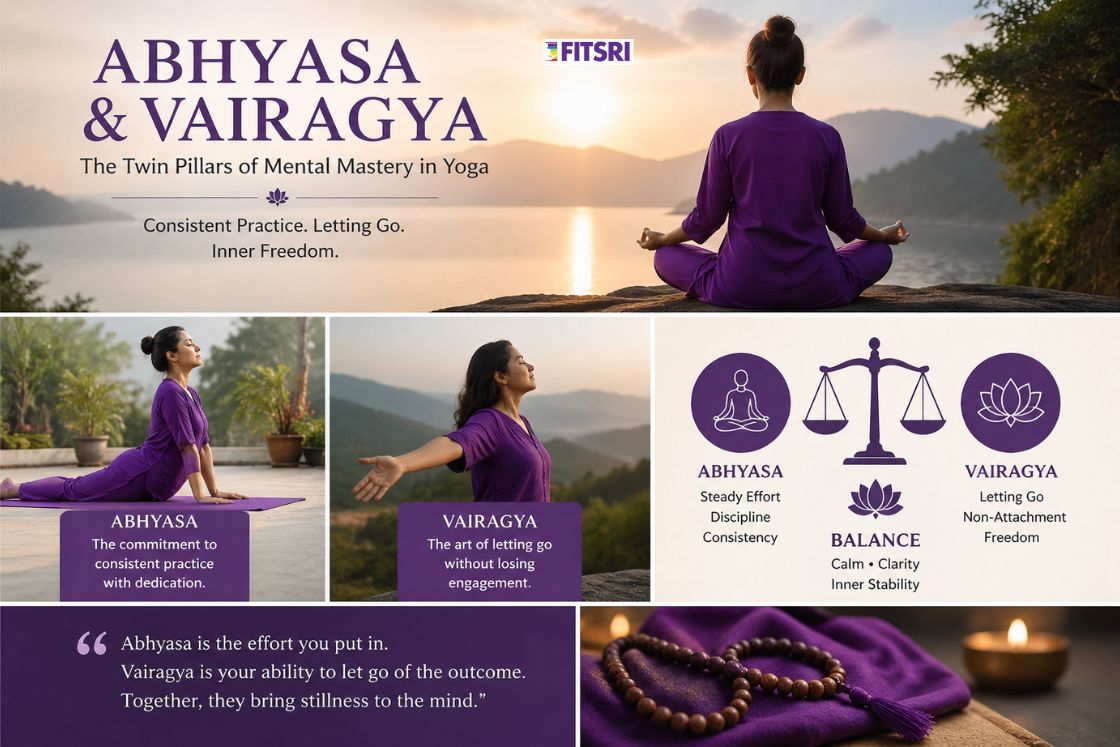
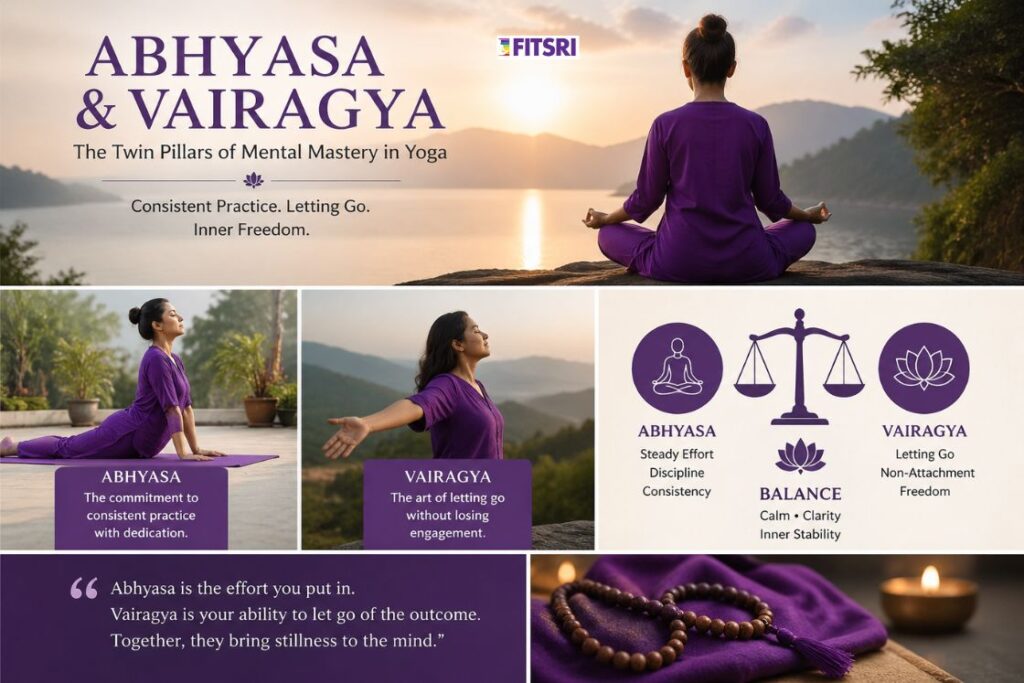
In yoga, this cycle is explained through two key principles: Abhyasa and Vairagya. Abhyasa means consistent practice, while Vairagya means non-attachment. Together, they help calm the mind and bring inner stability.
Patanjali saw this problem clearly, centuries ago. And in the Yoga Sutras, he named the two things that actually break the cycle: Abhyasa and Vairagya. These aren’t two separate practices you do at different times. They are two qualities you cultivate together, and together they are what mental mastery actually looks like.
Patanjali’s entire system of Yoga is built around one central problem: the uncontrolled movement of the mind. He calls these movements Chitta Vrittis, the constant waves of thought, desire, memory, and imagination that carry us from one reaction to the next. Most of our suffering, he argues, doesn’t come from the world itself. It comes from our mind’s interpretation of the world.
To calm these waves, Patanjali offers two tools in Yoga Sutra 1.12:
“Abhyasa Vairagya Abhyam Tan Nirodhah“
Through Abhyasa and Vairagya together, the fluctuations of the mind are stilled.
These two disciplines are the backbone of mental freedom in yoga. Let’s understand the meaning of Abhyasa and Vairagya before seeing how they work together.
What is abhyasa in Yoga?
Abhyasa in yoga means consistent and steady practice done with dedication over a long period of time. It is the effort to remain stable in a calm and focused state of mind.
The word Abhyasa is often translated simply as “practice,” but that translation undersells it. Most of us practice things casually. We practice occasionally, when we feel like it, when the conditions are right. Abhyasa is something different.
The root of the word refers to a kind of sitting that is deep, persistent, and self-sustaining. When you are truly in Abhyasa, you are not forcing yourself to practice. You have developed a natural pull toward the practice. The doing becomes its own reward.
Think of a child learning to walk. The child doesn’t approach it as a chore. She falls, gets up, falls again, and tries again, not because she has to, but because the act of trying itself is compelling. She is fully absorbed. That absorption, that steady and joyful engagement, is the spirit of Abhyasa.
Abhyasa according to the yoga sutras
Sutra 1.13 defines it this way:
“Tatra Sthitau Yatno Abhyasah”
Abhyasa is the sustained effort to remain stable in a state of inner harmony.
And Sutra 1.14 makes the requirement clear: this practice must be done for a long time, without interruption, and with sincerity and respect. Not for a few days or weeks, but over years of consistent effort.
That may sound demanding. But Patanjali is not being strict. He is being realistic. The mind has been conditioned for years. It takes steady practice to reshape it.
A simple way to understand this today: when someone has practiced something for a long time, they no longer depend on motivation. They show up naturally. The practice becomes part of who they are. That is what Abhyasa looks like in real life.
What is vairagya in yoga?
Vairagya in yoga means non-attachment or freedom from craving. It is the ability to experience life fully without becoming dependent on outcomes, desires, or external conditions.
Non-attachment is probably the most misunderstood idea in yoga. People hear it and picture a monk who feels nothing, cares for no one, and lives alone on a mountain. That is not Vairagya.
The word comes from “raga,” meaning color or attachment. Vairagya literally means becoming colorless, shedding the mental dyes that our attachments apply to our experience. When we are attached to something, we don’t see it clearly. We see it through the color of our craving or fear. Vairagya is the practice of seeing clearly.
Vairagya according to the yoga sutras
Verse 1.15 describes Vairagya as:
“Drishta Anushravika Vishaya Vritrishnasya Vashikara Sanjna Vairagyam”
Sutra 1.15 explains that when the mind loses its thirst for objects, whether seen directly or heard about, that mastery over desire is called Vairagya.
Notice what Patanjali does not say. He does not say you must stop enjoying things. He says the mind loses its thirst. There is a difference between enjoying a cup of tea and being attached to having tea every morning to the point where its absence disturbs your mood. Vairagya is the space between experience and craving.
Consider how often your mood depends on something external. A good response from someone you respect. A project going the way you hoped. The weather on a day you planned something. When these things don’t go your way, you suffer. That suffering is not caused by the situation, but by your attachment to a specific outcome. Vairagya is the practice of meeting life without that inner grip.
Sutra 1.16 goes further and describes Param Vairagya, the highest form of non-attachment. At this level, the yogi lets go not only of external attachments but also of the three Gunas: Tamas, Rajas, and Sattva. Even attachment to clarity or goodness is released.
This is a state of deep inner freedom, arising from the direct knowledge of pure consciousness (Purusha). While this may seem like a high teaching, it has a simple implication: even our identity, expectations, and beliefs can become subtle attachments that create suffering.
Vairagya is not cold indifference. It is warm engagement without clinging. You can love deeply and still practice Vairagya. You can work with full dedication and still practice Vairagya. The difference lies in your inner relationship, not in your outer actions.
How do abhyasa and vairagya work together?
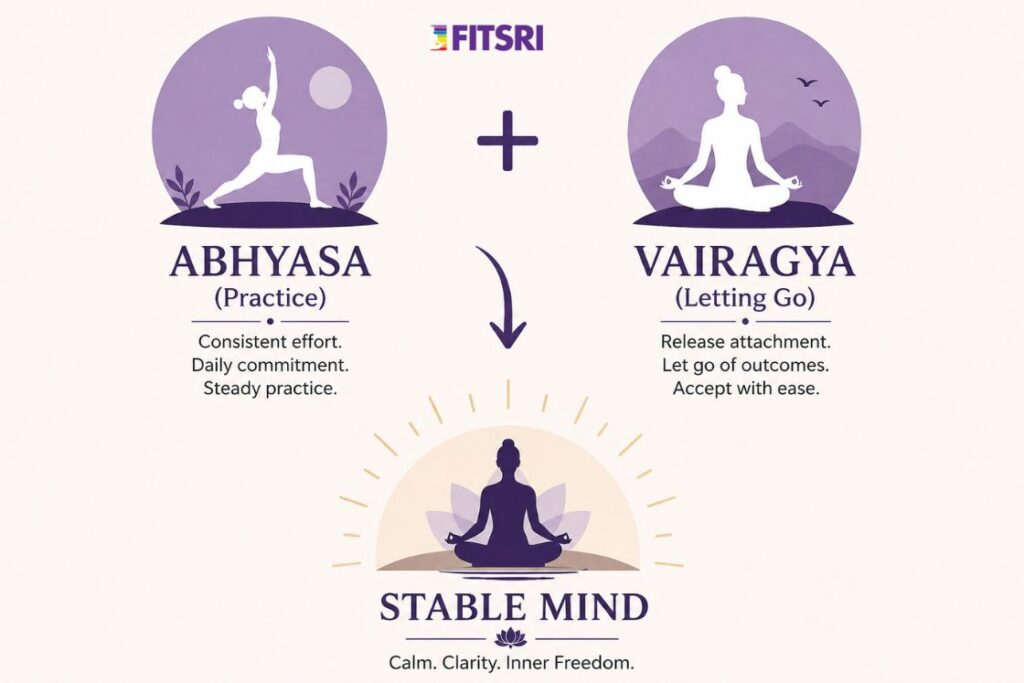
Abhyasa and Vairagya work together by balancing effort and letting go. Abhyasa builds consistent practice and discipline, while Vairagya helps you release attachment to the results of that practice. Together, they create a steady and calm state of mind.
These two principles can seem to pull in opposite directions. One asks you to show up, put in effort, and stay consistent. The other asks you to let go, release outcomes, and hold things lightly. How can both be true at once?
The answer is that they operate on different levels. Abhyasa is about your effort. Vairagya is about your relationship to the results of that effort.
A simple way to understand this is through a skilled musician. She practices every day with full focus and genuine love for the craft. That is Abhyasa. But when she performs, she does not cling to the outcome. She plays with presence, without being disturbed by mistakes or controlled by the audience’s reaction. That ease within full engagement is Vairagya.
Without Abhyasa, Vairagya becomes passive. You are not truly detached, you are simply not trying. The stillness becomes emptiness rather than peace. Without Vairagya, Abhyasa turns into obsession. You practice, but you become attached to progress, results, or being “good” at yoga. That attachment creates restlessness.
Together, they create something rare: wholehearted effort without inner pressure. You give your best, and you allow the results to unfold naturally.
As the ancient commentator Vyasa explains, without non-attachment, practice becomes obsession. Without steady practice, detachment becomes passivity. You need both, like two wings that allow you to move forward.
Applying abhyasa and vairagya in daily life
1. Combine effort and ease in your physical practice
Start your sessions with something active: sun salutations, jogging, cycling, or vigorous asana. Put in genuine effort. Let that be your Abhyasa. Then transition to something slower: yin yoga, pranayama, or seated meditation. That transition from effort to stillness is the felt experience of moving from Abhyasa toward Vairagya. Do this regularly and you train the nervous system to access both states.
2. Move from gross thoughts to subtle ones in meditation
When you sit for meditation, start by simply noticing the obvious thoughts arising: plans, worries, memories. Don’t fight them. Observe them. Then, as the obvious layer settles, notice what is underneath. Subtler pulls, subtler resistances. This movement from gross to subtle is exactly the journey Patanjali describes. The mind’s surface patterns give way to deeper ones, and through practice, even those begin to settle.
3. Stay aware of yourself while staying engaged with life
The reason most people lose their Abhyasa is simple: they lose awareness. They start a practice and it becomes mechanical. They are going through the motions rather than truly being present. True awareness is what sustains both disciplines. When you are genuinely present in what you are doing, practice doesn’t feel like a burden and detachment doesn’t feel like loss. Be mindful of how you breathe, how you eat, what you say, and how you respond. Awareness is the thread that holds everything together.
4. Never stop practicing, even imperfectly
There will be days when your meditation session is short, distracted, and unsatisfying. Do it anyway. There will be weeks when your routine falls apart. Start again without drama. Abhyasa doesn’t demand perfection. It demands continuity. The yogi who meditates imperfectly for years makes more progress than the one who practices perfectly for one month and then quits.
5. Track your attachments honestly
Sit down and make a real list. What are you attached to? Specific outcomes at work. A certain image of yourself. Someone’s approval. Certain comforts that feel like needs. Then ask: which of these are genuine needs and which are the mind’s conditioned cravings? This is the beginning of Vairagya, not as an abstract ideal but as a practical inquiry into your actual mental patterns.
6. Notice how the mind colors your experience
Our mind is a brilliant storyteller. It turns neutral events into disasters or triumphs, depending on which story it is running. When something goes wrong, notice the story your mind immediately builds around it. When something goes right, notice the immediate grasping for more. Meditation, breathwork, and consistent practice gradually thin out this coloring. You begin to see events a little more as they actually are, and a little less as your mind wants to interpret them.
Conclusion
Abhyasa and Vairagya are not advanced concepts for serious yogis on retreats. They are the most practical tools Patanjali offers for anyone who wants to feel less pushed around by their own mind.
Practice with sincerity. Let go of the grip on results. Do it again tomorrow. This is the whole teaching in its simplest form.
When both are present together, something genuinely shifts. The mind that once ran you begins to settle, not because you forced it, but because consistent effort and genuine release, held together over time, are simply more powerful than anything the mind can throw at you.
That is what Patanjali was pointing toward. And it is as available to you today as it was to any yogi centuries ago.
FAQs
1. What is the main difference between Abhyasa and Vairagya?
Abhyasa is the effort to stay steady in practice, while Vairagya is the ability to let go of attachment to results. One builds discipline, the other brings inner freedom. Together, they balance effort and ease.
2. Can you practice Abhyasa without Vairagya?
You can, but it often leads to frustration or burnout. Without Vairagya, practice becomes result-driven and stressful. Vairagya helps you stay calm and steady, even when progress feels slow.
3. Is Vairagya the same as detachment or indifference?
No. Vairagya is not indifference or lack of care. It means being fully involved in life without becoming emotionally dependent on outcomes. You still care, but you are not controlled by what happens.
4. How do I practice Abhyasa and Vairagya in daily life?
Start with small, consistent practices like meditation, breathwork, or mindful awareness. Stay regular in your effort (Abhyasa), and at the same time, let go of expectations about how the practice should feel (Vairagya).
5. Why are Abhyasa and Vairagya important in yoga?
They are important because they help calm the restless mind. Without practice, the mind remains unstable, and without detachment, it becomes reactive. Both are needed for inner balance and clarity.