Before Fidget Toys, There Were Beads: The Latest Craze is Part of a Long Tradition of Keeping Your Hands Busy
While fidget toys and other attention-focusing gadgets are now a multi-billion-dollar industry, they are also part of a long mindfulness tradition. Author and educator Alex Tzelnic explores the history and science behind using intentional, focused activity to direct attention...
 Fransebas
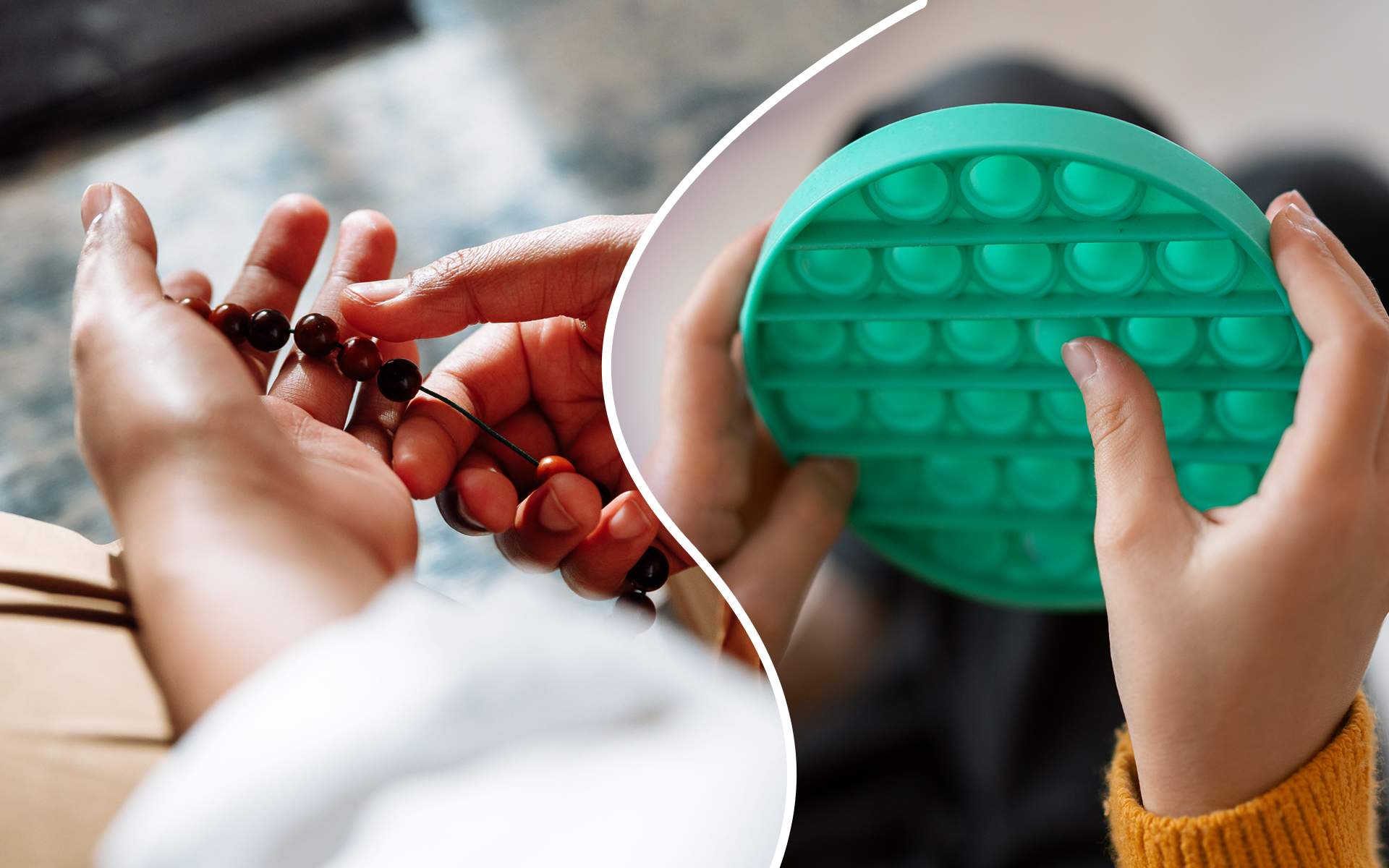
In 2005, I spent a semester in India on a Buddhist Studies program. For my independent study project, I researched the ritual circumambulation of Tibetan Buddhists, and spent three weeks observing practitioners walking clockwise around holy sites while muttering mantras and thereby improving their karma.
One interesting note was that almost no practitioner circumambulated empty handed. Whether they were turning a mala (the sanskrit word for meditation beads), or spinning a prayer wheel, almost everyone was keeping their hands occupied. The explicit point of such handiwork is to act as a karma amplifier—in this tradition, it’s understood that just as walking around a holy site provides beneficial karma, so does turning a sacred object clockwise while circumambulating.
But it is also indicative of the fact that, more than any other creature, humans like keeping their hands occupied.
Occupying one’s hands with something repetitive, whether it’s rotating a mala, knitting, or coloring, seems to provide a sensory anchor and act as a reliable antidote to racing thoughts.
A Brief History of “Busy Hands, Quiet Mind”
There is evidence of humans stringing beads over 120,000 years ago. Meditation beads first appeared in Hindu texts in the 8th century BCE. Prayer beads have also been used for centuries in both Christian and Islamic practices.
There is a reason the phrase “busy hands, quiet mind” is part of the lexicon. Occupying one’s hands with something repetitive, whether it’s rotating a mala, knitting, or coloring, seems to provide a sensory anchor and act as a reliable antidote to racing thoughts.
Recently I experienced this first hand (pun intended). At a faculty meeting, the school counselor was occupying his hands by cleaning some of the fidgets he gives out to middle schoolers, and he tossed me one. I played with it throughout a very dry presentation on benefits, and to my surprise, I was locked in. I’ve never considered myself someone with attentional issues, yet having an object with which to offload my excess energy helped my stay surprisingly present.
What strikes me about the fidget craze isn’t that we are selling out of squishy, kneadable toys, but that it took us so long to realize that the sensory anchors that adults have been using for millenia might also be useful for kids.
The experience reminded me of my own middle school days, when, much to the chagrin of our teachers, everyone tried to learn pencil tricks, twirling them and spinning them repetitively, resulting in the incessant clattering of writing utensils on tile floors. In those days, fidgets were not part of the attentional arsenal, so perhaps we were all simply improvising. Now fidgets are so popular there has even been a shortage of one popular brand.
What strikes me about the fidget craze isn’t that we are selling out of squishy, kneadable toys, but that it took us so long to realize that the sensory anchors that adults have been using for millenia might also be useful for kids.
Attentional Aids for Different Learners
The first fidget spinner was invented by Catherine Hettinger in 1993, but it didn’t attract much interest at the time. Then, in the spring of 2017, aided by social media, fidget spinners took off. Innovations followed, with sensory cubes, stress balls, and silicone popping toys helping the industry become a $9 billion dollar global behemoth.
Of course, much of the appeal of fidgets is that they are fun, colorful, cute, and collectible. Yet therapists, counselors, and educators also noticed how valuable these items could be for neurodiverse learners with autism, anxiety, and ADHD.
“The repetitive movement and sensory input is soothing for the nervous system as it discharges energy,” explained Dr. Corinne Buchanan, a licensed mental health counselor, mindfulness teacher, and instructor at the University of Florida. “In turn, this can help provide ‘noisy’ minds with enough sensory input to allow the brain to better focus on other stimuli, such as a less stimulating class lecture.”
These benefits have been confirmed by research. One study found that students with ADHD were able to stay on task better when using fidget spinners. Another study showed that allowing students to fidget boosted creativity.
There is a critical distinction professionals make in identifying fidgets as tools, not toys.
Help In Therapeutic Settings, As Well
Fidgets have also proved to be useful tools in clinical settings. Dr. Katharine Evarts, a licensed clinical psychologist and Director of Student Affairs at Antioch University, noted, “As therapists, it’s very important for us to have a number of examples of ‘grounding techniques’—such as tactile sensory experiences that draw one’s attention to the current moment—on hand whenever working with clients experiencing panic, anxiety attacks, trauma triggers, and even, frankly, intense emotions of any kind.”
Yet there is a critical distinction these professionals make in identifying fidgets as tools, not toys. As Josh Sussman, the counselor at my school (and the person who tossed me a fidget at our faculty meeting) wrote in a newsletter to our community on the subject, “The tool is supposed to help one’s eyes stay on the world in front of them and one’s brain to focus on the task at hand. If it starts to be used as a toy, it is time to revisit the purpose of the fidget and make adjustments to when it might be appropriate to use it.”
As these objects for settling the nervous system and grounding attention become more popular, they have normalized the idea that being seated and still is not always the most optimal way for students to learn or process emotions.
As these objects for settling the nervous system and grounding attention become more popular, they have normalized the idea that being seated and still is not always the most optimal way for students to learn or process emotions. By helping our bodies and minds be in the same place at the same time, they also helped bridge the gap between our external and internal worlds, a task mindfulness practitioners have been engaging in for a long time.
Alignment of Body and Mind
Thanks in part to Descartes, who gave primacy to our mental experience with his dictum, “I think, therefore I am,” we in the West have typically conceived of body and mind as separate.
Yet this distinction is one that is increasingly eroding as we understand more about the brain. It is also a distinction that does not occur as much in Eastern traditions, where mindfulness practice has had a lasting influence.
“Not all belief systems treat these realms as separate,” said Buchanan. “And in fact, as a somatic therapist, I would argue we have many examples of how our mental states impact our physical states and our physical states can impact our mental states in turn.”
For many mindfulness practitioners, beads act as a means of making this connection more apparent when it feels foggy. As a Zen practitioner, I have been taught to align the turning of my mala with the rising and falling of my breath to provide an anchor when discursive thoughts feel intractable.
Tuning into sensation is very different from the tuning out we might do when engaging with screens: Tactile engagement triggers the parasympathetic nervous system and leads to a physical calming, rather than dissociation.
Evarts described how this kind of tuning into sensation is very different from the tuning out we might do when engaging with screens: “Tactile engagement triggers the parasympathetic nervous system and leads to a physical calming, rather than dissociation. Rather than erasing the rest of ourselves in favor of immersion in a television show or fast-paced short video digestion, hands-on engagement facilitates a fuller embodiment of ourselves through mindfully focusing on all of our senses and the present moment.”
In an era in which dissociation is increasingly available, having a countermeasure to help align body and mind might be a meaningful arrow in the attentional quiver. Despite the flashy colors and whizzbang delights of modern fidgets, they are rooted in a tradition of sensory grounding implements that dates back millenia. Making them available as a tool isn’t a distraction but a way to combat the rampant tendency for distraction in a world full of it. The days of incessant pencil clattering might finally be over.
About The Author

Alex Tzelnic
Alex Tzelnic (he/him) is a Mindfulness Director and Physical Education teacher at Belmont Day School in Belmont, MA. Alex grew up in Concord, MA. As an avid athlete, he took an early interest in Zen practice, appreciating the way it stoked his curiosity by engaging both body and mind in asking the big questions. At Skidmore College he studied philosophy, religion, and Asian studies, spending a semester living in a Buddhist Monastery in India and deepening his study of mindfulness.
After college Alex pursued his passion for play by becoming a PE teacher. He also continued to explore his interest in practice by writing about mindfulness for publications like Tricycle Magazine. His thirst for insight and connection eventually led to an MA in Mindfulness Studies at Lesley University.

























.jpg&h=630&w=1200&q=100&v=c0f97a310e&c=1)