Meditation for Beginners: How to Start & What to Expect
Quick Answer Box To meditate as a complete beginner, sit comfortably with your spine upright, close your eyes, and focus […]
 Fransebas
Quick Answer Box
To meditate as a complete beginner, sit comfortably with your spine upright, close your eyes, and focus on the natural rhythm of your breath. When your mind wanders, gently return to the breath without judgment. Start with 5–10 minutes daily — that is a complete practice.
Most people think meditation is about emptying the mind.
It is not. And that single misunderstanding stops more beginners from ever starting than anything else.
Meditation for beginners is not about silence. It is not about achieving a blank mind, sitting cross-legged for an hour, or reaching some transcendent state. It is something far simpler — and far more accessible than most people realize.
Meditation is the practice of paying attention on purpose. You choose something to focus on (usually the breath), you notice when your mind has wandered, and you return. That is it. That wandering and returning — done again and again — is the actual training.
In this guide, you will learn everything you need to start a meditation practice today: what meditation actually is, what happens in the brain during meditation, how to sit, how to breathe, six beginner techniques explained in plain English, a complete 10-minute step-by-step practice, and honest answers to every question beginners ask.
You do not need an app. You do not need a cushion. You do not need prior experience.
You need five minutes and this guide.
What Is Meditation? (The Real Definition)
Meditation is the deliberate practice of training your attention.
That is the most accurate and useful definition for beginners. Not relaxation (though that often happens). Not spirituality (though it can include that). Not emptying the mind (which is neurologically impossible while awake).
At its core, meditation is an exercise for the mind — just as yoga is an exercise for the body. You choose a focus (breath, sound, sensation, mantra, visualization), you hold your attention on it, you notice when it drifts, and you return. Every return is a mental repetition — a rep in the gym of the mind.
Over time, this practice changes the brain measurably. It builds the neural pathways associated with focus, emotional regulation, compassion, and calm. This is not metaphor. It is neuroscience.
What Happens in Your Brain During Meditation
Understanding the neuroscience of meditation helps beginners commit to the practice — because it answers the question every beginner asks: “Is this actually doing anything?”
The Default Mode Network (DMN)
The Default Mode Network is the part of the brain that activates when you are not focused on a task — when you are daydreaming, ruminating, replaying past events, or worrying about the future. Research from Harvard Medical School shows that overactivity in the DMN is directly associated with anxiety, depression, and chronic mental restlessness.
Meditation consistently reduces DMN activity. When you focus on the breath, you are literally quieting the neural network responsible for mental noise.
Neuroplasticity and Gray Matter
A landmark study by Sara Lazar at Harvard found that experienced meditators had measurably greater cortical thickness in brain regions associated with attention, interoception, and sensory processing. The insula and prefrontal cortex — two regions central to emotional regulation and self-awareness — showed significant structural differences compared to non-meditators.
The Amygdala and Stress Response
The amygdala is the brain’s threat-detection center. Research published in Social Cognitive and Affective Neuroscience found that an 8-week mindfulness meditation program produced measurable reductions in amygdala density, directly reducing the intensity of the stress response.
What this means for beginners: Even 10 minutes of daily meditation produces measurable changes in brain activity within 8 weeks. You are not just relaxing. You are literally rewiring your brain. (Read the research)
The 5 Core Benefits of Meditation (With Evidence)
1. Reduces Stress and Cortisol Levels
Direct answer: Meditation activates the parasympathetic nervous system (the rest and digest response), directly counteracting the fight-or-flight stress response. Multiple clinical studies confirm that regular meditation practice reduces cortisol — the primary stress hormone — by measurable amounts.
This is why people who meditate consistently report that the same situations that previously triggered strong stress responses begin to feel more manageable. The threshold shifts — not because life gets easier, but because the nervous system becomes more regulated.
2. Improves Focus and Sustained Attention
Direct answer: Meditation is literally attention training. A 2010 study at the University of California Santa Barbara found that just two weeks of mindfulness meditation training significantly improved GRE reading comprehension scores and working memory capacity in undergraduate students.
For beginners, this shows up as: longer concentration spans, less susceptibility to distraction, and a greater ability to return focus to the task at hand after interruption.
3. Reduces Symptoms of Anxiety and Depression
Direct answer: A meta-analysis published in JAMA Internal Medicine reviewed 47 randomized clinical trials involving 3,515 participants and found that mindfulness meditation programs showed moderate evidence of improving anxiety, depression, and pain.
This does not mean meditation replaces medical or therapeutic treatment. It means it is a clinically supported complementary practice that works through measurable neurological mechanisms.
4. Improves Sleep Quality
Direct answer: Meditation reduces the hyperarousal of the nervous system — the activated, alert state — that prevents sleep onset. A 2015 study published in JAMA Internal Medicine found that mindfulness meditation significantly improved sleep quality in older adults with moderate sleep disturbances compared to a control group.
For beginners with insomnia or restless sleep, a 10-minute body scan meditation before bed is one of the most effective non-pharmacological interventions available.
5. Deepens Your Yoga Practice
Direct answer: Meditation and yoga are not separate practices — they are two aspects of the same system. In Patanjali’s Yoga Sutras, physical postures (asana) are described as preparation for meditation. The goal of asana practice is to create a body stable and comfortable enough to sit in stillness.
Beginners who add meditation to their yoga practice consistently report deeper body awareness, better breath control in poses, and a more genuine experience of the mental dimension of yoga.
How to Sit for Meditation: Posture Guide for Beginners
The single most important rule of meditation posture: Your spine must be upright but not rigid.
An upright spine keeps you alert. A collapsed spine leads to drowsiness. Rigidity creates tension that competes with stillness. The target is dignified ease — alert and relaxed simultaneously.
4 Sitting Options for Beginners
Option 1 — Chair Sitting (Recommended for most beginners) Sit toward the front edge of a firm chair. Feet flat on the floor, hip-width apart. Spine tall, not leaning against the chair back. Hands resting on thighs, palms down or up. Best for: Beginners with tight hips, knee issues, or anyone who finds floor sitting uncomfortable.
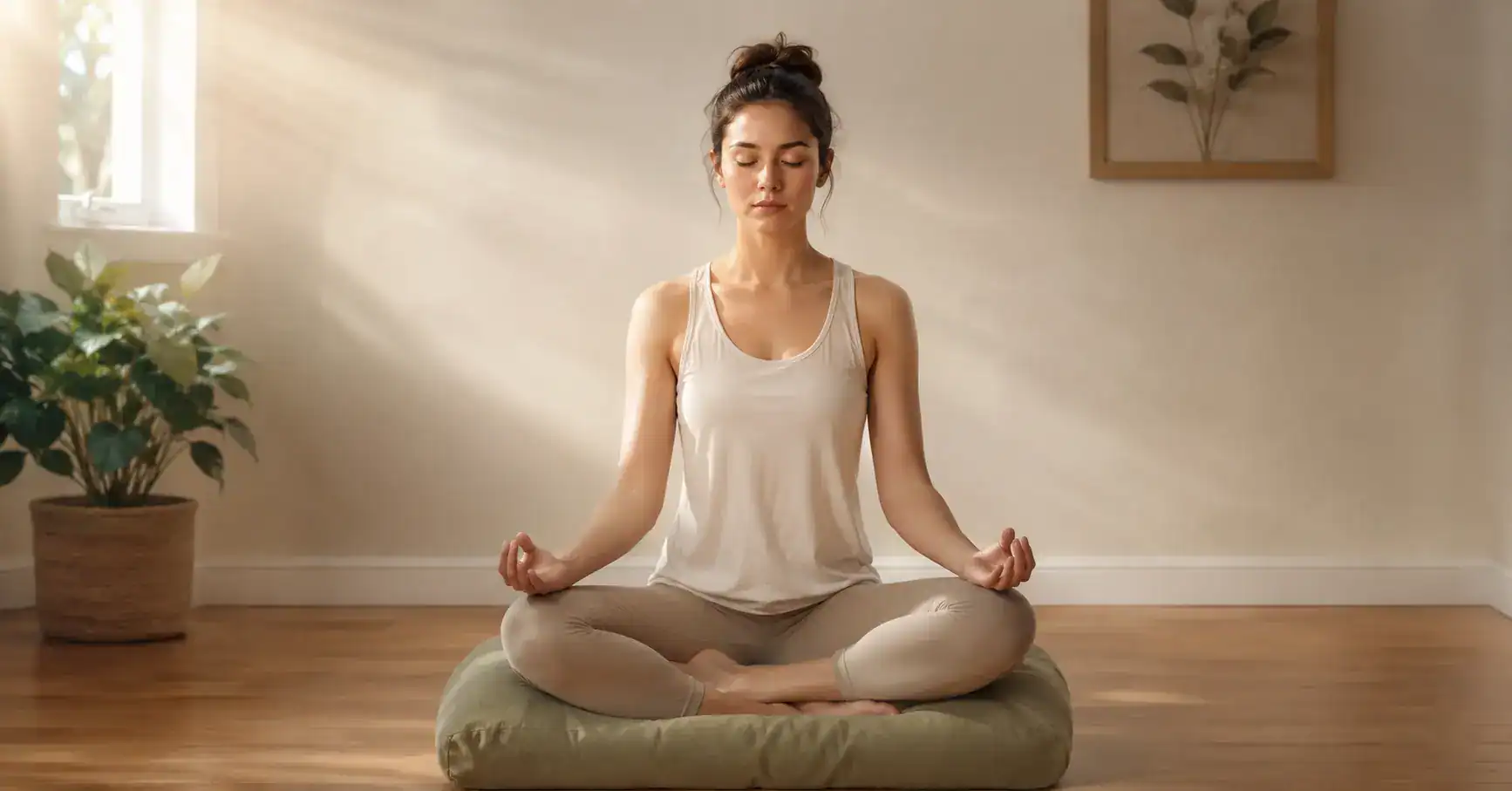
Option 2 — Cross-Legged on the Floor (Easy Pose / Sukhasana) Sit on a folded blanket or meditation cushion — this raises the hips above the knees, which protects the lower back. Cross your legs loosely in front. Hands on knees. Best for: Beginners with reasonable hip flexibility. Always use a cushion or blanket.
Option 3 — Kneeling (Seiza or Vajrasana) Kneel with a folded blanket or yoga block between your thighs and calves. Sit back onto the support. Spine tall. Hands on thighs. Best for: Beginners who find cross-legged sitting uncomfortable but prefer not to use a chair.
Option 4 — Lying Down (Savasana) Lie flat on your back, arms slightly away from the body, palms up. Most comfortable — and most prone to sleep. Recommended only for body scan meditation or if injury prevents sitting.
Hand Position (Mudra)
Chin Mudra: Index finger and thumb touch lightly. Other three fingers extended. Palms face up on knees. Classic, open, receptive. Resting hands: Simply rest both hands on your thighs — palms down for grounding, palms up for openness.Eyes: Open or Closed?
Closed eyes are easier for beginners — fewer external distractions. Recommended starting point.
Soft downward gaze (eyes 80% closed, gazing at the floor 3 feet ahead) prevents drowsiness. Used in Zen and Vipassana traditions.
Experiment with both. There is no universally correct answer.
The 6 Best Meditation Techniques for Beginners
Each technique below answers the beginner’s most common question: “But what do I actually DO?”
Technique 1 — Breath Awareness Meditation
What it is: The most fundamental and widely practiced form of meditation. You focus your entire attention on the physical sensation of breathing — the air entering the nostrils, the rise and fall of the chest or belly, the brief pause between inhale and exhale.
What you actually do: Sit comfortably. Close your eyes. Breathe naturally — do not try to control the breath. Simply observe it. Notice the inhale. Notice the exhale. When your mind wanders, gently return your attention to the breath. Repeat this for your entire session.
Why it works for beginners: The breath is always present, always available, and always in the present moment. Focusing on it immediately anchors the mind to now.
Best for: All beginners. The starting point for almost every meditation tradition in the world. Duration: Start with 5 minutes. Build to 10-20 minutes over your first month.
Technique 2 — Body Scan Meditation
What it is: A systematic practice of moving your attention through different parts of the body — from head to feet or feet to head — noticing sensations without trying to change them.
What you actually do: Lie down or sit comfortably. Start at the top of your head. Notice any sensations there — warmth, pressure, tingling, or nothing at all. Move your attention slowly downward: forehead, eyes, jaw, neck, shoulders, chest, arms, hands, belly, lower back, hips, thighs, knees, calves, feet, toes. Spend 20-30 seconds in each area.
Why it works for beginners: The body scan gives the wandering mind a specific, systematic task — which makes it easier to stay present than open-ended breath awareness. It also develops interoceptive awareness (the ability to feel internal body states).
Best for: Beginners who find pure breath awareness frustrating. Excellent as a sleep meditation. Duration: 10-20 minutes.
Technique 3 — Counting Breath Meditation
What it is: A structured variation of breath awareness that uses counting to anchor attention more firmly.
What you actually do: Breathe naturally. On each exhale, count silently: exhale “one,” exhale “two,” up to ten. Then start again from one. If you lose count or find yourself at eleven, simply return to one without judgment.
Why it works for beginners: Counting gives the analytical mind something specific to hold onto. Many beginners find pure breath awareness too open — the mind interprets “just watch the breath” as permission to think.
Best for: Beginners who are analytical or find their minds particularly active and resistant to stillness. Duration: 5-15 minutes.
Technique 4 — Mantra Meditation (Japa)
What it is: The practice of silently (or aloud) repeating a word, phrase, or Sanskrit mantra as the object of focus. The mantra replaces the breath as the anchor of attention.
What you actually do: Choose your mantra. Sit comfortably. Begin repeating the mantra silently — in rhythm with the breath or independently. When the mind wanders, return to the mantra.
Beginner-friendly mantras:
“So Hum” — Sanskrit for “I am that.” Inhale “So,” exhale “Hum.” One of the most widely taught beginner mantras. “Om” — The universal seed syllable. Chant aloud 3-9 times, then repeat silently. “Peace” — Inhale “peace,” exhale “peace.” Simple, secular, effective. “I am here” — A grounding affirmation mantra for anxious minds. “YAM” — The seed mantra for the heart chakra (Anahata). Excellent when combined with heart chakra yoga.Why it works for beginners: The mantra gives the thinking mind something to do, preventing random thought generation. The rhythm also activates the parasympathetic nervous system through breath regulation.
Best for: Beginners who find silence uncomfortable, those drawn to the spiritual dimension of yoga, anyone practicing heart chakra yoga alongside meditation. Duration: 10-20 minutes.
Technique 5 — Loving-Kindness Meditation (Metta)
What it is: A heart-centered practice from the Theravada Buddhist tradition in which you deliberately cultivate feelings of warmth, goodwill, and compassion — directing them toward yourself, loved ones, neutral people, difficult people, and all beings.
What you actually do: Sit comfortably. Bring to mind someone you love easily — a child, a pet, a close friend. Feel the warmth in your chest. Silently repeat: “May you be happy. May you be healthy. May you be safe. May you live with ease.” After several minutes, direct the same phrases toward yourself, then to a stranger, then to someone you find difficult, then to all beings everywhere.
Why it works for beginners: Loving-kindness meditation directly targets the heart chakra and the neural circuitry of compassion. Research from the University of North Carolina found that seven weeks of loving-kindness meditation increased positive emotions, sense of purpose, and social connection.
Best for: Beginners dealing with grief, relationship difficulties, self-criticism, or anyone practicing heart chakra yoga. Duration: 10-20 minutes.
Technique 6 — Guided Visualization Meditation
What it is: A meditation in which you follow a spoken or imagined visual journey — a peaceful place, a healing light, a nature scene — using the imagination as the object of focus.
What you actually do: Close your eyes. Imagine a place where you feel completely safe and at peace — a forest, a beach, a mountain top. Engage all your senses: what do you see, hear, smell? What does the air feel like on your skin? Stay in this place for your entire session, returning whenever the mind wanders.
Why it works for beginners: Visualization gives highly visual or creative minds something concrete to engage with. It is also deeply effective for anxiety because the nervous system responds to vividly imagined peaceful scenes almost identically to real ones.
Best for: Visual thinkers, beginners with high anxiety, those who struggle with the abstractness of breath-only practices. Duration: 10-20 minutes.
Step-by-Step: Your First 10-Minute Meditation Practice
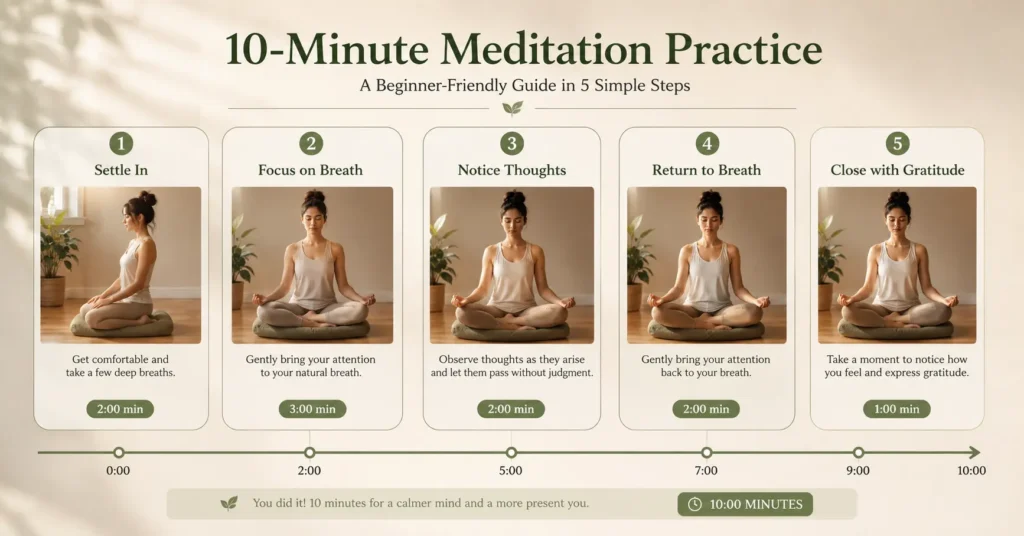
This is a complete, standalone meditation practice. Use it exactly as written for your first two weeks. It uses Breath Awareness as the primary technique.
What you need: A quiet space. A timer set for 10 minutes. A comfortable place to sit.
Step 1 — Settle (1 minute) Find your seat. Sit toward the edge of a chair or on a cushion on the floor. Feel both sitting bones making contact with your seat. Lengthen your spine gently — as if a thread is pulling the crown of your head toward the ceiling. Roll your shoulders back and down. Rest your hands on your thighs. Close your eyes.
Take three deep, deliberate breaths — inhale fully through the nose, exhale completely through the nose. Let the third exhale be a conscious release of the day, the to-do list, the noise. You are here now.
Step 2 — Establish Natural Breath (1 minute) Allow the breath to return to its natural rhythm — do not force it to be deep or slow. Simply observe. Notice the temperature of the air as it enters your nostrils. Notice the slight pause at the top of the inhale. Notice the release of the exhale. Notice the brief stillness at the bottom before the next breath begins.
You are not controlling the breath. You are watching it — as if you were watching a tide move in and out.
Step 3 — Anchor Your Attention (5 minutes) Choose one aspect of the breath to anchor your attention:
The sensation of air at the nostrils The rise and fall of your chest The expansion and contraction of your bellyWhichever you choose, stay with it for the rest of the practice.
Your mind will wander. This is not failure. This is the practice beginning. The moment you notice you have drifted: that noticing is the practice. Gently, without any self-criticism whatsoever, return your attention to the breath. No commentary. No judgment. Simply return.
Repeat this cycle of drift and return for 5 full minutes. Every return to the breath is a successful repetition.
Step 4 — Expand Awareness (2 minutes) In the last two minutes, widen your awareness beyond the breath. Notice the sounds in the room without naming or judging them — just sound. Notice any sensations in your body — temperature, weight, contact points with the seat. You are practicing open awareness — a broader, softer form of attention that holds everything without grabbing onto any of it.
Step 5 — Close with Intention (1 minute) Let your breath return to its natural depth. Before you open your eyes, set a simple intention: “I will pause and breathe before reacting today.” Gently open your eyes. Sit for another 30 seconds before standing.
That is your complete 10-minute beginner meditation practice.
The Most Common Beginner Question: “Is My Mind Too Busy to Meditate?”
Direct answer: No. A busy mind is not a barrier to meditation — it is the reason for it.
Every beginner believes their mind is unusually busy. They sit down, observe their thoughts for 60 seconds, and conclude that meditation “isn’t working” because their mind won’t stop.
Here is the reframe that changes everything: a mind that generates thoughts is a functioning mind. The Buddha called this “monkey mind” — the untrained mind that swings from thought to thought like a monkey swings from branch to branch. Every human has it. Every experienced meditator started with it.
The practice is not to stop the monkey from moving. It is to notice when it has moved — and to gently return it to the anchor. Over time, the swings become less frequent, less dramatic, and shorter in duration.
How many times the mind wanders in a 10-minute session:
Week 1: 50-100+ times. Completely normal. Month 1: 20-50 times. Significant improvement. Month 3: 5-20 times. The practice is maturing. Year 1+: Still wanders — but returns faster, with less friction.The number of times your mind wanders is irrelevant. What matters is how quickly you notice, and how gently you return.
How Long Should Beginners Meditate Each Day?
Direct answer: Start with 5 minutes. Build to 10. Stay at 10-20 minutes for your first three months.
| Week 1-2 | 5 minutes | 5-7 days | Build the habit — consistency over length |
| Week 3-4 | 10 minutes | 5-7 days | Develop the drift-and-return rhythm |
| Month 2 | 10-15 minutes | Daily | Deepen focus and reduce mind-wandering |
| Month 3 | 15-20 minutes | Daily | Experience genuine stillness |
| Month 4+ | 20-30 minutes | Daily | Mature practice with noticeable life effects |
The most important variable is not duration — it is consistency.
5 minutes every single day produces better results than 30 minutes three times a week. The brain learns meditation through repetition of the habit loop (sit, focus, wander, return, repeat) — and that loop is trained through frequency, not length.
When Is the Best Time to Meditate?
Direct answer: The best time to meditate is the time you will actually do it consistently. For most people, this is morning.
Morning Meditation (Recommended for Beginners)
Meditating first thing in the morning — before checking your phone, before reading news, before conversations begin — gives you access to a mind that has not yet been filled with the day’s inputs. It also ensures that meditation happens before the day’s demands crowd it out.
Morning meditation ritual suggestion:
Wake up naturally or with a gentle alarm Do not check your phone Drink a glass of water Sit for your meditation session (5-20 minutes) Optional: follow with your yoga practiceEvening Meditation
Evening meditation — 20-30 minutes before bed — is especially effective for sleep. The body scan technique is particularly powerful in the evening because it systematically releases the physical tension accumulated during the day.
The One Rule
Whatever time you choose: same time, same place, every day. Consistency of environment and timing is the single biggest predictor of habit formation in meditation practice.
How Meditation and Yoga Work Together
Meditation and yoga are not two separate practices. They are two aspects of the same path.
In Patanjali’s Yoga Sutras — the definitive classical text of yoga philosophy — the eight limbs of yoga describe a complete system for human flourishing. Physical postures (asana) are the third limb. Pranayama is the fourth. Withdrawal of the senses (pratyahara) is the fifth. Concentration (dharana) is the sixth. Meditation (dhyana) is the seventh.
This means asana practice is literally described in classical yoga as preparation for meditation. The body is made strong, flexible, and comfortable specifically so it can sit still in meditation.
Practical integration for beginners:
Before your yoga practice: 3-5 minutes of breath awareness meditation. Sets the intention, activates the breath-body connection, and brings you fully present before movement begins.
After your yoga practice: 5-10 minutes of seated meditation or body scan. The body is warm and the mind is already more settled than at the start of the day. This is often when beginners experience their deepest meditation.
On rest days from yoga: Meditation maintains the mind-body connection and continues the neurological benefits even when the body is resting.
Discover how heart chakra yoga and meditation work together: All You Need To Know About Heart Chakra Yoga
7 Common Beginner Meditation Mistakes (And Exactly How to Fix Them)
Mistake 1 — Expecting the Mind to Go Quiet What beginners think: “I’m doing it wrong — my mind won’t stop.” The truth: A quiet mind is a byproduct of consistent practice over months. It is not the goal of any single session. Fix: Reframe success. A successful meditation is one where you notice when the mind wanders and return to the anchor.
Mistake 2 — Sitting for Too Long Too Soon What beginners do: Start with 30-minute sessions inspired by articles about advanced practitioners. The problem: An untrained mind in a 30-minute session spends 25 of those minutes in pure thought, feels frustrated, and concludes meditation doesn’t work. Fix: Start with 5 minutes. Build by 2 minutes per week.
Mistake 3 — Controlling the Breath Instead of Observing It What beginners do: They try to breathe “correctly” — deeply, slowly, perfectly — and end up thinking about breathing rather than observing it. Fix: Let the breath breathe itself. Your job is observer, not controller.
Mistake 4 — Judging the Quality of the Session What beginners do: They rate each meditation as good (few thoughts) or bad (many thoughts). The truth: Both clear sessions and stormy sessions are equally valid practice. Fix: Drop the rating system entirely. The only measure: did you sit?
Mistake 5 — Meditating in an Uncomfortable Position What beginners do: Force a full lotus position because it “looks like meditation,” then spend the session distracted by physical pain. Fix: Use a chair. Physical comfort is not indulgence — it is a prerequisite for mental stillness.
Mistake 6 — Practicing Inconsistently What beginners do: Meditate for several days, miss a few, meditate again — never building the neural pathway that comes from daily repetition. Fix: Link meditation to an existing daily habit (making coffee, brushing teeth). Habit researchers call this “habit stacking.”
Mistake 7 — Stopping After One Difficult Session What beginners do: Have one session where the mind feels completely unmanageable, conclude they “can’t meditate,” and stop. The truth: Difficult sessions are often signs that meditation is working — surfacing mental activity that normally runs unnoticed. Fix: Commit to one month before evaluating. Week three is where something shifts.
Meditation for Specific Beginner Needs
Meditation for Stress and Anxiety
Best technique: Breath Awareness or 4-7-8 Breathing (inhale 4 counts, hold 7, exhale 8). The extended exhale activates the vagus nerve and the parasympathetic response directly.
Direct answer: Anxiety lives in the future. Meditation trains the mind to return to the present moment — where anxiety, by definition, cannot exist. The breath is always happening now. Every return to the breath is a return from anxiety’s territory to the present moment.
Meditation for Better Sleep
Best technique: Body Scan Meditation, practiced lying down, 10-20 minutes before sleep.
Direct answer: Insomnia is almost always caused or worsened by mental hyperarousal — an activated, thinking mind that cannot switch off. Body scan meditation systematically releases physical tension and shifts the nervous system from sympathetic (alert) to parasympathetic (rest) activation.
Meditation for Focus and Productivity
Best technique: Counting Breath Meditation, practiced in the morning, 10 minutes before beginning work.
Direct answer: Focus is a muscle. Meditation is its training. Every time you notice the mind has wandered and return it to the breath, you are performing one repetition of the focus muscle. After 8 weeks of daily practice, this muscle noticeably strengthens in everyday tasks.
Meditation to Deepen Yoga Practice
Best technique: Breath Awareness before yoga + Body Scan or Loving-Kindness after yoga.
Direct answer: Yoga postures prepare the body for meditation. Meditation deepens the internal awareness that makes yoga more than physical exercise. Practiced together, they form a complete system.
A 30-Day Beginner Meditation Plan
| 1-7 | Breath Awareness | 5 min | Learn to sit. Observe without controlling. |
| 8-14 | Breath Awareness | 10 min | Develop the drift-and-return rhythm |
| 15-21 | Body Scan | 10-15 min | Develop interoceptive awareness |
| 22-28 | Counting Breath | 10 min | Strengthen sustained attention |
| Day 29 | Loving-Kindness | 10-15 min | Open the heart dimension of practice |
| Day 30 | Free choice | 10-20 min | Practice from your own inner guidance |
After 30 days, you will have direct experience of four different meditation techniques, a stable daily habit, and enough self-knowledge to choose the direction of your continuing practice.
What to Expect After 30 Days of Daily Meditation
Cognitive changes:
Longer attention spans and faster return to focus after distraction Reduced mental chatter during non-meditation hours More space between stimulus and response — less reactivityEmotional changes:
Reduced baseline anxiety and irritability Greater emotional regulation Increased compassion for others and for yourselfPhysical changes:
Improved sleep onset and quality Lower resting heart rate in many practitioners Reduced muscle tension in jaw, neck, and shouldersIn your yoga practice:
More present and less distracted during poses Deeper awareness of breath in movement Greater ease in SavasanaPrecautions and When to Seek Support
Meditation is safe for the vast majority of people. However:
If you have trauma history: Some techniques can activate trauma memories in people with PTSD. If distress occurs, open your eyes, look around the room, and ground yourself externally. Consider working with a trauma-informed meditation teacher.
If you experience depersonalization or dissociation: Rarely, intensive meditation can trigger dissociative states. If you experience feelings of unreality during practice, stop and consult a mental health professional.
If you have severe depression: Meditation is a clinically supported complementary practice for mild to moderate depression. For severe depression, always practice under the guidance of a mental health professional.
For the vast majority of beginners practicing 5-20 minutes daily, these precautions are not relevant — but acknowledging them is part of honest, responsible guidance.
Conclusion
Five minutes from now, you could be meditating.
Not perfectly. Not with a blank mind. Not in lotus position. Just sitting — spine upright, eyes closed, attention resting on the breath, gently returning every time it wanders.
That is meditation for beginners. That is meditation for everyone.
The practice does not ask you to be different from who you are right now. It does not ask for a quiet mind, a spiritual background, or even a yoga mat. It asks only that you sit — and that you return. Again and again and again. That returning, practiced every day, is how the mind trains itself. It is how the nervous system heals. It is how the space between stimulus and response — the space where wisdom lives — grows wider.
You have been breathing your entire life. Meditation simply asks you to notice.
Start today. Five minutes. One breath at a time.
Begin your meditation journey with TheShivYoga.com — guided practices, yoga classes, and everything you need to build a complete mind-body practice from the ground up.
FAQ Section
Q1: How do I know if I am meditating correctly?
You are meditating correctly if you are sitting with your spine upright, focusing on your chosen anchor (breath, mantra, body), noticing when your mind wanders, and returning without judgment. That is the complete practice. If you are doing those four things — even imperfectly — you are meditating correctly.
Q2: What should I think about when meditating?
Nothing deliberately. The practice is to focus on the anchor (breath, mantra, body scan) rather than thinking. When thoughts arise — and they will — you simply notice them and return to the anchor. You are not suppressing thoughts. You are choosing not to follow them. The difference is everything.
Q3: Is it normal for my mind to wander constantly during meditation?
Completely normal. Every beginner experiences this. The untrained mind generates thoughts automatically and continuously. Meditation does not stop this immediately. Over weeks and months, the mind wanders less frequently and returns more easily. The wandering is not failure — noticing the wandering and returning is the entire practice.
Q4: Can I meditate lying down?
Yes, but with one important caveat: lying down significantly increases the likelihood of falling asleep, especially for tired beginners. If you are meditating specifically for sleep (body scan before bed), lying down is perfect. For all other meditation purposes, sitting upright keeps the mind in the alert-but-calm state that meditation cultivates.
Q5: How quickly will I see results from meditation?
Most beginners notice reduced stress reactivity and improved sleep within the first 2 weeks of daily practice (even just 5-10 minutes per day). Measurable improvements in focus typically appear within 4-8 weeks. The neurological changes confirmed by Harvard and NCBI research — structural changes in brain regions associated with attention and emotional regulation — develop over 8 weeks to several months of consistent daily practice.
Key Takeaways
After 30 days: measurably reduced stress, improved sleep, longer attention spans, and a noticeably different quality of presence in daily life.
Meditation is not about emptying the mind. It is the practice of noticing when the mind has wandered and returning to the anchor. That cycle of drift and return IS the training.
The neuroscience is real. Regular meditation reduces DMN activity, shrinks amygdala density, and builds cortical thickness in regions associated with attention and emotional regulation — within 8 weeks of daily practice.
Start with 5 minutes daily. Consistency beats duration. 5 minutes every day outperforms 30 minutes three times a week.
Six techniques for beginners: Breath Awareness, Body Scan, Counting Breath, Mantra, Loving-Kindness, and Guided Visualization. Each serves a different mind type and purpose.
The 10-minute practice (Settle, Natural Breath, Anchor, Expand, Intention) is a complete standalone beginner session. Use it daily for your first two weeks.
Meditation and yoga are one system. Asana prepares the body to sit still. Meditation deepens what yoga opens.
The biggest beginner mistake is expecting silence and judging sessions by how few thoughts arose. Every session where you sat down is a successful session.
Disclaimer: This article is for informational and educational purposes only. It does not constitute medical or psychological advice. If you are experiencing anxiety, depression, trauma, or any mental health condition, please consult a qualified healthcare provider or therapist. Meditation is a complementary practice — a support to professional care, not a replacement for it.
























.jpg&h=630&w=1200&q=100&v=c0f97a310e&c=1)