Muladhara Chakra (Root Chakra): Complete Balancing Guide
QUICK ANSWER The Muladhara chakra (root chakra) is the foundational energy center located at the base of the spine, governing […]
 JaneWalter

QUICK ANSWER
The Muladhara chakra (root chakra) is the foundational energy center located at the base of the spine, governing feelings of safety, stability, and belonging. Associated with the earth element and the color red, Muladhara is Sanskrit for “root support.” When balanced, it creates a sense of security and groundedness. When blocked, it manifests as fear, anxiety, and financial instability. Balancing occurs through grounding yoga poses, earth element meditation, and root chakra mantras.
You know the feeling: your mind is racing, your body feels jittery and unsteady, and no amount of deep breathing seems to help. You’re ungrounded.
In the chakra system of yoga philosophy, this state has a name and a location—and most importantly, a solution. The Muladhara chakra (also called the root chakra) is the energetic foundation upon which your entire system rests. When it is weak, unstable, or blocked, everything else becomes difficult. When it is strong, stable, and flowing, everything else becomes possible.
The root chakra is your body’s biological and energetic anchor to the earth. It is the source of your sense of safety, your resilience in the face of difficulty, your capacity to trust that you will be taken care of, and your ability to take action in the world from a place of groundedness rather than fear.
In the modern world—characterized by constant digital stimulation, financial uncertainty, social fragmentation, and the loss of direct connection to the earth—root chakra imbalance has become epidemic. Anxiety disorders, insomnia, chronic tension, financial struggle, relationship instability, and the vague sense of never being quite safe even when objectively nothing is wrong—these are all signatures of root chakra dysfunction.
This comprehensive guide walks through exactly what the Muladhara chakra is, where it is located, why it matters, what happens when it becomes blocked or overactive, and most importantly—specific, practical techniques to ground, balance, and activate this foundational energy center.
Whether you are new to the chakra system or have been working with chakra energy for years, understanding and balancing your Muladhara chakra will transform your sense of safety, stability, and capacity to move through the world with genuine confidence.
Ready to ground your energy and build the foundation for everything else in your life? Let’s begin.
WHAT IS MULADHARA CHAKRA? THE ROOT OF YOUR EXISTENCE
The word Muladhara comes from Sanskrit roots: Mula (मूल) meaning “root” and Adhara (आधार) meaning “support” or “foundation.” Together, Muladhara means “root support”—the energetic foundation upon which the entire chakra system (and the entire person) stands.
In yoga and Tantra philosophy, Muladhara is the first of the seven chakras, the foundational energy center from which all other chakras arise. Just as a tree cannot grow strong without deep, healthy roots, a person cannot develop psychological stability, emotional resilience, or spiritual growth without a balanced and flowing root chakra.
The Chakra System Context
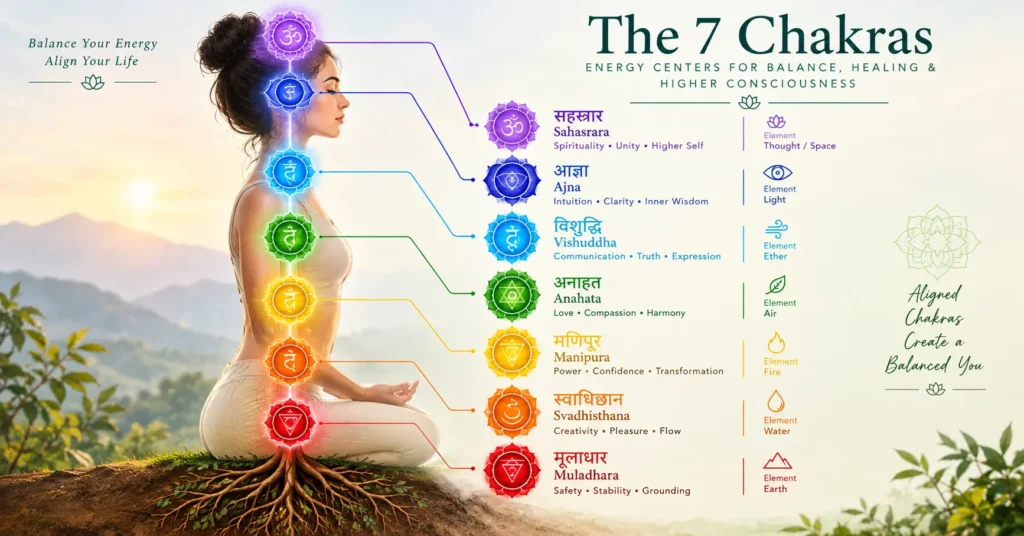
The seven chakras are energy centers distributed along the spine, each corresponding to specific psychological, emotional, and spiritual dimensions of human experience:
| Muladhara (Root) | Base of spine | Earth | Safety, stability, survival |
| Svadhisthana (Sacral) | Lower abdomen | Water | Creativity, pleasure, sexuality |
| Manipura (Solar Plexus) | Upper abdomen | Fire | Power, willpower, personal authority |
| Anahata (Heart) | Center of chest | Air | Love, compassion, connection |
| Vishuddha (Throat) | Throat | Ether | Communication, truth, expression |
| Ajna (Third Eye) | Between eyebrows | Light | Intuition, insight, inner vision |
| Sahasrara (Crown) | Top of head | Cosmic | Enlightenment, unity consciousness |
Muladhara is the foundation. Without a stable root, the entire structure becomes precarious.
Scientific Perspective vs. Traditional Philosophy
Important clarification: The chakra system is not validated by conventional science. It is a map of human experience developed within yoga and Tantric philosophy over thousands of years. While the anatomy of chakras is not physically measurable by modern instruments, the psychological and physiological effects of chakra-balancing practices are real and measurable—through changes in nervous system activation, stress hormone levels, breathing patterns, and subjective reports of wellbeing.
This guide presents the chakra system as a useful framework for understanding and working with human consciousness, not as literal anatomical structures. Many practitioners find this framework genuinely transformative regardless of its scientific status.
MULADHARA LOCATION: WHERE THE ROOT CHAKRA SITS
The Muladhara chakra is located at the base of the spine, between the anus and the genitals. More specifically:
In the body: At the level of the sacrum (the fused vertebrae at the base of the spine) In the spine: At the exit point of the Kundalini (the dormant spiritual energy that lies at the base of the spinal column in yoga philosophy) Energetically: It is considered the “grounding” center—the point at which the human energy system connects to the earthFrom this root location, energy flows upward through all six remaining chakras. This is why a weak root is like trying to build a house on an unstable foundation—everything above it is compromised.
The Location Matters: Grounding Energy
The fact that Muladhara is located at the base of the spine (literally at your base, your lowest point) is not accidental. The root chakra is about downward-moving energy—energy that roots you into the earth, that grounds you, that connects you to stability and support.
In yoga philosophy, there are two primary energy flows:
Apana Vayu (downward-moving energy) — associated with grounding, elimination, foundation Prana (upward-moving energy) — associated with vitality, expansion, growthMuladhara works primarily with Apana Vayu. Its purpose is not to make you light, expansive, or transcendent—it is to make you stable, rooted, and secure in your physical form and place in the world.
MULADHARA SYMBOL, COLOR & ELEMENT
Each chakra has traditional associations that help practitioners understand and work with its energy:
Color: Red
The color red is associated with Muladhara. Red represents:
Grounding and stability (the color of earth) Vital force and life energy Physical vitality and health Action and will Safety and protectionWhen visualizing or meditating on the root chakra, red is the color traditionally used.
Symbol: Four-Petaled Lotus
Muladhara is traditionally depicted as a four-petaled lotus flower. The four petals represent:
Physical existence and the material world The four directions (north, south, east, west) The four dimensions of human existence: physical, mental, intellectual, and blissful Stability through cardinal direction and groundingInside the lotus is a downward-pointing triangle, representing the descent of energy toward the earth—the downward movement that creates grounding.
Element: Earth
The earth element is associated with Muladhara. Earth represents:
Solidity and stability Physical form and materiality Nourishment and support Connection to the physical world The sense of smell (the sensory element associated with earth)Important distinction: While Muladhara is often called the “root” chakra, and roots go into the earth, Muladhara is not about burying yourself in materiality. Rather, it is about honoring and grounding your physical form—your body, your basic needs, your safe place in the world.
EIGHT BENEFITS OF A BALANCED MULADHARA CHAKRA
A balanced, flowing Muladhara chakra creates a foundation of genuine wellbeing. Here are the primary benefits:
1. Unshakeable Sense of Safety and Security
When your root chakra is balanced, you possess a deep biological confidence that you are safe—not because nothing bad can happen in the world, but because you trust your capacity to handle what comes. This is distinct from the anxious vigilance of a blocked root chakra, which constantly scans for danger even when safety is objectively present.
2. Grounding and Presence in the Physical Body
A balanced Muladhara helps you feel genuinely at home in your body. You are not dissociated from physical sensation; you are present and embodied. This is the foundation for all physical health, sexual satisfaction, and genuine embodied living.
3. Financial Stability and the Ability to Provide for Yourself
The root chakra governs your relationship with physical survival—including money. A balanced root chakra creates the psychological foundation for financial responsibility, the willingness to earn money through work, and the confidence that your basic needs will be met. Many people with root chakra imbalance struggle with financial instability not because of external circumstance, but because the internal foundation is missing.
4. Emotional Stability and Resilience
Without a stable foundation, emotions become overwhelming and destabilizing. A balanced Muladhara creates the stability that allows emotions to arise and pass without destabilizing your entire being. You become “emotionally resilient”—able to feel what you feel without being thrown off center.
5. Freedom from Chronic Anxiety and Fear
One of the most direct benefits of root chakra balancing is a reduction in generalized anxiety and free-floating fear. When Muladhara flows properly, the body’s threat-detection system recalibrates. You still feel appropriate fear in genuinely dangerous situations, but the chronic hypervigilance diminishes.
6. Stronger Immune Function
In traditional Chinese medicine and Ayurveda, health is understood to begin with a strong foundation. Modern research confirms that chronic stress from feeling unsafe (which reflects root chakra imbalance) suppresses immune function. A balanced Muladhara creates the physiological conditions for a stronger immune response.
7. Better Sleep Quality
Root chakra imbalance manifests as difficulty falling asleep and staying asleep—the body is unable to relax because it doesn’t feel safe enough to let the sleep state arrive. As Muladhara balances, sleep naturally improves.
8. Genuine Confidence and the Ability to Take Action
Confidence that matters is not ego or bravado—it is the deep trust that you can handle what comes. This arises from a stable root. With this foundation, you become willing to take risks, pursue goals, and move toward what matters to you.
KEY STATISTICS & RESEARCH
Anxiety prevalence: 28% of adults experience an anxiety disorder in their lifetime (NIH) Sleep disorders: 35% of adults report insufficient sleep quality (CDC) Chronic stress effects: Ongoing activation of the fight-or-flight response increases cortisol 50-300% above baseline (Journal of the American Medical Association) Yoga and anxiety reduction: Consistent yoga practice reduces anxiety by 20-30% in 4 weeks (Journal of Psychiatric Practice, 2017) Grounding techniques: Barefoot contact with earth reduces cortisol and improves sleep within 2-4 weeks (Journal of Inflammation Research, 2015) Root chakra and parasympathetic: Grounding practices activate the parasympathetic nervous system within 5 minutes (Heart Rate Variability studies)SIGNS OF MULADHARA IMBALANCE: BLOCKED VS. OVERACTIVE
Understanding how your root chakra may be out of balance is the first step toward restoring it. Muladhara imbalance shows up as either blocked/deficient (underactive) or overactive/excessive energy.
Blocked / Deficient Muladhara (Underactive)
When Muladhara is blocked or deficient, energy doesn’t flow properly and you experience:
Psychological/Emotional Signs:
Chronic anxiety and fear (especially around survival: money, health, safety) Feeling unsafe even in objectively safe situations Difficulty feeling grounded or present in your body (dissociation) Lack of confidence or self-trust Sense of not belonging, being an outsider Financial struggle or avoidance Difficulty making long-term commitmentsPhysical Signs:
Poor sleep quality or insomnia Digestive issues and poor appetite Low energy and fatigue Weight loss or inadequate nourishment Weak immune system (frequent illness) Poor circulation in legs and feet Physical weakness or difficulty with grounding posesBehavioral Signs:
Excessive worry about basic survival (money, health, security) Avoidance of physical activity Difficulty being physically present or embodied Scatter and lack of focusOveractive / Excessive Muladhara (Hyperactive)
When Muladhara is overactive, energy becomes stuck and you experience:
Psychological/Emotional Signs:
Excessive materialism and attachment to possessions Hoarding and inability to let things go Greed and excessive ambition for money/status Stubbornness and rigidity Possessiveness in relationships Excessive fear and hoarding behavior (“doomsday prepping”) Resistance to changePhysical Signs:
Weight gain and heaviness Digestive sluggishness Poor circulation Lethargy and heaviness in the body Edema and water retentionBehavioral Signs:
Rigidity and resistance to change Difficulty being flexible or adaptable Excessive focus on material security at the expense of other life dimensions Controlling behavior in relationshipsMisinformation Clarification
Important: Root chakra imbalance is NOT the same as a mental health condition, and chakra balancing is NOT a substitute for professional mental health treatment. If you are experiencing clinical anxiety, depression, or other mental health challenges, please work with a qualified mental health professional. Chakra work is a wonderful complement to professional care, not a replacement.
HOW TO BALANCE MULADHARA: STEP-BY-STEP GUIDE (8 TECHNIQUES)
Balancing the root chakra requires a multi-faceted approach that addresses the physical body, energy, and psychology simultaneously. Here are eight specific, practical techniques:
Technique 1: Grounding Yoga Poses (Asana)
Physical yoga poses that root you into the earth activate and stabilize Muladhara energy. The key is practicing with intentional grounding—feeling your feet press into the earth, your legs root down, your connection to stability.
Best Root Chakra Poses:
1. Tadasana (Mountain Pose) Stand with feet hip-width apart. Press all four corners of your feet firmly into the ground. Feel your weight distribute equally. Lengthen your spine upward while your feet root downward. Hold for 1 minute, feeling the stability of the mountain. This is the most fundamental grounding pose.
2. Malasana (Yogic Squat) Squat with feet wider than hip-width, knees pointing toward your pinky toes. Press your feet firmly into the earth. Bring hands to heart center. This pose directly activates Muladhara and stretches the hips (where root chakra tension often accumulates). Hold 1-2 minutes.
3. Uttanasana (Forward Fold) Stand with feet hip-width apart. Fold forward, letting your head hang heavy. Press your feet into the ground. Feel energy moving downward toward the earth. Hold 1-2 minutes.
4. Child’s Pose (Balasana) Kneel, sink hips back to heels, fold forward. Let your forehead rest on the ground. This pose creates surrender and grounding—energy naturally moves downward toward the earth. Hold 2-3 minutes.
5. Supported Bridge Pose (Setu Bandhasana) Lie on your back, bend knees, feet hip-width apart. Press feet firmly into ground, lift hips. This pose activates legs and glutes (root chakra muscles) while opening the hips. Hold 1-2 minutes.
Practice: Do a 5-minute grounding sequence daily: Tadasana (1 min) → Malasana (2 min) → Child’s Pose (2 min). Focus on feeling the downward press of your feet, the stability of the earth beneath you.
Technique 2: Pranayama (Breath Work) for Grounding
Certain breathing techniques activate the parasympathetic nervous system and ground scattered energy. The most effective for Muladhara is extended exhale breathing, which signals safety to your nervous system.
Root Chakra Breathing (LAM Breath):
Inhale through the nose for a count of 4 Exhale through the nose (or mouth) for a count of 8 (double the inhale) Continue for 5-10 minutesThe extended exhale activates the parasympathetic nervous system, telling your body that it is safe to relax. This is powerful for reducing anxiety and grounding scattered energy.
Alternative: Root Chakra Mantra Breathing
Inhale for 4 counts As you exhale, chant the root chakra mantra “LAM” (pronounced “lum”) Continue for 5-10 minutesChanting LAM while exhaling creates vibration that is believed (in traditional yoga) to resonate with and activate Muladhara.
Practice: Do extended exhale breathing for 10 minutes each morning. This single practice, done consistently, can transform your sense of grounding.
Technique 3: Root Chakra Meditation (Dharana)
A specific meditation focused on the root chakra location and color activates and balances its energy.
Root Chakra Meditation (15 minutes):
Seat yourself: Sit comfortably cross-legged or in a chair with feet flat on the ground. The key is feeling your base—your hips and feet—firmly rooted. Ground your awareness: Feel the weight of your body pressing into whatever is supporting you. Imagine roots extending from the base of your spine deep into the earth. Visualize red light: Bring your awareness to the base of your spine. Visualize a sphere of deep red light beginning to glow. With each exhale, the red becomes brighter, more stable, more present. Feel stability: As the red light grows, feel a sense of stability, safety, and groundedness spreading throughout your body. You are supported. You are safe. You belong. Return slowly: After 15 minutes, gently bring your awareness back to the room. Wiggle your fingers and toes. Open your eyes. Notice how you feel.Practice: Meditate on the root chakra 3-4 times per week, 15 minutes each session. Consistency is more important than duration.
Technique 4: Root Chakra Mudra (Hand Gesture)
Mudras are hand gestures believed to direct and concentrate prana. The root chakra mudra is simple and can be practiced anytime.
Root Chakra Mudra:
Sit comfortably with spine upright Touch the tip of your thumb to the tip of your index finger on both hands Rest the remaining three fingers on your thighs, palms facing down Hold this hand position while meditating or for 5-10 minutes dailyMeaning: This mudra is believed to activate the earth element and ground scattered energy.
Practice: Practice this mudra during meditation or while sitting quietly for 10 minutes daily.
Technique 5: Mantra and Affirmations (Vak Shakti)
Mantras are sacred sounds believed to carry energetic resonance. The root chakra mantra is LAM—chanted to activate and balance Muladhara.
How to Practice Root Chakra Mantra:
Sit comfortably with spine upright Take a deep breath As you exhale, chant “LAM” (pronounced “lum”) — extend it: “Laaaaaaam” The vibration will resonate in the lower abdomen and base of spine Repeat 10-20 times, or for 5-10 minutes Feel the vibration anchoring you downwardRoot Chakra Affirmations (use in addition to or instead of mantra):
“I am safe and secure.” “I am grounded and stable.” “My foundation is strong.” “I trust in the support of the earth.” “I am worthy of basic care and safety.” “I belong here.”Practice: Chant LAM for 10 minutes daily, or use affirmations during meditation or throughout the day. The repetition rewires the nervous system toward safety.
Technique 6: Eating Root Vegetables (Grounding Foods)
Food is medicine, and certain foods have properties that ground and stabilize energy. Foods that grow underground (root vegetables) are traditionally associated with grounding.
Root Chakra Foods:
Root vegetables: beets, carrots, parsnips, potatoes, sweet potatoes, turnips, radishes Protein: red meat, beans, tofu (building blocks of physical stability) Grains: oats, wheat, brown rice (grounding and stabilizing) Red foods: tomatoes, strawberries, watermelon, cherries (red = root chakra color) Earth-element spices: turmeric, ginger, cuminPractice: Intentionally eat more root vegetables and grounding foods. As you eat, bring awareness to the root chakra. Feel yourself becoming more grounded with each bite.
Technique 7: Barefoot Grounding (Earthing)
One of the most direct ways to balance Muladhara is literal physical contact between your bare feet and the earth.
Barefoot Grounding Practice:
Remove your shoes Stand or walk barefoot on natural earth: grass, soil, sand, or stone Feel your feet making full contact with the ground Bring awareness to the sensation of earth supporting you Practice for 10-20 minutes dailyResearch evidence: Studies show that 20 minutes of barefoot contact with earth reduces cortisol (stress hormone) and improves sleep within 2-4 weeks.
Practice: Make barefoot grounding a daily non-negotiable practice. Even 10 minutes in grass or on soil daily will noticeably shift your sense of groundedness.
Technique 8: Root Chakra Visualization Journey
A guided visualization that takes you on an inner journey to your root chakra:
10-Minute Root Chakra Visualization:
Settle into stillness: Lie down or sit comfortably. Close your eyes. Take 10 deep breaths. Descend to the base of your spine: Imagine your awareness traveling down your spine like an elevator descending toward the ground floor. With each exhale, you move deeper. Find the root chakra sphere: At the base of your spine, you discover a sphere of brilliant red light, slowly pulsing. This is your Muladhara. Explore the roots: From this red sphere, imagine roots extending downward through your hips, legs, feet, and deep into the earth. These roots anchor you. They hold you. They nourish you from below. Feel the earth’s support: Deep below, the roots touch the bedrock of the earth itself. Feel the earth’s ancient stability, its unshakeable presence. You are held by this earth. Return with grounding: Slowly, bring your awareness back up through the roots, through your legs, into your torso. The red light of Muladhara glows warm and stable. You are grounded. You are safe. You belong. Open slowly: Take three deep breaths, wiggle your fingers and toes, and slowly open your eyes.Practice: Do this visualization 2-3 times per week, or whenever you feel scattered or ungrounded.
COMMON MULADHARA IMBALANCES & HOW TO WORK WITH THEM
Different imbalances require different approaches:
If Your Root Chakra is BLOCKED (Underactive):
Primary practice: Grounding (barefoot, heavy foods, forward folds, downward energy focus)
Spend more time in grounding yoga poses Practice extended exhale breathing daily Spend barefoot time on earth Eat root vegetables and heavy, grounding foods Meditate on Muladhara 4-5 times per week Use affirmations: “I am safe. I am grounded. I belong.”Avoid: Practices that emphasize upward energy (arm balances, inversions, crown chakra focus) without grounding foundation.
If Your Root Chakra is OVERACTIVE (Hyperactive):
Primary practice: Flexibility and release (hip openers, meditation, surrender)
Practice hip-opening poses (pigeon pose, happy baby) Spend time in restorative yoga (child’s pose, supported forward fold) Meditate on the quality of release and letting go Work with affirmations: “I release what I don’t need. I trust in change. I am flexible and adaptable.” Explore what you’re gripping too tightly (material possessions, control, certainty)Avoid: Heavy, grounding foods and practices that increase rigidity. Instead, emphasize flexibility and openness.
KEY TAKEAWAYS
Muladhara is the foundation — The root chakra is the first and most foundational energy center, upon which all other chakras depend. Location matters — Muladhara is located at the base of the spine (sacrum level), the point where your energy system connects to the earth. Safety is the primary function — Muladhara governs your sense of safety, stability, and belonging in the world. Blocked root = anxiety — Root chakra imbalance directly correlates with anxiety, insecurity, and the sense of being unsafe even when objectively safe. Red color represents grounding — The traditional color red symbolizes stability, life force, and connection to earth. LAM is the root chakra mantra — Chanting LAM (लं) resonates with and activates Muladhara energy. Earth element grounds energy — The earth element associated with Muladhara represents stability and nourishment. Grounding yoga poses activate Muladhara — Poses that press feet into earth (Tadasana, Malasana, Child’s Pose) directly stimulate root chakra energy. Extended exhale breathing activates safety — Breathing with a longer exhale than inhale (4:8 ratio) signals your nervous system that you are safe. Barefoot grounding is scientifically validated — Research shows 20 minutes of barefoot earth contact reduces stress hormones and improves sleep. Blocked vs. overactive has different solutions — Blocked root chakra needs heavy, grounding practices. Overactive root chakra needs flexibility and release. Balancing takes consistency, not intensity — Meaningful shifts occur within 2-4 weeks of consistent practice, not from occasional intense effort. Root chakra imbalance is NOT a mental health diagnosis — Chakra work complements mental health treatment but does not replace professional care. All eight grounding techniques work synergistically — The most powerful approach combines yoga, breathing, meditation, mantras, food, earthing, and visualization. A balanced root is the foundation for everything else — Physical health, emotional stability, financial wellbeing, and spiritual growth all depend on a strong, flowing Muladhara.MULADHARA CHAKRA FAQ
Q1: Where is the Muladhara chakra located exactly?
The Muladhara chakra is located at the base of the spine, specifically at the level of the sacrum — between the anus and genitals. In energy terms, it is where the root of your being connects to the earth beneath you. It is your energetic anchor point.
Q2: What does LAM mean, and why is it the root chakra mantra?
“LAM” (लं) is the Sanskrit seed mantra for Muladhara. In yogic tradition, each chakra has a vibrational frequency, and LAM is believed to resonate at the frequency of the root chakra. Chanting LAM activates and balances Muladhara energy. The “L” sound reverberates at the base of the spine.
Q3: How long does it take to balance a blocked root chakra?
Root chakra balancing is not a destination but an ongoing practice. Many practitioners notice meaningful shifts (better sleep, reduced anxiety) within 2-4 weeks of consistent practice. Deeper transformation typically unfolds over 3-6 months. Patience and consistency matter far more than intensity.
Q4: Can root chakra imbalance cause anxiety?
Yes. Root chakra imbalance strongly correlates with anxiety because the root governs your sense of safety. When it’s blocked, your nervous system remains in partial fight-or-flight activation. Balancing Muladhara through grounding practices activates the parasympathetic nervous system, reducing anxiety.
Q5: What are the red warning signs that my root chakra is severely blocked?
Severe root chakra blockage appears as: chronic anxiety or panic attacks, chronic insomnia, persistent fear, complete dissociation from your body, financial instability you can’t explain, relationship instability, or feeling fundamentally unsafe even in objectively safe situations. If this is you, combine chakra work with professional mental health support.
CONCLUSION
You cannot build a healthy, stable, thriving life on a weak foundation.
This is true of houses. It is true of organizations. And it is true of human beings. The Muladhara chakra is your biological and energetic foundation — the bedrock upon which everything else in your life is built.
When this foundation is solid, stable, and flowing with energy, you become unshakeable. Difficult things still happen — that is life. But you meet them from a place of groundedness, stability, and trust in your capacity to handle what comes. You sleep deeply. You move through the world with quiet confidence. You can focus on growth and spiritual development because your basic needs feel secure.
When the foundation cracks — when Muladhara becomes blocked or imbalanced — everything else becomes harder. You lie awake at night with racing anxiety. You struggle financially not because of external circumstances alone but because the internal foundation is missing. You feel unsafe even in objectively safe situations. You cannot relax. You cannot trust. You cannot grow.
The good news is that Muladhara imbalance is not permanent. It is not something you are stuck with. It is not a diagnosis that requires medication (though medication can be helpful alongside other work). It is simply a rebalancing problem — and it has solutions.
The eight techniques in this guide — grounding yoga, extended exhale breathing, root chakra meditation, mudras, mantras, grounding foods, barefoot earthing, and visualization — are not theoretical. They are practical, accessible, proven methods that have worked for thousands of practitioners across thousands of years.
They work because they address the root cause directly: disconnection from the earth, from your body, from your sense of safety and belonging.
Start small. Tomorrow, stand barefoot on grass for 10 minutes. That single act — that simple reconnection between your bare feet and the earth — is the beginning of everything else. From there, add one practice. Then another. Not in a week, not all at once, but gradually, persistently, with patience.
Your Muladhara chakra is waiting to anchor you, ground you, and give you the foundation you deserve.