Sympathetic Understanding Born of Ego
When joined with awareness and discernment, this self-cherishing ego can become the reference for cherishing others. The post Sympathetic Understanding Born of Ego appeared first on Tricycle: The Buddhist Review.
 Koichiko

The Buddha taught that the ego mind that cherishes the self is the same mind that gives birth to the enlightened, or bodhi, mind. With awareness and discernment, this self-cherishing ego can become our reference for cherishing others. This is called sympathetic understanding. By first recognizing our own restless energy and intolerance, we can see how strong such habits can be. And we can develop a more sympathetic understanding of others who react in the same way.
This sympathetic attitude requires careful introspection, discrimination, and awareness. By observing our own actions and reactions, we can see the restless, impatient energy that aspires to our own happiness alone. Seeing our own self-cherishing allows us to know how others feel. Reflecting on our own tendency to give in to misguided tolerance becomes our reference for being tolerant of others. In this way, our own intolerant, self-cherishing energy can change into a deep awareness that every other sentient being in movement, every drowa, feels the same way. From sympathetic understanding, a more genuine compassion is born.
In the Mahayana teachings, compassion is the key to transforming intolerance into genuine tolerance. This is a step-by-step process of direct experience and introspection. Without such introspection, compassion is just an emotion or an acquired knowledge. Acquired knowledge is shallow and easy to forget. A word like bodhichitta, for example, can be quickly read or conceptually understood, without us really experiencing it or knowing what it means. Without introspection and direct experience, the teachings could become dogmatic and not necessarily to the point.
After months of traveling and teaching around the world, I remember very often returning home and complaining to my teacher about various issues related to students and practitioners. During the course of one such discussion, he stopped me abruptly with a simple question: “Do you really like the people you work with?” This stopped me and made me think carefully. To my surprise, I found that while I did not necessarily dislike them, I didn’t particularly like them either. This exchange has been an extremely important teaching for me. It clearly pointed out the importance of realizing that—before I could have any hope of ever demonstrating compassion for all sentient beings—I had to take the first small step. I had to cultivate the sympathetic attitude that sees the sameness of all sentient beings’ experiences. Once I was able to appreciate the sameness of our experiences, I could take the next step toward genuine empathy or compassion for others.
To develop a sympathetic attitude that will eventually blossom into compassion, you start by first training the mind to see and listen to others. Then you will have a deeper understanding of their hopes and fears, which are no different from your own. You have to be brave enough to look straight into the eyes of their pain and suffering and see their hunger and anxiety and insecurities beneath the makeup and polite words. And then you will see clearly how the habit of self-cherishing leads to the many ways we all react and act out.
Our modern societies have become very adept at covering up and packaging things very beautifully. No matter what the actual content of the package may be, most of the effort seems to go into the packaging. We work hard to hide and conceal anything that looks ugly, sad, or inefficient. This emphasis on outer appearance over inner content can easily influence our minds. When we look at each other, for example, if the outer appearances look fine, we may fail to see any inner struggles. We are misled to think that since everything is fine on the outside, everything is fine on the inside. We won’t take the time to appreciate whatever inner struggles someone might be experiencing. Our reliance on outer appearances makes it difficult to develop a sympathetic attitude, and it keeps us from any true understanding of suffering.
Today, many people try to understand the concept of suffering through books. Of course, some of you will say that you certainly do understand what suffering is: you are suffering a disease, a divorce, or the loss of your job, your money, or your home. That is indeed suffering. But it doesn’t necessarily mean that your mind has opened up to the manifold and diverse experiences of suffering, which other sentient beings in this world are going through.
We tend to forget the fact that the true nature of samsara is suffering and to rely instead on beautiful packaging. Such a mistaken perspective causes us to become more absorbed in the bubbles of our own experiences—which, in turn, fuels our intolerance toward others. Then rather than opening the mind up with a deep sympathetic understanding of others, we may just keep chasing one beautiful bubble after another. And in the chase, we may forget how to live with one another.
Four Simple Steps
There is a beautiful example of how to cultivate sympathetic understanding in four simple steps:
First, let sympathetic understanding knock.
Second, open the door and let it enter.
Third, welcome it and allow it to rest.
Fourth, aspire to hold sympathy for others within your heart.
When someone wishes to enter a house, they first knock on the door (step 1). Hearing the knock, you open the door and welcome the person in (step 2). In the same way, when the sympathetic attitude knocks at the door of your heart, open the door of your heart and let it in. Welcome it and allow it to rest there (step 3). This becomes your aspiration to hold sympathy for others within your heart (step 4).
In practice, when any thought or experience of empathy knocks at the door of your heart, it is important that you open the door and let it fully enter your mindstream. Welcome this sympathetic understanding. Make sure to open the doors of your heart and mind wide enough to truly understand what another sentient being is going through. If you are unable to do this, you will find yourself living in a bubble of selfishness, shut off in a world with only three inhabitants: me, myself, and I. In this case, no matter how much you meditate or whatever else you do, compassion will remain only an idea, without the necessary power to transform your attitude.
True compassion means allowing introspection and understanding to knock on the door of your heart. Allow it to enter. Welcome it as you would welcome a guest. Allow this awareness to rest and feel comfortable in the space of your heart and mind. When it becomes more constant in your mindstream, use it as the basis of a deeper understanding of others’ wish for happiness and freedom from their manifold states of suffering. In this way, the transition from self-cherishing to the cherishing of others becomes more natural, and everything that occurs within the vastness of mind can be handled with the grace and elegance of kindness.
We do not begin the journey on the bodhisattva path without ego.
Accomplishing these four steps is called accomplishing “aspiration bodhichitta”: the wish for the happiness of all sentient beings. Whenever you feel a strong wish to find happiness and to be free from suffering, whenever you are going through various experiences of hope and fear, happiness and suffering, use these moments to deepen your awareness of others. Through your own experience, you can learn to recognize that this is exactly how all other sentient beings experience the same thing. This is the basis of sympathetic understanding. When your own ego-cherishing becomes the reference for cherishing others, that is the beginning of bodhi mind: a bodhisattva’s mind.
We do not begin the journey on the bodhisattva path without ego. The self-cherishing ego is there, but its movements can be moved in the right direction. That same ego can become your reference for learning about the ego-cherishing of all sentient beings. When ego’s natural propensity for movement moves in the right direction, we learn what it means to move away from the cause of suffering and toward true happiness for ourselves and others. In short, moving your mind in the right direction liberates the mind from the causes of suffering. This is what is meant by “training the mind.”
Contemplation
Just as a perfectly clean and beautiful lotus grows from a muddy pond, let the experience of your own self-cherishing ego be your reference for understanding others. From your own struggles with ego, allow yourself to recognize that all sentient beings struggle in the same way in their pursuit of happiness and freedom from suffering. Let your own intolerance for threats to your happiness be a reference for understanding others’ intolerance. Let the importance of your own hopes and fears allow you to understand the play of others’ hopes and fears—and the pain of not moving the mind in the right direction.
♦
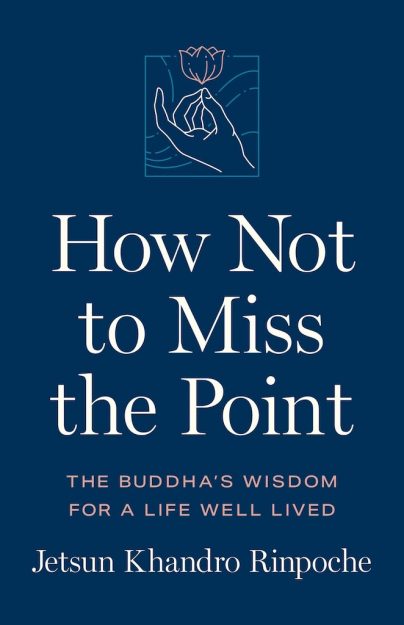
From How Not to Miss the Point: The Buddha’s Wisdom for a Life Well Lived by Jetsun Khandro Rinpoche. © 2025 by Dharmashri Group. Reprinted in arrangement with Shambhala Publications, Inc. Boulder, CO