Nothing to Attain
In his latest book, Zen teacher Tenshin Reb Anderson provides intimate teachings and a detailed history for those willing to see with new eyes. The post Nothing to Attain appeared first on Tricycle: The Buddhist Review.
 ShanonG
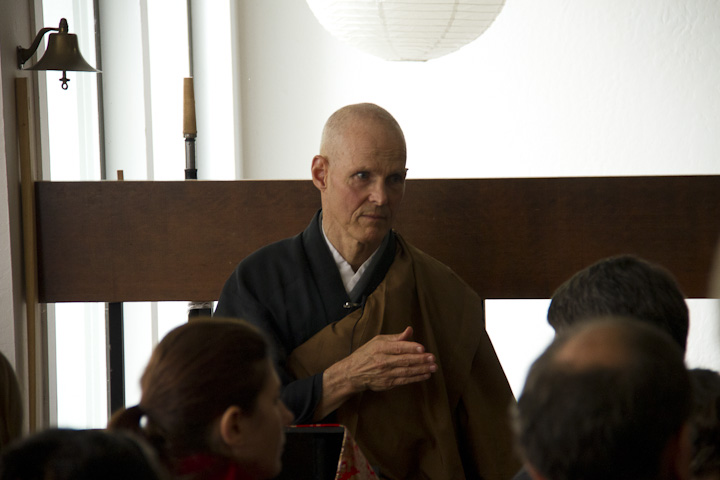
In his latest book, Zen teacher Tenshin Reb Anderson provides intimate teachings and a detailed history for those willing to see with new eyes.
Tenshin Reb Anderson. | Image via rebanderson.org
In the Avatamsaka (or Wondrous Flower Adornment) Sutra, the Buddha says that “all living beings fully possess the wisdom and virtues of the buddhas” but that “because of misconceptions and attachments, they do not realize it.” Tenshin Reb Anderson—student of Shunryu Suzuki, abbot and then co-abbot of the San Francisco Zen Center from 1986 to 1995, and now a senior dharma teacher there—opens his latest book, Nothing to Attain: Zen Stories of Faith and Understanding, with this teaching, which forms the core of the book (and, arguably, of Anderson’s Zen teachings more broadly). The teaching, Anderson writes, is both that “we have nothing to attain and we have to engage in the great work of dropping off misconceptions and attachments.”
To illustrate this, Anderson presents his translation/adaptation of the parable of the destitute child, from the fourth chapter of the Lotus Sutra (the title of which, “Faith and Understanding,” provides the subtitle for the present book). In this parable, a son wanders away from home and remains lost for fifty years. When he returns, the father recognizes the son, but the son, awed by the riches and not recognizing his father, tries to flee. He eventually returns to accept a job shoveling dung, then, over time, receives increasingly greater honors from his father, whom he still does not recognize, until finally the father reveals their relationship and names the son as his heir. The “treasures came to the son of themselves,” Anderson writes at the conclusion of the parable, without the son having “any intention to obtain them.”
For Anderson, the parable allegorizes spiritual practice: we have “an original home from which we have wandered away” to which we can return through “expedient practices” and eventually “transition to the real selfless practice of the buddhas, which is our family business.” The rest of the book then provides exposition of the parable, through excerpts from other Zen scriptures as well as anecdotes from Anderson’s life (including many reminiscences of Shunryu Suzuki), with the book tracing the same course as the wandering son of the parable, using original home, wandering, dung shoveling, and eventual inheritance of the family business as metaphors for aspects of spiritual practice.
Although Nothing to Attain runs just under two hundred pages, including endnotes, it presents a good introduction to Zen teachings and history. Readers meet Zen ancestors from its early history in China, including the legendary first ancestor Bodhidharma as well as Mazu, Yangshan, Guishan, and Dongshan, who lived and taught in the 8th and 9th centuries CE, during China’s Tang dynasty period, on through Dogen and Hakuin. Anderson generally uses the Chinese, rather than Japanese, forms of names for these early figures, which, depending on the reader’s Zen lineage, may make it hard at first to recognize some figures, familiar to some from koan study, such as Juzhi (Gutei), Zhaozhou (Joshu), and Xuefeng (Seppo). Many of these stories are Anderson’s translations, or occasionally adaptations from previous English translations such as Thomas Cleary’s Book of Serenity. As a translator/adapter, Anderson seems to be of the school of thought that values accessibility over exact fidelity to the original; this approach makes the book likely to be of more interest to newer practitioners than to those already experienced with reading stricter translations of Zen’s foundational texts.
The stories Anderson tells of his own life progress more or less chronologically, giving the general contours of his life. Anderson spent his early years in Minnesota, first encountering Zen in the book Zen Flesh, Zen Bones (Paul Reps, 1957), while studying psychology at the University of Minnesota. Having come to an early intuition “about the intimate relationship between the quality of our bodily posture and the quality of our mind,” and sensing that the kind of study he wanted was beyond the purview of the university, he decided to leave graduate school and go to San Francisco Zen Center (which he had previously visited) after seeing his graduate advisor eating at McDonald’s, bent over a hamburger like “a kind of question mark.” It was there, in San Francisco, that Anderson practiced under Shunryu Suzuki (whose importance in bringing Zen to America would be hard to overstate) and received the dharma name Tenshin, which itself furnishes a few stories, including Suzuki’s initial explanation of its meaning as “Reb is Reb.” Even five-and-a-half decades after Suzuki’s death in 1971, it is clear how much Anderson esteems his teacher; that Nothing to Attain offers more stories of Suzuki is something for which we can be truly grateful.
Not all of the major events in Anderson’s life at San Francisco Zen Center receive mention in Nothing to Attain. There have been shortcomings, and how one feels about these may be decisive in how one feels about Anderson as a person and as a teacher of the dharma.
In 1987, shortly after being named Dainin Katagiri’s successor as abbot of Zen Center, Anderson was arrested for brandishing a firearm. Anderson claimed that after being mugged, he went home to retrieve an unloaded gun and then chased down the mugger, threatening him with the unloaded gun. He took a six-month voluntary leave of absence from his post as abbot and, when he returned in 1988, served as co-abbot with Sojun Mel Weitsman until 1995.
The gun incident begins four years earlier, though, soon after Anderson received dharma transmission from Zentatsu Richard Baker (though Baker has denied that Anderson completed this process) and around the time Baker resigned as abbot amid unrelated allegations of an affair. In his 2001 book Being Upright: Zen Meditation and the Bodhisattva Precepts, Anderson claims that while running in Golden Gate Park, he found the gun along with the body of a man who appeared to have committed suicide, and that he sat zazen with the body with the intention to “go back and sit with [the] body again and eventually call the police.” Anderson claims that after his third visit to sit zazen with the dead man, he told a police officer, and that on the fourth visit, he took the gun home. Even if one accepts Anderson’s account, there is enough “arrogance and inflation” (as he calls it in Being Upright) to raise doubts about his integrity; given the implausibility of much of the story, and the fact that nobody can corroborate any of it except for the brandishing that got him arrested, one may also wonder what really happened.
One might hold that the murkiness around Anderson’s dharma transmission (and that the transmission comes through Baker, himself a controversial figure) and the gun fiasco disqualify Anderson as a Zen teacher. One might hold the contrary opinion, that Anderson has made sufficient penance and that the respect of other Zen teachers (several of whom have provided blurbs for Nothing to Attain) indicate that he is a respectable teacher and his writing worth attending to. Zen teaches that existence is paradoxical, that everyone is possessed of innate buddha-nature and yet also fallible and subject to delusion, that, as Anderson puts it, all “beings are living together in a sea of suffering,” and therefore perhaps the best approach is to acknowledge both Anderson’s shortcomings and that he nonetheless has worthwhile teachings to offer.
In the end, though, Zen consists of practices, in body and mind, and not study alone. To the extent that Nothing to Attain points back to Zen’s core principles, introduces newcomers to some of the ancestors, or brings new insights to the more experienced, it is a good book and one worth reading. The important thing to remember, though, which Anderson writes in the book’s final paragraph, is that there is “nothing to attain and everything to realize.”

Thank you for subscribing to Tricycle! As a nonprofit, we depend on readers like you to keep Buddhist teachings and practices widely available.
This article is only for Subscribers!
Subscribe now to read this article and get immediate access to everything else.
Already a subscriber? Log in.