Yoga Asanas for Migraine Headaches: Relief Guide
⚡ Quick Answer BoxThe best yoga asanas for migraine headaches are gentle forward folds, neck releases, supported inversions, and restorative […]
 KickT
KickT
⚡ Quick Answer Box
The best yoga asanas for migraine headaches are gentle forward folds, neck releases, supported inversions, and restorative poses that reduce the cortisol elevation, cervical muscle tension, and sympathetic nervous system hyperactivation that trigger and worsen migraines. The top poses include Child’s Pose, Seated Forward Fold, Legs Up the Wall, Standing Forward Fold, Cat-Cow, and Supported Bridge. Research shows regular yoga practice reduces migraine frequency by up to 50% and decreases attack severity — particularly when combined with pranayama and consistent daily practice.
A migraine is not just a headache. It is a full neurological event — throbbing, disabling, often accompanied by nausea, light sensitivity, and a need to retreat from the world entirely. For the 1 billion people worldwide who experience migraines, the search for relief that actually works — without the side effects of daily medication — is a constant, exhausting priority.
Yoga asanas for migraine headaches offer something that most pharmaceutical approaches do not: a practice that addresses the underlying neurological and physiological triggers of migraine rather than simply suppressing the pain signal once an attack has already begun.
Through specific asanas, breathwork, and the science of nervous system regulation, yoga targets the cervical muscle tension, cortisol elevation, trigeminal nerve sensitization, and sympathetic nervous system hyperactivation that create the conditions for migraine attacks — reducing both the frequency of attacks and the severity of pain when they occur.
This guide covers everything you need: the neuroscience of how yoga prevents and relieves migraines, which specific asanas deliver the greatest benefit and why, what to practice during an active attack versus between attacks, and a complete daily migraine management routine you can start today.
Understanding Migraines: What Yoga Is Actually Addressing
Before the asanas — the neuroscience. Understanding the mechanisms of migraine makes the practice more targeted, more effective, and more sustainable.
What Is a Migraine?
A migraine is a neurological disorder characterized by recurrent attacks of moderate-to-severe head pain, typically unilateral (one side), pulsating in quality, and lasting 4–72 hours. Migraines are classified as:
Migraine without aura — head pain without preceding neurological symptoms Migraine with aura — preceded by visual disturbances, sensory changes, or speech difficulties Chronic migraine — 15 or more headache days per month, with 8 or more meeting migraine criteria Cervicogenic headache — headache originating from the cervical spine (neck) — a subtype where yoga is particularly effectiveThe 5 Neurological Triggers Yoga Directly Addresses
1. Cortisol-driven sensitization Chronic stress elevates cortisol, which lowers the pain threshold of the trigeminal nucleus — the primary pain-processing center for migraine. Lower pain threshold means stimuli that would not normally trigger a migraine (light, sound, smell) cross the threshold and initiate an attack. Yoga reduces cortisol, directly raising this threshold.
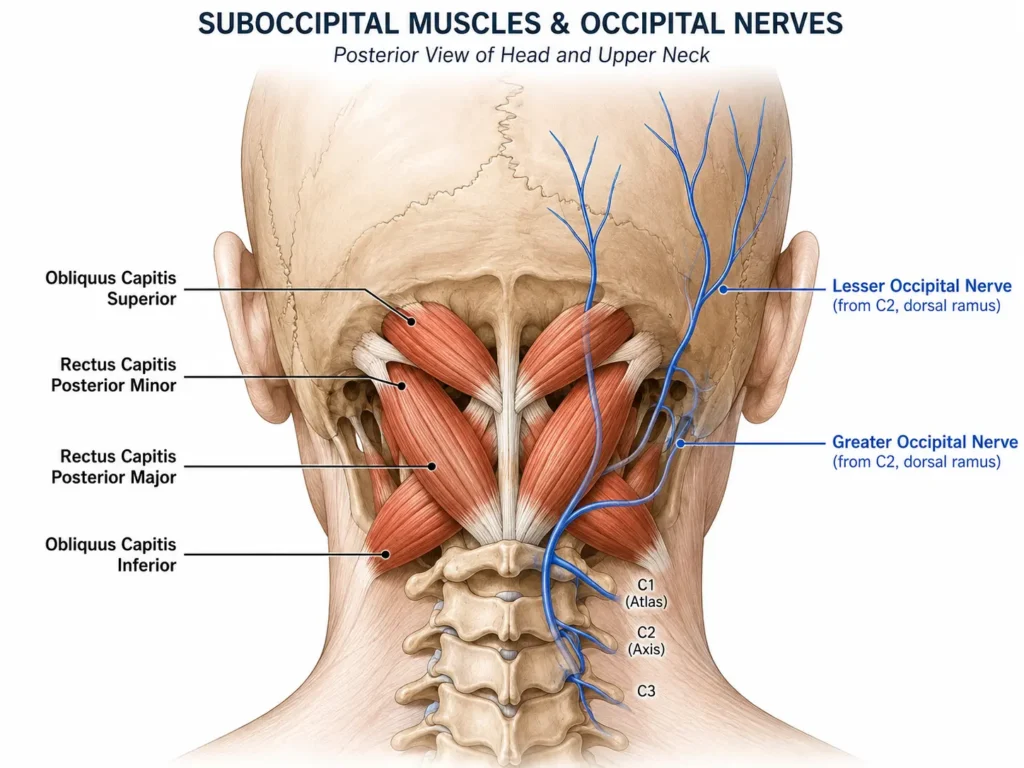
2. Cervical muscle tension and suboccipital compression The suboccipital muscles — four small muscles at the base of the skull connecting the occiput to the first and second cervical vertebrae (C1 and C2) — are chronically contracted in migraine sufferers. This contraction compresses the greater and lesser occipital nerves, which refer pain directly into the head in a pattern that is indistinguishable from migraine. Yoga asanas targeting cervical flexibility and suboccipital release directly address this trigger.
3. Sympathetic nervous system hyperactivation The sympathetic (“fight or flight”) nervous system is chronically overactive in migraine sufferers — creating a state of neurological hypervigilance in which the central nervous system is primed to generate pain. Restorative yoga and extended exhale breathing shift the system toward parasympathetic (“rest and digest”) dominance, reducing this neurological priming.
4. Serotonin dysregulation Serotonin levels drop sharply immediately before a migraine attack — triggering the vasodilation and neurogenic inflammation of the trigeminal vascular system that drives migraine pain. Yoga practice — particularly regular, consistent practice — supports serotonin regulation through multiple pathways including improved sleep, cortisol reduction, and vagal tone enhancement.
5. Central sensitization In chronic migraine, the central nervous system develops a state of amplified pain processing — called central sensitization — in which the brain’s pain-processing pathways become hypersensitive. Yoga Nidra and restorative yoga are among the few non-pharmacological interventions shown to reduce central sensitization through their direct effects on brain-wave states and autonomic nervous system regulation.
What the Research Shows
A randomized controlled trial published in Headache: The Journal of Head and Face Pain found that yoga reduced migraine attack frequency, duration, and pain intensity significantly in participants who practiced consistently over 3 months — with greater benefits than medication-only management.
Research published by the National Center for Biotechnology Information confirms that yoga and pranayama activate the parasympathetic nervous system and reduce cortisol — directly addressing two of the five neurological triggers listed above. (Read the research)
Two Types of Migraine Yoga Practice
Before presenting the asanas, understand that migraine yoga practice falls into two distinct categories — with different poses appropriate for each:
Type 1: Active Attack Practice (During a Migraine)
Goal: Reduce pain, calm the nervous system, shorten attack duration Appropriate poses: Only the most gentle, dark-room, minimal-movement practices What to avoid: Any inversion, any bright light, any strong compression of the head or neck
Type 2: Prevention Practice (Between Attacks)
Goal: Reduce attack frequency, address underlying triggers, build neurological resilience Appropriate poses: Full range of cervical releases, gentle inversions, forward folds, twists, and breathwork Frequency: 4–5 sessions per week for measurable prevention benefit
This distinction — which most yoga-for-migraine content misses entirely — determines whether a yoga practice helps or accidentally worsens a migraine situation.
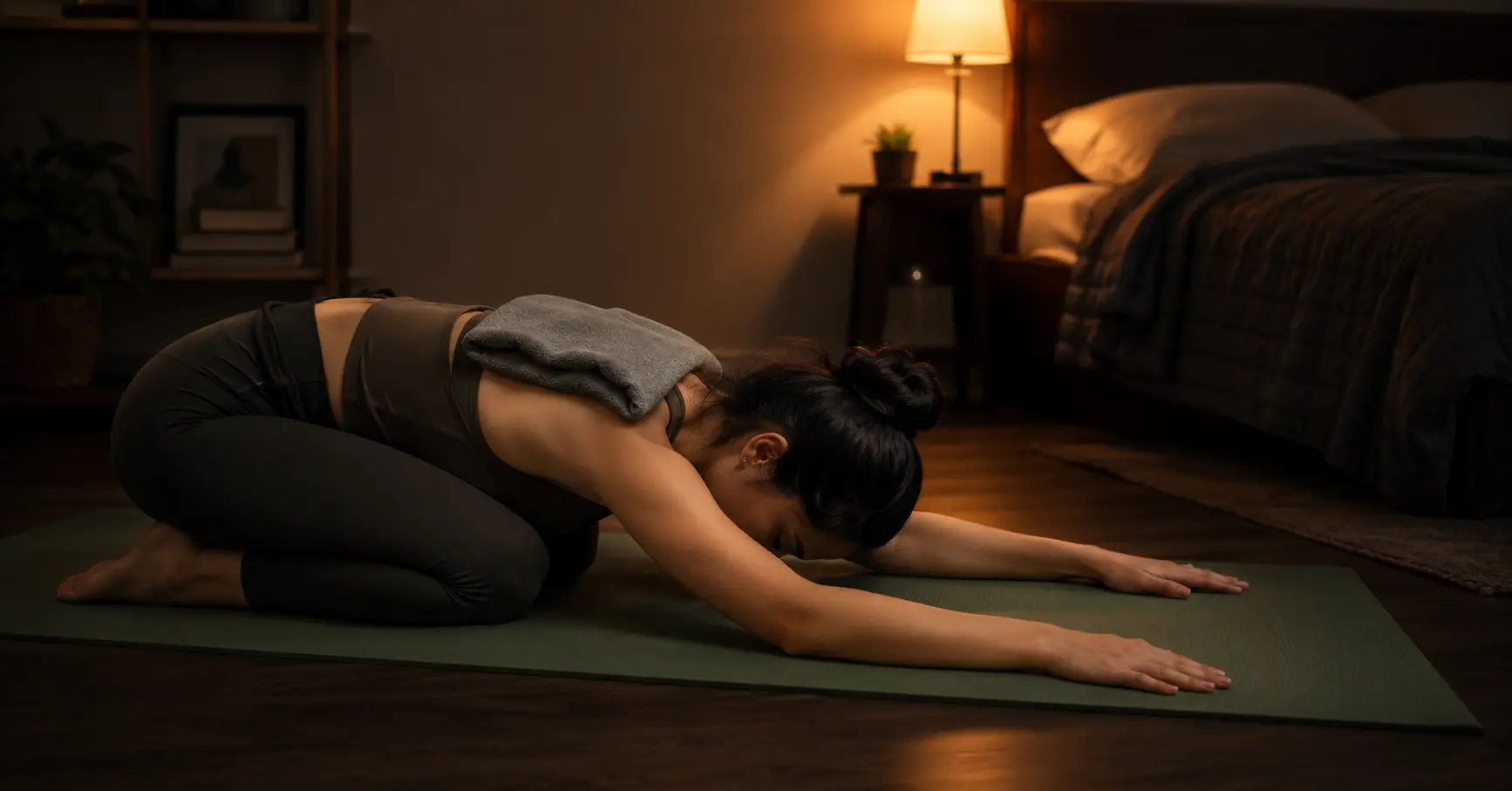
1. Child’s Pose (Balasana) — Active Attack + Prevention
Child’s Pose is the single most appropriate yoga asana for an active migraine attack — and one of the most valuable prevention poses between attacks.
Why it specifically helps migraines: Child’s Pose simultaneously activates three migraine-relevant mechanisms:
Forehead pressure on the mat activates the frontal lobe’s parasympathetic centers — directly calming trigeminal nerve activity. The gentle forehead pressure also stimulates the frontal sinus, reducing sinus-related migraine triggers. Forward fold position stimulates the vagus nerve through abdominal compression, shifting the autonomic nervous system away from the sympathetic hyperactivation that primes migraine attacks. Cervical traction — the gentle elongation of the cervical spine in Child’s Pose releases suboccipital compression — directly addressing the occipital nerve compression that triggers or worsens migraine.How to do it:
From tabletop, bring your big toes together and widen your knees to the edges of your mat Exhale and walk your hands forward, lowering your torso between your thighs Rest your forehead on the mat — or on a folded blanket if it doesn’t reach comfortably Let your arms extend forward OR rest them alongside your body, palms up With each exhale — consciously release the muscles at the base of your skull Extend your exhale to 6–8 counts — this maximizes vagal activation Notice the weight of your head being supported completely — no neck muscles holdingHold: 15–20 slow breaths (4–6 minutes). During an active attack, hold as long as comfortable in a dark, quiet room.
Active attack modification: Place a cold or warm compress (whichever you personally find relieving) on the back of your neck while in Child’s Pose. The combination of the suboccipital release from the pose and the thermal therapy creates compounded relief.
Avoid during attack if: The forward fold position worsens nausea. In this case, use Constructive Rest Position (pose 2) instead.
2. Constructive Rest Position (Semi-Supine)
Constructive Rest is the most accessible migraine relief pose — requiring no flexibility, no effort, and no risk of worsening symptoms. It is appropriate even during severe attacks.
Why it specifically helps migraines: The semi-supine position with knees bent creates a state of complete mechanical neutrality for the cervical spine — releasing all postural muscle tension in the neck and suboccipital region without any compression or traction. This neutral cervical position allows the suboccipital muscles to fully release, reducing the occipital nerve compression that drives cervicogenic migraine pain.
The position also allows the weight of the head to be completely supported by the floor — removing the gravitational load on the cervical spine that postural muscle tension must otherwise counteract.
How to do it:
Lie on your back on a firm surface — a yoga mat on the floor is preferable to a soft bed during attacks Bend your knees and place your feet flat, hip-width apart Place a thin folded blanket or book under your head — enough to keep your cervical spine in neutral (neither tilted back nor pushed forward) Place your hands on your lower belly Close your eyes With each exhale — consciously release the muscles at the base of your skull, your jaw, and your forehead Practice the extended exhale: inhale 4 counts, exhale 6–8 countsHold: 10–20 minutes. During severe attacks, stay here as long as needed.
Migraine-specific note: The book or blanket height under the head matters significantly. Too low — the head tilts back, compressing the suboccipitals. Too high — the chin presses into the chest, restricting breathing. The correct height keeps the cervical spine long and the chin very slightly tilted toward the chest — a position that maximally reduces suboccipital tension.
3. Standing Forward Fold (Uttanasana) — Prevention Only
Standing Forward Fold increases blood flow to the brain through a controlled, gravity-assisted mild inversion — while simultaneously stretching the entire posterior cervical chain from the occiput to the sacrum.
Why it specifically helps migraines: The posterior cervical chain — the network of muscles, tendons, and fascia running from the base of the skull down through the neck, upper back, and thoracic spine — is chronically contracted in migraine sufferers. This contraction creates a sustained compression of the cervical nerve roots and occipital nerves that lowers the migraine threshold continuously. Standing Forward Fold creates a long, sustained stretch of this entire chain — releasing accumulated tension from the neck downward.
How to do it:
Stand with feet hip-width apart Soften your knees generously — this is not a hamstring stretch during migraine practice Inhale and lengthen your spine Exhale and hinge slowly forward from the hips Let your head hang completely — no muscles holding the head up. The neck is entirely passive. Clasp opposite elbows and let the weight of your arms add gentle traction to the cervical spine Sway gently side to side if it feels relieving — 1–2 cm in each direction With each exhale — feel the muscles at the base of your skull lengthening and releasingHold: 15–20 slow breaths (4–6 minutes)
Migraine-specific note: The completely passive neck is the therapeutic element — not the hamstring stretch depth. Bend your knees as much as needed to ensure your head hangs freely with zero cervical muscle activation. A head hanging with bent knees provides more migraine relief than a straight-legged fold where neck muscles are still holding.
Prevention only: Do not practice this pose during an active migraine attack if being upright worsens symptoms. During attacks, use Child’s Pose or Constructive Rest instead.
4. Cat-Cow (Marjaryasana-Bitilasana) — Prevention + Gentle Attack
Cat-Cow is one of the most targeted yoga asanas for cervicogenic migraine specifically — creating rhythmic, breath-synchronized mobility through the cervical and thoracic spine that directly releases the vertebral joint restrictions associated with neck-triggered headaches.
Why it specifically helps migraines: The C2–C3 facet joints (second and third cervical vertebrae) are the primary referral source for cervicogenic headache — a subtype of headache that accounts for approximately 15–20% of all chronic headaches and is particularly responsive to yoga intervention. Restricted mobility at these joints — caused by poor posture, forward head position, and sustained desk work — refers pain directly into the head in a migraine-like pattern.
Cat-Cow creates the most accessible and safest available mobility exercise for these joints — taking the entire cervical and thoracic spine through its full flexion-extension range with each breath cycle.
How to do it:
Start in tabletop — wrists under shoulders, knees under hips Move much more slowly than a normal Cat-Cow — 4 counts for inhale, 6 counts for exhale Cow (inhale): Allow the movement to begin at the tailbone, ripple up through the lumbar, thoracic, and then cervical spine — the head rises last, gently Cat (exhale): Round from the tailbone upward — the head drops last, chin toward chest Pay specific attention to the cervical-thoracic junction (where the neck meets the upper back) — this area is typically the most restricted in migraine sufferers Close your eyes and direct your awareness to the sensations at the base of your skullHold: 15–20 very slow breath cycles (5–7 minutes)
Migraine-specific note: During an active mild migraine, keep the movement very small — particularly in the neck. A tiny, gentle version of Cat-Cow with the head movement minimized still provides meaningful cervical joint mobilization without risking aggravation.
5. Neck Rolls and Cervical Release (Targeted Suboccipital Release)
Neck Rolls in yoga are often performed quickly and superficially — which provides little migraine benefit. The slow, targeted version described here is specifically designed to release the suboccipital muscles and cervical facet joints most directly responsible for migraine triggering.
Why it specifically helps migraines: The suboccipital muscle group — rectus capitis posterior major and minor, obliquus capitis superior and inferior — are the primary muscular trigger for cervicogenic migraine. These four small muscles sit directly at the base of the skull and are chronically contracted in people who:
Work at a desk or computer Hold chronic postural stress (forward head position) Experience anxiety (the suboccipitals contract with emotional stress) Have experienced whiplash or cervical injuryTargeted slow release of these muscles — through the sequence below — directly reduces the occipital nerve compression they create.
How to do it:
Sit comfortably — either cross-legged on the mat or in a chair Lengthen your spine and let your shoulders drop away from your ears Step 1 — Chin tucks: Gently draw your chin straight back (not down) — creating a “double chin” position. Hold 3 breaths. Release. Repeat 5 times. This directly stretches the suboccipital muscles. Step 2 — Lateral tilt: Drop your right ear toward your right shoulder — very slowly. Hold 5 breaths. Feel the left side of the neck and base of skull lengthening. Slowly return to center. Repeat left side. Step 3 — Diagonal stretch: Drop your chin toward your right collarbone. Hold 5 breaths — feel the stretch at the left-rear base of skull (left suboccipitals). Slowly return. Repeat to the left. Step 4 — Slow half-circles: Chin to chest, slowly rotate right (ear toward right shoulder), pause, return to chin-to-chest, rotate left. Never roll the head fully backward.Hold: 3–5 breaths at each position. Full sequence takes 5–8 minutes.
Migraine-specific note: Never force cervical rotation or tilt during or near a migraine attack. All movement should be slow enough that you could stop at any point without jarring. If any position reproduces or worsens head pain — stop immediately and return to Constructive Rest.
6. Legs Up the Wall (Viparita Karani) — Prevention + Gentle Attack
Legs Up the Wall is the most effective supported inversion for migraine prevention — improving cerebral circulation, draining vascular congestion from the head, and activating deep parasympathetic nervous system restoration.
Why it specifically helps migraines: Migraine is fundamentally a vascular-neurological event — involving changes in cerebral blood flow and vascular tone in the meningeal vessels. The mild inversion of Legs Up the Wall creates a gentle, gravity-assisted redistribution of blood volume away from the overloaded venous return of the upright position — reducing the vascular congestion that contributes to migraine onset and severity.
Additionally, the complete physical surrender required by this pose — no muscular effort, complete supported rest — activates the deepest available parasympathetic state outside of sleep, directly countering the sympathetic hyperactivation that primes migraine attacks.
How to do it:
Sit sideways next to a wall in a dimly lit room Swing your legs up the wall as you lower your back to the floor Shuffle your hips close to the wall — comfortable distance, not forced Place a folded blanket under your hips for slight elevation — this enhances the mild inversion Let your legs rest completely against the wall — no muscular effort Place a cold cloth or eye pillow over your eyes if that is personally relieving Arms rest at your sides, palms facing up Extend your exhale to 6–8 counts throughout the holdHold: 10–15 minutes. This is the pose worth holding the longest in any migraine prevention session.
Active attack use: Legs Up the Wall can be practiced during a mild-to-moderate active migraine in a completely dark, quiet room. The combination of the mild inversion, the darkness, and the extended exhale breathing can meaningfully shorten attack duration.
Avoid during attack if: The inversion position (legs above heart) worsens the throbbing sensation or nausea. In this case, remain flat in Constructive Rest.
7. Supported Bridge Pose (Setu Bandha — Passive Version)
Supported Bridge with a block under the sacrum creates a gentle, passive inversion of the pelvis and lumbar spine — releasing lower back and sacral tension that refers up through the spinal column and contributes to headache and migraine via dural tension.
Why it specifically helps migraines: The dura mater — the outermost membrane covering the brain and spinal cord — runs as a continuous tube from the cranium to the sacrum. Tension in the sacrum and lower lumbar spine can create tension along the entire dural tube, which is transmitted directly to the cranial dura and meninges — contributing to headache and migraine. Supported Bridge gently decompresses the sacrum and lumbar spine, releasing dural tension from below.
How to do it:
Lie on your back with knees bent, feet flat hip-width apart Press gently through your feet to lift your hips a few inches Slide a yoga block under your sacrum on its lowest or middle height Lower your hips onto the block — completely surrendering your weight to it Arms rest at your sides, palms up Close your eyes and breathe — extending the exhale Feel the sacrum being gently supported and decompressedHold: 5–10 minutes
Migraine-specific note: This is one of the most therapeutically specific poses for migraine sufferers who experience neck and headache pain that travels upward from the lower back. If you notice that your migraines are accompanied by lower back tightness or sacral tension, this pose is particularly relevant for your specific migraine pattern.
8. Seated Forward Fold (Paschimottanasana) — Prevention
The seated forward fold activates vagal tone — raising the threshold at which the trigeminal nucleus generates pain — making it one of the most neurologically targeted yoga asanas for migraine prevention.
Why it specifically helps migraines: The trigeminal nucleus caudalis (the brainstem nucleus where migraine pain originates) receives inhibitory input from the vagus nerve. Higher vagal tone means stronger inhibitory input to this nucleus — directly raising the migraine threshold. Sustained seated forward folds produce measurable increases in heart rate variability (a clinical proxy for vagal tone), making them one of the most targeted migraine-prevention asanas in this guide.
How to do it:
Sit with legs extended straight, feet gently flexed Place a bolster or folded blanket across your thighs if available Inhale and lengthen your spine from the tailbone to the crown Exhale and hinge forward from your hips — not your waist Let your torso rest on the bolster — forehead supported if possible Extend your exhale to 6–8 counts throughout the hold Feel the back of your neck completely releasing with each exhaleHold: 15–20 breaths (5–7 minutes)
Migraine-specific note: The forehead support in this pose — resting on a bolster rather than hanging in mid-air — is particularly beneficial for migraine. Gentle pressure on the forehead activates the frontal lobe’s parasympathetic centers, creating an additional layer of trigeminal inhibition.
9. Eagle Arms (Garudasana Arms) — Seated
Eagle Arms in a seated position provides one of the most targeted releases available for the trapezius, rhomboids, and posterior cervical muscles — the muscle group most responsible for tension-type headache and tension-triggered migraine.
Why it specifically helps migraines: The upper trapezius — the large triangular muscle running from the base of the skull, across the top of the shoulder, and down to the mid-thoracic spine — is the most common referral source for tension headache. Trigger points (hyperirritable spots in the muscle) in the upper trapezius refer pain directly into the head in a pattern that covers the temple, behind the eye, and across the forehead — areas perfectly overlapping with migraine distribution. Eagle Arms creates a sustained cross-body stretch of this muscle that directly releases these trigger points.
How to do it:
Sit comfortably with your spine tall Extend both arms straight forward at shoulder height Cross your right arm UNDER your left arm at the elbows Bend both elbows and wrap the forearms around each other — attempting to bring the palms together (or as close as comfortable) Lift your elbows to shoulder height Draw the elbows slightly away from your face — feeling the stretch deepen between the shoulder blades and across the upper back With each exhale — feel the upper trapezius and rhomboids releasing Hold for 8 breaths, then switch which arm crosses on topHold: 8 breaths each side (3–4 minutes)
Migraine-specific note: This pose can be practiced anywhere — at a desk, in a chair, or on a mat. For migraine sufferers who experience headaches triggered by computer work, a 5-minute Eagle Arms break every 2 hours of desk work is one of the most practical preventive interventions available.
10. Supine Spinal Twist (Supta Matsyendrasana) — Prevention
The supine spinal twist releases the thoracic spine and rib cage — improving respiratory mechanics, stimulating the vagus nerve through abdominal compression, and releasing the thoracic and cervical restrictions that contribute to headache referral patterns.
Why it specifically helps migraines: Restricted thoracic mobility — caused by desk posture, shallow breathing, and chronic stress — reduces respiratory expansion, decreases vagal tone, and creates a “tethering” effect on the cervical spine that amplifies suboccipital tension. The supine twist directly restores thoracic mobility, releasing this tether and reducing the upward referral of tension into the neck and head.
How to do it:
Lie on your back with knees bent, feet flat Draw both knees to your chest and hold them briefly Let both knees fall slowly to the RIGHT Extend your left arm out to the left at shoulder height — palm up Let both shoulders remain grounded on the floor — no forcing Gaze gently to the left With each exhale — feel the left thoracic spine (mid-back) releasing Hold 10–12 slow breaths, then return to center and switch sidesHold: 10–12 breaths each side (4–5 minutes)
Migraine-specific note: If you notice that your migraines are accompanied by tightness specifically in the mid-back and between the shoulder blades, the thoracic restriction addressed by this twist is likely a significant contributor to your specific migraine pattern. Prioritize this pose in your prevention practice.
11. Corpse Pose with Extended Body Scan (Savasana + Yoga Nidra)
Yoga Nidra practiced in Savasana is the most powerful migraine-prevention practice in this entire guide — working through the mechanism of central sensitization reduction that no physical asana can replicate.
Why it specifically helps migraines: Central sensitization — the state in which the brain’s pain-processing pathways are chronically hypersensitive — is the defining feature of chronic migraine. In centrally sensitized migraine, stimuli that would not trigger pain in a non-migraine sufferer (moderate light, ambient sound, normal touch) cross the pain threshold and trigger attacks or worsen ongoing ones.
Yoga Nidra induces theta brain waves (4–8 Hz) — the same neurological state as deep non-REM sleep — in which the brain performs its most critical pain-processing recalibration. Regular Yoga Nidra practice has been shown to reduce central sensitization over time, progressively raising the pain threshold and reducing migraine frequency.
How to do it:
Lie flat on your back — bolster under knees, blanket over body, eye pillow over eyes Darken the room completely if possible Take 5 slow, deep breaths — extending the exhale to 8 counts Begin the body scan: Right foot → right calf → right knee → right thigh → right hip Left foot → left calf → left knee → left thigh → left hip Lower abdomen → lower back → upper abdomen → chest Right hand → right forearm → right upper arm → right shoulder Left hand → left forearm → left upper arm → left shoulder Throat → jaw → specific attention to the jaw — consciously release all jaw tension Temples → forehead → specific attention to the forehead — smooth, release Crown of head After completing the scan — rest in open awareness. Notice any sensations without engaging with them.Hold: 20–30 minutes minimum for therapeutic migraine benefit.
Migraine-specific attention points: The jaw and forehead receive extra attention in this body scan because temporomandibular joint (TMJ) tension and frontalis muscle (forehead) tension are two of the most common muscular contributors to migraine. Consciously releasing these areas during Yoga Nidra progressively reduces their resting tension level over weeks of practice.
12. Alternate Nostril Breathing in Sukhasana (Nadi Shodhana Pranayama)
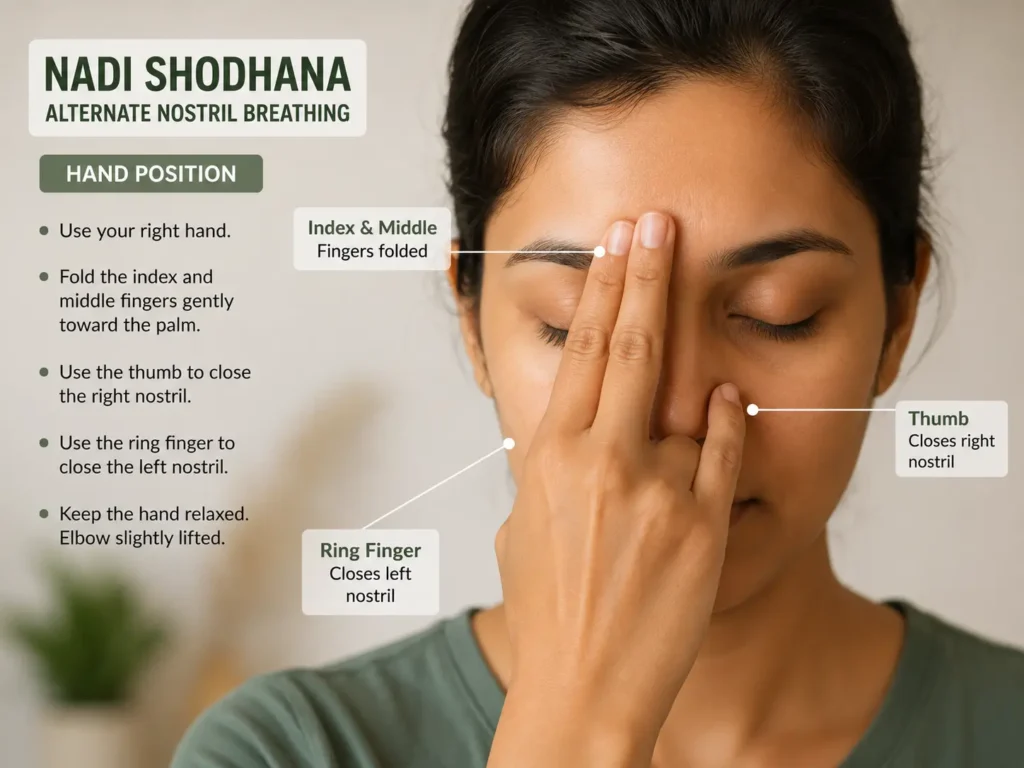
Nadi Shodhana is the most evidence-supported pranayama technique for migraine prevention — directly balancing the autonomic nervous system and improving cerebral blood flow regulation.
Why it specifically helps migraines: Research published in the Journal of Alternative and Complementary Medicine found that Nadi Shodhana pranayama significantly reduced migraine attack frequency and intensity in participants who practiced daily for 3 months. The mechanism is threefold:
Autonomic balance: Alternate nostril breathing balances the activity of the sympathetic and parasympathetic nervous systems — directly reducing the sympathetic hyperactivation that primes migraine Cerebral blood flow regulation: Each nostril is associated with different cerebral hemisphere activity. Alternate nostril breathing normalizes the lateralized cerebral blood flow dysregulation that precedes migraine with aura Cortisol reduction: The extended exhale component of Nadi Shodhana directly activates vagal tone and reduces serum cortisol — raising the migraine thresholdHow to do it:
Sit in Easy Pose (Sukhasana) — cross-legged on a folded blanket, or in a chair Rest your left hand on your left knee, palm up Bring your right hand to your face — index and middle fingers rest on your forehead between the eyebrows Close your RIGHT nostril with your right thumb Inhale slowly through your LEFT nostril for 4 counts Close BOTH nostrils (thumb + ring finger) — pause briefly Release your thumb — open RIGHT nostril Exhale through your RIGHT nostril for 8 counts (extended exhale) Inhale through your RIGHT nostril for 4 counts Close both — brief pause Open LEFT nostril — exhale through LEFT for 8 counts This is one complete cycle. Practice 10–15 cycles.Hold: 10–15 cycles (approximately 5–8 minutes)
Migraine-specific note: The 4:8 inhale-to-exhale ratio (double-length exhale) is the most therapeutically relevant breathing pattern for migraine. The extended exhale maximizes vagal activation and cortisol reduction. If you find it difficult initially, start with a 4:6 ratio and gradually extend toward 4:8 over 2–4 weeks.
Avoid during active migraine with nausea: Any seated upright practice may worsen nausea. In this case, practice the extended exhale breathing while lying in Constructive Rest instead.
Complete Migraine Yoga Sequences
Active Attack Protocol (10–20 Minutes — Dark Room)
Use during: Active migraine attack, mild-to-moderate severity Environment: Dark room, minimal sound, comfortable temperature
| 1 | Extended exhale breathing (4:8) | 5 min | Vagal activation, trigeminal inhibition |
| 2 | Constructive Rest Position | 10 min | Cervical decompression, full rest |
| 3 | Child’s Pose (with compress) | 5 min | Suboccipital release, vagal activation |
| 4 | Legs Up the Wall (if tolerated) | 10 min | Cerebral vascular redistribution |
| 5 | Yoga Nidra Body Scan | 20 min | Central sensitization reduction |
Prevention Practice (35–45 Minutes — 4–5x Per Week)
Use between: Attacks, for long-term frequency reduction
| 1 | Nadi Shodhana pranayama | 8 min | Autonomic balance, cortisol reduction |
| 2 | Neck rolls + suboccipital release | 7 min | Suboccipital tension release |
| 3 | Cat-Cow (slow) | 5 min | Cervical-thoracic mobility |
| 4 | Child’s Pose | 5 min | Vagal tone, suboccipital release |
| 5 | Standing Forward Fold | 5 min | Posterior cervical chain release |
| 6 | Eagle Arms (seated) | 4 min | Upper trapezius trigger point release |
| 7 | Supine Twist | 5 min | Thoracic mobility, vagal tone |
| 8 | Supported Bridge | 7 min | Dural tension release |
| 9 | Seated Forward Fold | 7 min | Vagal tone increase |
| 10 | Legs Up the Wall | 10 min | Cerebral circulation, parasympathetic |
| 11 | Yoga Nidra | 20 min | Central sensitization reduction |
Pranayama for Migraines: 4 Targeted Techniques
1. Extended Exhale Breathing (4:6 or 4:8)
Migraine mechanism: Directly activates vagal tone, reducing sympathetic nervous system hyperactivation and raising the trigeminal pain threshold. The single most accessible migraine intervention available — requires no movement and can be practiced during severe attacks.
How: Inhale 4 counts, exhale 6–8 counts. Practice for 5–10 minutes. Works best lying in Constructive Rest or Child’s Pose.
2. Nadi Shodhana (Alternate Nostril Breathing)
Migraine mechanism: Balances autonomic nervous system activity and normalizes lateralized cerebral blood flow — both directly relevant to migraine pathophysiology. Research-supported for reducing migraine frequency with daily 8-week practice.
How: See complete instructions in Pose 12 above. Practice daily for prevention benefit.
3. Bhramari (Humming Bee Breath)
Migraine mechanism: The cranial vibration created by Bhramari stimulates the vagus nerve through the auricular branch (the vagus nerve’s ear branch) and increases nitric oxide production in the sinuses. Nitric oxide is a vasodilator — which may seem counterintuitive for migraine (which involves vasodilation). However, the regulated nitric oxide from Bhramari supports healthy vascular tone regulation, distinct from the pathological vasodilation of migraine.
Additionally, the focus required for Bhramari shifts attention away from pain — a genuine neurological distraction mechanism that reduces pain perception.
How: Sit comfortably, close ears with thumbs, place fingers over face. Inhale fully, exhale with sustained “mmmm” humming. Feel the vibration in your skull. Repeat 8–10 times.
Use: Between attacks for prevention. During mild attacks if the vibration is not aggravating.
4. Cooling Breath (Sitali Pranayama)
Migraine mechanism: Sitali — breathing through a curled tongue or through the teeth — creates a cooling, moistening effect on the inhaled air that directly cools the blood in the carotid arteries supplying the brain. For migraines associated with heat, inflammation, or a sensation of heat in the head, Sitali provides one of the most targeted immediate relief mechanisms available in pranayama.
How: Curl your tongue into a tube (or, if unable, lightly touch upper and lower teeth together). Inhale slowly through the curled tongue or teeth — feel the cool air on the tongue. Close the mouth and exhale through the nose. Repeat 10–15 times.
Use: Particularly during migraines accompanied by a sensation of heat or burning in the head.
What to Avoid: Yoga Poses and Practices That Can Worsen Migraines
This section is as important as the poses themselves — and is almost never covered by other yoga-for-migraine resources.
❌ Headstand (Sirsasana) and full inversions during or near attacks Full inversions dramatically increase intracranial pressure — which directly worsens migraine pain and can prolong attacks. Never practice Headstand during or within 24 hours of a migraine attack.
❌ Hot yoga or any heating practice Elevated body temperature is a well-documented migraine trigger. Hot yoga — or any vigorous, heat-generating practice — should be avoided by migraine sufferers, particularly during the premonitory (pre-attack) phase.
❌ Rapid, jerky movements or dynamic jumping Any sudden movement of the head or sudden changes in blood pressure (such as jumping transitions between poses) can trigger or worsen migraine. All transitions should be slow and deliberate.
❌ Deep backbends during attacks Intense backbends like Wheel Pose significantly increase heart rate and blood pressure — which can worsen migraine vascular dynamics during an attack.
❌ Strong Kapalabhati during or near attacks The rapid abdominal contractions of Kapalabhati increase intracranial pressure transiently with each contraction. During or near an attack, avoid Kapalabhati entirely. It is appropriate only during the inter-attack prevention practice of low-frequency migraine sufferers.
❌ Holding the breath (kumbhaka) during attacks Breath retention increases intracranial pressure and CO2 — both of which can aggravate migraine. Use only extended exhale breathing during active attacks.
Building a Long-Term Migraine Management Yoga Practice
Yoga’s greatest benefit for migraine is preventive — and prevention requires consistency over time.
Week 1–2: Practice the Active Attack Protocol when needed. Add 15 minutes of Nadi Shodhana and Child’s Pose daily between attacks. Focus on learning the Extended Exhale breath pattern.
Week 3–4: Begin the Prevention Practice sequence (35–45 minutes) 3 times per week. Track your migraine frequency, duration, and intensity in a simple journal.
Month 2: Increase to 4–5 Prevention Practice sessions per week. Add Yoga Nidra daily — even on non-yoga days. Begin to notice changes in attack frequency.
Month 3: Research suggests measurable reduction in migraine frequency — up to 50% in some studies — at this point in consistent practice. Continue and refine based on your personal migraine patterns and triggers.
The most important habit: Practice Nadi Shodhana for 8 minutes every morning regardless of migraine status. This single daily practice — more than any individual asana — has the most consistent research support for long-term migraine frequency reduction.
Yoga for Migraines: Lifestyle Factors That Amplify Results
Sleep: Irregular sleep and poor sleep quality are among the most consistent migraine triggers. Our Yoga Poses for Sleep guide covers the specific bedtime practices that directly improve the sleep quality that migraine management depends on.
Stress management: Between yoga sessions, chronic stress continuously re-elevates cortisol — re-lowering the migraine threshold that your practice is working to raise. Consistent attention to stress boundaries amplifies yoga’s preventive effect significantly.
Hydration: Dehydration is a reliable migraine trigger. Drinking sufficient water daily — particularly before and after yoga practice — directly supports the migraine prevention work of your asana practice.
Screen breaks: Forward head posture during screen use compresses the suboccipital muscles between sessions. The Eagle Arms break described in Pose 9 — practiced every 2 hours of screen time — is one of the most practical workplace migraine prevention strategies available.
Conclusion
A migraine is the nervous system in distress — overwhelmed, sensitized, and signaling through pain that something in the body’s regulatory systems needs attention.
Yoga does not silence that signal by force. It addresses what the signal is pointing to: the accumulated tension in the suboccipital muscles, the cortisol that has lowered the pain threshold, the sympathetic nervous system that has been running too hot for too long, the central sensitization that has made the entire nervous system a hair-trigger for pain.
Session by session, breath by breath, the practice works at these root causes. The suboccipitals release. The cortisol drops. The vagal tone rises. The brain’s pain-processing pathways recalibrate. And the migraines — slowly, measurably, across weeks and months of consistent practice — become less frequent, less severe, and less defining of your days.
This is not a quick fix. Nothing honest about migraine management is. But yoga is a practice you can do today, on the worst days, in a dark room with a cold cloth on your neck — and also on the good days, as prevention, as maintenance, as the long, patient work of restoring neurological balance.
Start where you are. Breathe out for longer than you breathe in. Let the nervous system remember what calm feels like.
Your migraine practice begins with one exhale. Visit TheShivYoga.com and practice with us.
Medical Disclaimer: This article is for informational and educational purposes only. It does not constitute medical advice and is not a substitute for professional neurological or medical care. Migraines are a complex neurological condition requiring diagnosis and management by a qualified healthcare provider. Always consult your neurologist or physician before beginning or modifying a yoga practice for migraine management. If you experience sudden severe headache (“thunderclap headache”), headache with fever, stiff neck, confusion, or vision changes, seek emergency medical care immediately.
Key Takeaways
Yoga asanas for migraine headaches address five specific neurological mechanisms: cortisol reduction, suboccipital muscle release, sympathetic nervous system downregulation, serotonin regulation support, and central sensitization reduction. Two distinct practice types are needed: an Active Attack Protocol (during migraines — gentle, dark room, minimal movement) and a Prevention Practice (between attacks — 35–45 minutes, 4–5x per week). Child’s Pose is the single most effective pose for immediate migraine relief — combining suboccipital release, vagal activation, and forehead pressure that calms the trigeminal nucleus. The suboccipital muscles (four small muscles at the base of the skull) are the primary muscular trigger for cervicogenic migraine. Targeted neck release and Cat-Cow directly address these muscles. Nadi Shodhana pranayama practiced daily for 8 minutes has research support for reducing migraine frequency by up to 50% within 8–12 weeks — making it the single highest-value daily practice for migraine sufferers. Never practice Headstand, hot yoga, Kapalabhati, or breath retention during or within 24 hours of a migraine attack — these practices increase intracranial pressure and can worsen attacks significantly. Yoga Nidra reduces central sensitization — the chronic pain amplification that defines chronic migraine — through its direct effects on theta brain-wave states and autonomic nervous system recalibration. Research shows consistent yoga practice reduces migraine frequency by up to 50% and reduces attack severity and duration within 3 months of regular practice. Yoga is a complementary practice — never a replacement for prescribed migraine medication or neurological care.FAQ Section
Q1: Can yoga stop a migraine attack once it has already started?
Yoga cannot always stop an active migraine, but specific practices — particularly Child’s Pose, Constructive Rest, extended exhale breathing (4:8 ratio), Legs Up the Wall, and Yoga Nidra practiced in a dark, quiet room — can meaningfully reduce pain intensity and shorten attack duration by activating the parasympathetic nervous system and releasing cervical muscle tension that worsens pain.
Q2: How long does yoga take to reduce migraine frequency?
Most research on yoga for migraine shows measurable reduction in attack frequency within 8–12 weeks of consistent practice (4–5 sessions per week). A randomized controlled trial found up to 50% reduction in migraine frequency after 3 months of yoga. Daily Nadi Shodhana pranayama (8 minutes) showed significant benefits within 8 weeks in separate research.
Q3: Which single yoga pose is most effective for migraine relief?
Child’s Pose is the single most effective yoga asana for immediate migraine relief — combining suboccipital muscle release, vagal nerve activation through abdominal compression, and forehead pressure that directly calms trigeminal nerve activity. For prevention, Legs Up the Wall and the Nadi Shodhana pranayama have the strongest research support for long-term frequency reduction.
Q4: Is yoga safe to practice during a migraine aura?
Gentle yoga — extended exhale breathing and Constructive Rest — is generally safe during migraine aura. Avoid all inversions, vigorous movement, bright lighting, and strong breath practices (Kapalabhati, breath retention) during aura. Move into a dark, quiet space and begin the Active Attack Protocol. The goal is to reduce sympathetic nervous system activity before full-onset pain develops.
Q5: Can yoga replace migraine medication?
No — yoga should not replace prescribed migraine medication without consultation with your neurologist. Yoga is a complementary practice that addresses migraine triggers and reduces attack frequency and severity over time. Many people find that consistent yoga practice allows them to reduce (not eliminate) medication reliance — but this should always be done under medical supervision and never unilaterally.
























.jpg&h=630&w=1200&q=100&v=c0f97a310e&c=1)