YouTube Shorts: Hooks and Curiosity Loops That Explode Your Views
Want more leads from YouTube Shorts? Wondering how to create YouTube Shorts that get more than a thousand views? In this article, you'll discover techniques produce YouTube Shorts that people will watch, rewatch, and share. Are You Using YouTube...
 JimMin
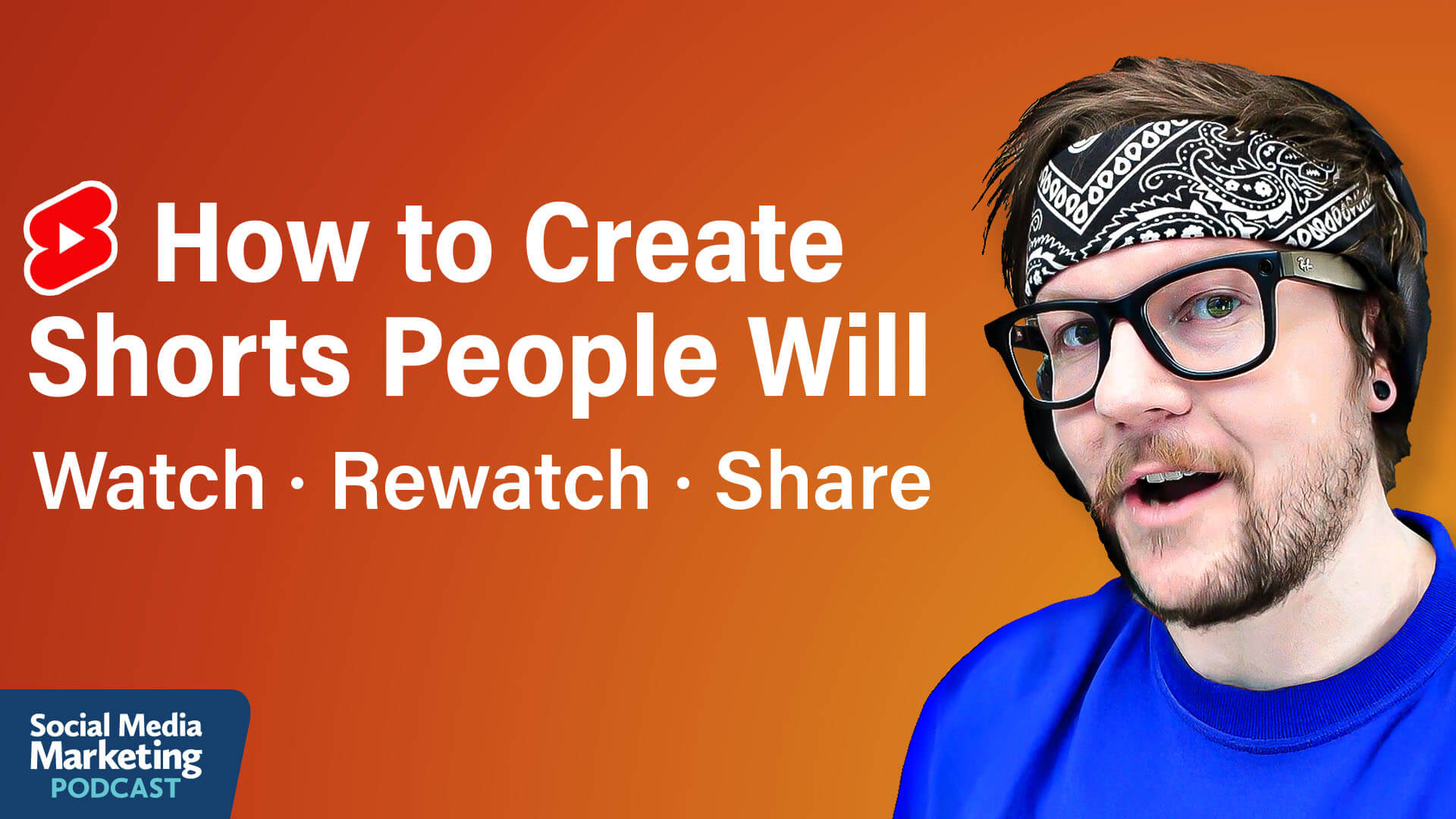
Want more leads from YouTube Shorts? Wondering how to create YouTube Shorts that get more than a thousand views?
In this article, you'll discover techniques produce YouTube Shorts that people will watch, rewatch, and share.
This article was co-created by John Scott and Michael Stelzner. For more about John, scroll to the end of this article.
Are You Using YouTube Shorts Wrong?
The business case for marketing with YouTube Shorts is hard to ignore. YouTube is a pure video platform owned by Google, the world's number one search engine. That means your Shorts can surface not just on YouTube but also in Google search results.
Yet, John Scott says YouTube Shorts is the most underutilized platform in marketing. Not because it doesn't work, but because most businesses are approaching it completely wrong.
Every platform optimizes for the metrics that match its design. Instagram prioritizes sharing. Its seamless DM feature makes it easy to send Reels directly to friends, so sharing is what the algorithm rewards.
YouTube has no equivalent to DMs, so it optimizes for something else: watch time. The longer a viewer stays on your video before swiping away, the more YouTube rewards you with additional impressions and distribution.
Get this right, and you can build genuine trust and brand loyalty with viewers, not just raw exposure. Below, you’ll find tips to help.
#1: Shift From a Promotional Mindset to a Value-First Mindset
The single biggest mistake businesses make is treating YouTube Shorts as a promotional tool designed to sell something or drive traffic to a landing page. Essentially, using organic Shorts as ads.
Shorts viewers, however, open the Shorts feed to learn something quickly or be entertained without leaving the feed. When a Short feels like a commercial, those viewers swipe away.
So, when YouTube pushes your ad-like Short to a seed audience of roughly 1,000 viewers to test performance, and those viewers swipe early because the content feels like an ad, the low retention signals to YouTube that the video isn't worth promoting further. Your Short fails to gain traction.
Whether through entertainment or education, the overarching lesson here is that you need to focus on a value-first approach for every Short you create. John offers the additional insight that every Short should also stand on its own as a
To illustrate how you can use Shorts to market a product and drive traffic to your website, John describes a Short he recently saw promoting a men’s hair styling product.
The video opens with a top-down shot of a man's head as a hand enters the frame holding a can of powder. The hand tips the can over, dumping powder all over his head and face, creating a chaotic, messy moment that immediately grabs attention. Then water is added, making it even worse. Next, a woman’s hand rubs the top of his head, and she holds up her hand to reveal the mess. The scenario is entertaining enough to stop the scroll; it's funny, chaotic, and it gives viewers a little hit of dopamine from the humor.
Then, almost immediately, the next shot shows his head looking clean and smooth, and includes a simple line of text: “Link in description.” That brief pivot from entertaining chaos to a solution is effective, enabling a sale without ad-like content.
3 Days of World-Class Training—Zero Travel!

Couldn't make it to Social Media Marketing World and AI Business World this year? Get all of the great content at a fraction of the price with a Virtual ticket.
That’s full access to recordings of every keynote, workshop, and session—the ones people travel thousands of miles to see. Don't wait. Get your Virtual ticket and enjoy actionable content that you can watch anytime, anywhere.
A related mistake is using Shorts as trailers for longer content.
Shorts viewers don't want to leave the feed, and YouTube doesn't want them to leave either, so ending a Short with “Check out my full video for more” is a fast path to low retention. The exception in this instance is using Shorts to share a podcast or video clip that delivers complete value on its own.
#2: Structure Your YouTube Shorts With Curiosity Loops
In Shorts, the moment you raise a question in the viewer's mind and leave it unanswered, you’ve opened a curiosity loop. The loop doesn't close until you provide the answer. The tension between the two instances is what drives watch time.
The structure of a curiosity loop is found in a story.
Storytelling has a reputation for being complicated, and it can be, but for 30- to 60-second marketing shorts, it’s best to simplify your story to an obstacle followed by a solution. The obstacle is the conflict or problem that creates tension. The solution is how it gets resolved.
In the hair product Short, the mess on the head is the obstacle, the smooth application of the product is the solution, and the “link in description” line is the briefest possible call to action. Three beats deliver a complete story.
Pro Tip: The most important factor in your story is audience perspective. Most people scrolling the Shorts feed aren’t specialists in what they’re searching for. They don't understand industry jargon, technical frameworks, or niche-specific terminology. As you structure your story, you need to find the part of your story that any person would immediately understand, find intriguing, or relate to. If a layman wouldn't get it, the loop won't open.
#3: How to Model Successful Curiosity Loops
The first step is to stop the scroll. That's where hooks come in. Text, audio, and visual hooks can be stacked or used independently; a single strong hook can be enough to stop a scroll.
Audio Hooks: This isn’t simply what you hear in the first few seconds of a Short. It’s what you hear that makes you curious. Someone saying their name is audio. Someone saying, “I just found a dark secret!” is an audio hook.
Visual Hooks: What do you see that creates immediate credibility or intrigue? What is visually present that makes you want to watch the entire short?
Text Hooks: John believes text hooks are the most underutilized type. A text hook is a phrase that appears on screen and sets the narrative plot, essentially telling the viewer that something specific is about to unfold. Critically, it's not what you're saying out loud. It's the subtext to the situation, a layer of meaning that sits beneath the spoken words and reframes everything the viewer is watching.
For example, imagine a Short with this line on screen while a marketer appears to be having a normal client conversation. “What marketers say to their clients vs. what they want to say.” The viewer now knows the spoken words aren't the whole story, so they stay to find out what the marketer is really thinking. The text hook creates a gap between what's visible and what's real, and that gap generates powerful curiosity.
To craft a scroll-stopping hook structure, the starting point isn't brainstorming from scratch. It's studying what's already performing. Find a viral Short from within or outside your niche, identify what hook it used, and ask how you can apply that same structural dynamic to your topic or niche.

Want to Unlock AI Marketing Breakthroughs?
If you’re like most of us, you are trying to figure out how to use AI in your marketing. Here's the solution: The AI Business Society—from your friends at Social Media Examiner.
The AI Business Society is the place to discover how to apply AI in your work. When you join, you'll boost your productivity, unlock your creativity, and make connections with other marketers on a similar journey.
Here's an example:
This Short opens with the line: “These are the top three businesses with the lowest failure rate.” That's a powerful audio hook. Why does it work? The listicle format triggers a specific psychological pull: viewers feel compelled to stay to hear the third item. Visually, the speaker is standing in front of an expensive car and holding cash, which instantly signals credibility and authority. The text hook in this example is notably absent.To adapt this hook, John replaces the category and the qualifier. “Businesses” becomes whatever niche category applies to you. “Lowest failure rate” becomes the most relevant benefit or outcome in your field.
For a creator teaching YouTube Shorts strategy, that becomes: “These are the top three Shorts niches with the highest payout.” Same structural mechanics, completely different application.
For a toy store, it becomes: “These are the top three toys kids love that cost parents the least.”
Pro Tip: John's tool, HookBomb, is designed to surface viral hooks across the Shorts feed and show marketers and creators how to adapt them.
#4: Tips to Establish, Open, and Close Curiosity Loops
To establish the substance of your curiosity loop, look at a story or insight you want to share and ask, “What is the single most unexpected or puzzling element of this?”
This is your angle. Front-loading the angle in your Short opens the curiosity loop.
3 Ways to Open Curiosity Loops
I wish I had known this before I [built/started/tried] [niche activity]. This phrase immediately signals to the viewer that something went wrong and that an obstacle is coming, one they can avoid by watching to the end.
But/Therefore statements. This structure chains conflict to resolution in a rhythm that keeps viewers engaged. “I was doing this, but then this happened, therefore I did that.” Every “but” opens a new conflict and extends the curiosity loop,
Pairing two unexpected elements establishes intrigue and elicits curiosity.
John used that opening with a real estate client whose first attempt at a Short explained their marketing strategy, shared some numbers, and then talked about how they helped a client overcome challenges and eventually sell a house.
That’s a lot for one Short in the Shorts feed. And, recalling John’s note on audience perspective, it’s highly unlikely that anyone scrolling through Shorts and thinking about buying or selling a house is thinking about real estate marketing metrics.
The same client had a much simpler story. Competing agents kept pulling her for-sale yard signs out of the ground. She eventually solved it by buying a specialized tool that let her drive signs deeper, making them nearly impossible to remove.
In its boring version, that story is: “My signs kept getting ripped out, so I bought a tool to put them in deeper. The end.” There's an obstacle/conflict and a solution/resolution, but nothing to create curiosity. John reframed that story as: “Somebody keeps ripping my for-sale signs out of the yards. So I bought a baseball bat.”
A baseball bat has nothing to do with real estate signs, and that's exactly the point. A viewer’s brain immediately jumps to an unexpected scenario. Is she going to wait in her car and confront whoever is doing this? The viewer has to stay to find out what actually happens.
The resolution is that she uses the bat to hammer the signs deeper into the ground, making them nearly impossible to remove. It lands as a funny, satisfying twist. The story went from forgettable to viral-worthy by leading with the single most unexpected element and letting the resolution pay it off.
How to Close Curiosity Loops
John closes curiosity loops differently depending on whether the Short is primarily entertaining or educational.
Entertainment-focused Shorts close with a punchline or twist that subverts expectations just enough to leave the viewer surprised yet satisfied.
Educational Shorts end on the key insight or takeaway, the piece of value the viewer was promised when the loop opened.
Pro Tip: John advises against asking for likes, comments, or subscriptions at the end of a Short. In his experience, that tacked-on CTA breaks the story's momentum and actually suppresses organic engagement. When viewers are genuinely satisfied by the content, they’ll engage on their own.
John Scott is a YouTube Shorts expert and creator coach who helps marketers and entrepreneurs build audiences and grow their businesses through short-form video. He is the founder of hookbomb.com. Follow him on YouTube.
Other Notes From This Episode
Connect with Michael Stelzner @Stelzner on Instagram and @Mike_Stelzner on X. Watch this interview and other exclusive content from Social Media Examiner on YouTube.Where to subscribe: Apple Podcasts | Spotify | YouTube Music | YouTube | Amazon Music | RSS
✋🏽 If you enjoyed this episode of the Social Media Marketing podcast, please head over to Apple Podcasts, leave a rating, write a review, and subscribe.
Stay Up-to-Date: Get New Marketing Articles Delivered to You!
Don't miss out on upcoming social media marketing insights and strategies! Sign up to receive notifications when we publish new articles on Social Media Examiner. Our expertly crafted content will help you stay ahead of the curve and drive results for your business. Click the link below to sign up now and receive our annual report!

Curious About How to Use AI?
Our newest show, AI Explored, might be just what you're looking for. It's for marketers, creators, and entrepreneurs who want to understand how to use AI in their business.
It's hosted by Michael Stelzner and explores this exciting new frontier in easy-to-understand terms.
Pull up your favorite podcast app and search for AI Explored. Or click the button below for more information.









![4 Marketing Trends & Strategies That Might Not Survive in 2025 [New Research]](https://www.hubspot.com/hubfs/marketing%20trends%20that%20might%20not%20survive%202024.png)
_1.png)












.jpg&h=630&w=1200&q=100&v=c0f97a310e&c=1)