Love Letters from Rain
Using indigo and micronized silver, multidisciplinary artist Miya Ando crafts odes to the ephemerality of natural phenomena. The post Love Letters from Rain appeared first on Tricycle: The Buddhist Review.
 Kass
Kass
As a child growing up in Japan, Miya Ando once encountered a term for rain that utterly mystified her: kitsune no yomeiri, or “fox wedding rain.” When it rains while the sun is shining, her grandparents told her, foxes have their wedding ceremonies. “I was shocked that there existed a word so specific for that type of rain,” she writes.
The moment stayed with her, as did the sense of wonder and reverence it inspired. In the decades since, Ando has carried this spirit of reverence into her work as a multidisciplinary artist, dedicating much of her career to examining and expressing the fleeting beauty of transient phenomena. Ando’s latest project, Water of the Sky: A Dictionary of 2,000 Japanese Rain Words, turns in particular to the ways that rain has been described and understood across millennia. Drawing from Buddhist rain sutras, Heian poetic anthologies, and regionally specific expressions from throughout Japan, Ando presents 2,000 Japanese terms for rain and their English interpretations, as well as accompanying drawings that aim to convey not only each type of rain but also the kind of physical and emotional transformation it might enact in observers. Through compiling vast visual compendia, Ando explores how attention to everyday phenomena like rain can invite wonder and awe—and what these fleeting phenomena can teach us in turn about our own impermanence.
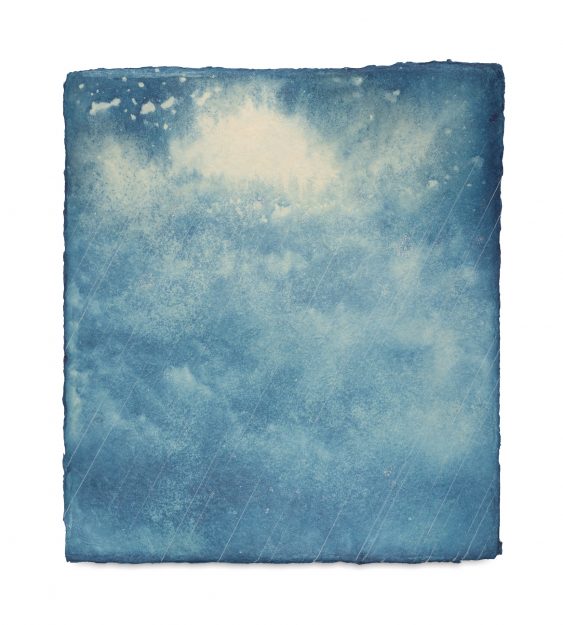 0126_Kitsune no Yomeiri (Rain That Falls Even Though The Sun Is Shining / The Day That Foxes Have Their Wedding Ceremony), 2021, natural indigo dye, micronized pure silver, graphite, Kozo paper. Courtesy Miya Ando
To honor the sacred and mystical dimensions of rain, the collection takes its title from an ancient Japanese term for rain, ama no mizu, which literally translates to “water of the heavens.” This mystical focus guides Ando’s selection of source materials as well, which reflect her own biography and the many influences that have shaped her path. In a nod to her Buddhist upbringing, the dictionary contains a number of expressions associated with Buddhist rain sutras and rain deities, including at least two dozen amagoi, or prayers for rain (for instance, Ama No Gawa Nawashiro-mizu Ni Sekikudase Amakudarimasu Kami Naraba Kami (“Open, O God, the Celestial River, the Milky Way, to Send Water to the Rice Fields”—The Priest Noin’s Poem That Was Used as a Rain Prayer) (#1876)). Inspired by her mother and grandmother’s practice of tea ceremony, she includes an assortment of Zen idioms (zengo) that use rain to communicate metaphysical teachings on the precarity of existence, like Ame Narazu Shite Hana nao Otsu (“Even If There Is No Rain, Petals Will Fall”) (#1559). In addition, Ando sourced a variety of terms from the writings of Heian-period women poets that her mother introduced her to at a young age, many of which are seasonal observations, linking rain to the blossoming of wisteria or the waxing and waning of the moon. A number of the words are hyperlocal to particular regions and dialects; many are archaic and have fallen almost entirely out of use (the earliest entries date back to 720 CE; the most recent, from the 20th century, is kuroi ame, which describes the black rain that fell on Hiroshima following the atomic bomb). Through her expert curation, Ando shines light on language that no longer exists and resurrects lost or forgotten ways of seeing and experiencing the world.
As a Japanese American artist, Ando has long been fascinated by the lexical gaps, or lacunae, that exist between languages and cultures. A sixteenth-generation descendent of Bizen swordsmiths turned priests, she split her childhood between her grandfather’s Nichiren Buddhist temple in Okayama, Japan, and the Santa Cruz Mountains of California. This experience growing up between cultures instilled in her a sense of how language can communicate the underlying philosophy of a culture, and in particular how lexical gaps can offer a window into differing cultural value systems. “When you truly value something, you give it a name,” she told Tricycle’s editor-in-chief, James Shaheen, on a recent episode of Tricycle Talks. “So this is a way to look at what we value in one society versus another.” For Ando, art offers one way of drawing attention to these gaps and gesturing toward what we can learn from concepts we don’t have the words for.
 0372_Ame no Inori (Rain Prayer / Praying to the Gods and the Buddha for Rain), 2021, natural indigo dye, micronized pure silver, graphite, Hahnemühle paper
In exploring these gaps Ando’s work is often meditatively serial—her collection of moon drawings has more than 1,500 entries, and she recently completed a series of illustrations of the 498 aspects of the rainy moon—and in this respect she follows in the tradition of generations of Japanese artists before her who have turned their attention to the changing of the seasons in minute detail. (This summer she exhibited a show on the traditional seventy-two microseasons, an ancient Japanese calendar where the year is divided into five- to six-day intervals that track the emergence and disappearance of various flora and fauna; Ando first learned of this way of marking time from her grandmother, who, as an Urasenke tea master, carefully observed all seventy-two seasons in her dress and daily life.)
According to Ando, this hyperspecific awareness stems from a reverence for nature and a sense of mono no aware, which she translates as “an empathy for the pathos of transitory things.” “The idea of mono no aware is both a philosophical and aesthetic idea,” she says. “It’s about having a sensitivity to or an appreciation of particularly fleeting things. Why are fleeting things depicted as particularly beautiful? It’s because we are fleeting. It’s an empathy to yourself, and you are no different from these fleeting things like clouds and falling stars.”
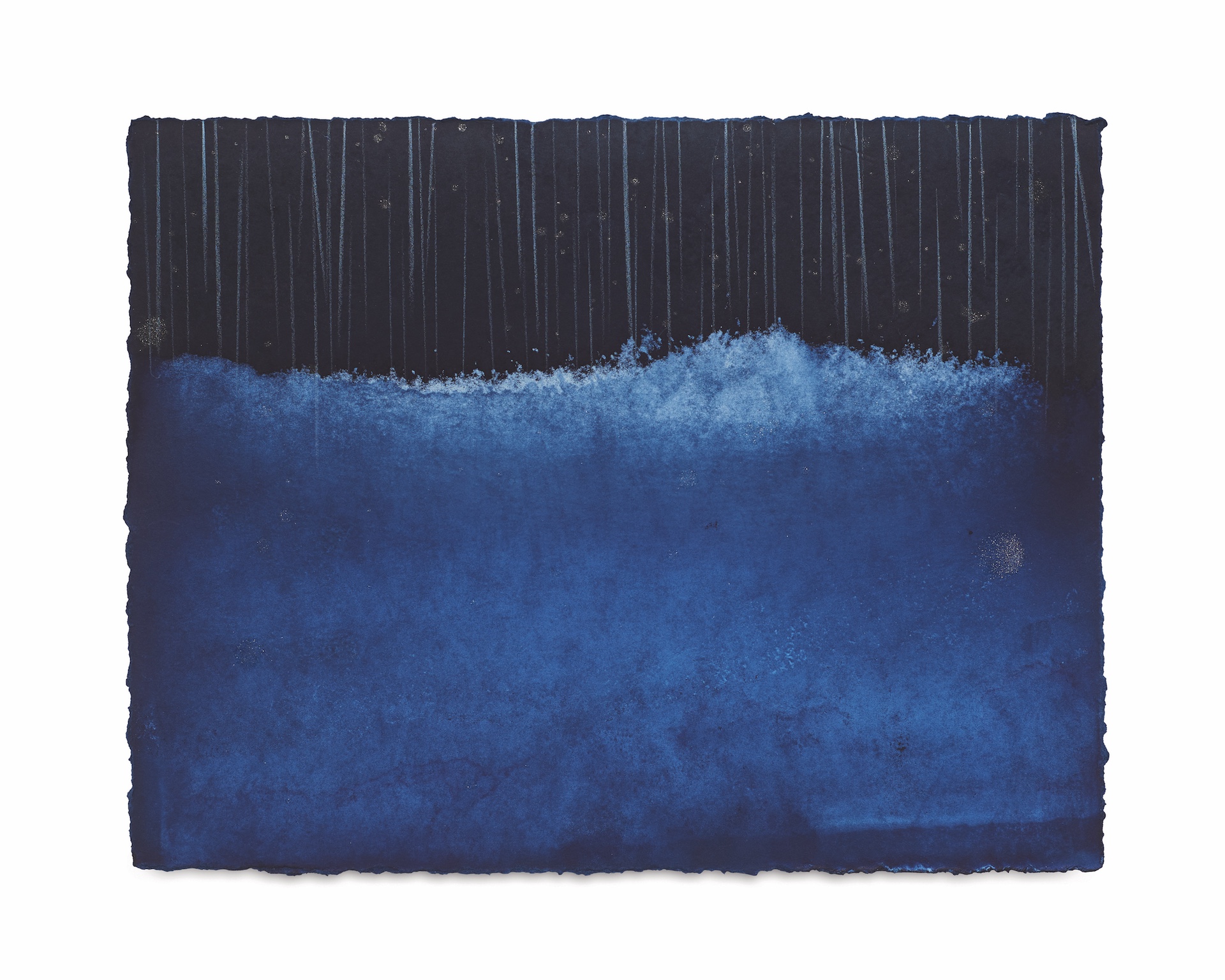
 1152_Sanbaine (A Sudden Evening Storm That Occurs So Quickly, One Has No Time to Make Even Three Bundles of Rice), 2021, natural indigo dye, micronized pure silver, graphite, Hahnemühle paper. Courtesy Miya Ando
This paradox of capturing transience lies at the heart of Ando’s creative practice, as she has spent much of the past two decades chronicling and representing manifestations of impermanence in the natural world. She describes her focus as shinrabansho, literally “the all-covering forest,” or all things in nature that exist under heaven, like clouds, rain, shooting stars, and the cycle of the moon, as how they’ve been recorded and depicted in language and literature. In looking to the rain and clouds as teachers of impermanence, she takes a cue from the 15th-century monk Ikkyu Sojun, who writes, “Let us learn to read the love letters sent from the wind, rain, snow, and moon, rather than studying complicated things, such as sutras.”
“It’s just a perception shift to think about how the natural world is a mirror of our own lives and our own impermanence,” she told Tricycle. “You just look at the seasons changing and rain and things that are evanescent—it mirrors our own evanescence. In this context of mono no aware, impermanence and death and dying are not nihilistic. It is an opportunity to be aware of the present moment, and you feel lucky that you saw something particularly evanescent in nature, like a shooting star or falling petal or momiji leaf.”
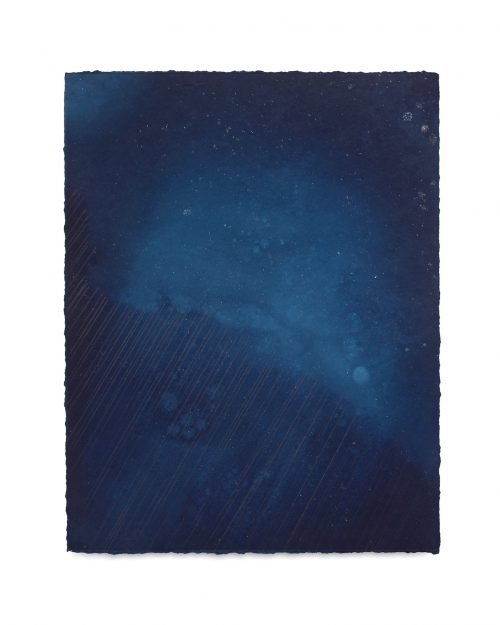 0222_Tsukishigure (Rain in the Moonlight), 2021, natural indigo dye, micronized pure silver, graphite, Hahnemühle paper. Courtesy Miya Ando
This evanescence extends to Ando’s choice of materials for the drawings that accompany the compendium: In order to depict such an elusive subject matter, she uses micronized silver, which reflects light differently based on the time of day, and traditional indigo dye, which she describes as a natural clock. “The longer a material is submerged in this dye, the deeper the hue,” Ando writes. “Conceptually, therefore, it is a material that both records and communicates time’s passage.” She describes the resulting visual interpretations of the terms as evocations rather than illustrations, as they attempt to embody the ephemeral nature of each form of rain.
Ando’s astute attention to impermanence becomes particularly poignant in light of climate change—not only are many of the terms falling out of use, but the types of rain they describe are changing or disappearing altogether due to shifting weather patterns. To this end Ando views her work as an “extinction diary” or time capsule, preserving and passing down knowledge that might otherwise be lost to time. In this way her project suggests how close ecological awareness can invite care and compassion, a lesson that becomes all the more important as we contemplate our dying planet.
 1354_Ushō (To Sing While Being Rained upon and Wet from the Rain), 2021, natural indigo dye, micronized pure silver, graphite, Hahnemühle paper. Courtesy Miya Ando
Perhaps this is one of the greatest gifts of Water of the Sky: that Ando’s own careful observation might instill in her viewers a similar posture of attention and devotion to the fleeting phenomena that make up our lives and our ever-changing world. Through the collection’s rich vocabulary for the minutia of existence we might discover new language for everyday wonders that usually escape our notice. Like Ando’s childhood wonder at the notion of fox wedding rain, we might encounter new ways of seeing that change how we relate to manifestations of impermanence, whether a falling raindrop or the inevitability of our own demise. And perhaps, following the example set by Ikkyu Sojun—and Ando herself—we might learn to read the love letters sent by transient things—and savor their beauty while we can.