Raising Happy Children In Challenging Times: Practices that Build Essential Skills For Well-Being
Can you build your child’s capacity to be more inclined towards well-being, even during seasons of difficulty or uncertainty? Teachers Wendy O’Leary and Helen Maffini say yes, and offer three everyday practices you can try today for raising happy...
 Astrong
Sometimes happiness might seem like a stretch—for us and even for our children. The stresses of daily life, getting out the door in the morning, managing a household, coordinating schedules, as well as the bigger issues, including concern about the struggles in the world, can all take a toll on us as adults. Given the increasing issues with children’s mental health, we know it’s taking a toll on our children as well.
And yet, amid difficulties, happiness is still attainable and essential to well-being and resilience. Research on adult well-being shows that there are specific steps we can take to develop and nurture happiness.
As James Baraz writes, joy is “a general feeling of aliveness and well-being that is characterized by meeting ups and downs in life with authenticity and perspective.”
Based on our work with children, we know this is true for them, as well. It can be as simple as enjoying a hug, being mesmerized by a ladybug, or giggling at the shape of a cloud. These simple pleasures can be little moments of joy for our children and for us—and they can be a part of raising happy children who are resilient, even in the middle of normal ups and downs.
Not Denying Difficulty, But Opening to Possibility
When we talk about raising happy children, we are not talking about “happiness” as the fleeting emotion that is a response to good or fun things. We are not suggesting pushing difficulties aside, but instead developing the capacity to hold them alongside our well-being. As James Baraz writes in Awakening Joy, joy is “a general feeling of aliveness and well-being that is characterized by meeting ups and downs in life with authenticity and perspective.”
We envision a happy child as one with a developing sense of ease with themselves, one who often sees and enjoys the good around them and within themselves.
Happiness is not a destination or something to be achieved, but rather what Chang Meng Tan, author of Search Inside Yourself, defines as “a deep sense of flourishing that arises from an exceptionally healthy mind.”
We envision a happy child as one with a developing sense of ease with themselves, one who often sees and enjoys the good around them and within themselves.
Research by the Center for Healthy Minds shows that well-being is a learnable skill. There are multiple evidence-based perspectives offering practical ideas for cultivating happiness.
In particular, The Resilience Project by Hugh Van Cuylenburg focuses on gratitude, empathy, and mindfulness to support resilience and happiness. The Action for Happiness Project has a similar focus and lists mindfulness, gratitude, and kindness as core skills. In Hardwiring Happiness, Rick Hanson adds to this list and stresses the importance of inclining the mind, or being on the lookout, for happiness and then taking it in.
Raising Happy Children Starts by Building Well-Being Skills Together
Here are three fun activities based on these frameworks to try with your child.
Inclining The Mind And Taking It In Practice: Glimmer Wand
Glimmers, coined by Deb Dana, are little moments of peace, safety, and happiness.
Cut out, decorate, and glue a star on top of a popsicle or other stick. You can write “catching glimmers” on the star. Share about glimmers and use the wand to “cast a spell” to notice and enjoy glimmers that day. You can also wave it overhead as people share their glimmers and how they make them feel.
The brain has a negativity bias. By pausing to seek out glimmers, we can train our brains to notice and savor delight more often.
Gratitude Practice: Gratitude Sandwich
Children can draw and cut out pictures of five things or people they are grateful for as their sandwich fillings.
Cut two pieces of paper for the sandwich bread.Glue one piece of the “bread“ to the top and one to the bottom of a poster. Paste the fillings between the bread (or Velcro so it’s interchangeable).Write Gratitude Sandwich and “I am grateful for…” on the “bread.”Leave the sandwich somewhere visible and use it as a conversation starter about gratitude.Dr. Robert Emmons at UC Davis found that feeling gratitude can move our nervous system out of the stress response. Giving children a visual link to things that foster feelings of gratitude can help strengthen the body-brain connection and develop positive neural pathways.
Cultivating happiness can be quite simple if we focus on it, even when things are hard. Pausing to notice and take in the good, feeling gratitude, and connecting with others with empathy and kindness in the tiny moments of our day can make a genuine difference.
Connection Practice: Links of Love
Have the child think about five people who make them feel loved or happy.
String a bead for each person onto a pipe cleaner. Twist the ends together so the beads don’t fall off. These are links of love.Have them touch one bead at a time and remember the special person. Take a breath in, taking in their love, and out, offering love back to them.Encourage them to notice how they feel. The links of love can be attached to a backpack, worn around a wrist, or left in a visible location.Especially when a child feels lonely or insecure, having a physical anchor can remind them that they are worthy and loved.
Tuning Attention Towards Happiness
Cultivating happiness can be quite simple if we focus on it, even when things are hard. Pausing to notice and take in the good, feeling gratitude, and connecting with others with empathy and kindness in the tiny moments of our day can make a genuine difference.
Fun, hands-on activities, like those above, can help both adults and children lean into happiness and create space for more joy in our lives.
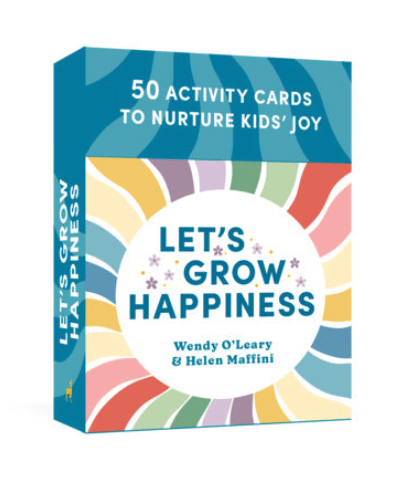
Would you like more support building habits of well-being and resilience in your child? Try our new card deck, available April 21. Let’s Grow Happiness includes 50 activity cards to help kids build gratitude, self-compassion, and emotional regulation skills.