Researchers Explain What The Redness On Your Face Actually Is
Is rosacea or sensitive skin to blame?
 Koichiko

Image by iStock Alona Siniehina May 10, 2026 If your skin stings, burns, or flushes at the slightest provocation, you've probably wondered whether you're dealing with sensitive skin or rosacea. Both conditions involve facial redness and reactivity, making it difficult to distinguish between the two. This confusion led researchers to ask the question, do sensitive skin and rosacea share the same underlying mechanisms? Or are they they distinct conditions that just happen to look similar? The findings were just published in the Journal of the American Academy of Dermatology.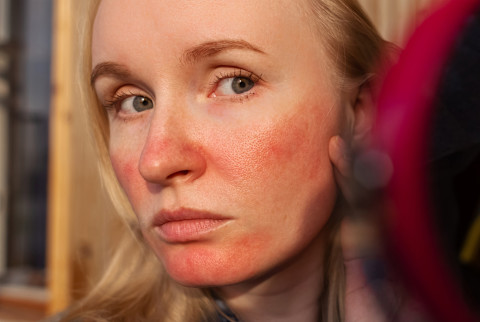
Sensitive skin & rosacea have different biological fingerprints
Researchers recruited 30 participants: 15 with self-reported sensitive skin and 15 without. They measured the amount of tiny organisms that live on facial skin called Demodex Mites, as well as two antimicrobial peptides, cathelicidin and dermcidin, that play key roles in skin's immune defense. Demodex mite overgrowth and elevated cathelicidin are already well-established drivers of inflammation in rosacea. The question was whether sensitive skin follows the same pattern.
The researchers found that Demodex mites were present in 20% of both the sensitive skin group and the non-sensitive group, with no difference at all. This presented a sharp contrast to rosacea, where Demodex overgrowth is a hallmark feature.
Even more telling, cathelicidin and dermcidin levels were actually lower in the sensitive skin group compared to those without skin sensitivity.
In rosacea, these antimicrobial peptides are typically elevated and contribute to the inflammation that causes persistent redness and flushing.
Looking at these findings, the researchers realized that sensitive skin stems from impaired barrier function and heightened nerve sensitivity, rather than the immune dysregulation and mite overgrowth that characterize rosacea.
Why rosacea treatments may not work for sensitive skin
This distinction might not matter much when you're looking in the mirror, but it does when it comes to your skincare routine.
Many rosacea treatments specifically target Demodex mites (like ivermectin) or aim to calm the overactive immune response. But if your skin sensitivity is rooted in barrier dysfunction and neurosensory issues, those approaches may have no effect.
For sensitive skin, the focus should shift toward repairing and protecting the skin barrier. Think gentle cleansers, ceramide-rich moisturizers, and avoiding known irritants like fragrance and harsh active ingredients. Calming ingredients like centella asiatica and niacinamide may also help soothe reactions.
How to tell which condition you're dealing with
Both conditions involve facial redness, but there are some key differences to keep in mind:
If you're unsure, a dermatologist can help distinguish between the two. Rosacea is a clinical diagnosis based on visible signs, while sensitive skin is often identified through patient-reported symptoms and patch testing.
The takeaway
Sensitive skin and rosacea may look similar on the surface, but this research suggests they have fundamentally different biological drivers. If you feel like your skin is always inflamed but rosacea treatments aren't helping, this is your sign to shift your focus toward barrier repair and nerve-calming strategies for sensitive skin instead.





















.jpg&h=630&w=1200&q=100&v=c0f97a310e&c=1)