‘Erasure’ and Other Poems
Three poems by the Taiwanese writer Chen Yuhong The post ‘Erasure’ and Other Poems appeared first on Tricycle: The Buddhist Review.
 JaneWalter
Chen Yuhong is one of the most prominent contemporary poets in Taiwan. Though her work has been translated into a number of languages including Japanese, French, Dutch, and Swedish, until this year it had yet to be published in English. With Impossible Paradise, translators George O’Connell and Diana Shi present nearly three decades of Chen’s poetry in English for the first time.
For Chen, translation is fundamental to the creative process, and in addition to having her own work translated, she has translated into Chinese works by Louise Glück, Anne Carson, Sappho, and Matthieu Ricard. Her translation informs her own poetry, and both hinge upon the practice of attentive listening. “As a translator, I mediate between two languages and cultures, trying to carry across the voice I hear in the host language to the target language,” she told Poetry Nation Review. “As a poet, I feel the impulse to write, to channel that voice that I hear inside, inspiration you may call it, faithfully into the present, like Pythia repeating Apollo’s words. I translate, I create, and I re-create.”
In her own writing, Chen draws inspiration from classical Chinese poets including Li Bai and Li Qingzhao, as well as Buddhist and Daoist sutras. As a child she was raised Catholic, but as she grew older, she turned to Buddhist texts to address her lingering questions about death and reincarnation. “They offered me a different way to look at the world, teaching me the impermanence of life and sunyata, or emptiness,” Chen says, though she acknowledges that many of her questions still remain unanswered—as she quips, “Will I ever have an answer to all my questions about life and death? Perhaps not.”
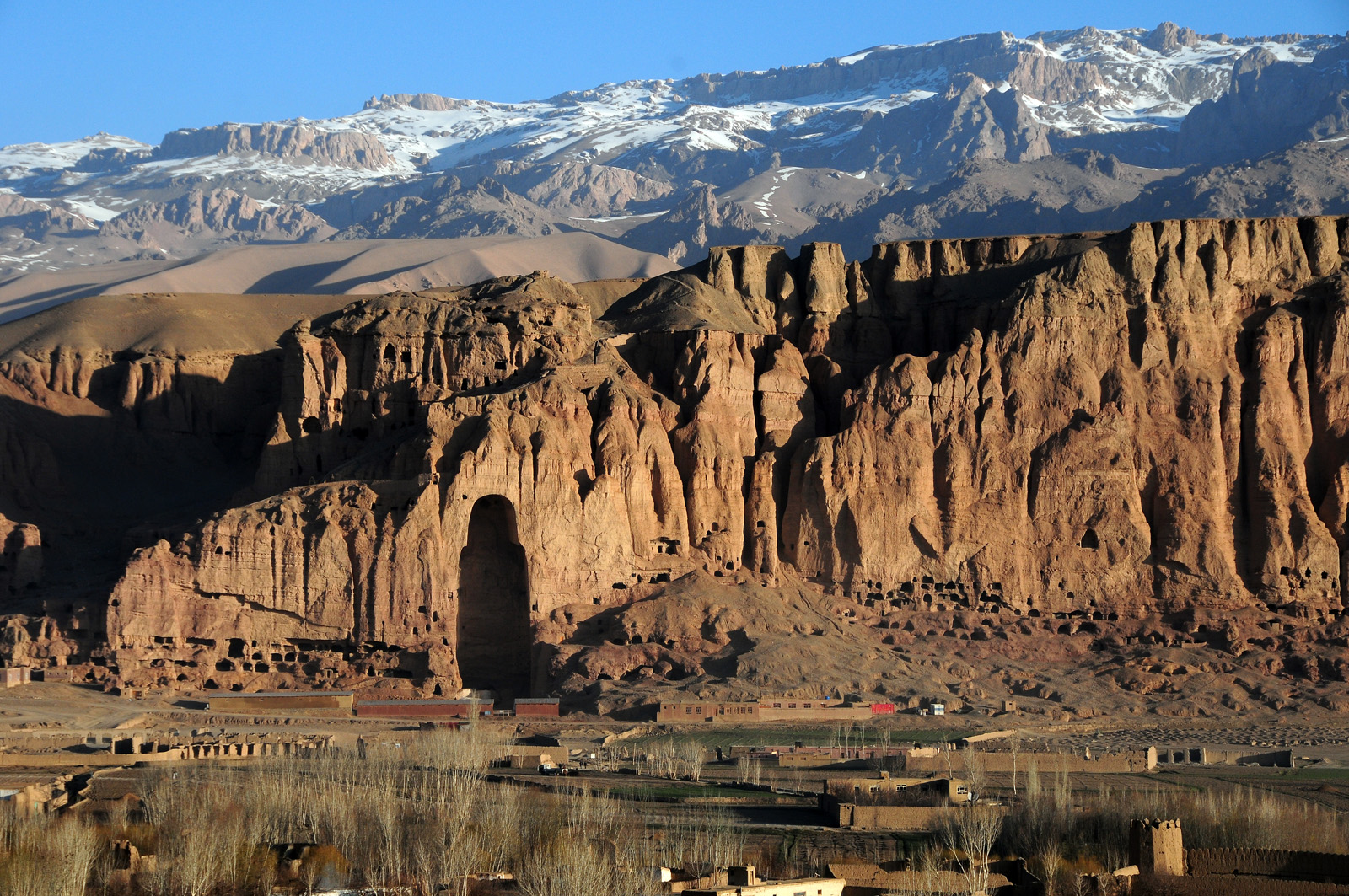
Chen’s poetry similarly resists definitive answers and instead makes space for contradiction and paradox, like the destroyed Buddha statue that lives “amid rubble, amid the broken, / amid the colossal task.”
–Sarah Fleming
Buddhist Pine
Taipei, November
1.
In lotus posture
it blends with the lichen,
a meditative painting
more tranquil than a cat
and closer to the cleanness of rain,
the tranquility of stone,
undisturbed by birds or insects,
inside, outside time and space,
ambiguous,
polysemous,
a feline plant
my Buddhist pine.
2.
Winter, spring,
seasons leave no trace.
This winged apsara, three chi tall,
as if a sacred canopy, its green peaks
mimicking a mountain range,
staunch as a young Greek spear-bearer
in balanced antitheses.
A form so classical
withstands weather
and the flickered shadow
of a passing butterfly.
Daylight’s white paper
leaves no trace, nor the sound
of cars, people, dogs.
Erasure
In March 2001, the Taliban destroyed two immense 6th-century Buddhas carved into a cliff face at Afghanistan’s Bamyan site. One was called “The Immortal.”
A colossal task,
twenty days
digging and chiseling Buddhas
from the cliff face,
packing explosives
to ensure Buddhas’ brains
limbs, ribcages, bellies
are wholly blown to dust.
Twenty nights they pray
to make sure
the immortal’s made mortal.
When the smoke thins
all’s shattered.
The residents keep farming
and two white doves land in one Buddha’s
empty niche.
All’s normal,
the bodhisattva’s mind ethereal space
where everything’s relinquished.
Buddha lives amid rubble, amid the broken,
amid the colossal task.
Necessities
The necessity of living, of freedom, idling, taking a stroll,
daydreaming in a trance
The necessity of no phone, no TV, but reading, pausing, seeing and hearing,
drinking tea, birdsong in the tree of longing
The necessity of mindfulness, of the ocean, of fine drizzle gently settling
on a parasol tree, shadows, the spells of wind, flowers, snow, the moon
The necessity of Bach, of a little willfulness, of yes and no, of writing,
of the glass skylight
The necessity of space, emptiness, time, devotion, of Giorgio Morandi
and Willem de Kooning
The necessity of being fickle, suspicious, light and minimal, of cleanness,
visual perspective, slowness
The necessity of the insipid, of beauty, writing poetry, accepting spiders
and lizards, ice and fire
The necessity of hunger, of two weeks indoors, of cutting the hair short,
of hot springs, of questioning
The necessity to walk tightropes, be fragile or soft, to be oneself,
to come and go alone
The necessity for a falling sky to be held aloft, for despair, ecstasy,
night, stone, appearances
The necessity to be acute, to see how small the self, to sense slight loss,
to not write poems
The necessity of parting from life and death, from knowing how time drifts
in the dark, of middle age, of wandering, of being without desire
The necessity of waiting for a flower’s bloom, of retention, of forgetfulness,
of being logical and illogical
The necessity of listening to one’s heartbeat, of letting go, of going astray,
of exhaustion, of looking death in the eye
The necessity of imperfection, of reading all the Heart Sutra,
of earning the trust of a street dog, of being slightly neurotic
The necessity to be a bit eccentric, to feel without seeming to,
to write poetry with distance and no need to explain
The necessity to cultivate a patch of mint, to raise a sweet family,
to have no work uniform, no need to punch in
The necessity of no bird’s nest, no shark fin, of nihilism, of sitting in the back yard
seeing the moon, of the Cloud Gate Performance Workshop
The necessity of New York, of Paris, of someone ruminating at ten below zero,
of not considering firewood, rice, oil, salt
The necessity to walk ten li for a cup of coffee, to write from memory
one hundred Tang poems, to be exquisite, to wear loose clothes
The necessity of flowers fallen on the path unswept for a guest, of being desireless, of not
writing poetry, of Confucius, Laozi, and Zhuangzi
The necessity of Ya Xian, Luo Fu, Zheng Chouyu, of being out of place,
being of this time this moment, of consulting an old gardener
The necessity of simmering a pot of lily, red dates, and longan porridge,
of writing poetry, of not writing poetry, of living
♦
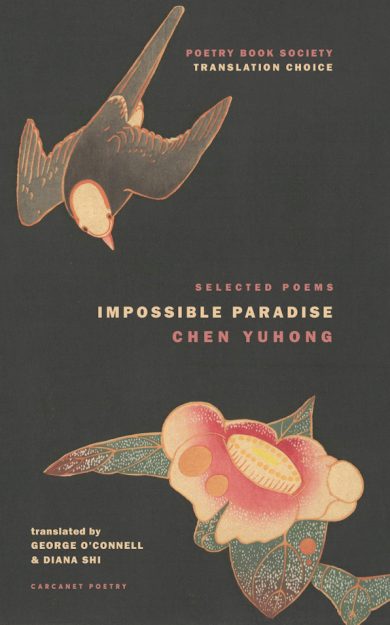
From Impossible Paradise by Chen Yuhong, translated by George O’Connell and Diana Shi. Reprinted by permission of Carcanet Press.