AEO Tools Compared: How to Choose an AI Search Visibility Platform
Compare HubSpot AEO, Scrunch, Profound, and Peec AI, and learn which AI search visibility features actually matter before choosing an AEO platform.
 Netzender Editorial Team
AEO tools are evolving from simple prompt trackers into full AI search visibility platforms. The better products now help teams monitor brand mentions, citations, competitors, AI crawlers, referral traffic, and the pages most likely to influence AI-generated answers.
But the category is still young, terminology is inconsistent, and feature lists change quickly. A tool that looks comprehensive on a pricing page may still be weak for the particular questions your team needs to answer.
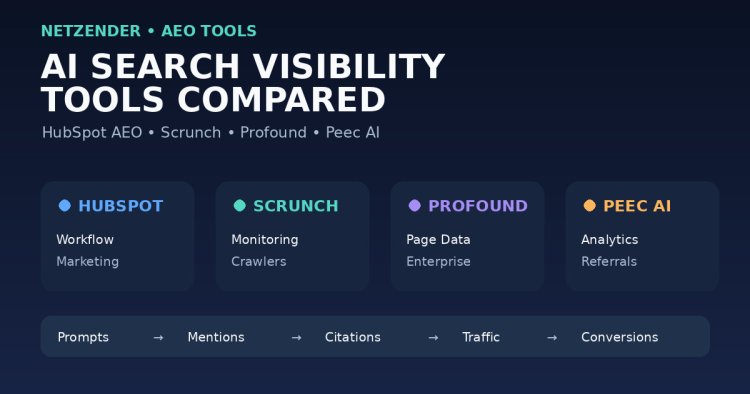
This guide compares four notable platforms — HubSpot AEO, Scrunch, Profound, and Peec AI — and, more importantly, explains what to evaluate before choosing any AEO or AI search visibility platform.
The goal is not to declare one universal winner. Different teams need different combinations of monitoring, diagnostics, attribution, workflow, and scale.
What Is an AEO Tool?
An Answer Engine Optimization tool helps marketers understand how a brand or website appears in AI-generated search and answer experiences.
Depending on the platform, that can include:
- tracking prompts;
- measuring brand mentions;
- tracking citations;
- comparing competitors;
- analyzing cited domains and URLs;
- monitoring AI crawlers;
- measuring AI referral traffic;
- finding content gaps;
- recommending pages to improve;
- monitoring sentiment or brand perception;
- reporting by model, country, topic, or persona.
AEO overlaps with GEO, LLM optimization, AI visibility, and traditional SEO. Vendors use different names, so compare actual capabilities rather than product labels.
The Four Platforms Compared in This Guide
| Platform | Strongest Fit | Notable Strength |
|---|---|---|
| HubSpot AEO | Marketing teams already using HubSpot | AI visibility integrated with marketing workflows and recommendations |
| Scrunch | Brands needing broad multi-platform monitoring and crawler visibility | Prompt, source, crawler, site-map, and AI-readiness analysis |
| Profound | Enterprise SEO and AI-search teams | Deep page-level citation, crawler, benchmarking, and agent workflows |
| Peec AI | Marketing and SEO teams wanting accessible AI analytics | Visibility, position, sentiment, source analysis, referrals, and reporting |
These summaries are directional, not absolute. Product capabilities and plans continue to change.
1. HubSpot AEO
HubSpot launched its dedicated AEO product in 2026 as an extension of its broader marketing platform.
Its current documentation describes tracking across ChatGPT, Gemini, and Perplexity. Teams can monitor brand visibility, tracked prompts, mentions, citation patterns, and recommendations designed to identify opportunities for improvement.
HubSpot also allows AEO workflows through its connector, making it possible for eligible users to review AI visibility information and recommendations through supported AI assistants.
Where HubSpot AEO Stands Out
- natural fit for existing HubSpot customers;
- brand visibility reporting;
- tracked prompt management;
- citation analysis;
- competitor comparison;
- recommendations tied to content opportunities;
- integration with existing marketing workflows.
Who Should Consider It?
HubSpot AEO is especially interesting for companies already using HubSpot for marketing, CRM, content, or reporting.
The advantage is not necessarily maximum model coverage. It is workflow integration: AI visibility data can sit closer to the marketing systems the team already uses.
Official references: HubSpot AEO and HubSpot AEO documentation.
2. Scrunch
Scrunch has developed from an AI search monitoring platform into a broader system covering prompts, citations, brand presence, crawlers, technical visibility, and optimization signals.
Its current documentation lists monitoring across major platforms including ChatGPT, Perplexity, Google AI Overviews, Google AI Mode, Gemini, Claude, Microsoft Copilot, Grok, and Meta AI.
Scrunch also provides site-level and URL-level capabilities. Its Site Maps feature can combine crawler discovery, citations, AI referrals, agent traffic, and audit information at the page level.
Its Signals area is designed to surface actionable opportunities instead of requiring teams to manually search dashboards for changes.
Where Scrunch Stands Out
- broad multi-platform coverage;
- prompt and entity monitoring;
- citation and source analysis;
- AI crawler traffic monitoring;
- URL-level analysis;
- country, persona, platform, and topic segmentation;
- site maps and technical AI-readiness signals;
- optimization opportunities through Signals.
Who Should Consider It?
Scrunch is a strong candidate for brands that need to understand both what AI systems say and how AI systems interact with the website itself.
That distinction matters for larger sites where crawler accessibility and machine-readable content can become operational problems.
Official references: Scrunch platform overview, platform coverage, and Site Maps documentation.
3. Profound
Profound positions itself toward teams that want detailed AI search intelligence combined with operational workflows.
Its Pages product brings citation data and bot activity together at the URL level. Teams can inspect citation share, crawler access, page-level history, content characteristics, and referral information.
Profound also benchmarks pages against a large network of pages and can surface page-specific recommendations that can be passed into its AI Marketer and Agent workflows.
This makes it different from a lightweight prompt-monitoring tool. It is increasingly designed as an AI-search operating system for teams working across content, analytics, and optimization.
Where Profound Stands Out
- page-level citation analysis;
- AI bot activity alongside citation data;
- citation share diagnostics;
- network benchmarking;
- content-readiness scoring;
- prompt and competitor intelligence;
- agent-assisted recommendations and workflows;
- enterprise-oriented analytics.
Who Should Consider It?
Profound makes the most sense when an organization needs deeper diagnosis than “how often was our brand mentioned?”
Enterprise SEO, content, and AI-search teams may value the ability to connect specific pages with citation behavior, crawler behavior, competitive benchmarks, and recommended actions.
Official references: Profound Pages and Profound platform walkthrough.
4. Peec AI
Peec AI focuses heavily on making AI search analytics understandable to marketing and SEO teams.
Its core reporting includes Visibility, Position, Sentiment, and Share of Voice. Teams can organize prompts, compare competitors, inspect sources, and analyze performance across AI models.
Peec has also expanded into attribution. Its AI referrals feature can connect with Google Analytics to show sessions, engagement, conversions, and revenue coming from AI assistants.
Its current product set also includes crawlability analysis and source-level reporting, making it broader than a simple AI rank tracker.
Where Peec AI Stands Out
- clear marketing-focused dashboards;
- visibility, position, sentiment, and share of voice;
- prompt management;
- competitor benchmarking;
- source and URL analytics;
- AI referral traffic;
- conversion and revenue attribution;
- crawlability insights;
- multi-project reporting.
Who Should Consider It?
Peec is appealing to teams that want to connect AI visibility with marketing outcomes without starting with an enterprise-heavy implementation.
The AI referrals capability is particularly useful because citation visibility alone does not tell you whether AI-originated users actually visit or convert.
Official references: Peec AI, AI Visibility, and AI Referrals.
What Should You Actually Compare?
Feature matrices can become misleading because almost every vendor can claim to offer “AI visibility.” The important question is how each platform implements it.
1. AI Platform Coverage
First, determine which answer engines matter to your audience.
Possible platforms include:
- ChatGPT;
- Google AI Overviews;
- Google AI Mode;
- Gemini;
- Perplexity;
- Claude;
- Microsoft Copilot;
- Grok;
- Meta AI;
- regional or vertical AI search experiences.
More platform coverage is not automatically better. A B2B software company may care far more about ChatGPT, Claude, Gemini, and Copilot than about every consumer AI product.
2. Prompt Tracking Methodology
Ask how prompts are created and executed.
- Can you define your own prompts?
- Does the tool suggest prompts?
- Can prompts be grouped by intent?
- Can you segment by country or language?
- Can you assign personas?
- How frequently are prompts rerun?
- Can you inspect the underlying responses?
A visibility score is difficult to interpret if you do not understand the prompt set behind it.
3. Mentions Versus Citations
Do not let a platform collapse every AI visibility signal into a single number.
A brand mention and a citation are different events.
For the measurement framework, see our guide to AEO mentions vs. citations.
A useful platform should help you determine:
- whether your brand was mentioned;
- whether your domain was cited;
- which URL was cited;
- which competitors were mentioned;
- which third-party sources influenced the response.
4. Source and Citation Analysis
The most actionable question is often not “Are we visible?” but “What sources are winning when we are not?”
Look for:
- cited domains;
- cited URLs;
- citation frequency;
- competitive citation share;
- source categories;
- prompt-to-source relationships;
- changes in citation patterns over time.
This helps content teams decide whether they need a new page, stronger evidence, better technical accessibility, or improved third-party authority.
5. Page-Level Diagnostics
Brand-level dashboards are useful for executives, but SEO teams eventually need URL-level information.
Ask whether the tool can show:
- which pages receive citations;
- which pages receive AI crawler visits;
- which pages receive AI referrals;
- which pages are eligible but rarely cited;
- which pages have technical problems;
- which content characteristics correlate with citation changes.
This is an area where products such as Profound and Scrunch currently put significant emphasis.
6. AI Crawler Visibility
AI crawler monitoring is becoming a separate layer of AEO.
A site may have excellent content but still create problems for AI crawlers because of robots rules, rendering, JavaScript, CDN behavior, authentication, or page structure.
Useful technical reporting can include:
- which AI bots visit;
- which URLs they request;
- response codes;
- crawl frequency;
- robots.txt restrictions;
- differences between human and crawler rendering.
For the broader retrieval model, see How AI Search Engines Choose Sources for Their Answers.
7. Referral Traffic and Conversion Attribution
A citation is useful, but business teams ultimately want to know what happens next.
Look for the ability to measure:
- AI referral sessions;
- landing pages;
- engagement;
- leads;
- revenue;
- conversion rate;
- performance by assistant.
Peec's AI referrals feature is a good example of the category moving beyond visibility into attribution.
8. Brand Perception and Sentiment
Some platforms attempt to measure how AI systems describe a brand, not merely whether they mention it.
This can help identify:
- frequent attributes associated with your brand;
- positive or negative descriptions;
- competitive positioning;
- incorrect product associations;
- reputation gaps.
These metrics should be treated as analytical signals, not as a universal measurement of what “AI thinks.”
For a broader reputation framework, see our guide to AI reputation signals.
9. Recommendations Versus Raw Data
Some teams want raw visibility data. Others need the platform to answer: “What should we do next?”
Recommendation systems may identify:
- content gaps;
- pages that need refreshing;
- citation opportunities;
- technical crawler issues;
- competitor advantages;
- prompts where visibility is weak.
Evaluate whether recommendations are transparent enough that your team can understand why a change is suggested.
10. Reporting and Integrations
For agencies and larger companies, reporting can become more important than one individual dashboard.
Check for:
- CSV export;
- API access;
- Looker Studio or BI integrations;
- Google Analytics integration;
- scheduled reports;
- shareable dashboards;
- multi-client workspaces;
- SSO and permissions.
11. Geography and Language
AI answers can vary by geography and language.
If your company operates globally, verify whether the tool supports:
- country-level tracking;
- multiple languages;
- regional prompts;
- location-aware comparisons;
- country-specific competitors.
12. Data Reproducibility
Generative answers are probabilistic. The same prompt can produce different results.
Ask vendors:
- how often prompts are sampled;
- whether responses are stored;
- whether historical outputs can be inspected;
- how visibility metrics are calculated;
- how model changes affect trend data.
If your team cannot understand the methodology, small changes in a score may be difficult to interpret.
Which AEO Tool Is Best for Different Teams?
Best fit for existing HubSpot marketing teams
HubSpot AEO deserves consideration when AI visibility needs to live close to CRM, marketing, content, and campaign workflows.
Best fit for broad AI platform and crawler monitoring
Scrunch is particularly interesting when multi-platform monitoring, crawler behavior, technical visibility, and website-level diagnostics matter together.
Best fit for enterprise page-level intelligence
Profound is a strong candidate for organizations that want deeper URL-level citation analysis, benchmarking, crawler diagnostics, and agent-assisted workflows.
Best fit for marketing analytics and AI referral attribution
Peec AI is compelling for teams that want approachable visibility reporting plus source analytics, competitive tracking, and AI referral measurement.
Should You Buy an AEO Tool Yet?
Not every website needs a paid AI visibility platform today.
You may be able to start with:
- Google Search Console;
- Bing Webmaster Tools AI Performance;
- web analytics;
- server logs;
- manual prompt testing;
- a controlled spreadsheet of brand and competitor prompts.
A paid platform becomes more valuable when manual monitoring becomes too slow, when you need competitor benchmarking, when multiple markets must be tracked, or when stakeholders require reliable reporting.
Before adding another platform, targeted workflows can help clarify what you actually need. See our Semrush AI search visibility audit and Ahrefs MCP SEO workflows for two practical examples.
A Practical Buying Checklist
Before signing a contract or starting a large implementation, answer these questions:
- Which AI platforms actually matter to us?
- How many prompts do we need?
- Which countries and languages matter?
- Do we need citation-level or only brand-level monitoring?
- Do we need crawler diagnostics?
- Do we need AI referral attribution?
- Do we need multi-client reporting?
- Do we need API access?
- Can we inspect the raw AI responses?
- How is each visibility metric calculated?
- Can we export our historical data?
- How does pricing change as prompts, models, countries, and brands increase?
Do Not Choose a Platform From One Visibility Score
The biggest mistake is buying an AEO platform because one dashboard gives your brand a simple score.
The score is only useful if you understand what produced it.
A strong AI search measurement system should help connect:
Prompt → Response → Mention → Citation → Source → Page → Visit → Conversion
The closer a platform gets to connecting that entire chain, the easier it becomes to make useful decisions.
Final Takeaway
There is no single best AEO tool for every company.
HubSpot AEO offers strong workflow alignment for HubSpot-centric marketing teams. Scrunch combines broad AI monitoring with crawler and site intelligence. Profound goes deeper into page-level citation diagnostics and enterprise workflows. Peec AI provides accessible marketing analytics with strong source, competitor, and referral reporting.
Do not choose based only on how many AI models appear on a feature page.
Choose based on the decisions your team actually needs to make: which prompts matter, where citations come from, which pages need work, whether AI crawlers can access them, how competitors are performing, and whether AI visibility is producing meaningful business results.