Best AI Agents for Marketing in 2026: 11 Tools for Content, Ads, CRM & Automation
Compare 11 AI agents and agentic marketing tools for 2026, including Zapier, HubSpot, Skott, Omneky, Chatsonic, Anyword, Pega, Synthesia, RTB House, Lucy, and Cursor. Learn what is truly agentic, what each tool does best, and where human review still matters.
 Netzender Editorial Team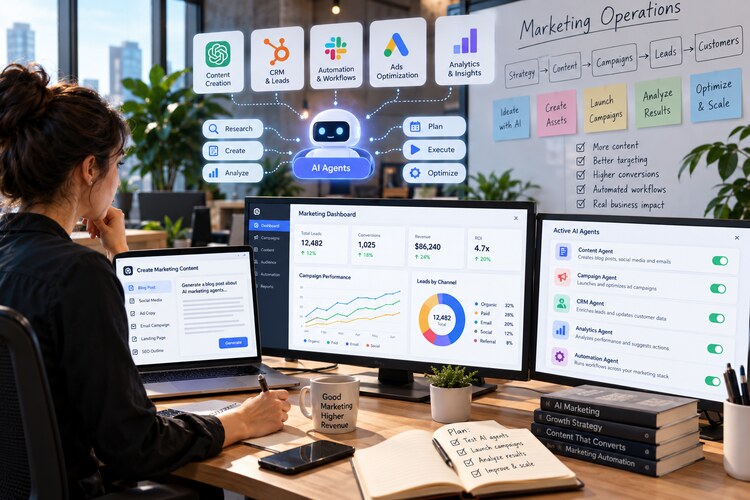
AI marketing agents have moved beyond the chatbot stage. In 2026, the most useful systems can research, create, analyze, trigger workflows, work with business data, and in some cases take actions across an entire marketing stack.
But there is an important distinction: not every product marketed with AI is actually an AI agent. Some tools can reason and execute multi-step tasks with meaningful autonomy. Others are excellent AI-powered platforms for writing, video, advertising, knowledge retrieval, or analytics but still depend heavily on human direction.
This guide separates those categories so you can choose technology based on what it can actually do rather than how aggressively the word agent appears in the marketing copy.
Last reviewed: October 2026.
Best AI Agents for Marketing in 2026: Quick Comparison
| Platform | Best for | How we classify it | Human oversight |
|---|---|---|---|
| Zapier | Cross-app marketing automation | Agentic automation platform | Recommended for approvals and sensitive actions |
| HubSpot Agent Hub | CRM, leads, customer data and GTM workflows | Agent platform | Configurable guardrails and workflows |
| Skott by Lyzr | Coordinating multi-channel marketing work | Agentic marketing system | Best with editorial and campaign review |
| Omneky | Paid-media creative and campaign execution | Specialized advertising agent | Review creative, budgets and launches |
| Chatsonic | Research, content and marketing workflows | Agentic marketing assistant | Review research and published content |
| Anyword | Performance-focused marketing content | AI content platform with agentic features | Marketer selects strategy and final output |
| Pega Infinity 26 | Enterprise customer engagement and governed AI | Enterprise agentic platform | Strong governance focus |
| Synthesia | AI video production at scale | Specialized AI platform | Human review before publication |
| RTB House | Programmatic advertising and retargeting | AI-powered advertising platform | Campaign strategy remains marketer-led |
| Lucy | Enterprise marketing knowledge retrieval | AI knowledge platform | Users validate source material and conclusions |
| Cursor | Technical marketing, websites and growth engineering | Coding agent | Code review and deployment controls required |
What Is an AI Marketing Agent?
A useful definition is simple: an AI agent can take a goal, decide what steps are required, use available tools or data, and perform at least part of the work without being prompted for every individual action.
That is different from a conventional AI tool. A writing generator might produce five headlines when asked. An agentic system could research the audience, inspect campaign data, draft the headlines, choose a channel, prepare the campaign, route it for approval, and update the CRM after the campaign runs.
The difference is not whether a product uses a large language model. The difference is whether it can move from answering to acting.
If you are considering building your own system rather than buying one, our guide to building an AI employee for a business workflow explains how tools, context, permissions, and human approvals fit together.
11 AI Agents and Agentic Marketing Tools Worth Knowing
1. Zapier: Best for Connecting AI to Your Marketing Stack
Zapier has evolved from traditional trigger-and-action automation into an orchestration layer for AI-assisted and agentic workflows.
Its biggest advantage is connectivity. A marketing team can connect CRM records, spreadsheets, forms, email, advertising systems, support tools, databases, and thousands of other applications without building every integration from scratch.
In 2026, Zapier supports agentic AI inside workflows as well as connections between external AI assistants and business applications. That makes it particularly useful when the goal is not just to generate content but to make something happen afterward.
Good marketing use cases:
- Qualify inbound leads and update the CRM.
- Summarize form submissions before routing them to sales.
- Research prospects and prepare personalized outreach.
- Turn campaign results into scheduled reports.
- Connect AI assistants with marketing applications and data.
- Add human approval before high-impact actions are executed.
Best for: marketing operations teams that already work across several SaaS applications.
Watch-out: do not use probabilistic AI where a simple deterministic automation would be safer, cheaper, and easier to debug.
2. HubSpot Agent Hub: Best for CRM-Centered Marketing and Sales
HubSpot's AI strategy has expanded well beyond a writing assistant. In its current platform, Agent Hub brings together agents for customer conversations, prospecting, customer intelligence, content, and custom workflows built around CRM context.
This is important because useful marketing agents need business context. A generic model may know how to write an email, but an agent connected to CRM records can understand the account, contact history, lifecycle stage, prior conversations, and other structured customer data.
Good marketing use cases:
- Research accounts before outreach.
- Generate personalized follow-up using CRM context.
- Create content based on the organization's own information.
- Surface customer intelligence from calls, emails, documents, and CRM records.
- Build custom agents and insert them into repeatable workflows.
Best for: organizations already using HubSpot as their central go-to-market platform.
Watch-out: the value drops if customer records are incomplete or poorly maintained. Agent quality still depends heavily on data quality.
3. Skott by Lyzr: Best for an Agentic Marketing Operating Layer
Skott is one of the products on this list that most closely matches the idea of an agentic marketing system rather than a single AI feature.
Lyzr positions Skott as an Agentic OS for Marketing: a coordination layer for specialized agents handling areas such as content, SEO, social media, email, distribution, reporting, and other marketing workflows.
The practical appeal is coordination. Instead of asking one isolated tool to create a blog post and another tool to create social posts, an agentic system can share context across workflows and keep the work aligned.
Good marketing use cases:
- Research and plan content.
- Create and repurpose campaigns across channels.
- Coordinate specialized marketing agents.
- Maintain shared brand and workflow context.
- Automate repetitive campaign operations while retaining review points.
Best for: agencies and marketing teams trying to coordinate multiple AI workflows rather than adding another isolated AI writer.
Watch-out: broad autonomy makes governance more important. Start with one repeatable workflow and expand after measuring the result.
4. Omneky: Best for AI Advertising Creative and Execution
Omneky has moved much closer to true agentic advertising. Its platform can generate advertising assets, work with brand data, analyze performance, create variations, and support campaign launches across multiple advertising channels.
Its AI Agent is particularly relevant to performance marketers because it can connect the analytical and execution sides of paid media. Instead of merely generating an image, the system can help interpret campaign performance, create new variations, refine them, and move approved assets toward launch.
Good marketing use cases:
- Create image and video ad variations from a campaign brief.
- Analyze creative performance.
- Generate additional variants based on winning concepts.
- Maintain brand rules across creative production.
- Prepare and launch multi-channel campaigns.
Best for: teams where paid-media creative production has become a bottleneck.
Watch-out: autonomous creative generation does not remove the need for claim review, brand review, budget controls, and platform-policy checks.
For another example of AI changing ad operations, see our guide to Meta AI advertising and Advantage+.
5. Chatsonic: Best for Research-to-Content Marketing Workflows
Chatsonic is now better described as a marketing-focused AI workspace than as a simple chatbot alternative.
It combines web research, multiple AI models, content generation, analysis, and integrations with marketing tools. For content teams, that matters because research, drafting, optimization, and publishing often happen across separate applications.
Good marketing use cases:
- Research current topics using web information.
- Create and refine marketing content.
- Analyze marketing data and prepare reports.
- Work with marketing integrations from a conversational interface.
- Build repeatable AI-assisted content and optimization workflows.
Best for: content and growth teams that want research and production in one working environment.
Watch-out: treat generated research as a starting point. Important statistics, claims, and product details should still be checked against primary sources.
6. Anyword: Best for Performance-Focused Marketing Copy
Anyword approaches generative AI from a performance-marketing angle. Instead of focusing only on producing more copy, the platform emphasizes brand context, performance data, predictive scoring, and improving content before it is published.
Its newer agentic capabilities make it more useful for teams that want content generation connected to brand rules and performance signals.
Good marketing use cases:
- Create ad, email, landing-page, and social copy.
- Apply brand voice and messaging rules.
- Compare variations using predictive performance scoring.
- Use previous campaign performance to improve future content.
- Bring performance intelligence into other AI applications through integrations and APIs.
Best for: demand generation and performance teams where conversion quality matters more than raw content volume.
Watch-out: predictive scores are decision support, not guarantees. Real campaign performance remains the final test.
7. Pega Infinity 26: Best for Governed Enterprise Agentic AI
Pega is the enterprise-oriented option in this guide. Infinity 26 combines agentic AI with workflow orchestration and governance across customer engagement, service, and operational processes.
That makes Pega relevant to large organizations where an agent cannot simply be given unrestricted access to customer data and business processes.
Good marketing use cases:
- Coordinate customer engagement decisions with business rules.
- Connect AI agents to enterprise workflows.
- Personalize customer interactions using governed data.
- Control agent behavior in regulated or high-risk environments.
- Orchestrate marketing, service, and operational processes across systems.
Best for: enterprises with complex customer journeys, compliance requirements, and established workflow infrastructure.
Watch-out: this is not a lightweight AI tool for a solo marketer. Implementation complexity is part of the tradeoff for enterprise control.
8. Synthesia: Best Specialized AI Tool for Marketing Video
Synthesia belongs in this guide because video production is an important part of modern marketing automation, but it is important to classify it correctly.
It is primarily an AI video platform rather than a general-purpose marketing agent. It can create presenter-led videos using AI avatars and voiceovers, translate content into many languages, transform existing material into video, and make updates without a traditional reshoot.
Good marketing use cases:
- Product explainers and demonstrations.
- Localized campaign videos.
- Customer education.
- Internal enablement and sales content.
- Rapid updates to existing video material.
Best for: organizations producing repeatable video content at scale.
Watch-out: it solves the video-production problem, not the entire marketing workflow. Strategy, distribution, positioning, and performance analysis still need other systems.
9. RTB House: Best AI-Powered Platform for Programmatic Advertising
RTB House is another case where accurate classification matters. It is not a conversational AI agent. It is a full-funnel advertising platform that uses Deep Learning for programmatic advertising, audience activation, retargeting, and campaign optimization.
For marketing teams, it represents a different type of AI automation: machine-learning systems continuously making optimization decisions inside an advertising environment.
Good marketing use cases:
- Retargeting and customer re-engagement.
- Programmatic media buying.
- Full-funnel advertising campaigns.
- Audience optimization.
- Dynamic campaign decision-making at scale.
Best for: brands with meaningful paid-media budgets and mature performance-marketing programs.
Watch-out: algorithmic optimization and an AI agent are not the same thing. Marketers should judge the platform on incremental campaign performance, not agent terminology.
10. Lucy: Best for Finding Knowledge Hidden Across Marketing Assets
Large marketing organizations often have a different AI problem: they already possess the information they need, but nobody can find it.
Lucy is an AI-powered knowledge-management platform designed to make enterprise information easier to search and use. It can work across documents and other organizational resources so teams can retrieve historical brand knowledge, research, campaign material, and other internal information using natural-language questions.
Good marketing use cases:
- Find old campaign research and presentations.
- Surface prior brand and customer insights.
- Reduce duplicate research.
- Give distributed teams access to shared organizational knowledge.
- Support strategy work with internal evidence rather than generic model knowledge.
Best for: enterprises with large archives of marketing, research, and brand information.
Watch-out: Lucy is better understood as an enterprise knowledge layer than as a campaign-execution agent.
11. Cursor: Best Agent for Technical Marketers and Growth Engineering
Cursor may look like an unusual entry in a marketing list, but technical marketing increasingly involves code: landing pages, tracking implementations, structured data, automation scripts, experimentation systems, data pipelines, and internal tools.
Cursor's agents can inspect codebases, edit multiple files, run commands, test changes, and work on larger software tasks. Cloud agents can also continue longer-running development work remotely.
That gives technical marketers and growth engineers a different kind of leverage from a content generator.
Good marketing use cases:
- Build landing-page experiments.
- Create internal marketing utilities.
- Implement analytics and tracking changes.
- Automate repetitive data-processing work.
- Maintain marketing websites and integrations.
- Prototype AI-powered growth tools.
Best for: growth engineers, technical marketers, developers, and teams where marketing operations involve code.
Watch-out: coding agents can make consequential changes. Repository permissions, test coverage, code review, secrets, and deployment controls still matter.
If you want to go from using AI software to building your own product, see our practical workflow for building an AI app without starting from a blank codebase.
Which AI Marketing Agent Should You Choose?
There is no single best platform for every marketing team. The better question is: which part of your workflow do you want the AI to own?
- Cross-app operations: start with Zapier.
- CRM-centered marketing and sales: HubSpot Agent Hub is the natural candidate.
- Multi-channel agentic marketing: evaluate Skott.
- Paid-media creative: look closely at Omneky.
- Research and content workflows: Chatsonic is a practical option.
- Performance-focused copy: Anyword is more specialized.
- Enterprise governance: Pega deserves consideration.
- Video production: Synthesia solves a specific production problem well.
- Programmatic advertising: RTB House is an advertising platform rather than a general agent.
- Enterprise knowledge: Lucy addresses information retrieval rather than campaign execution.
- Technical growth work: Cursor provides coding-agent capabilities.
How to Evaluate an AI Marketing Agent Before You Buy
1. Start with an actual workflow
Do not begin with the question, “Where can we use AI?” Begin with a recurring workflow that consumes time or creates bottlenecks.
A good pilot has a clear beginning, a clear output, and a measurable baseline. Lead qualification, campaign reporting, content repurposing, creative iteration, and customer research are better starting points than a vague goal such as “automate marketing.”
2. Separate deterministic work from judgment
If a task can be expressed as a fixed rule, conventional automation is often more reliable. Use an agent where interpretation, context, reasoning, or dynamic decision-making adds value.
3. Check what actions the agent can actually take
Some products are described as agents even though they primarily generate an answer. Look for tool access, integrations, memory or context, multi-step execution, triggers, and the ability to continue toward an outcome.
4. Define approval boundaries
An agent drafting an ad is different from an agent publishing an ad. An agent recommending a budget change is different from one that can spend the budget.
High-impact actions should have explicit permissions and, when appropriate, human approval.
5. Measure business outcomes, not AI activity
The number of prompts, generated assets, or completed agent runs is not the goal.
Measure outcomes such as hours saved, campaign cycle time, qualified leads, conversion rate, cost per acquisition, revenue contribution, error rate, or the amount of work completed without adding headcount.
A Practical AI Marketing Agent Workflow
Consider a simple inbound lead workflow:
- A prospect submits a form.
- The agent reads the form and relevant CRM history.
- It researches the organization using approved sources.
- It evaluates whether the lead matches your qualification criteria.
- It prepares a concise account summary.
- It drafts a personalized follow-up.
- A salesperson approves the message for high-value accounts.
- The system sends the email and updates the CRM.
- The next action is scheduled automatically.
The valuable part is not the email draft. The value comes from joining research, reasoning, data, workflow execution, and follow-up into one system.
What AI Marketing Agents Still Get Wrong
Agentic systems are more capable than conventional chatbots, but increased autonomy also increases the cost of mistakes.
- Unsupported claims: generated marketing copy can invent statistics, product capabilities, testimonials, or comparisons.
- Bad context: poor CRM data produces poor decisions at greater speed.
- Brand drift: automation can scale inconsistent messaging just as easily as good messaging.
- Permission risk: agents with broad access can make changes outside the intended scope.
- Prompt injection: agents consuming external content can encounter malicious or misleading instructions.
- Automation bias: teams can begin accepting machine recommendations simply because they arrive quickly.
The strongest systems therefore combine AI autonomy with narrow scopes, permissions, logging, testing, and human review at consequential decision points.
The Future of AI Agents in Marketing
The direction in 2026 is becoming clearer: the future is unlikely to be one giant autonomous marketing robot running an entire company without supervision.
Instead, teams are combining specialized agents, deterministic workflows, business applications, shared data, and human decision-makers.
Agents will increasingly handle research, routing, monitoring, drafting, analysis, and routine execution. Humans will remain most valuable where strategy, taste, accountability, negotiation, positioning, and unusual judgment are required.
The competitive advantage will not come from adopting the most AI tools. It will come from designing better systems of work.
Frequently Asked Questions
What is an AI marketing agent?
An AI marketing agent is software that can pursue a marketing goal, determine or follow multiple steps, use tools or data, and perform actions with some degree of autonomy. A conventional AI tool usually performs a narrower task in response to a direct request.
What is the best AI agent for a small marketing team?
For many small teams, the most useful starting point is an agent or automation platform that connects the applications they already use. Zapier can be a strong option for cross-app workflows, while teams centered on HubSpot may gain more value from agents operating directly within their CRM environment.
Are all AI marketing tools AI agents?
No. AI copywriters, video generators, recommendation systems, and advertising algorithms can all be valuable without being autonomous agents. The key test is whether the software can reason about a goal and execute multiple steps or actions rather than simply produce one output.
Can AI agents run marketing campaigns automatically?
Some platforms can prepare, modify, launch, or optimize campaign activity. That does not mean every action should be fully autonomous. Budget changes, public publishing, sensitive customer communication, and regulated claims often deserve human approval.
Will AI agents replace marketing teams?
They are more likely to change the shape of marketing work. Repetitive coordination and production can increasingly be automated, while strategy, creative judgment, positioning, customer understanding, and accountability remain human responsibilities.
Final Verdict
The phrase “AI marketing agent” now covers several very different technologies. That makes careful classification more useful than another list of tools all presented as if they do the same thing.
Zapier, HubSpot, Skott, Pega, and increasingly Omneky demonstrate what happens when AI can move beyond generation and take action inside real business workflows. Chatsonic and Anyword bring agentic capabilities closer to content and performance marketing. Synthesia, RTB House, Lucy, and Cursor solve more specialized problems that can still become important components of an agentic marketing stack.
Choose the workflow first. Give the system only the access it needs. Keep humans at consequential checkpoints. Then measure whether the agent actually improves the economics or quality of the work.